Feeds:
Posts
Comments

(Updated Oct. 30, 2024)

Since 1967, the Cardinals have won World Series championships under three different managers.

Red Schoendienst, inducted into the National Baseball Hall of Fame as a player in 1989, managed the Cardinals to the 1967 World Series title against the Red Sox.

Whitey Herzog, inducted into the Hall of Fame as a manager in 2010, led the Cardinals to the 1982 World Series championship against the Brewers.

Tony La Russa, inducted into the Hall of Fame as a manager in 2014, guided the Cardinals to two World Series crowns _ 2006 against the Tigers and 2011 against the Rangers.

Here’s how key decisions made by those Cardinals managers helped lead to World Series titles:

RED SCHOENDIENST, 1967 World Series

Key decision: During the regular season, Schoendienst platooned Roger Maris in right field with Alex Johnson. For the World Series, Schoendienst decided to start Maris in every game, figuring his experience (Maris had played in five World Series for the Yankees) gave him the advantage.

“Maris is steady in the field,” Schoendienst said to The Sporting News. “He rarely makes a mistake out there and he doesn’t make mistakes running the bases. He has the advantage of having been through all that World Series pressure.”

It was the right move. Maris hit .385 (10-for-26) with seven RBI and made 15 putouts (with one error in 61 innings) during the seven-game Series.

Key fact: Schoendienst became the fourth manager _ and first in 36 years _ to start the same eight regulars in the same batting order for a World Series that went seven or more games, according to The Sporting News.

The other managers to do so were Jimmy Collins of the 1903 Red Sox, Fred Clarke of the 1909 Pirates and Connie Mack of the 1931 Athletics.

Excluding the pitcher, St. Louis’ batting order for all seven games was: Lou Brock, left field; Curt Flood, center field; Roger Maris, right field; Orlando Cepeda, first base; Tim McCarver, catcher, Mike Shannon, third base; Julian Javier, second base; and Dal Maxvill, shortstop.

Quotable: Bob Gibson was the winning pitcher for three of the Cardinals’ four victories. Asked what he told his team before Game 7, Schoendienst said to the Associated Press, “Nothing. I gave the ball to Gibson.”

WHITEY HERZOG, 1982 World Series

Key decision: After joining the Cardinals in June 1980, Herzog built the team around speed, defense and relief pitching. Two of his cornerstone acquisitions were catcher Darrell Porter and closer Bruce Sutter.

Porter hit .286 with five RBI and prevented eight wild pitches, earning the World Series Most Valuable Player Award. Sutter recorded two saves, including two hitless innings in the Game 7 clincher.

Wrote Palm Beach Post columnist Steve Hummer, “This is the Whitey Herzog Signature Model World Series.”

(According to Memories and Dreams, the magazine of the Baseball Hall of Fame, Tony La Russa said that during an off-season appearance he and Herzog made together in 1983, Herzog advised him about the importance of having a dependable closer. “He said, ‘You’re never a smart manager until you have a quality closer,’ ” La Russa recalled.)

Key fact: The Cardinals utilized speed (seven stolen bases to Milwaukee’s one) with a relentless array of singles and doubles (27 hits to 11 for Milwaukee in the final two games) to overtake the Brewers after losing three of the first five.

Said Tigers manager Sparky Anderson to The Sporting News: “That’s the one thing about a speed-versus-power World Series. Power can stop; can be stopped. Speed never stops.”

Quotable: After St. Louis won Game 7, Herzog said, “We ain’t the best team ever to win a World Series, but we sure as hell ain’t the worst. We played our game all the way: speed and defense, some hitting and some pitching.”

TONY LA RUSSA, 2006 World Series

Key decision: La Russa gambled by naming rookie Anthony Reyes rather than veteran Jason Marquis as the Cardinals’ Game 1 starting pitcher. Reyes was 5-8 during the regular season. He had the fewest wins of any Game 1 starter in World Series history.

“It’s not an easy call. We wrestled with this,” La Russa told the Associated Press.

Relying almost exclusively on a fastball, Reyes delivered. He held the Tigers to four hits and two runs over eight innings and St. Louis won, 7-2. It set the tone for a Series the Cardinals clinched in five games.

Key fact: La Russa became only the second big-league manager to win a World Series championship in each league. Sparky Anderson had done it with the 1975 and ’76 Reds and with the 1984 Tigers. La Russa had won with the 1989 Athletics.

Quotable: After earning the Series championship with a team that had 83 regular-season wins, La Russa told MLB.com, “It was really fun to be around this group. They were so determined.”

TONY LA RUSSA, 2011 World Series

Key decision: La Russa was concerned about starting ace Chris Carpenter in Game 7 on short rest. Starters Kyle Lohse and Edwin Jackson were fully rested. On the morning of Game 7, La Russa told reporters, he called pitching coach Dave Duncan, seeking advice.

“I called (Duncan) in the morning and I said, ‘How about the alternatives?’ He says, ‘Are you kidding? It’s Chris Carpenter.’ And he hung up.”

La Russa started Carpenter, who rewarded him with six solid innings and earned the win in the Cardinals’ 6-2 victory.

Key fact: With the win, the Cardinals improved to 7-1 when Game 7 of a World Series is played at St. Louis.

Quotable: Third baseman David Freese, winner of the 2011 World Series MVP Award, told New York Times columnist George Vecsey of La Russa, “He’s got a plan with every thought, with everything he says.”
(Updated April 20, 2019)

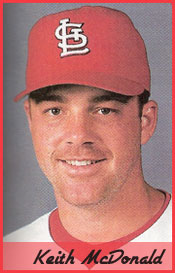
When Keith McDonald was promoted from Class AAA Memphis to replace injured catcher Eli Marrero and serve as the backup to Mike Matheny, he was shocked by the Cardinals’ decision.

McDonald was hitting .246 with one home run and 17 RBI for Memphis when the Cardinals called him to the majors in July 2000.
What happened next was magical.

McDonald hit home runs in his first two big-league at-bats, becoming the second major-league player to accomplish the feat. His first three Cardinals hits were home runs. Those would be his only hits in the major leagues.

Surprise promotion

When Marrero tore ligaments in his left thumb, some speculated the Cardinals might make a trade for a catcher, but they opted instead to bring up McDonald, 27, on July 2, 2000.

McDonald, who spent seven seasons in the minor leagues after being selected by the Cardinals in the 24th round of the 1994 amateur draft, was “shocked” by the promotion, the St. Louis Post-Dispatch reported.

Two days later, before a July 4 crowd of 46,022 at St. Louis, McDonald made his major-league debut, pinch-hitting for shortstop Edgar Renteria in the eighth inning with the Cardinals holding a 13-3 lead over the Reds. McDonald responded with a solo home run against reliever Andy Larkin. Video

“I just kept running, hoping I’d touch every base so I wouldn’t get called out,” McDonald told the Post-Dispatch. “I was running with my head down, so I didn’t see it go out.”

Said Matheny: “I told him before he went up there that when you get your first shot you should take advantage of it.”

The crowd urged a curtain call, but manager Tony La Russa, not wanting to show up the Reds in such a lopsided game, convinced McDonald to stay in the dugout, according to the Associated Press. Boxscore

Encore

In his next appearance, on July 6, McDonald was given the start at catcher against the Reds. Batting in the No. 8 spot, McDonald led off the second inning with a home run against Osvaldo Fernandez, tying the score 3-3. Video

“You got to be kidding me,” Cardinals broadcaster Mike Shannon said on the telecast.

Said broadcast partner Joe Buck: “Is it that easy?”

With a nod to McDonald’s teammate Mark McGwire, a headline in the Post-Dispatch declared, “There’s a new Mac in town.”

“I’m the most surprised of anyone,” McDonald said. “The fans are probably going to expect it every time, but it may be a long time before I hit the next one.”

Teammates Renteria and Jim Edmonds prodded McDonald to wave to the crowd from the dugout steps. “I didn’t want to go,” said McDonald. “I have never done that, but it felt great.”

McDonald became the second big-league player to hit home runs in each of his first two at-bats, tying the mark first achieved by Browns left fielder Bob Nieman on Sept. 14, 1951, at Boston’s Fenway Park.

“It would have been a lot better if we’d have won,” McDonald said after the Reds won, 12-6. Boxscore

McDonald’s final hit in the big leagues came in another blowout, a 15-7 White Sox victory over the Cardinals on July 15, 2000, at Chicago. Pinch-hitting for Matheny, McDonald, in his sixth big-league at-bat, hit a two-run home run against Jesus Pena with two outs in the top of the ninth. Video and Boxscore

Back to minors

After two weeks with the Cardinals, McDonald was returned to Memphis and was replaced by Rick Wilkins, 33, a big-league journeyman. In six games with St. Louis, McDonald had three hits in seven at-bats, with five RBI and three runs scored.

At Memphis, McDonald completed his minor-league season with a .263 batting average and five home runs. He helped Memphis advance to the Class AAA World Series, where he batted .412.

In 2001, McDonald appeared in two games (both in late September) for the Cardinals, going hitless in two at-bats. He left the Cardinals organization after the 2002 season and spent the next four years in the minor-league systems of the Cubs, Pirates, Rangers and Yankees.

In 13 years in the minors, he slugged 78 home runs in 984 at-bats, but it’s those three big-league home runs that make McDonald a permanent part of Cardinals lore.

(Updated Oct. 29, 2020)

Kansas City was a fitting site for Tony La Russa’s appearance as a manager in the All-Star Game.

La Russa, who left the Cardinals after leading them to the 2011 World Series title, came back and managed the National League to an 8-0 victory in the All-Star Game on July 10, 2012, at Kansas City. Boxscore

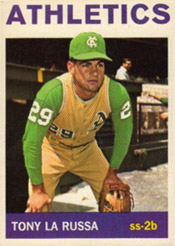
Kansas City was where La Russa scored his first big-league run, and had his first big-league at-bat and first big-league hit, when he was a rookie infielder for the Athletics in 1963.

Prime prospect

La Russa was a 17-year-old shortstop for Jefferson High School in Tampa, Fla., when he was signed by the Athletics to a package worth $100,000 on June 7, 1962, the same night he received his high school diploma. He batted .479 his senior season.

La Russa was signed by Athletics scout Charlie Gassaway and supervisor of scouts Joe Bowman. Because Major League Baseball didn’t have a draft at that time, any team could bid for a prospect. According to The Sporting News, 17 scouts representing 14 teams approached La Russa. The Yankees and Indians joined the Athletics as top bidders.

“We think he is one of the outstanding infielders in the country,” Bowman said. “He is the highest-priced infielder Kansas City ever signed.”

Athletics owner Charlie Finley met with La Russa to seal the deal, which included $8,000 toward a college education, plus a new car. La Russa chose a white Pontiac Bonneville with black leather interior, according to the book “Tony La Russa, Man on a Mission.”

Rushed to majors

After a summer of minor-league baseball in 1962, La Russa returned home to Tampa. While playing in a softball game, he injured his throwing arm, according to the “Man on a Mission” book. With his right arm in a sling, La Russa was unable to play in spring training for the Athletics in 1963.

La Russa, 18, made his major-league debut on May 10, 1963, as a pinch-runner for Chuck Essegian in the eighth inning of the Athletics’ game against the Twins at Minnesota. Boxscore

Utilized primarily as a pinch-runner by manager Eddie Lopat, La Russa appeared in his first 14 big-league games without an at-bat. He scored his first big-league run on July 13, 1963, in the second game of a doubleheader against the Indians at Kansas City.

Running for Gino Cimoli, La Russa scored from second on a bases-loaded double by Jerry Lumpe in the fifth inning. The game is noteworthy, not for La Russa’s run, but because Indians pitcher Early Wynn earned his 300th and last major-league win. Boxscore

A month later, La Russa got his first at-bat. It occurred on a Thursday afternoon, Aug. 15, 1963, at Kansas City. After replacing Lumpe at second base in the fifth inning, La Russa faced Tigers starter Hank Aguirre in the sixth and flied out to center fielder Bill Bruton. Boxscore

La Russa’s first major-league hit came two days later at Kansas City. Pinch-hitting in the sixth for pitcher Bill Fischer, La Russa hit a two-out triple to right off Orioles starter Steve Barber, a 20-game winner that year. Boxscore

According to the “Man on a Mission” book, La Russa, near the end of the season, told a Kansas City reporter, “I know I’ll be sent down next season and I’m looking forward to it. I’ve learned a lot from our players and also by watching such fine shortstops as (Wayne) Causey, Luis Aparicio, Zoilo Versailles and others. I’ve had plenty of help from everyone on the club, especially catcher Charlie Lau, who detected a hitch in my swing at the plate.”

It would be five years before La Russa would return to the major leagues. By then, the Athletics had moved from Kansas City to Oakland.

(Updated July 30, 2024)

One measure of the exceptional baseball skills of Stan Musial is the number of triples he hit.

Today, most baseball fans associate a prolific triples hitter with a speedster. Musial was a slugger (475 home runs, 1,951 RBI) who also had the bat control, hitting eye and speed to collect a high number of doubles (725) and triples (177).
Asked about Musial’s baserunning style, Fred Hutchinson, who managed the Cardinals, told Roger Kahn of Sport magazine, “It’s like a wounded turkey. Ever see a turkey run after he’s been wounded by a shotgun? He’s leaning all off to one side, going like hell. That’s what Stan’s running makes me think of.”

Musial led the National League in triples four times _ 20 in 1943, 20 in 1946, 18 in 1948 and 13 in 1949 _ before he turned 29. (He shared the NL lead with teammate Enos Slaughter in 1949.) Musial also was the NL co-leader in triples (with 12) in 1951, becoming the first player to lead the league in that category five times.

(Tigers outfielder Sam Crawford led the American League in triples five times. Crawford, who played for the Reds and Tigers from 1899-1917, is the big-league career leader in triples, with 309.)

In the first three seasons Musial led the NL in triples, he also was the batting champion and winner of the Most Valuable Player Award in each of those years (1943, 1946 and 1948).

When Musial received his first MVP Award, he told The Sporting News he got a bigger thrill from leading the league in triples.

“I guess it’s because I get a chance to run when I hit for three,” Musial said. “Sure, a home run is good for one more base, but I like that contest with the running outfielder and I get a big thrill out of sliding safely to third base.”

No player in the history of big-league baseball hit more triples and as many home runs as Musial. Among the outstanding hitters with fewer career triples than Musial are Rogers Hornsby (169), Roberto Clemente (166), Lou Gehrig (163), Willie Mays (140), Babe Ruth (136), Joe DiMaggio (131), Jimmie Foxx (125), Hank Aaron (98), Barry Bonds (77), Mickey Mantle (72), Mel Ott (72), Frank Robinson (72), Ted Williams (71), Reggie Jackson (49), Willie McCovey (46), Ken Griffey Jr. (38), Alex Rodriguez (31) and Albert Pujols (16).

“To hit a home run, all you need is some strength and quick wrists,” Aaron told Baseball Digest in 1999. “To be able to hit a triple, you need speed, power to the gaps and you need to be a smart baserunner.”

Throughout his big-league career (1941-63), Musial most often was compared with his AL counterpart, Red Sox outfielder Ted Williams. In October 1946, the only time Musial and Williams competed against one another in a World Series, Dodgers manager Leo Durocher rated Musial the best.

“Musial is a two-to-one better hitter,” Durocher told The Sporting News. “You can pitch to Williams, crowd him and keep the ball on the handle. Williams can hit to only one field. Musial can hit to all fields and you can’t fool him. Williams has only one advantage. He has more power _ and power worries you. You are afraid to make one mistake. But I’ll take Musial any day _ and what is more, I’m not comparing dispositions.”

From 1942-60, no one hit more triples than Musial.

The similarities between Lance Lynn and Alan Benes are striking.

Lynn, a Cardinals right-hander and Indiana native who turned 25 in 2012, struck out at least 11 batters in consecutive games that year.

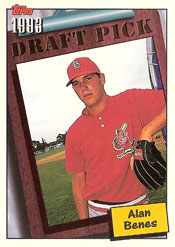
Benes, a Cardinals right-hander and Indiana native who turned 25 in 1997, struck out at least 11 batters in consecutive games that year.
Lynn became the first Cardinals pitcher since Benes to strike out at least 11 in consecutive games.

One area where they differed, though, was in the results of those back-to-back high-strikeout games.

Lynn got wins in both _ he struck out 11 in six innings in the Cardinals’ 14-2 victory over the Astros at Houston on June 7, 2012, Boxscore and followed that with a 12-strikeout performance in 7.1 innings in the Cardinals’ 1-0 victory over the White Sox at St. Louis on June 13. Boxscore

Benes got the win when he struck out 11 in six innings in the Cardinals’ 8-3 victory over the Padres at San Diego on June 11, 1997. Benes was even better in his next start, June 16 against the Brewers. Like Lynn, it involved a 1-0 game, but Benes wasn’t as fortunate.

In a duel of power pitchers, Benes was matched against Ben McDonald in the first interleague game at Milwaukee’s County Stadium. (The Brewers, now with the Cardinals in the National League Central Division, then were members of the American League.)

Both starters were sharp. McDonald struck out 12 in eight innings before being lifted for Bob Wickman. When Brewers second baseman Mark Loretta struck out leading off the bottom of the ninth, it was the 11th strikeout recorded by Benes. (Among his other strikeout victims that night was Brewers catcher Mike Matheny.)

At that point, Benes had yielded three hits, all singles, in the scoreless game.

Jeromy Burnitz, the Brewers’ strapping left-handed batter, then stepped to the plate. Benes got ahead of the count with a fastball on the outside corner. Benes’ next pitch was similar to the first _ but this time Burnitz was ready. He crushed the thigh-high fastball 410 feet to straightaway center field for a walkoff home run and 1-0 Brewers victory. Boxscore

“It wasn’t a bad pitch to a lot of guys, but to Burnitz in that situation, it wasn’t a great pitch,” Benes told the Milwaukee Journal Sentinel. “He’s a guy who likes to take the fastball away from you, and I had done a good job of changing speeds against him all day.”

Said Burnitz: “I knew it had a chance because I smoked it. I was excited. I’d never hit a game-winning home run before.”

The ninth-inning setback in a scoreless game was the second Benes experienced within a month. On May 16, Benes held the Braves hitless for 8.2 innings in Atlanta until Michael Tucker doubled. The Braves won, 1-0, in the 13th against reliever John Frascatore. Boxscore

Asked how his effort against the Brewers rated with his performance against the Braves, Benes replied, “Comparable stuff, or at least close.”

A week earlier, Cardinals manager Tony La Russa had told Rick Hummel for The Sporting News that Benes was as good as any young pitcher in baseball. The Brewers were believers.

“That guy has got great stuff,” Burnitz said of Benes.

Said Milwaukee manager Phil Garner: “We were duly impressed by him. It’s OK if we don’t see him again until next year.”

Previously: Near no-hitter by Alan Benes became crushing loss

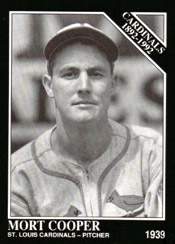
Early in the 1943 season, a report circulated that Mort Cooper, ace of the Cardinals’ rotation, had a sore arm. A few weeks later, The Sporting News claimed “warm weather brought the (arm) around.”

Whatever the explanation, Cooper recovered and became the only Cardinal to pitch one-hitters in consecutive complete-game starts.

Cooper’s back-to-back one-hitters occurred five years after the Reds’ Johnny Vander Meer became the only big-league pitcher to toss consecutive no-hitters.

On Memorial Day, May 31, 1943, Cooper held the Dodgers to one hit in the Cardinals’ 7-0 victory in the opener of a doubleheader at St. Louis.

Billy Herman got the lone Dodgers hit. Herman’s double to start the fifth inning was “a high, twisting two-bagger just inside the foul line,” United Press reported, and it fell beyond the reach of right fielder Stan Musial.

Herman, who also walked, and Augie Galan, who walked twice, were the only Dodgers baserunners. Cooper struck out two and improved his record to 5-3. His brother, catcher Walker Cooper, and Musial drove in two runs apiece. Boxscore

“If Cooper still has a sore arm,” wrote Hugh Fullerton Jr. of the Associated Press, “manager Billy Southworth probably wishes that all his other pitchers would go out and get one just like it.”

Four nights later, June 4, 1943, at St. Louis, Cooper held the Phillies hitless for seven innings and settled for a one-hitter in the Cardinals’ 5-0 victory.

Jimmy Wasdell of the Phillies opened the eighth by lining a single to left. Pinky May, who reached on an error by Cooper and was erased on a double play, was the only other Phillies baserunner. Cooper struck out five in a game that took 1:42 to complete. Boxscore

Jack Cuddy of United Press described why Cooper was so effective:

“Mort can provide the pitch that’s needed at a proper time _ fastball, screwball, forkball or curve. His fastball is the most effective pitch. This is blurred lightning, with a hop at the end. But to southpaw batsmen, he feeds screwballs, keeping them on the outside so that they can’t be pulled to right field.

“Right-handed hitters get the fastball and the forkball. The latter approaches the plate in drunken fashion, like a knuckler’s butterfly pitch. It’s almost impossible to smack the ‘fork’ solidly. In addition, Mort has unusual control. With a 3-and-2 count on the batsman, he can produce a feint or an actual in the strike zone that forces (1) a waiting called strike or (2) a whiff.”

In his start after the second one-hitter, Cooper pitched another complete game and earned the win in the Cardinals’ 4-3 victory over the Pirates on June 9, 1943, at St. Louis. The Pirates got seven hits, two apiece by Vince DiMaggio and pitcher Rip Sewell. Boxscore

Helping the Cardinals win their second consecutive pennant, Cooper, 30, finished 1943 with a 21-8 record and 2.30 ERA. He had six shutouts and 24 complete games among his 32 starts.

His back-to-back gems in 1943 were the only one-hitters of his major-league career.