Feeds:
Posts
Comments

In 1968, Larry Jaster made a conversion from reliever to starter for the Cardinals.

Jaster began the 1968 season in the bullpen. A 24-year-old left-hander, Jaster was 1-1 with a 2.13 ERA in seven relief appearances until he moved into the rotation in late May.

Here is how he did in his first four starts that season:

_ Cardinals 2, Dodgers 1, May 20, 1968, at St. Louis: Jaster pitched a two-hitter, yielding singles to Wes Parker and Paul Popovich, and stopped the Cardinals’ four-game losing streak.

The Dodgers scored an unearned run in the first. Willie Davis walked, took second on a passed ball by Tim McCarver, was bunted to third and scored on a groundout by ex-Cardinal Ken Boyer.

Jaster had pitched five consecutive shutouts against the Dodgers in 1966. After he baffled the Dodgers again with his first start of 1968, frustrated Los Angeles manager Walter Alston stormed into the clubhouse, grabbed a box of bubble gum and threw it across the room “as players and the chewy pellets scattered,” The Sporting News reported. Boxscore

_ Phillies 1, Cardinals 0, May 25, 1968, at St. Louis: Lack of run support led to Jaster taking a loss, even though he held Philadelphia to one earned run in 7.1 innings.

The Phillies scored in the sixth when a sacrifice fly by Don Lock drove in Johnny Callison from third.

St. Louis was held to five singles by ex-Cardinal Larry Jackson and reliever Turk Farrell. The Cardinals had two on with one out in the ninth when Farrell relieved and got Phil Gagliano to pop out and Dave Ricketts to line out. Boxscore

_ Cardinals 2, Mets 0, May 31, 1968, at New York: Outdueling Tom Seaver with a dazzling curve to complement his fastball and changeup, Jaster pitched a two-hitter, walking none.

The Mets were hitless until Greg Goossen singled between short and third with two outs in the eighth.

“It wasn’t a bad pitch. The pitch (a curve) was lower than waist high,” Jaster said to The Sporting News.

A ninth-inning single by Don Bosch accounted for New York’s other hit.

“I think I would have got the perfect game if I had got past Goossen,” Jaster said. Boxscore

_ Cardinals 3, Astros 1, June 5, 1968, at Houston: Jaster allowed one earned run in eight innings. Wayne Granger pitched the ninth for the save. Bob Aspromonte drove in Jim Wynn from third with a single for Houston’s run. Boxscore

Jaster was 4-2 with a 0.98 ERA after the win over Houston. He won just once after July 23, losing eight of his last nine decisions and finishing 9-13 with a 3.51 ERA.

(Updated March 27, 2018)

Ron Plaza never played a game in the major leagues, but he influenced several Cardinals big-leaguers.

Plaza was a manager in the Cardinals’ farm system for six years, posting a 432-329 record. He also was an infielder in the Cardinals’ organization for 11 years.

St. Petersburg was the site of Plaza’s biggest success as a Cardinals minor-league manager. Replacing Sparky Anderson, Plaza managed St. Petersburg to a 96-43 record and the Florida State League championship in 1967. He was named winner of the Class A league’s Manager of the Year Award.

The other Cardinals farm clubs managed by Plaza were Billings (1963), Winnipeg (1964), Cedar Rapids (1965-66) and St. Petersburg (1968).

Among the players Plaza managed in the Cardinals’ system was pitcher Steve Carlton, who would earn election to the National Baseball Hall of Fame. Pitching for Plaza’s 1964 Winnipeg club, Carlton was 4-4 with a 3.36 ERA.

In the June 15, 1968, edition of The Sporting News, Carlton cited Plaza, Clyde King, Hal Smith, Grover Resinger and Billy Muffett as Cardinals instructors who had a positive influence on him. “I had good instructors all along the line,” Carlton said.

Future Cardinals who played for Plaza on the 1967 championship St. Petersburg team were outfielders Boots Day (70 RBI and 21 stolen bases in 136 games) and Jose Cruz (.278 batting average in 78 games) and pitcher Santiago Guzman (16-3, 1.74 ERA in 23 starts).

In 1968, pitcher Reggie Cleveland, who would go on to a 13-year major-league career, was 15-10 with a 2.77 ERA in 27 starts for Plaza’s St. Petersburg team.

After the 1968 season, Plaza was selected to the coaching staff of the Seattle Pilots, an American League expansion team managed by Joe Schultz, who had been a coach for the Cardinals from 1963-68. Plaza had played for three Cardinals farm clubs managed by Schultz: 1959 Omaha, 1961 Charleston and 1962 Atlanta.

In his book “Ball Four,” Pilots pitcher Jim Bouton wrote about Plaza.

The Pilots were relocated to Milwaukee after one season in Seattle and became the Brewers. Schultz and Plaza weren’t retained.

Plaza joined manager Sparky Anderson’s coaching staff with the 1978 Reds. He remained a Reds coach through 1983, serving under managers John McNamara and Russ Nixon.

In 1986, Plaza became a coach for manager Jackie Moore with the Athletics. After Moore was fired in June, Plaza served out the season for Moore’s replacement _ Tony La Russa.

As a player in the Cardinals’ organization, Plaza’s best year was 1956 when he hit .297 in 121 games as a second baseman for Class AAA Rochester, managed by Dixie Walker.


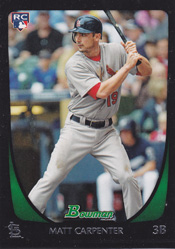
With a dominating hitting performance, Matt Carpenter joined an exclusive and eclectic Cardinals rookie club.

Batting sixth and starting at first base, Carpenter was 4-for-4 with five RBI, a home run and a triple in the Cardinals’ 10-3 victory over the Cubs on April 15 in St. Louis. Carpenter, a left-handed batter, had a RBI-single off left-hander Paul Maholm in the second inning, a two-run homer off right-hander Lendy Castillo in the fifth and a two-run triple off right-hander Rodrigo Lopez in the seventh. Boxscore

According to the Elias Sports Bureau, Carpenter is the third Cardinals rookie with four hits, five RBI and a home run in a game. The others are third baseman Les Bell (1925) and first baseman Fred Whitfield (1962).

The St. Louis Post-Dispatch and MLB.com, using information supplied by a Cardinals media relations staffer, reported outfielder Joe Hague also had four hits, five RBI and a home run in a 1970 game as a St. Louis rookie.

(Though Hague did achieve such a performance, I believe he wasn’t a rookie when it occurred. According to Major League Baseball, a player is considered a rookie if he hasn’t exceeded 130 big-league at-bats and hasn’t accumulated more than 45 days on a big-league team’s active roster. Hague accumulated more than 45 days on the Cardinals’ roster in 1969. He opened the ’69 season with the Cardinals and was with them until being demoted to the minor leagues in mid-June.)

Nonetheless, the magnitude of Carpenter’s achievement is placed in perspective when one considers it’s been at least four decades (and probably longer) since any other Cardinals rookie did the same.

Here’s how the others did it:

LES BELL

After appearing in fewer than 18 games for St. Louis in 1923 and again in 1924, Bell, 23, opened the 1925 season as the Cardinals’ everyday third baseman.

On April 18 at Chicago, the rookie, batting fifth, went 5-for-6 with two home runs and six RBI in the Cardinals’ 20-5 victory over the Cubs.

A right-handed batter, Bell hit a three-run homer off right-hander Guy Bush in the fourth and a two-run homer off right-hander Elmer Jacobs in the seventh. Bell also had two doubles and a single. It would be the only five-hit game of his nine-year big-league career. Boxscore

FRED WHITFIELD

A first baseman and left-handed batter, Whitfield as a rookie had a reputation as a potent hitter held back by fielding deficiences. On Aug. 12, 1962, Whitfield, 24, started at first base in the second game of a doubleheader against the Phillies at St. Louis. Batting third, he went 4-for-5 with a home run and five RBI, though the Phillies completed a sweep with a 9-7 victory.

In the sixth inning, Whitfield hit a grand slam off left-hander Bill Smith, giving the Cardinals a 7-6 lead. It was St. Louis’ first grand slam of the season. Whitfield also had a double and two singles. Boxscore

“Fred Whitfield is the greatest hitter I’ve ever seen _ for the number of times I’ve seen him bat against us,” Phillies manager Gene Mauch said to The Sporting News.

In 1970, Whitfield finished his nine-year big-league career with the Expos, managed by Mauch.

JOE HAGUE

Whether or not he was a rookie, Hague, a left-handed batter, deserves mention here for going 4-for-5 with a home run and five RBI in the Cardinals’ 9-2 victory over the Mets on May 28, 1970, at New York.

Batting sixth and playing right field, Hague, 26, had a two-run single off right-hander Don Cardwell in the first, a solo homer off left-hander Tug McGraw in the eighth and a two-run single off McGraw in the ninth. Hague also singled in the sixth. Boxscore

The home run was the first by a Cardinals batter other than Richie Allen or Joe Torre in nearly three weeks.

(Note: In the next game after Carpenter’s historic performance, he hit a bases-loaded sacrifice fly in the 10th inning to give the Cardinals a 2-1 win over the Reds on April 17. According to Elias Sports Bureau, Carpenter is the first rookie with a walk-off RBI in the major leagues this season.)

Previously: Is David Freese capable of 100-RBI season?

(Updated March 1, 2022)

In 2000, Will Clark produced four home runs in the first five games he played for the Cardinals.

A first baseman, Clark was acquired by the Cardinals from the Orioles on July 31, 2000, in a trade for minor-league infielder Jose Leon. The first-place Cardinals, seeking to secure the National League Central Division crown, saw Clark, 36, as a replacement for slugger Mark McGwire, who was sidelined because of tendinitis in his right knee. In 79 games with the 2000 Orioles, Clark batted .301 with nine home runs and 28 RBI.

San Francisco treat

With the Giants from 1986-93, Clark batted .299 with 1,278 hits in 1,160 games and an on-base percentage of .373. In the 1987 National League Championship Series versus the Cardinals, Clark batted .360 with nine hits in seven games. Nine months later, in July 1988 at St. Louis, Clark got into a tussle with Cardinals infielders Jose Oquendo and Ozzie Smith, who didn’t like the way he slid into second base.

Asked what he thought about Clark becoming his teammate, Oquendo, a coach with the 2000 Cardinals, told the St. Louis Post-Dispatch, “Will is a nice guy. He knows the game, knows how the game should be played.”

Regarding their 1988 altercation, Oquendo said, “That’s all forgotten. We always have joked about it every time we see each other.”

Warm welcome

Clark was delighted to join the Cardinals and play for a contender. In an interview with the Baltimore Sun, Clark said his message to the Cardinals was, “I’ll do whatever you need me to do. That’s what team players do. That’s how you win, by going about things in a team concept. Whatever (manager) Tony La Russa and the Cardinals want me to do, I’ll do.”

La Russa told the Associated Press, “Will Clark is a winning-type of veteran. He should help us … (Clark) knows how to come up and get a base hit in a key situation. He’s a very competitive guy.”

Clark was in the second season of a two-year, $11 million contract. As part of the trade, the Orioles agreed to pay about half of Clark’s remaining salary for the season, the Baltimore Sun reported.

“There was a great deal of interest from Clark’s side to try to come here,” Cardinals general manager Walt Jocketty said to the Post-Dispatch. “He wanted to play on a winner.”

Columnist Tom Wheatley of the Post-Dispatch concluded, “Clark’s team-first attitude will fit right in.”

Sizzling slugger

In his Cardinals debut, Aug. 1, 2000, at Montreal, Clark entered the game in the sixth inning to play first base, replacing Eduardo Perez. In the seventh, Clark doubled versus Expos reliever Anthony Telford in his first Cardinals at-bat. Boxscore

Clark started at first base in each of the Cardinals’ next four games _ and he hit a home run in each. Here’s a look:

_ Aug. 2, 2000, Cardinals 10, Expos 7, at Montreal: Batting cleanup, Clark went 3-for-4 with a walk, two RBI and two runs scored. He hit a second-inning solo home run against Mike Johnson. Boxscore and video

_ Aug. 4, 2000, Braves 6, Cardinals 4, at St. Louis: In a preview of the NL Division Series matchup, Clark, batting sixth, hit a solo home run against Tom Glavine in the second inning on the first pitch he saw in his first home game as a Cardinal. Clark received a standing ovation from the crowd of 48,901 when he walked to the plate for the first time, and he got a curtain call after hitting the home run. Boxscore and video

“After that first standing ovation, in my heart I bonded with them already before I even stepped to the plate,” Clark said. “The change of scenery, the emotional lift it gave me, means a lot. The batteries have been recharged.”

_ Aug. 5, 2000, Cardinals 5, Braves 0, at St. Louis: Clark hit a two-run home run in the first inning against John Burkett, a former Giants teammate. Clark also drew two walks and scored twice. Boxscore

_ Aug. 6, 2000, Braves 6, Cardinals 4, at St. Louis: Clark’s solo home run against Kevin Millwood in the fourth inning was part of a 3-for-4 performance. Clark’s batting average after five games with the Cardinals was .643. Boxscore

“I’ve got a whole new attitude,” Clark said. “I’m loving life.”

In a profile of Clark after he joined the Cardinals, Sports Illustrated’s Kostya Kennedy described him as “St. Louis’ swaggering shaman, a wise head on the field and a spirited voice in the clubhouse.”

“Sarcastic, cantankerous and quick to carp in his chipmunk-pitched Louisiana drawl, Clark struts through the clubhouse razzing all men equally,” Kennedy noted.

Real deal

In a 2019 interview with Cardinals broadcasters Dan McLaughlin and Rick Horton, Clark recalled when he joined the team he was brought in to see La Russa, who said, “We let the players police themselves and that’s what I want you to do. I want you to run the clubhouse.”

Clark replied, “Sounds great to me.”

“I had a lot of fun doing it,” Clark said. “J.D. Drew and Rick Ankiel took some (verbal) beatings. Rick didn’t mention that in his book, I don’t think.”

McGwire returned to the Cardinals in September, but was limited to 14 at-bats for the month. Clark played in 51 regular-season games for the 2000 Cardinals and batted .345 (59-for-171) with 12 home runs, 42 RBI, a .426 on-base percentage and a .655 slugging percentage.

Sparked by Clark’s hitting, the Cardinals won the division title, finishing 10 games ahead of the second-place Reds.

Clark continued to deliver in the postseason. He hit a three-run home run against Glavine in Game 2 of the NL Division Series at St. Louis on Oct. 5. Boxscore In the NL Championship Series against the Mets, Clark led the Cardinals with a .412 batting average (7-for-17).

The Cardinals offered Clark a chance to return in 2001, but it would have meant being a utility player and learning to play the outfield. He opted instead to retire from playing.

(Updated April 20, 2022)

In his first season in the National League, Jackie Robinson was a force against the Cardinals, especially in a key September series that secured the Dodgers’ bid to win the 1947 pennant.
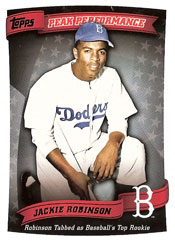
Robinson integrated major-league baseball when he batted second and played first base in the Dodgers’ 1947 season opener on April 15 against the Braves at Brooklyn. Boxscore

The 1947 Dodgers would finish in first by five games over the defending champion Cardinals and Robinson was a big factor. In 23 games against the 1947 Cardinals, Robinson hit .309 with three home runs, four steals, 11 walks and 10 RBI. His on-base percentage was .381.

Proposed protest

Robinson faced the Cardinals for the first time in the regular season on Tuesday afternoon, May 6, at Brooklyn in the opener of a three-game series. Batting second and playing first base, Robinson went 2-for-5 (a pair of singles) with a run scored in the Dodgers’ 7-6 victory. Boxscore

The New York Herald Tribune reported some Cardinals players tried to organize a strike in protest of Robinson’s presence in the major leagues. National League president Ford Frick confirmed to the Associated Press that Cardinals owner Sam Breadon had informed him there was “a movement among the Cardinals to strike in protest during their series if Robinson is in the lineup.”

“From what (Breadon) told me afterward, the trouble was smoothed over,” Frick said.

Breadon, manager Eddie Dyer and several Cardinals players denied knowledge of any strike plan.

“I brought the matter up with two of my leading players,” Breadon said to the Associated Press. “They never intimated that such a thing was even thought of.”

Said Dyer: “The report my club threatened a strike against Robinson is absurd. At no time, to my knowledge, did my players consider such a foolish action. They never discussed it. No one ever discussed it with them.”

Dodgers manager Burt Shotton told the United Press he didn’t believe the Cardinals had intended to strike. “I would have known about it had anything been done,” Shotton said.

Stanley Woodward, sports editor of the New York Herald Tribune, defended the accuracy of the report as “essentially right and factual.”

“The denial by Sam Breadon … is so spurious as to be beneath notice,” Woodward wrote.

in his 1948 book, “Jackie Robinson: My Own Story,” Robinson said, “We played our early May series with the Cards without any overt bad feeling. By and large, the Cardinals treated me as merely another ballplayer.”

Attracting a crowd

Robinson’s first visit to St. Louis with the Dodgers came two weeks later. In his book “1947,” Dodgers broadcaster Red Barber said, “St. Louis was the tough town. If there was to be trouble for Robinson, it figured to be in St. Louis. Robinson knew in advance he would not be permitted to stay in the Chase Hotel with the rest of the team. He was to have a room in town with a Negro family. He would come and go to Sportsman’s Park on his own, and depart by himself.”

Robinson’s first game at St. Louis occurred on Wednesday afternoon, May 21, in a 4-3 Dodgers victory. Robinson helped attract the largest weekday crowd of the season, 16,249. “About 6,000 were Negroes,” noted the St. Louis Post-Dispatch.

“Robinson was cheered each time he went to bat and the Dodgers as a team received more vocal encouragement than they usually get at Sportsman’s Park,” the Post-Dispatch reported.

Robinson was 0-for-4 with a walk and a run scored. Boxscore

Cardinals confrontation

A month later, on June 14 in St. Louis, Robinson lost his temper in an encounter with Cardinals pitcher Harry Brecheen in the second game of a Saturday doubleheader.

Brecheen “was having it easy, throwing up slow twisters and dinky curves that we could not hit for love nor money,” Robinson said in his book.

In the sixth inning, with the Cardinals ahead, 7-0, Robinson batted, “swung at one of those dinkies and topped the ball between the pitcher’s mound and first base,” he recalled. Brecheen fielded the ball, ran toward the base line and waited for Robinson to arrive rather than toss to first base.

“Brecheen knew as well as I did that any other player would have run over him and knocked him down in the hope that he’d drop the ball,” Robinson said. “Of course, that was the sort of thing I’d been told to avoid. I stopped dead on the base line. He tagged me.”

Robinson told Breechen, “You better play your position like you’re supposed to. Next time, I’m going to dump you on the back of your lap.” Boxscore

In his book, Robinson said, “That was the first time I had ever actually lost my temper on the field” since arriving in the big leagues. “It was also the first time I had ever said an angry word to an opposing player.”

Battles in Brooklyn

As the season unfolded, Robinson’s impact grew in games against the Cardinals.

On July 18, Robinson had three RBI, including a two-run home run against Al Brazle, and two runs scored in the Dodgers’ 7-0 victory at Brooklyn. Dodgers starter Ralph Branca pitched seven perfect innings before Enos Slaughter led off the eighth with a single. Boxscore

The next day, Robinson had two hits and a steal of home, though the Cardinals won, 7-5. Boxscore

A month later, on Aug. 20, the Cardinals were back in Brooklyn and Branca was pitching another gem against them until the Cardinals rallied to tie the score with two runs in the ninth inning.

In the 11th, with Hugh Casey pitching for the Dodgers, Slaughter hit a ground ball toward first base. Robinson fielded it and headed to the bag. As Slaughter arrived, he stepped on Robinson’s right foot, spiking him.

Robinson suffered no cut, but, to the Dodgers and the Brooklyn crowd, it appeared Slaughter intentionally tried to injure Robinson. Slaughter said it was an accident, not deliberate.

Robinson told The Sporting News, “All I know is I had my foot on the inside of the bag. I gave Slaughter plenty of room.”

In his book, Robinson said, “I don’t think he did it intentionally … He said later I had taken too much of the bag. I didn’t think so, but in all fairness to him I should report there had been some talk around the league that I was taking too much room on first base when I tagged the bag.” Boxscore

Pennant race

Brooklyn held a 4.5-game lead over the second-place Cardinals heading into their final series against one another Sept. 11-13 at St. Louis. The Cardinals knew their best chance to overcome the Dodgers was to sweep.

Brooklyn won two of the three _ and the standout player was Robinson. He batted .462 in the series.

In the opener, Cardinals catcher Joe Garagiola, running to first base after hitting a grounder, stepped on Robinson’s right heel, “tearing the back of Jackie’s shoe,” the New York Daily News reported.

According to Red Barber, Robinson “was seething, remembering the close call he had suffered when Slaughter’s spikes just missed his Achilles tendon.”

When Robinson batted in the next inning, he and Garagiola exchanged heated words. Garagiola “made a crack about my race,” Robinson said in his book.

According to the St. Louis Star-Times, Garagiola threw down his mask.

“For a moment, it looked as though we would come to blows,” Robinson said.

Plate umpire Beans Reardon stepped between Garagiola and Robinson. Dodgers coach Clyde Sukeforth “charged out of the dugout and berated Garagiola,” the Daily News reported, before Reardon shoved Sukeforth back toward the dugout.

“It was all over fast,” Reardon told the Star-Times. “I just told them, ‘That’s enough, boys. Let’s play ball.’ ”

When Robinson batted again, in the fifth, he slugged a two-run homer, tying the score and sparking the Dodgers to a 4-3 victory. Boxscore

“I don’t think Garagiola did it intentionally,” Robinson told the Post-Dispatch of the spiking, “but this makes three times in two games with the Cardinals that it’s happened. He cut my shoe all to pieces.”

After St. Louis won the second game, 8-7, the Dodgers came back to win the finale by the same score. Robinson had three hits and a walk, but his most important play came on defense. In the eighth inning, the Cardinals had runners on first and second with two outs when Nippy Jones, seeking his eighth hit of the series, hit a pop-up that drifted toward the Dodgers dugout. Robinson reached for the ball, caught it and spilled into the dugout. Boxscore

“As I grabbed that foul, I tried to break my fall,” Robinson told The Sporting News, “but I don’t know what would have happened if Ralph Branca hadn’t tackled me.”


(Updated Nov. 21, 2024)

Long before Fidel Castro began his dictatorial reign in Cuba, the Cardinals visited that country to play spring training exhibition games.

The Cardinals’ Cuba trips were noted for baseball _ even a bit of romance _ and not controversy.

The Cardinals visited Cuba in 1936, 1937 and 1940, playing exhibition games in Havana.

Mike Gonzalez, a Cuban native born in Havana in 1890, was a coach with the 1936 Cardinals and resided in Havana. He was instrumental in helping arrange the Cardinals’ four-game exhibition series in March 1936 against two longtime Cuban League clubs, Habana and Almendares.

(Gonzalez had a 17-year career as a big-league catcher, including three stints with the Cardinals. He played winter ball in the Cuban League from 1910-1936. Gonzalez was a Cardinals coach from 1934-46. He twice served as the Cardinals’ interim manager, replacing Frankie Frisch in 1938 and Ray Blades in 1940, and compiled a 9-13 record overall in that role.)

Under the headline, “Cards’ Spanish Bad, So Is Their Playing,” The Sporting News reported on the arrival of the 1936 Cardinals in Havana:

“A big crowd was at the dock when the S.S. Florida nosed into Havana Bay and, what is more important, there was a tremendous crowd at the beautiful Tropical Park, a sunken garden baseball field, when the Cardinals put on their uniforms to play the Habana team of the Cuban winter league.”

Habana won the first and third games against the Cardinals by scores of 13-8 and 2-1 in 11 innings. In the first game, The Sporting News reported:

“An aviator flew so low over the field that the bleacherites pulled in their necks. He was dropping handbills and it was reported the next day that he drew a $1,000 fine for endangering the crowd, besides scaring hell out of the Cards.”

The Cardinals won the second and fourth games, against Almendares, by scores of 5-4 and 6-1. (In Game 2, outfielder Pepper Martin had a ninth-inning RBI to tie the score and then scored the winning run for St. Louis.)

More than 30,000 attended the four games, with near-sellout crowds for the final two at Tropical Park, a setting so spectacular The Sporting News described it as “playing a ballgame in the orchard room of a big greenhouse.”

A year later, March 1937, the Cardinals returned to Cuba for a two-game exhibition set against the New York Giants, who were using Havana as a spring training base. The Cardinals and Giants split the two games, with the Cardinals winning 4-3 in the opener and the Giants winning 5-4 in 10 innings in the second game. (Cardinals manager Frankie Frisch stroked a two-run pinch-hit single in the seventh inning of the first game.)

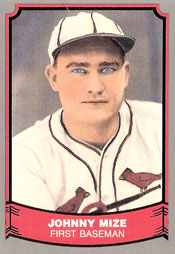
The trip became more noteworthy for what happened off the field for 24-year-old first baseman Johnny Mize.

Jene Adams, a 19-year-old aspiring concert contralto singer from St. Louis, and her mother had been spending the late winter of 1937 in Daytona Beach, Fla., the Cardinals’ spring training base. They became acquainted with Mrs. Sam Breadon, wife of the Cardinals’ owner, and Mrs. Robert Hyland, wife of the Cardinals’ physician. Mrs. Breadon and Mrs. Hyland invited Jene Adams and her mother to accompany them to Havana for the Cardinals’ games with the Giants.

The Sporting News, in a 1940 feature, described what happened next:

“At the Plaza Hotel in Havana one morning, Jene was talking to Mrs. Hyland in the lobby when Mize strolled by. Mrs. Hyland introduced him to Miss Adams.

“We could hang out a tropical moon here for trimmings, but nothing happened in the way of romance until the team returned to Daytona Beach. There the young pair became better acquainted. Dan Cupid gradually worked into the picture. The engagement of the National League’s No. 1 slugger and Miss Adams came early in the summer of the same year, 1937. On Aug. 8, they were married.”

In March 1940, the Cardinals returned to Havana for a four-game exhibition series against a Cuban all-star team. The all-stars were managed by Havana native Dolf Luque, who pitched in the big leagues for 20 years (primarily with the Reds and Giants) and earned 194 wins, and featured left-handed pitcher Luis Tiant Sr., father of the future major-league pitcher of the same name.

(In the book “Voices from Cooperstown,” Hall of Fame catcher Al Lopez told author Anthony J. Connor, “I caught Dolf Luque at the end of his career and that was an education. He was the smartest pitcher I ever caught. He could spot the ball wherever he wanted, any kind of pitch.”)

The Cardinals’ batting order for the opening game was third baseman Don Gutteridge, second baseman Stu Martin, right fielder Enos Slaughter, first baseman Johnny Mize, catcher Don Padgett, center fielder Terry Moore, left fielder Pepper Martin, shortstop Marty Marion and pitcher Mort Cooper.

St. Louis won the first three games by scores of 5-4, 6-0 and 5-3. Left fielder Joe Medwick, who had been a holdout from spring training because of a contract dispute, made his first official appearance of the spring as a pinch-hitter in the third game. The Cuban all-stars won the finale, 4-2, behind the four-hit pitching of Agapito Mayor.