Feeds:
Posts
Comments

(Updated Aug. 27, 2015)

An indicator of how special a hitter Ted Simmons was is the number of four-hit games he had for the Cardinals.
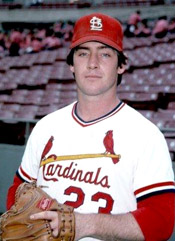
Simmons achieved four hits in a game 19 times as a Cardinal.

Simmons had more four-hit games (six) against the Cubs than any other opponent.

Here is a look at Simmons’ five most notable four-hit games as a Cardinal:

_ Cardinals 11, Pirates 0, Aug. 14, 1971, at Pittsburgh: Simmons caught Bob Gibson’s only career no-hitter and went 4-for-6 with a RBI and two runs scored. It was Simmons’ first four-hit game in the big leagues.

Simmons is the only Cardinals catcher to achieve four hits in a game in which he caught a no-hitter.

Simmons’ four hits came against three pitchers: a RBI-single off Bob Johnson in the first, a fifth-inning double off Bob Moose, and singles in the sixth and eighth innings off Bob Veale. Boxscore

In the book “The Ted Simmons Story,” Simmons said of the no-hit game by Gibson, “I’d never seen anything like it. I guess it will always remain my biggest thrill in baseball.”

_ Cardinals 2, Cubs 1, Sept. 30, 1972, at Chicago: In an admirable display of durability and productivity, Simmons was 4-for-7, scored the winning run, caught all 16 innings, made 15 putouts and committed no errors in a game that took 4:49 to complete.

In the 16th, Simmons led off with a double against Tom Phoebus and scored on Ted Sizemore’s single to left, breaking the 1-1 tie. Boxscore

_ Cardinals 8, Reds 0, June 13, 1973, at Cincinnati: Simmons came stunningly close to catching another no-hitter while collecting four hits.

Rick Wise held the Reds hitless until Joe Morgan singled to center with one out in the ninth. Wise settled for a one-hitter and the win.

Morgan singled sharply on a 2-and-1 belt-high fastball. Simmons had called for a curve.

“You have to go with your pitcher _ he’s the man who’s going for the no-hitter,” Simmons said to The Sporting News. “He wanted to challenge them with his best pitch. I thought when Pete Rose (first batter in the ninth) flied out, the no-hitter was in the bag. Rick had pinpoint control. He was painting the outside corners on both right- and left-handed batters.”

Simmons was 4-for-5, including a two-run single off Jack Billingham in the Cardinals’ seven-run third inning. Boxscore

_ Cardinals 8, Braves 7, May 4, 1976, at Atlanta: Simmons was 4-for-5 with three RBI, including the game-winning hit.

With the score 7-7 in the 12th, Simmons hit a one-out double to the right-center field gap off Adrian Devine, scoring Bake McBride from first. Boxscore

It was Simmons’ second four-hit game in four days. As the starting left fielder, he had four hits on May 1 against the Dodgers.

_ Cardinals 8, Braves 5, June 9, 1980, at Atlanta: Simmons played an integral role in assuring Whitey Herzog’s first game as St. Louis manager was a success. Simmons was 4-for-4 and scored three runs.

In the 10th, with the score tied 5-5 and Larry Bradford pitching, Keith Hernandez walked and Simmons followed with a single to center. Bradford was replaced by Gene Garber, who yielded a three-run home run to the first batter he faced, George Hendrick. Boxscore

Previously: The story of how Ted Simmons became a Cardinal
(Updated Feb. 19, 2023)

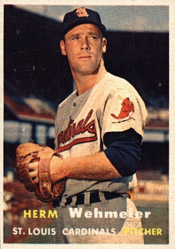
In a classic example of the adage “if you can’t beat ’em, join ’em,” the pitcher who posted the worst career record against the Cardinals got traded to them and enjoyed the best stretch of his big-league tenure.

In 31 appearances against the Cardinals for the Reds and Phillies from 1949-1956, Herm Wehmeier was 0-14 with a 4.89 ERA.

(Yovani Gallardo has the second-worst career mark versus the Cardinals. In 19 starts against the Cardinals, Gallardo was 1-11 with a 6.45 ERA.)

Wehmeier’s 14th loss to St. Louis occurred May 9, 1956, in the Cardinals’ 3-0 victory over the Phillies. Boxscore

Two days later, on May 11, 1956, the Cardinals traded pitchers Harvey Haddix, Stu Miller and Ben Flowers to Philadelphia for Wehmeier and pitcher Murry Dickson. The deal was unpopular with many Cardinals fans. Haddix won 20 in 1953 and 18 in 1954. Though his record in 1955 fell to 12-16, many saw him as a pillar of St. Louis’ rotation.

Cardinals coach Terry Moore, who was the Phillies’ manager when Philadelphia acquired Wehmeier from the Reds in 1954, recommended Wehmeier to St. Louis general manager Frank Lane. According to The Sporting News, Lane said he sought Wehmeier “because he can be depended upon to trouble Brooklyn and Milwaukee, teams the Cards must stop to win.”

Cardinals pitching coach Bill Posedel was successful in working with Wehmeier. Reporting for The Sporting News, Bob Broeg wrote, “Wehmeier began to work with a high leg kick, similar to Paul Derringer’s, and … he concentrated on letting up on his fastball and curve when the opposition would expect the Wehmeier of old to try to bust his fastball by ’em.”

The results were impressive. Wehmeier won eight of nine decisions for the 1956 Cardinals from July 21 to Sept. 11. He saved his best for his last start of the year.

On the morning of Saturday, Sept. 29, the next-to-last day of the 1956 season, the Braves held first place in the National League, a half-game ahead of the Dodgers.

That day, the Dodgers swept a doubleheader against the Pirates. The Braves entered their night game at St. Louis knowing they needed to win to keep a share of first place. Milwaukee started its ace, Warren Spahn, against Wehmeier.

(In his autobiography, “I Had a Hammer,” Hank Aaron called Wehmeier “my worst nightmare,” because in 1955 he batted .105 against him, with two singles in 19 at-bats.)

Spahn and Wehmeier dueled into the 12th inning with the score tied 1-1. In the bottom of the 12th, Rip Repulski lashed a double against Spahn, scoring Stan Musial from second and giving the Cardinals a 2-1 victory. Boxscore

In Aaron’s book, Spahn said, “Beyond a doubt, that Saturday game in St. Louis was the most heartbreaking moment I had in 21 years of baseball.”

The loss dropped the Braves a game behind the Dodgers, who clinched the pennant the next day. The win capped a successful season for Wehmeier. The right-hander finished 12-9 with a 3.69 ERA for St. Louis. It would be the most single-season wins he’d post in his big-league career.

Wehmeier was named the Cardinals’ 1957 Opening Day pitcher by manager Fred Hutchinson. The assignment was especially important for Wehmeier because he would be facing the Reds in Cincinnati.

A Cincinnati native, Wehmeier had been an outstanding athlete at Western Hills High School. When he signed with the Reds at age 18, he was billed as a hometown hero. Instead, plagued by wildness and high expectations, Wehmeier was a bust. In nine seasons with the Reds, Wehmeier was 49-69. He issued more walks (591) than strikeouts (478) and became a target of fan hostility.

“He was one of the greatest natural athletes we ever had in Cincinnati,” Reds general manager Gabe Paul said. “But never in my long baseball experience have I heard a man booed as bitterly as was Wehmeier. Nothing he could do was right. Even when he won, they booed him.”

Wrote Broeg: “One of Wehmeier’s troubles as a Red was that the former Cincinnati high school hero tried too hard. The more red-necked he became and the harder he tried to throw, the wilder he became, either walking himself into trouble or getting the ball up where power hitters and others could swing for the fences.”

When Wehmeier took the mound in the Cardinals’ 1957 opener, his mother, father, sister and brother were in the stands. What they witnessed must have stunned many Reds fans. Wehmeier pitched a complete game and got the win in the Cardinals’ 13-4 victory. Boxscore

Wehmeier was winless in May and June, but recovered to win five consecutive decisions from Aug. 24 to Sept. 15. He finished the 1957 season at 10-7 with a 4.31 ERA.

In May 1958, Wehmeier was sent to the Tigers in a waiver deal. He suffered an elbow injury soon after and, at 31, his playing career was done. His big-league record: 92-108. For St. Louis, Wehmeier was 22-17.

Wehmeier scouted for the Reds for three years (he recommended they sign another phenom from Western Hills High School, Pete Rose) and then left baseball. He worked for a trucking company in Texas.

In May 1973, Wehmeier, 46, was testifying during a theft trial in federal court in Dallas when he suffered a fatal heart attack. In an obituary, The Sporting News reported, “Wehmeier was on the witness stand testifying for the government when he collapsed. The case involved theft of merchandise from a shipping company of which Wehmeier was an official.”

Previously: An interview with former Cardinals pitcher Al Jackson

In 1968, Larry Jaster made a conversion from reliever to starter for the Cardinals.

Jaster began the 1968 season in the bullpen. A 24-year-old left-hander, Jaster was 1-1 with a 2.13 ERA in seven relief appearances until he moved into the rotation in late May.

Here is how he did in his first four starts that season:

_ Cardinals 2, Dodgers 1, May 20, 1968, at St. Louis: Jaster pitched a two-hitter, yielding singles to Wes Parker and Paul Popovich, and stopped the Cardinals’ four-game losing streak.

The Dodgers scored an unearned run in the first. Willie Davis walked, took second on a passed ball by Tim McCarver, was bunted to third and scored on a groundout by ex-Cardinal Ken Boyer.

Jaster had pitched five consecutive shutouts against the Dodgers in 1966. After he baffled the Dodgers again with his first start of 1968, frustrated Los Angeles manager Walter Alston stormed into the clubhouse, grabbed a box of bubble gum and threw it across the room “as players and the chewy pellets scattered,” The Sporting News reported. Boxscore

_ Phillies 1, Cardinals 0, May 25, 1968, at St. Louis: Lack of run support led to Jaster taking a loss, even though he held Philadelphia to one earned run in 7.1 innings.

The Phillies scored in the sixth when a sacrifice fly by Don Lock drove in Johnny Callison from third.

St. Louis was held to five singles by ex-Cardinal Larry Jackson and reliever Turk Farrell. The Cardinals had two on with one out in the ninth when Farrell relieved and got Phil Gagliano to pop out and Dave Ricketts to line out. Boxscore

_ Cardinals 2, Mets 0, May 31, 1968, at New York: Outdueling Tom Seaver with a dazzling curve to complement his fastball and changeup, Jaster pitched a two-hitter, walking none.

The Mets were hitless until Greg Goossen singled between short and third with two outs in the eighth.

“It wasn’t a bad pitch. The pitch (a curve) was lower than waist high,” Jaster said to The Sporting News.

A ninth-inning single by Don Bosch accounted for New York’s other hit.

“I think I would have got the perfect game if I had got past Goossen,” Jaster said. Boxscore

_ Cardinals 3, Astros 1, June 5, 1968, at Houston: Jaster allowed one earned run in eight innings. Wayne Granger pitched the ninth for the save. Bob Aspromonte drove in Jim Wynn from third with a single for Houston’s run. Boxscore

Jaster was 4-2 with a 0.98 ERA after the win over Houston. He won just once after July 23, losing eight of his last nine decisions and finishing 9-13 with a 3.51 ERA.

(Updated March 27, 2018)

Ron Plaza never played a game in the major leagues, but he influenced several Cardinals big-leaguers.

Plaza was a manager in the Cardinals’ farm system for six years, posting a 432-329 record. He also was an infielder in the Cardinals’ organization for 11 years.
St. Petersburg was the site of Plaza’s biggest success as a Cardinals minor-league manager. Replacing Sparky Anderson, Plaza managed St. Petersburg to a 96-43 record and the Florida State League championship in 1967. He was named winner of the Class A league’s Manager of the Year Award.

The other Cardinals farm clubs managed by Plaza were Billings (1963), Winnipeg (1964), Cedar Rapids (1965-66) and St. Petersburg (1968).

Among the players Plaza managed in the Cardinals’ system was pitcher Steve Carlton, who would earn election to the National Baseball Hall of Fame. Pitching for Plaza’s 1964 Winnipeg club, Carlton was 4-4 with a 3.36 ERA.

In the June 15, 1968, edition of The Sporting News, Carlton cited Plaza, Clyde King, Hal Smith, Grover Resinger and Billy Muffett as Cardinals instructors who had a positive influence on him. “I had good instructors all along the line,” Carlton said.

Future Cardinals who played for Plaza on the 1967 championship St. Petersburg team were outfielders Boots Day (70 RBI and 21 stolen bases in 136 games) and Jose Cruz (.278 batting average in 78 games) and pitcher Santiago Guzman (16-3, 1.74 ERA in 23 starts).

In 1968, pitcher Reggie Cleveland, who would go on to a 13-year major-league career, was 15-10 with a 2.77 ERA in 27 starts for Plaza’s St. Petersburg team.

After the 1968 season, Plaza was selected to the coaching staff of the Seattle Pilots, an American League expansion team managed by Joe Schultz, who had been a coach for the Cardinals from 1963-68. Plaza had played for three Cardinals farm clubs managed by Schultz: 1959 Omaha, 1961 Charleston and 1962 Atlanta.

In his book “Ball Four,” Pilots pitcher Jim Bouton wrote about Plaza.

The Pilots were relocated to Milwaukee after one season in Seattle and became the Brewers. Schultz and Plaza weren’t retained.

Plaza joined manager Sparky Anderson’s coaching staff with the 1978 Reds. He remained a Reds coach through 1983, serving under managers John McNamara and Russ Nixon.

In 1986, Plaza became a coach for manager Jackie Moore with the Athletics. After Moore was fired in June, Plaza served out the season for Moore’s replacement _ Tony La Russa.

As a player in the Cardinals’ organization, Plaza’s best year was 1956 when he hit .297 in 121 games as a second baseman for Class AAA Rochester, managed by Dixie Walker.


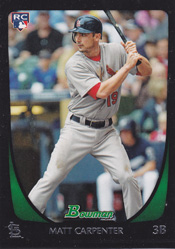
With a dominating hitting performance, Matt Carpenter joined an exclusive and eclectic Cardinals rookie club.

Batting sixth and starting at first base, Carpenter was 4-for-4 with five RBI, a home run and a triple in the Cardinals’ 10-3 victory over the Cubs on April 15 in St. Louis. Carpenter, a left-handed batter, had a RBI-single off left-hander Paul Maholm in the second inning, a two-run homer off right-hander Lendy Castillo in the fifth and a two-run triple off right-hander Rodrigo Lopez in the seventh. Boxscore

According to the Elias Sports Bureau, Carpenter is the third Cardinals rookie with four hits, five RBI and a home run in a game. The others are third baseman Les Bell (1925) and first baseman Fred Whitfield (1962).

The St. Louis Post-Dispatch and MLB.com, using information supplied by a Cardinals media relations staffer, reported outfielder Joe Hague also had four hits, five RBI and a home run in a 1970 game as a St. Louis rookie.

(Though Hague did achieve such a performance, I believe he wasn’t a rookie when it occurred. According to Major League Baseball, a player is considered a rookie if he hasn’t exceeded 130 big-league at-bats and hasn’t accumulated more than 45 days on a big-league team’s active roster. Hague accumulated more than 45 days on the Cardinals’ roster in 1969. He opened the ’69 season with the Cardinals and was with them until being demoted to the minor leagues in mid-June.)

Nonetheless, the magnitude of Carpenter’s achievement is placed in perspective when one considers it’s been at least four decades (and probably longer) since any other Cardinals rookie did the same.

Here’s how the others did it:

LES BELL

After appearing in fewer than 18 games for St. Louis in 1923 and again in 1924, Bell, 23, opened the 1925 season as the Cardinals’ everyday third baseman.

On April 18 at Chicago, the rookie, batting fifth, went 5-for-6 with two home runs and six RBI in the Cardinals’ 20-5 victory over the Cubs.

A right-handed batter, Bell hit a three-run homer off right-hander Guy Bush in the fourth and a two-run homer off right-hander Elmer Jacobs in the seventh. Bell also had two doubles and a single. It would be the only five-hit game of his nine-year big-league career. Boxscore

FRED WHITFIELD

A first baseman and left-handed batter, Whitfield as a rookie had a reputation as a potent hitter held back by fielding deficiences. On Aug. 12, 1962, Whitfield, 24, started at first base in the second game of a doubleheader against the Phillies at St. Louis. Batting third, he went 4-for-5 with a home run and five RBI, though the Phillies completed a sweep with a 9-7 victory.

In the sixth inning, Whitfield hit a grand slam off left-hander Bill Smith, giving the Cardinals a 7-6 lead. It was St. Louis’ first grand slam of the season. Whitfield also had a double and two singles. Boxscore

“Fred Whitfield is the greatest hitter I’ve ever seen _ for the number of times I’ve seen him bat against us,” Phillies manager Gene Mauch said to The Sporting News.

In 1970, Whitfield finished his nine-year big-league career with the Expos, managed by Mauch.

JOE HAGUE

Whether or not he was a rookie, Hague, a left-handed batter, deserves mention here for going 4-for-5 with a home run and five RBI in the Cardinals’ 9-2 victory over the Mets on May 28, 1970, at New York.

Batting sixth and playing right field, Hague, 26, had a two-run single off right-hander Don Cardwell in the first, a solo homer off left-hander Tug McGraw in the eighth and a two-run single off McGraw in the ninth. Hague also singled in the sixth. Boxscore

The home run was the first by a Cardinals batter other than Richie Allen or Joe Torre in nearly three weeks.

(Note: In the next game after Carpenter’s historic performance, he hit a bases-loaded sacrifice fly in the 10th inning to give the Cardinals a 2-1 win over the Reds on April 17. According to Elias Sports Bureau, Carpenter is the first rookie with a walk-off RBI in the major leagues this season.)

Previously: Is David Freese capable of 100-RBI season?

(Updated March 1, 2022)

In 2000, Will Clark produced four home runs in the first five games he played for the Cardinals.

A first baseman, Clark was acquired by the Cardinals from the Orioles on July 31, 2000, in a trade for minor-league infielder Jose Leon. The first-place Cardinals, seeking to secure the National League Central Division crown, saw Clark, 36, as a replacement for slugger Mark McGwire, who was sidelined because of tendinitis in his right knee. In 79 games with the 2000 Orioles, Clark batted .301 with nine home runs and 28 RBI.

San Francisco treat

With the Giants from 1986-93, Clark batted .299 with 1,278 hits in 1,160 games and an on-base percentage of .373. In the 1987 National League Championship Series versus the Cardinals, Clark batted .360 with nine hits in seven games. Nine months later, in July 1988 at St. Louis, Clark got into a tussle with Cardinals infielders Jose Oquendo and Ozzie Smith, who didn’t like the way he slid into second base.

Asked what he thought about Clark becoming his teammate, Oquendo, a coach with the 2000 Cardinals, told the St. Louis Post-Dispatch, “Will is a nice guy. He knows the game, knows how the game should be played.”

Regarding their 1988 altercation, Oquendo said, “That’s all forgotten. We always have joked about it every time we see each other.”

Warm welcome

Clark was delighted to join the Cardinals and play for a contender. In an interview with the Baltimore Sun, Clark said his message to the Cardinals was, “I’ll do whatever you need me to do. That’s what team players do. That’s how you win, by going about things in a team concept. Whatever (manager) Tony La Russa and the Cardinals want me to do, I’ll do.”

La Russa told the Associated Press, “Will Clark is a winning-type of veteran. He should help us … (Clark) knows how to come up and get a base hit in a key situation. He’s a very competitive guy.”

Clark was in the second season of a two-year, $11 million contract. As part of the trade, the Orioles agreed to pay about half of Clark’s remaining salary for the season, the Baltimore Sun reported.

“There was a great deal of interest from Clark’s side to try to come here,” Cardinals general manager Walt Jocketty said to the Post-Dispatch. “He wanted to play on a winner.”

Columnist Tom Wheatley of the Post-Dispatch concluded, “Clark’s team-first attitude will fit right in.”

Sizzling slugger

In his Cardinals debut, Aug. 1, 2000, at Montreal, Clark entered the game in the sixth inning to play first base, replacing Eduardo Perez. In the seventh, Clark doubled versus Expos reliever Anthony Telford in his first Cardinals at-bat. Boxscore

Clark started at first base in each of the Cardinals’ next four games _ and he hit a home run in each. Here’s a look:

_ Aug. 2, 2000, Cardinals 10, Expos 7, at Montreal: Batting cleanup, Clark went 3-for-4 with a walk, two RBI and two runs scored. He hit a second-inning solo home run against Mike Johnson. Boxscore and video

_ Aug. 4, 2000, Braves 6, Cardinals 4, at St. Louis: In a preview of the NL Division Series matchup, Clark, batting sixth, hit a solo home run against Tom Glavine in the second inning on the first pitch he saw in his first home game as a Cardinal. Clark received a standing ovation from the crowd of 48,901 when he walked to the plate for the first time, and he got a curtain call after hitting the home run. Boxscore and video

“After that first standing ovation, in my heart I bonded with them already before I even stepped to the plate,” Clark said. “The change of scenery, the emotional lift it gave me, means a lot. The batteries have been recharged.”

_ Aug. 5, 2000, Cardinals 5, Braves 0, at St. Louis: Clark hit a two-run home run in the first inning against John Burkett, a former Giants teammate. Clark also drew two walks and scored twice. Boxscore

_ Aug. 6, 2000, Braves 6, Cardinals 4, at St. Louis: Clark’s solo home run against Kevin Millwood in the fourth inning was part of a 3-for-4 performance. Clark’s batting average after five games with the Cardinals was .643. Boxscore

“I’ve got a whole new attitude,” Clark said. “I’m loving life.”

In a profile of Clark after he joined the Cardinals, Sports Illustrated’s Kostya Kennedy described him as “St. Louis’ swaggering shaman, a wise head on the field and a spirited voice in the clubhouse.”

“Sarcastic, cantankerous and quick to carp in his chipmunk-pitched Louisiana drawl, Clark struts through the clubhouse razzing all men equally,” Kennedy noted.

Real deal

In a 2019 interview with Cardinals broadcasters Dan McLaughlin and Rick Horton, Clark recalled when he joined the team he was brought in to see La Russa, who said, “We let the players police themselves and that’s what I want you to do. I want you to run the clubhouse.”

Clark replied, “Sounds great to me.”

“I had a lot of fun doing it,” Clark said. “J.D. Drew and Rick Ankiel took some (verbal) beatings. Rick didn’t mention that in his book, I don’t think.”

McGwire returned to the Cardinals in September, but was limited to 14 at-bats for the month. Clark played in 51 regular-season games for the 2000 Cardinals and batted .345 (59-for-171) with 12 home runs, 42 RBI, a .426 on-base percentage and a .655 slugging percentage.

Sparked by Clark’s hitting, the Cardinals won the division title, finishing 10 games ahead of the second-place Reds.

Clark continued to deliver in the postseason. He hit a three-run home run against Glavine in Game 2 of the NL Division Series at St. Louis on Oct. 5. Boxscore In the NL Championship Series against the Mets, Clark led the Cardinals with a .412 batting average (7-for-17).

The Cardinals offered Clark a chance to return in 2001, but it would have meant being a utility player and learning to play the outfield. He opted instead to retire from playing.