Feeds:
Posts
Comments

In 1987, the Cardinals made a trade with the Pirates that stunned fans of both teams. Whether one believes the deal helped or hurt the Cardinals is a matter of perspective.

On April 1, 1987, the Pirates traded catcher Tony Pena, a four-time all-star, to the Cardinals for outfielder Andy Van Slyke, catcher Mike LaValliere and pitcher Mike Dunne.

The deal brought immediate results for the Cardinals. Though he had a subpar regular season, Pena helped the Cardinals win the 1987 National League East Division championship. Inspired by his first exposure to postseason baseball, Pena was a key part of St. Louis’ march to the pennant and a berth in the World Series.

After two more seasons with St. Louis, Pena became a free agent and signed with the Red Sox.

Van Slyke, LaValliere and Dunne all blossomed into top producers for the 1987 Pirates. Van Slyke and LaValliere played integral roles in helping Pittsburgh emerge from a last-place team in 1986 to win three consecutive NL East titles (1990-92).

Informed of the trade made by general managers Dal Maxvill of the Cardinals and Syd Thrift of the Pirates, Pena and Pirates manager Jim Leyland cried.

“My heart’s bleeding,” Pena said to the Associated Press. “I made my life with this ballclub.”

Said Leyland, who approved of the deal: “We’ve traded the best and most durable catcher in baseball.”

Pena, 29, was a three-time winner of the Gold Glove Award and popular with Pirates fans. In an editorial, the Pittsburgh Press wrote,

If Pirates fans could cast a mold of their prototype baseball player, it would come out looking a lot like Tony Pena. He plays baseball the way they like to see it played _ with zest, verve and abandon.

Reaction to the trade largely was negative in Pittsburgh. Wrote columnist Bruce Keidan of the Pittsburgh Post-Gazette,

Sorely in need of a starting pitcher, a first-rate shortstop and a right-handed power hitter, the Pirates conspired to give away an all-star catcher without obtaining any of the three.

Said Thrift: “How am I going to explain to my 82-year-old mother when the fans boo me?”

Adding to the despair of many Pirates fans was the reaction to the trade by the Cardinals.

“In Tony Pena, we are getting one of the premier players in the game,” Maxvill said to the Associated Press.

Added manager Whitey Herzog: “When you get a ballplayer of that caliber, you’ve done something. We are really happy. We paid a good price to get him, but it was worth it.”

The Cardinals had entered the 1986 season with Mike Heath as their starting catcher. He couldn’t hit (.205 in 65 games) and the Cardinals dealt him to the Tigers in August that season.

Herzog figured to utilize a platoon of LaValliere and Steve Lake at catcher in 1987, but the thought of having two slow-footed, light-hitting catchers concerned him. Thrift, looking to lift a team that had finished 64-98 in 1986, dangled Pena as trade bait.

“This is a move we believe will benefit the Pirates … Van Slyke has the capability and physical tools to become an outstanding, complete player,” Thrift told the Post-Gazette.

It soon became evident the trade may not have been as lopsided as initially thought.

Post-Gazette columnist John Steigerwald wrote,

Who got the better of the deal depends on which Tony Pena the Cardinals got … Chances are the Cardinals got the same two Tony Penas that have played here, the hot one and the cold one.

If you think the Pirates were robbed, it might make you feel better to know that longtime Cardinals announcer Jack Buck told me yesterday that he thinks Andy Van Slyke is the best defensive outfielder in the National League and that he is as exciting in right field as Pena is behind the plate.

In interviews immediately after the trade was made, Van Slyke and LaValliere provided insights into how they expected to contribute to the Pirates.

“I felt that this (1987) was my year to blossom,” Van Slyke told the Post-Gazette. “This was my year to do the things everybody anticipated me doing in St. Louis. But I can do it here. Sure I can.”

Said LaValliere: “I pride myself an awful lot on my defense … That’s probably my strongest point _ working with my pitchers … With the Cardinals, I knew who I had to kick in the butt and who I had to burp. I’ll have a crash course here.”

Pirates players bought into the trade. Said outfielder Mike Diaz: “The team isn’t made up of one player … We got two starters (Van Slyke and LaValliere) for the price of one.”

In retrospect, the Pirates got three starters for the price of one.

Dunne, 24, earned a spot in the rotation of the 1987 Pirates, posting a 13-6 record and 3.03 ERA in 23 games.

LaValliere, 27, earned a Gold Glove Award in 1987, finishing second in the NL in fielding among catchers, with a .992 percentage. He went on to a seven-year career with Pittsburgh.

Van Slyke, 27, opened the 1987 season in right field for Pittsburgh, with Barry Bonds in center and Bobby Bonilla in left. (During the season, Van Slyke was shifted to center, with Bonds moved to left and Bonilla to right). Van Slyke had the stellar season he expected in ’87, batting .293 with a .359 on-base percentage, 36 doubles, 11 triples, 21 home runs and 82 RBI.

In eight years with Pittsburgh, Van Slyke hit .283 with an on-base percentage of .353. He won a Gold Glove Award in five consecutive seasons (1988-92).

The Cardinals had made the deal, in part, because they believed rookie Jim Lindeman was ready to become an everyday right fielder, but he wasn’t as talented as Van Slyke. (A year later, to plug the gap in right field, the Cardinals traded their productive second baseman, Tom Herr, to the Twins for outfielder Tom Brunansky).

Pena batted .214 with 5 home runs and 44 RBI for St. Louis in 1987. He hit much better in the postseason (.381 in the NL Championship Series against the Giants, and .409 in the World Series against the Twins).

Pena was better in 1988 (.263, 10 homers, 51 RBI) and in 1989 (.259, 4 homers, 37 RBI, with an all-star berth) for St. Louis. He also ranked first in fielding among NL catchers in both seasons (.994 in ’88 and .997 in ’89).
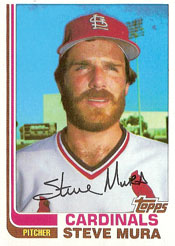
The Cardinals career of Steve Mura was as unusual as it was short.

Unusual because Mura was successful (12 wins in 1982) yet he didn’t appear in the National League Championship Series or World Series for the Cardinals that year.

Unusual because Mura arrived in a trade that took two months to complete and he departed because of a free-agent signing that didn’t involve him or the Cardinals.

Unusual because Mura at times pitched terribly for St. Louis and other times nearly was unhittable, sometimes experiencing both extremes in consecutive starts.

Mura, a right-hander, was 12-11 with a 4.05 ERA for the ’82 Cardinals. He ranked second among Cardinals pitchers that season in complete games (7) and strikeouts (84), and third in wins (12), starts (30) and innings pitched (184.1). He also was first in walks (80).

Despite that steady use, manager Whitey Herzog preferred to start Dave LaPoint and John Stuper (along with aces Joaquin Andujar and Bob Forsch) ahead of Mura in the postseason.

Mura, a right-hander, was acquired by the Cardinals from the Padres in December 1981 in a trade for outfielder Sixto Lezcano. The deal also was supposed to include Cardinals shortstop Garry Templeton for Padres shortstop Ozzie Smith, but that part wasn’t completed until February 1982.

Though he had a 5-14 record for the 1981 Padres, Mura earned a spot in a Cardinals rotation that included Forsch, Andujar, John Martin and Andy Rincon to open the season.

Mura started the Cardinals’ 1982 home opener, but lasted just 1.1 innings, allowing 3 runs, 3 hits and 3 walks in the Pirates’ 11-7 victory. Boxscore

Five days later, April 15, Mura pitched a four-hitter against the Cubs in the Cardinals’ 6-1 victory at Wrigley Field. Chicago’s only run came on a Keith Moreland home run with two out in the ninth. Boxscore

Those kinds of up-and-down performances continued for Mura and, along with his high walk totals, contributed to Herzog’s decision not to use him in the postseason.

Mura was 0-4 with a 5.59 ERA in June and 3-0 with a 1.77 ERA in July.

He told The Sporting News a rediscovered curveball, a new cut fastball and the ditching of an ineffective slider led to his turnaround in July.

“I can’t throw the ball straight anymore,” Mura said. “The ball is taking off all over. It’s moving more than usual and I’m not used to it. But it helps me more than it hurts me. I’m getting so many more pop-ups now.”

After pitching a complete game in the Cardinals’ 12-5 victory over the Pirates at Pittsburgh on Aug. 15, Mura was 11-7 with a 3.62 ERA. Boxscore

Then he lost four of his last five decisions.

After the Cardinals won the World Series title, Mura filed for salary arbitration.

At the time, big-league baseball rules stated if a team lost a top free agent (deemed Type A) to another team, it could replace the departed player with a major-league caliber player from a compensation pool. Any big-leaguer left off a 26-player protected list by his team was eligible to be chosen from the compensation pool. (This rule was instituted after the 1981 season and lasted four years before it was erased).

The White Sox had lost free-agent outfielder Steve Kemp to the Yankees after the 1982 season. The White Sox chose Yankees pitcher Rudy May from the compensation pool. But May had a no-trade clause, voiding the deal.

Instructed to make another choice, the White Sox selected Mura, who had been left unprotected by the Cardinals.

Mura reported to spring training in 1983, expecting manager Tony La Russa and pitching coach Dave Duncan to have him in Chicago’s starting rotation. But Mura opened the season in the bullpen and his career headed into a downward spiral.

He made just six relief appearances for the 1983 White Sox and was critical of La Russa and Duncan. “I’m not doing any good throwing 5 minutes of batting practice,” Mura said to The Sporting News. “… I wish they would make up their mind and trade me or something instead of letting me rot.”

In May, the White Sox demoted Mura to Class AAA Denver. He was 3-11 with a 4.82 ERA in 19 starts for Denver. Meanwhile, La Russa and Duncan were leading the White Sox to their first American League West Division championship.

At spring training in 1984, Mura competed for the No. 5 starter spot in the White Sox rotation. La Russa told The Sporting News Mura “was much improved from last year. He showed he can pitch in the majors.” But the White Sox released him before the season began.

Mura pitched for the Phillies’ Class AAA team in Portland (Ore.) in 1984, posting a 9-4 record and 5.00 ERA. Released by the Phillies, he signed for 1985 with the Athletics. After opening the season at Class AAA Tacoma and posting a 7-5 record, Mura was called up to Oakland on July 1. In 23 games for the Athletics, including one start, Mura was 1-1 with a 4.13 ERA.

In December 1985, two months shy of his 31st birthday, Mura was released by the Athletics. His professional baseball career was finished.

Previously: Jim Kaat interview: 1982 Cardinals were most close-knit club

(Updated: Oct. 21, 2018)

Even in the immediate afterglow of their first World Series title in 15 years, the Cardinals and manager Whitey Herzog were willing to trade significant and popular starters in order to secure another all-star for the left side of the infield.

Less than two months after winning the 1982 World Series championship, the Cardinals came close to acquiring third baseman Buddy Bell from the Rangers.

Bell would have paired with Ozzie Smith to give the Cardinals a premier third base/shortstop combination.

To acquire Bell, Herzog was willing to trade right fielder George Hendrick, third baseman Ken Oberkfell and possibly pitcher Bob Forsch.

When trade negotiations collapsed in December 1982, Herzog expressed great disappointment.

In the Dec. 20, 1982, edition of The Sporting News, St. Louis writer Rick Hummel reported the Cardinals made “a strong pitch” for Bell, “but withdrew their offer after several days of negotiating.”

Texas writer Jim Reeves confirmed the Rangers “seriously considered” trading Bell and “were close with St. Louis and Baltimore.”

Hummel reported the Cardinals offered Hendrick, Oberkfell and pitcher Steve Mura for Bell. The Cardinals also were in serious negotiations with free-agent pitcher Floyd Bannister. Hummel reported the Cardinals would have substituted Forsch for Mura if they signed Bannister.

(Bannister spurned a $4.5 million, five-year offer from the Cardinals and signed a similar contract with the White Sox. A major reason he chose the White Sox was because Dave Duncan, Bannister’s pitching coach with the Mariners, had joined the White Sox to become pitching coach for manager Tony La Russa).

In offering Hendrick, Oberkfell and Mura or Forsch for Bell, the Cardinals were offering a lot to the Rangers:

_ Hendrick led the 1982 Cardinals in home runs (19), RBI (104) and slugging percentage (.450). He hit .321 in the 1982 World Series and drove in the go-ahead run in Game 7.

_ Oberkfell batted .289 for the 1982 Cardinals and ranked third among National League third basemen in assists.

_ Forsch had 15 wins in 1982, his sixth consecutive season of double-digit victories for the Cardinals. Mura posted 12 wins in 1982.

Herzog, who perhaps valued defense above all other skills, saw an opportunity to give the Cardinals a pair of Gold Glove winners on the same side of the infield.

Bell, 31, was in his prime. At that time, he had won four Gold Glove awards (Ozzie Smith had just won his third) and Bell had been a four-time American League all-star. Bell also batted .296 with an on-base percentage of .376 in 1982.

Bell had caught the attention of Hall of Fame third baseman Brooks Robinson, who told columnist Peter Gammons that winter, “It’s only recently that I’ve come to appreciate him. I never realized how much range he has or the plays he makes.”

Herzog seemed stunned Rangers general manager Joe Klein rejected his offer for Bell.

“It’s amazing that a team can lose 100 games (Texas lost 98 in 1982) and won’t make a deal,” Herzog told The Sporting News. “I feel sorry for people in baseball who have a million-dollar investment and don’t know what to do.”

In its Dec. 6, 1982, edition, Klein had told The Sporting News, “I won’t say I wouldn’t trade Bell, but I’d have to receive an offer that would knock my socks off.”

Texas reportedly had rejected offers from the Yankees (who refused to part with pitcher Dave Righetti), Reds (who may have offered a package that included pitcher Bruce Berenyi and infielder Ron Oester) and White Sox (who offered pitcher Britt Burns after they had signed Bannister).

Three years later, July 19, 1985, the Rangers traded Bell to the Reds for outfielder Duane Walker and pitcher Jeff Russell. By then, Terry Pendleton had replaced Oberkfell at third base and the Cardinals were headed to their second pennant-winning season under Herzog.

Buddy Bell never did play for the Cardinals, but his son did. David Bell was a Cardinals infielder from 1995-98 and in 2014 he became their assistant hitting coach. On Nov. 3, 2014, the Cardinals promoted David from assistant hitting coach to bench coach. After the 2017 season, he left the Cardinals for a front office position, vice president of player development, with the Giants. On Oct. 21, 2018, David Bell was chosen to be manager of the Reds.

Previously: How the Cardinals’ trade for Ozzie Smith almost collapsed

(Updated Feb. 21, 2022)

Big-league scouts touted catcher Ted Simmons as a can’t-miss prospect. The Cardinals chose him in the first round of the 1967 amateur draft and were rewarded. In 13 seasons with the Cardinals, Simmons hit .298, compiled 2,626 total bases and had an on-base percentage of .366.

In June 1967, Simmons, 17, was a highly regarded athlete at Southfield High School in Michigan. According to Sport magazine, Simmons, a fullback, was offered football scholarships to schools such as Michigan, Michigan State, Ohio State and Purdue.
“The pressure my senior year was intense,” Simmons told Sport. “Everyone around me was always speculating about my prospects and options as if I were a hot stock. They were all whispering in my ear and trying to pull me this way and that.”

In an article for The Sporting News, writer Jack Lang polled major-league scouts for their choices on the nation’s top 12 baseball draft prospects and Simmons ranked ninth.

Simmons told Sport, “I knew what was happening to me by around 14, 15 years old. By that time, I was already working out with the Tigers and hitting balls into the upper deck at Tiger Stadium.”

With the 10th overall choice in the first round, the Cardinals caught a break when two teams selecting ahead of them took catchers but bypassed Simmons.

The Senators, with the fifth overall selection, took Johnny Jones, a high school catcher from Tennessee. The Angels, just ahead of the Cardinals with the ninth overall pick, seemed certain to choose Simmons, but instead took Mike Nunn, a high school catcher from North Carolina.

Simmons, two months shy of his 18th birthday, had hoped to be chosen by his home state Tigers, who had the 14th pick of the first round.

After the Cardinals chose him, Simmons said, “The contract will have to be big enough to make it worthwhile for me to pass up college. I’d have to say I’d want about $50,000, although some people have told me it should be $75,000 and some say $100,000.”

Simmons ended up with the best of both. The Cardinals scout who recommended him, Mo Mozzali, signed Simmons for $50,000 and Simmons enrolled at the University of Michigan as a physical education and speech major, beginning classes in the fall of 1967.

In a 2013 interview with Cardinals Gameday Magazine, Simmons recalled, “I got first-round money, which was a ton of money then, and got my school paid for. I bought a Dodge Charger, brand-spanking new. For a poor kid from Detroit, (the money) was huge _ I mean huge _ for me and my family.”

After signing, Simmons reported to the Cardinals’ Gulf Coast League team, managed by George Kissell, in Sarasota, Fla.

On Simmons’ first day there, Kissell met with a group of players and diagrammed a relay play on a chalkboard. According to Cardinals Gameday Magazine, Kissell asked, “Does anyone know what to do or where to go here?”

When no one responded, Kissell said, “I bet Mr. Simmons knows. Mr. Simmons, why don’t you come up here and diagram the play for all of us?”

Simmons looked at the chalkboard and said, “I don’t know.”

“OK, Mr. Simmons, you can sit back down then,” Kissell said. “I’ll tell everyone where to go.”

Years later, Simmons told Cardinals Gameday Magazine, “Yes, I was the No. 1 pick, everyone knew that and I got more money, but I didn’t know anything more than anyone else in that group and George thought it was important to point that out to everyone, especially to me.”

In his debut game as a professional on July 1, 1967, Simmons, playing the outfield, hit a two-run home run in the eighth inning, lifting Sarasota to a 4-2 victory. The Sporting News reported the feat in a story headlined, “Simmons Sock Star In Opener Of Gulf Coast.”

In six games for Sarasota, Simmons batted .350 (7-for-20) with two home runs and eight RBI. That earned him a promotion to Cedar Rapids, where he hit .269 (46-for-171) before reporting to the University of Michigan.

In the book “The Ted Simmons Story,” author Jim Brosnan said a report Cedar Rapids manager Jack Krol sent to the Cardinals on Simmons suggested “wherever he plays, he’ll hit. He’s a natural. From both sides of the plate.”

Three years later, on Memorial Day weekend in 1970, Simmons took over for Joe Torre as the Cardinals’ everyday catcher. Simmons stayed in that starting role for the next decade.


(Updated Oct. 25, 2022)

Mike Shannon almost got traded to the Red Sox before he played a game for the Cardinals.

Shannon was loaned by the Cardinals to the Red Sox organization during the summer of 1962. For a while, the Red Sox were interested in acquiring him and the Cardinals were interested in doing a deal.

Shannon began the 1962 season with the Cardinals’ Class AAA Atlanta farm club in the International League. After 31 games with Atlanta, Shannon was among the top 10 in the league in batting at .321. He also had four home runs and 15 RBI.
After that, Shannon’s production dropped. He played a total of 66 games with Atlanta and hit .260 with six homers and 28 RBI.

During the 1962 season, the Cardinals loaned Shannon to the Red Sox, who assigned him to their Class AAA Seattle farm club, managed by Johnny Pesky, in the Pacific Coast League. The move revived Shannon, who hit .311 with seven home runs and 47 RBI in 76 games for Seattle.

“The Red Sox showed some interest in him,” Cardinals manager Johnny Keane told the St. Louis Post-Dispatch. “We would have dealt him if we could have got what we wanted, but then the Red Sox lost interest in him.”

Overall, Shannon’s combined season statistics for Atlanta and Seattle were solid: .288 batting average, 13 home runs, 75 RBI in 142 games.

At age 23, he finally got the call to St. Louis.

In his first big-league game, on Sept. 11, 1962, at St. Louis against the Reds, Shannon, batting seventh and playing right field, went 1-for-4 in the Reds’ 6-2 victory. Shannon’s hit was one of only three the Cardinals managed against Cincinnati ace Bob Purkey.

After grounding out to second baseman Don Blasingame in the second inning, Shannon led off the fourth with a single to left. Dal Maxvill bunted Shannon to second before Purkey struck out Bob Gibson and Julian Javier. Boxscore

That was Shannon’s lone Cardinals highlight that month. After getting that first big-league hit, Shannon went 0-for-12 the rest of September before singling to left in his last at-bat of the season against Billy Pierce in the eighth inning of a 6-3 Giants victory on Sept. 26 at San Francisco. Boxscore

In 10 games for the 1962 Cardinals, Shannon hit .133 (2-for-15) with a walk and three strikeouts.

Shannon also opened the 1963 season in the minor leagues, but by mid-season in 1964 he became the Cardinals’ right fielder and played an important role in sparking them to a World Series title that year.

Converted to a third baseman for the 1967 season, Shannon was a starter for two more Cardinals pennant winners and another World Series championship team. He joined their broadcast team in 1972.

Gary Carter’s most dramatic game against the Cardinals was his first with the Mets. On April 9, 1985, Carter hit a 10th-inning walkoff home run against Neil Allen, lifting the Mets to a 6-5 victory on Opening Day at New York. Boxscore

The Hall of Fame catcher played well against the Cardinals in a big-league career from 1974-92. Carter produced 30 home runs, 127 RBI and a .423 slugging percentage versus the Cardinals.

His two most outstanding games against the Cardinals were at St. Louis while he was with the Expos.

On Sept. 26, 1977, Carter went 3-for-4 with five RBI, scored twice, walked and stole a base in the Expos’ 9-5 victory. It marked the first time Carter, 23, had driven in five runs in a big-league game.

The big blow was Carter’s two-out, three-run home run in the seventh inning off starter Eric Rasmussen, snapping a 2-2 tie. In the ninth, after St. Louis had rallied to tie the score 5-5, Carter hit a two-run single to left off Al Hrabosky and scored on a sacrifice fly, keying a four-run Expos uprising. Boxscore

Three years later, May 31, 1980, Carter delivered another five-RBI performance at St. Louis. He was 4-for-4 with two home runs (including an inside-the-park homer) with three runs scored, but the Cardinals won, 8-6.

Batting in the cleanup spot for the first time that season, Carter blooped a ball into left-center field against Bob Forsch in the sixth. As left fielder Dane Iorg and center fielder Tony Scott chased after it, “Iorg threw a cross block on Scott that would have done any football linebacker proud,” the Montreal Gazette reported. “Scott went down in a heap and stayed there. Iorg recovered, but it was shortstop Garry Templeton who eventually tracked the ball down on the warning track as Carter circled the bases.”

It was the second and last inside-the-park home run of Carter’s big-league career.

“We were both looking at the ball,” Iorg said. “I certainly didn’t see Tony and I’m sure he didn’t see me.”

A two-run homer off Pete Vuckovich in the seventh capped Carter’s outstanding evening. Boxscore

Previously: Cardinals were victims of historic homers by Gil Hodges