Feeds:
Posts
Comments

(Updated April 17, 2022)

As both a pitcher and as a coach, Dyar Miller displayed patience and determination in achieving his goals.
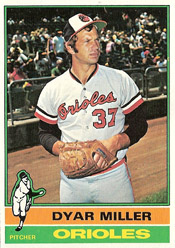
Miller was a Cardinals minor-league coach or instructor for 19 seasons _ from 1985-86 and from 1995-2011.

After all those years of service, he got his first chance to be a Cardinals big-league coach in 2012.

When Derek Lilliquist was promoted from St. Louis bullpen coach to pitching coach Jan. 6, 2012, replacing Dave Duncan, who resigned to tend to his ailing wife, Miller was promoted from Cardinals minor-league pitching coordinator to St. Louis bullpen coach.

“It’s always nice to reward people, but this is not a gift,” farm director John Vuch told Cardinals Magazine. “Dyar has earned the opportunity. We’ve got a lot of people who have been in the organization for a long time, but you don’t put a guy in that role just because he’s been here for a long time. You do it because he’s the best fit and has something to offer.”

Miller’s final years as a professional player were with the Cardinals’ Class AAA Louisville team from 1982-84. Louisville’s manager in 1983 and 1984 was Jim Fregosi, who had managed Miller with the big-league Angels in 1978 and 1979.

After retiring as a player, Miller coached in the Cardinals’ system at Class AA Arkansas (1985) under manager Jim Riggleman and at Louisville (1986) under Fregosi.

“I always liked his mental and physical toughness,” Fregosi told Cardinals Magazine.

In June 1986, Fregosi left Louisville to replace Tony La Russa as manager of the White Sox. In 1987, Fregosi hired Miller as Chicago’s bullpen coach. Miller was bullpen coach for the White Sox again in 1988 and also served most of that season as the interim replacement for ailing pitching coach Don Rowe.

After Fregosi was fired following the 1988 season, Miller coached in the Tigers’ system (1989-90) and the Indians’ system (1991-94) before returning to the Cardinals’ organization as pitching coach at Louisville (1995-96) under manager Joe Pettini.

From 1997-2000, Miller was the Cardinals’ roving minor-league pitching instructor. He was pitching coach for the Cardinals’ Class AAA Memphis club from 2001-2007, then Cardinals minor-league pitching coordinator from 2008-2011.

He spent the 2012 season as bullpen coach of the big-league Cardinals under manager Mike Matheny and then was replaced by Blaise Ilsley.

Miller joined the Astros’ organization as a minor-league coach in 2013.

As a player, Miller persevered to reach the major leagues as much as he did as a coach.

A graduate of Utah State with a bachelor of science degree as a history major, Miller went unchosen in the amateur draft and signed with the Phillies as a catcher in July 1968. After four games and seven at-bats with Class A Huron, managed by Dallas Green, Miller was released by the Phillies.

Undaunted, he transformed himself into a pitcher and was signed by the Orioles in 1969. Miller, a right-hander, spent six seasons in the Orioles’ system, mostly as a starting pitcher.

In 1975, nearing his 29th birthday, Miller went to spring training with the Orioles, figuring it likely was his last chance to make the big-league roster. Rising to the challenge, Miller posted the best ERA among Orioles pitchers in spring exhibition games. So it was crushing when Baltimore manager Earl Weaver informed him he was being sent to Class AAA Rochester to open the 1975 season.

Weaver told Miller the Orioles had tried to trade him to a major-league club rather than return him to the minors, but there weren’t any takers.

“He had earned a chance to pitch in the big leagues, but we couldn’t find anybody who’d give him a shot,” Weaver told The Sporting News.

Angered and hurt, Miller lashed out at Weaver. “I was burning,” he recalled to Cardinals Magazine. Weaver told The Sporting News he understood Miller’s response and didn’t hold it against him.

“It brought tears to my eyes. It really did,” Weaver said. “I felt sorry for the guy. To be honest with you, I didn’t know if he’d ever get another chance to do what he had done.”

Miller reported to Rochester and was converted to a reliever. Relying on a slider he learned while playing winter baseball in Mexico, he excelled in the role, posting a 5-0 record, 2.20 ERA and seven saves in 19 games. In June, he was called up to the Orioles. After taking the loss in his big-league debut against the Athletics (the Orioles’ catcher that night: Dave Duncan) Boxscore, Miller enjoyed a stellar rookie season for Baltimore, compiling a 6-3 record, 2.72 ERA and eight saves.

Miller pitched in the big leagues from 1975-81 for the Orioles, Angels, Blue Jays and Mets, finishing with a 23-17 record, 3.23 ERA and 22 saves in 251 games.
(Updated March 22, 2026)

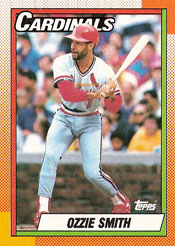
On July 8, 1988, at San Francisco, the Cardinals featured a batting order with six switch-hitters: first baseman Jose Oquendo, second baseman Luis Alicea, shortstop Ozzie Smith, third baseman Terry Pendleton, left fielder Vince Coleman and center fielder Willie McGee. Catcher Tony Pena, right fielder Tom Brunansky and pitcher Joe Magrane batted right-handed.

Stacking the batting order with switch-hitters didn’t work for manager Whitey Herzog that night, though. Giants right-hander Mike LaCoss pitched a four-hitter in San Francisco’s 1-0 victory. Boxscore

For LaCoss, it was his only shutout of the season and the last of his big-league career. Three of the Cardinals’ hits were singles by switch-hitters Alicea, McGee and Oquendo.

LaCoss “was getting his curveball in on the first pitch,” catcher Bob Melvin told the San Francisco Examiner. “When you are able to throw a strike on the first pitch with a breaking ball, that means you’ve got a lot of room to work from there with your other pitches.”

Mixing in fastballs, split-fingered pitches and changeups, LaCoss never topped 92 mph on the radar gun.

“I don’t think he threw a fastball right over the middle of the plate all night,” Melvin told the Peninsula Times Tribune. “He was hitting the corners with it and keeping the breaking ball down.”

With a cold wind blowing through Candlestick Park and a fog rolling in, it was a “perfect LaCoss night,” the Examiner noted.

“Clubs don’t like to come in and play under these conditions,” LaCoss said to the newspaper. “The wind blows in the hitters’ faces and their eyes start to water. If it’s windy and cool, I feel like I have an advantage. When you know what you’re doing and have some luck, you can make the ball move more.”

St. Louis’ switching-hitting infield that night was reminiscent of the 1965 Dodgers, who also started four switch-hitting infielders _ first baseman Wes Parker, second baseman Jim Lefebvre, shortstop Maury Wills and third baseman Jim Gilliam _ in the World Series against the Twins. Boxscore

In 1993, the Mets opened the season with six switch-hitters in their lineup: catcher Todd Hundley, first baseman Eddie Murray, shortstop Tony Fernandez, third baseman Howard Johnson, left fielder Vince Coleman and right fielder Bobby Bonilla. Boxscore


Gil Hodges hit two of the most important home runs of his career against the Cardinals.

Hodges, a first baseman, played 18 seasons in the big leagues with the Dodgers and Mets.

He was one of the greatest right-handed home run sluggers in the National League in the 1950s, and an outstanding defensive first baseman.

Hodges had more career RBI (190) against the Cardinals than he did against any other team. His 57 career home runs against the Cardinals rank only behind the 58 he hit against the Cubs.

In 1962, as a member of the expansion Mets, Hodges hit a pair of historic home runs against St. Louis.

On April 11, 1962, Hodges hit the first regular-season home run in Mets history. The solo shot leading off the fourth inning against Cardinals starter Larry Jackson was Hodges’ 362nd of his career and moved him ahead of Joe DiMaggio for 11th place on big-league baseball’s all-time list. The Cardinals won, 11-4, at St. Louis in the Mets’ first regular-season game. Boxscore

Almost three months later, July 6, 1962, Hodges hit the 370th and last home run of his big-league career. The solo blast off Ray Sadecki with one out in the second moved Hodges into 10th place on big-league baseball’s all-time list, ahead of Ralph Kiner, and solidified Hodges’ hold on the record (since broken) for most National League home runs by a right-handed batter. The Mets, who had lost nine of their previous 11, beat the Cardinals, 10-3, at New York. Boxscore

With the Dodgers, Hodges three times produced five RBI in a game against the Cardinals. The most important of those was the first.

On Sept. 22, 1949, the Cardinals clung to a 1.5-game lead over the second-place Dodgers heading into the finale of a three-game series with Brooklyn at St. Louis. Hodges delivered three singles, a walk and five RBI, carrying the Dodgers to a 19-6 victory and cutting the Cardinals’ lead to a half-game. Boxscore

Hodges had two-run singles off Ted Wilks in the fourth and fifth innings, and drew a bases-loaded walk against Ken Johnson in the sixth.

Brooklyn took over first place on Sept. 29 and went on to win the pennant, finishing a game ahead of the Cardinals, who had 96 wins.

In his book “Stan Musial: The Man’s Own Story,” Musial expressed his admiration for Hodges as a fielder as well as a slugger.

“Gil Hodges was a remarkable first baseman,” Musial said. “If Hodges had been left-handed, he might have been remembered as the most efficient first baseman ever … The quick-handed, good-natured big guy revolutionized bunt defense. Fact is, the Dodgers as a team popularized the pressure-charging defense that makes sacrificing difficult …

“For his blacksmith build, Gil was quick and had lightning-like hands … A gentle big guy who could really hit the long ball.”

(Updated Sept. 25, 2016)

Barry Larkin played shortstop with distinction for the Reds from 1986-2004, but for most of the first half of his career he was overshadowed by the Cardinals’ Ozzie Smith.

In a classy twist, Smith witnessed and cheered Larkin’s greatest individual feat on a baseball field.
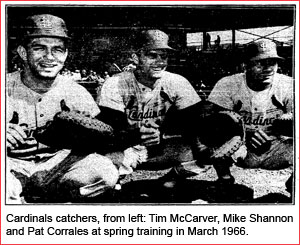
Smith won the Gold Glove Award among National League shortstops in each of Larkin’s first seven seasons in the major leagues, including 1990, when Larkin helped lead Cincinnati to its most recent World Series championship.

Larkin didn’t win the first of his three Gold Glove awards until 1994, the year Smith turned 40. Smith, who won the Gold Glove Award 13 times, was inducted into the National Baseball Hall of Fame in 2002.

In 2012, it was Larkin’s turn.

Larkin, 1995 winner of the NL MVP Award, had 2,340 hits and a .295 career batting average.

Larkin had several memorable performances against the Cardinals, including a pinch-hit grand slam off reliever Steve Kline in St. Louis’ 11-10 victory over the Reds on July 28, 2004, at Cincinnati. Boxscore

Larkin’s greatest moment against the Cardinals occurred in the first game of a Sunday afternoon doubleheader on Sept. 22, 1996, at Cincinnati.

In the fifth inning, with St. Louis ahead 3-1, Larkin launched a home run, his 30th of the season, over the left-field wall against starter Donovan Osborne. With that solo shot, Larkin became the first shortstop in major-league history to achieve 30 homers and 30 stolen bases in a season.

As he rounded first base, Larkin thrust both fists in the air in jubilation. Smith, positioned at shortstop for the Cardinals, hollered his congratulations as Larkin trotted past him.

Asked afterward to assess Larkin’s feat, Smith told the Associated Press, “It gives him his own spot in history. It’s a great accomplishment.”

Larkin became the 17th player in big-league history to achieve 30 homers and 30 steals in a season. Fifteen were outfielders and the other, Howard Johnson of the Mets, was a third baseman.

Larkin finished the 1996 season with 33 homers and 36 steals. He would achieve the steals standard again (with 30 in 1999, his fifth season of 30 or more steals), but he never came close to matching 30 homers.

Previously: Ken Boyer belongs in Hall of Fame

(Updated Aug. 8, 2019)

A short, successful stint as a Cardinals catcher revived the big-league career of Mike Shannon.

Shannon opened the 1965 season as the Cardinals’ right fielder, but went hitless in his first 14 at-bats and had one hit in his first 23 at-bats.

Lunging for pitches out of the strike zone, Shannon was batting .095 on June 1 when manager Red Schoendienst moved him to the bench and tried other players in right.

On Aug. 6, 1965, the Cardinals were playing the Giants at St. Louis when Hal Lanier slid into home plate and spiked the left thumb of Tim McCarver as the Cardinals’ catcher attempted to apply a tag. McCarver was replaced by Bob Uecker, the Cardinals’ only other catcher. Boxscore

Two days later, Aug. 8, 1965, Uecker was struck by a foul tip off the bat of the Giants’ Dick Schofield in the first inning. The ball split Uecker’s right thumb, forcing him to leave the game.

McCarver was unable to play, so Schoendienst brought in Shannon to catch. According to The Sporting News, Shannon hadn’t caught in a game since he was a youth in sandlot baseball.

It didn’t take long before Shannon was tested. The Giants had runners on second and third with one out in the first when Willie McCovey lifted a pop-up in foul territory. Shannon made the catch.

In the fourth, Shannon provided “the defensive thrill of the game,” the St. Louis Post-Dispatch reported. Willie Mays was on first with one out when Jim Ray Hart lined a double to center. Curt Flood retrieved the ball and fired it to shortstop Dick Groat, whose relay throw to Shannon was in time to tag out Mays. Hart broke for third base on the play and Shannon alertly threw to third baseman Ken Boyer, who tagged out Hart.

Shannon fielded flawlessly (no errors, one assist, six putouts) in the game and broke his batting slump, with a double, triple, walk, RBI and run scored. The Giants, who won 6-4, didn’t attempt a steal against Shannon. “They respected Shannon’s arm,” said coach Joe Schultz.

The Cardinals used five pitchers, including knuckleballers Barney Schultz and Bob Purkey and a left-handed sinkerballer, Hal Woodeshick. Boxscore

“I wouldn’t be afraid to go with Shannon after what he showed me handling Barney Schultz’s knuckleball and Hal Woodeshick’s sinker,” Schoendienst said.

Shannon said he was helped by having caught during batting practice that season. “I didn’t go into the job exactly cold,” Shannon said.

Schoendienst noted, “You could see Shannon’s signs from the scoreboard in the first inning, but coach Joe Becker showed Mike how to hide his signs after that.”

The Post-Dispatch reported Shannon “did superbly” and the San Francisco Examiner noted he “played a tremendous game.”

“Shannon showed he could do an excellent job as a catcher and that makes him even more valuable,” Schoendienst said.

After the game, the Cardinals called up Dave Ricketts from the minor leagues to be the everyday catcher while McCarver and Uecker mended.

Starting catcher

On Aug. 12, 1965, at Milwaukee, Ricketts got a day off and Shannon got his first start at catcher. He caught 12 innings, committing no errors and making six putouts, and the Braves attempted no steals against him.

“Shannon did a great job behind the plate,” said Braves manager Bobby Bragan, a former catcher. “I don’t think he boxed more than one ball all day long.”

In the seventh, Shannon hit a solo home run against Wade Blasingame. In the 13th, Shannon’s two-out single off knuckleballer Phil Niekro scored Boyer from second in the Cardinals’ 5-4 victory. Boxscore

“Shannon showed he could hit a knuckleball as well as he could catch one,” the Post-Dispatch reported.

Ricketts came in to catch the bottom half of the 13th; Shannon moved to right.

“Mike Shannon hits better wearing a catcher’s mitt,” the Associated Press reported. “Shannon, who played himself out of a starting job in the outfield because of a .193 batting average before he turned catcher, now has four hits in eight trips to the plate as a receiver.”

Said Shannon: “I’m an outfielder, but if Red Schoendienst wants me to become a catcher, I’ll become a catcher.”

Shannon made one more start at catcher, Aug. 14, at St. Louis in the Reds’ 4-2 victory. Shannon made no errors, had nine putouts and kept the Reds from attempting a steal. Boxscore

When McCarver returned to the lineup, Shannon returned to the outfield, though he appeared in one more 1965 game at catcher, replacing McCarver for the final three innings of the Cardinals’ 19-8 victory at Houston Sept. 30. Boxscore

Versatile player

After the season, Shannon reported to the Florida Instructional League to develop his catching skills. In November, The Sporting News reported, “The talented outfielder, ready to do almost anything to get untracked after his miserable 1965 showing, is concentrating on catching and boning up on the strike zone.”

“Shannon has been working on the fundamentals of catching, especially throwing,” Cardinals general manager Bob Howsam said. “He’s done a great job, too. We’re figuring him as an outfielder yet, but this gives him a chance to do many things.”

The Cardinals opened the 1966 season by shifting Lou Brock from left field to right and starting Alex Johnson in left, with Shannon on the bench. Johnson was hitting .186 on May 17 when he was sent to the minor leagues. Brock was moved back to left field and Shannon took over in right. He played well all season, hitting .288 with 16 home runs.

Shannon made one appearance as a catcher in 1966. On June 5, in the Braves’ 14-4 victory at Atlanta, Shannon replaced McCarver in the eighth and caught a flawless inning. It was his last game as a catcher. Boxscore

Shannon’s career statistics as a catcher: five games, 33.2 innings, 24 putouts, one assist, no errors, no stolen bases against and a 1.000 fielding percentage.

After the 1966 season, the Cardinals acquired Roger Maris from the Yankees to play right field and asked Shannon to learn another position: third base. He became the starting third baseman for the Cardinals’ pennant-winning clubs in 1967 and 1968.

Previously: Cardinals came close to dealing Shannon

(Updated April 26, 2023)

Cardinals catchers sometimes make successful baseball broadcasters.

Tim McCarver was named the 2012 Ford C. Frick Award winner for excellence in broadcasting.

McCarver is one of three former Cardinals players to earn the Frick Award. The others, Joe Garagiola (1991) and Bob Uecker (2003), also were catchers.

_ Garagiola played for the Cardinals from 1946-51 and was a member of their 1946 World Series championship team.

_ Uecker played for the Cardinals as McCarver’s backup from 1964-65 and was a member of their 1964 World Series championship team.

_ McCarver played for the Cardinals from 1959-69 and 1973-74, was a member of their 1964 and 1967 World Series championship teams and was the analyst for Fox during its telecasts of the 2011 World Series that yielded the Cardinals their 11th championship.

In a conference call interview arranged by the Hall of Fame, McCarver said, “There is a natural bridge from being a catcher to talking about the view of the game and the view of the other players. It is translating that for the viewers.”

A 20-member committee consisting of 15 Frick Award winners (including Garagiola and Uecker) and five broadcast historians/columnists (including St. Louis resident Bob Costas) voted for the 2012 Frick Award winner.

McCarver first explored a career in broadcasting in 1975. After he was released by the Red Sox on June 23, McCarver, 33, said he figured his playing career was finished. He went to Philadelphia and auditioned for broadcasting jobs with television stations there. The Phillies surprised him by offering him a playing contract. McCarver signed with them July 1.

In 1977, as the Blue Jays prepared for their inaugural season as an American League expansion franchise in Toronto, they contacted McCarver. Writing about it in October 1979 for The Sporting News, Hal Bodley reported, “The Blue Jays offered McCarver a four-year contract as a member of their radio-TV team. He turned it down. At that time, there was an informal agreement that when he finally decided to retire, he would get some type of a position with the (Philadelphia) club.”

In his Hall of Fame conference call, McCarver confirmed that Phillies executive Bill Giles approached him in 1977 and “told me that when my playing days were over there would be a spot for me in the broadcast booth.”

When McCarver retired as a player after the 1979 season, the Phillies did hire him for their broadcast team, primarily to work with Prism, a fledgling cable television company that did about 30 Phillies games each year.

“I have often said that I was very fortunate to get into the business with the likes of (Phillies broadcasters) Andy Musser, Harry Kalas, Chris Wheeler and, of course, the irrepressible Richie Ashburn,” McCarver said.

By all accounts, McCarver, glib and gabby, was a broadcast natural. Yet, he yearned to become just the 10th player to appear in major-league games stretching over four decades. On Sept, 1, 1980, the Phillies activated him. McCarver had five at-bats in six games. His only hit (a two-run double off Steve Ratzer of the Expos) came at Montreal in his final game, Oct. 5, 1980, 11 days shy of his 39th birthday. Boxscore

After three years as a Phillies broadcaster, McCarver joined the Mets’ broadcast team in 1983 and stayed with them through 1998. He also was a broadcaster for the Yankees, Giants and Cardinals, and with NBC, CBS, The Baseball Network and Fox.

With CBS, he was paired with longtime Cardinals broadcaster Jack Buck, another Frick Award winner (1987).

Later, with Fox, McCarver worked with Jack’s son, Joe Buck. In a 2012 interview with Cardinals Magazine, Joe Buck said of McCarver, “As an analyst, he’s the best at first-guessing, the best at looking ahead as to what could happen. I think he’s the best in the history of the medium. I don’t think anybody is better at looking forward or giving the options than Tim McCarver.”