Feeds:
Posts
Comments

(Updated Aug. 29, 2018)

Jim Kaat earned 283 major-league wins, won 16 Gold Glove awards and pitched for the Cardinals’ 1982 World Series championship team.
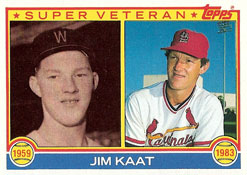
On Dec. 2, 2011, I interviewed Kaat by email. He was gracious with his time and thoughtful with his answers _ a Hall of Fame-quality person in every way.

Because the interview was for this Cardinals history blog, all the questions were about the Cardinals. The interview is presented here, in its entirety:

Q: It’s ironic you and your first Cardinals manager, Ken Boyer, are on the Golden Era ballot together as candidates for election to the National Baseball Hall of Fame. What are your recollections of Ken Boyer?

Jim Kaat: I always respected Kenny. He was a quiet leader as a manager. He was easy to please and easy to play for.

Q: Ted Simmons was the catcher when you joined St. Louis in 1980. You and Simmons have well-earned reputations for being smart and innovative thinkers. How did you get along with Ted Simmons?

Jim Kaat: Teddy and I became close as batterymates. I enjoyed pitching to him and being his friend and teammate.

Q: Your first win for the Cardinals was a 10-inning shutout against the Mets in New York on June 4, 1980. You had been pitching primarily in relief until then that year. What do you recall about pitching such a gem at 41 years old? Boxscore

Jim Kaat: (The manager) kept asking me from the fifth inning on, “Are you ok?” I said I felt fine. I was getting the hitters out, so let me keep going. It was quite a surprise. I hadn’t started much for a couple of years. (Note: Until then, Kaat had made just one start in 1980 and two starts in 1979).

Q: You were the starting pitcher in Whitey Herzog’s first game as Cardinals manager (June 9, 1980, at Atlanta). What do you recall about Herzog’s arrival and what he said to you and the team that day? Boxscore

Jim Kaat: I honestly don’t recall much except it was something like, “We are out of the pennant race but give me everything you’ve got so I can evaluate where you will fit in next year.”

Q: Bob Forsch was a classy Cardinal whose recent passing saddened many. What are your recollections of Bob Forsch?

Jim Kaat: He was a durable pitcher. Quiet, but a tough competitor. He had a wry sense of humor and was fun to be around. A great teammate.

Q: Besides the obvious talents in players such as Bruce Sutter, Ozzie Smith and Keith Hernandez, what were the intangible qualities that made the 1982 Cardinals a World Series championship club?

Jim Kaat: Selfless players. They were all team-first guys. It’s the most close-knit team I ever played on (in 25 big-league seasons). They broke us up too soon.

Q: As someone who is a successful player as well as a successful broadcaster, could you please share your impressions of longtime Cardinals broadcasters Mike Shannon and the late Jack Buck?

Jim Kaat: Both are legendary broadcasters. Jack, on a national scale. Mike is to St. Louis what Scooter (Phil Rizzuto) was to New York and what Richie Ashburn was to Philadelphia. He’s a genuine guy with a big heart.

Q: How does Albert Pujols compare with all of the great players you have seen?

Jim Kaat: He has to be right at the top with all the all-time greats for doing what he has done over a decade.

Q: Lastly, as a former Cardinal and as a baseball fan, what are your observations about the 2011 Cardinals’ historic late-season surge and dramatic post-season run to a World Series title?

Jim Kaat: I’m happy for them. It was not the greatest quality of play by either (World Series) team, but it was very exciting. It’s always good to see the Cardinals fans get rewarded. It’s the best baseball town in America.

Previously: How Jim Kaat revived both his career and the Cardinals

(Updated April 30, 2020)

At 41, Jim Kaat was an unlikely candidate to be a savior for the Cardinals’ pitching staff in 1980.

The Cardinals bought Kaat’s contract from the Yankees on April 30, 1980.
Before the Cardinals called, Kaat looked to be finished as a player. The Yankees were ready to cut him loose after he posted an 0-1 record and 7.20 ERA in four relief stints for them in 1980.

“I was auditioning for a broadcasting job, cutting a demonstration tape,” Kaat told the St. Louis Post-Dispatch.

Fine fit

The Cardinals were willing to take a chance on Kaat because their bullpen was in tatters. In the Cardinals’ first 17 games, their relievers were 0-5 with a 7.46 ERA. Of the Cardinals’ first 10 defeats, four came in their opponents’ last at-bat and six occurred in the seventh inning or later.

“We want somebody who can put the lid on,” Cardinals manager Ken Boyer told the Post-Dispatch. “Kaat has always had good stuff and he’s a great competitor.”

Said Cardinals pitching coach Claude Osteen: “Age doesn’t apply to Kaat. He’s probably as quick around the mound as anybody in baseball. He has the body of a younger man, certainly not someone in his 40s.”

Kaat told the Post-Dispatch, “I stay in shape. I’ve always treated baseball as a year-round job. With all the weight machines and exercise facilities available to them, there is no reason for baseball players to be out of shape.”

Old reliable

Kaat made an immediate impact with the Cardinals, pitching scoreless relief in his first three outings, retiring 14 batters in a row and lifting the club’s confidence.

The left-hander made his Cardinals debut on the day he was acquired. Relieving starter Pete Vuckovich with one out in the eighth on April 30, 1980, against the Cubs at St. Louis, Kaat retired five Cubs on eight pitches. Using a slider and curve, he struck out Larry Biittner and got the other four on groundouts. Boxscore

“Kaat comes in and gets five outs in his first game,” Cardinals catcher Ted Simmons said to The Sporting News. “That is reassuring and that can carry over.”

It was Kaat’s first appearance since allowing three runs in one inning to the White Sox two weeks earlier with the Yankees.

“When I keep the ball low and have it sink, when batters are hitting the ball on the ground, I know I’m pitching my way,” Kaat told the Post-Dispatch.

Getting it done

With his starting rotation in disarray because of injuries to Bob Forsch, John Fulgham and Silvio Martinez, Boyer turned to Kaat to help fill the void.

“I still think I’m best as a starter,” Kaat said to the Post-Dispatch.

On June 4, 1980, at New York, Kaat pitched a 10-inning shutout, limiting the Mets to seven singles, in the Cardinals’ 1-0 victory. Ken Reitz hit a home run off Neil Allen in the 10th, giving Kaat his first win as a Cardinal. Boxscore

Under the headline “Stubborn Dutchman Jim Kaat Is Up There With Immortals,” columnist Furman Bisher wrote in The Sporting News, “On the day he was 41 years, six months and 27 days old, Kaat pitched 10 shutout innings and beat the Mets, and he still looked at the end as if he could have pitched until dawn.”

The shutout was the 31st and last of Kaat’s big-league career, but it wasn’t his last impressive performance for the Cardinals.

Four days after Kaat’s shutout, the Cardinals fired Boyer and replaced him with Whitey Herzog. In Herzog’s first game, Kaat started, gave up two earned runs in 6.2 innings against the Braves and St. Louis won, 8-5, in 10 innings. Boxscore

On June 23, 1980, Kaat pitched a seven-hitter in the Cardinals’ 6-1 victory against the Pirates. It was Kaat’s 266th career win, tying him with Bob Feller. Kaat also had a stolen base. Boxscore

As columnist Bill Conlin observed, “Jim Kaat is doing everything but stitching up the baseballs.”

Kaat pitched in 49 games, including 14 starts, for the 1980 Cardinals and had an 8-7 record and 3.82 ERA.

He became a key setup reliever for closer Bruce Sutter in the Cardinals’ 1982 World Series championship season. In four seasons with the Cardinals, Kaat was 19-16 with 10 saves and a 3.82 ERA.

(Updated Nov. 17, 2023)

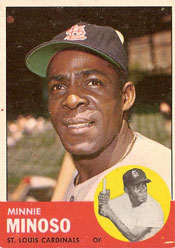
Outfielder Minnie Minoso spent most of his 17-year big-league career with the White Sox and Indians. When Minoso was acquired by the Cardinals after the 1961 season, it was believed he could be the key component in making St. Louis a pennant contender in 1962. Instead, Minoso, injury plagued, was a flop.

The Cardinals traded Joe Cunningham, a first baseman and outfielder, to the White Sox for Minoso on Nov. 27, 1961 _ two days before Minoso’s birthday. Reports varied regarding Minoso’s age. The Associated Press reported Minoso would turn 39 on Nov. 29, 1961, but added “some insist he is at least 42.”

St. Louis had finished 80-74 in 1961, 13 games behind the National League champion Reds. Minoso hit .280 with 28 doubles, 14 home runs and 82 RBI for the 1961 White Sox. The Cardinals saw him as their left fielder, joining an outfield of Curt Flood in center and Stan Musial in right.

Joe Reichler, reporting the trade for the Associated Press, wrote, “Johnny Keane, manager of the Cardinals, was almost as pleased by the acquisition of Minoso as he was when his daughter presented him with his second grandchild last week … Minoso, despite his age, is still one of the fastest men in baseball and swings one of the biggest bats.”

In The Sporting News, Oscar Kahan wrote, “The Cuban Comet, aged as he may be, supplies so many plus factors to the picture that the Redbirds’ outlook has brightened considerably.”

Minoso was a “little bit shocked” by the trade, according to United Press International. The wire service reported Minoso had purchased a $40,000 house in Chicago in 1961 and moved his family there from Cuba. He had been working as a goodwill ambassador for the White Sox during the off-season, selling tickets and promoting the club.

“I don’t know whether I’ll go to the Cardinals,” Minoso said. “I consider myself a free agent. I have a few jobs in mind. I have a lot of friends in Chicago and there are other things I can do in Chicago.”

Minoso eventually relented and opened the 1962 season as the Cardinals’ left fielder. He started two games before pulling a rib muscle in batting practice. It was nearly two weeks before he recovered.

Batting primarily sixth in the order, Minoso struggled, but Keane stuck with him. On May 11, a Friday night in St. Louis, Minoso was in left field when the Cardinals faced the Dodgers. In the sixth inning, with the score 2-2 and the bases loaded, Duke Snider launched a line drive to deep left-center. Minoso chased after it, skidded on the warning track and crashed headfirst into the concrete wall. The ball bounced away for a three-run triple. Boxscore

The collision with the wall left Minoso unconscious. His right eye was completely closed and his head and face were swollen and bleeding, the Associated Press reported. Minoso was carried off on a stretcher and rushed to a hospital. Doctors determined Minoso had a fractured skull and a fractured right wrist. The skull fracture, according to the Associated Press, was three to four inches long above the right ear.

Cardinals center fielder Curt Flood told the Los Angeles Times, “By the time I got to him his right eye already was closing and he was bleeding. He was out cold and didn’t move a muscle. His breathing was labored and I was afraid he’d swallowed his tongue.”

According to The Sporting News, Minoso knew he was quite close to the wall, “but I don’t remember after that.”

Minoso was sidelined for two months before he returned on July 20 and struck out while batting for pitcher Bob Duliba. Boxscore

On Aug. 18, in the second game of a doubleheader against the Mets in New York, Minoso hit his only Cardinals home run, a solo shot off Ray Daviault in a 10-0 St. Louis victory. Boxscore

The next day, batting in the sixth inning, Minoso was hit on the left arm by a pitch from the Mets’ Craig Anderson and was lifted for a runner. Boxscore

Two days later, Aug. 21 at Milwaukee, Minoso appeared as a defensive replacement in left field in the eighth inning against the Braves, but his left arm became swollen. Doctors discovered Minoso had suffered a broken forearm when hit by the Anderson pitch. His season was finished.

In 39 games for St. Louis, Minoso hit .196 with one home run and 10 RBI.

In the book “We Played, the Game,” Cardinals catcher Tim McCarver recalled that Minoso “got so furious at himself after going 0-for-4 that he walked under a cold shower with all his clothes on, including his bat and his spikes. That was a sight.”

Minoso went to spring training with the Cardinals in 1963, hoping to earn a spot as a reserve, but on April 2, a week before the season opener, his contract was sold to the Senators for what The Sporting News reported as “in excess of the $20,000 waiver price.”

From 1974 through 1980, the Cardinals’ Bob Forsch made 17 starts against Houston and the Astros’ Ken Forsch made eight starts against St. Louis, but the brothers never started in the same game against one another.

Bob Forsch and Ken Forsch did pitch in the same game four times _ in each, Bob was a starter and Ken was a reliever _ and it was Bob who usually got the upper hand.

Ken Forsch entered the majors with Houston in 1970. Bob Forsch, four years younger than Ken, made his big-league debut with the Cardinals on July 7, 1974. Two weeks later, Bob faced Ken in a major-league game for the first time.

In his book “Tales From The Cardinals Dugout,” Bob Forsch wrote he and his brother almost faced one another as starting pitchers in Game 1 of the 1982 World Series. Ken Forsch then was with the Angels, who played the Brewers in the best-of-five American League Championship Series. The Brewers won Game 5, earning the AL pennant, but if the Angels had won, “Kenny … was scheduled to pitch the opener in the World Series,” Bob Forsch wrote. “I was scheduled to start Game 1 for the Cardinals.”

Here are the four games in which Bob Forsch and Ken Forsch pitched:

Cardinals 9, Astros 1, July 21, 1974, at St. Louis

In his fourth big-league appearance, Bob Forsch earned his second win and pitched his second complete game.

Ken Forsch pitched the seventh and eighth innings and gave up three runs.

In the eighth, Bob Forsch batted against his brother for the first time in the big leagues. With Mike Tyson on third and one out, Bob Forsch hit a grounder to shortstop Roger Metzger, who threw to the plate to retire Tyson. The next batter, Jose Cruz, hit an inside-the-park home run off the center-field wall, scoring Bob Forsch from first. Boxscore

Describing his at-bat, Bob Forsch wrote, “I hit what I thought was a sizzling ground ball to the shortstop … I didn’t want to strike out. I was just so glad I hit the ball … and that my brother didn’t hit me first.”

The game was the finale of a four-game series. Before the first game, Bob Forsch was shagging balls in the outfield during batting practice when Ken Forsch walked onto the field, greeted his brother, congratulated him on reaching the major leagues and shook hands with him. Wrote Bob Forsch:

When batting practice was over, we left the field. Bob Gibson came over and told me, “That’ll cost you $25 (for fraternizing with an opponent). Don’t talk to anyone on the other team.”

This was my own flesh and blood. And Gibby obviously knew it. I mean, Kenny had his uniform on with “FORSCH” on the back. Nobody spoke up and defended me. Hey, I was a rookie. And who’s going to go against Bob Gibson?

Astros 8, Cardinals 7, June 15, 1975, at St. Louis

Bob Forsch was lifted for pinch-hitter Ron Fairly in the eighth inning, with the Cardinals ahead, 7-4. But the Astros loaded the bases against Al Hrabosky in the ninth. After Mike Garman relieved Hrabosky, Cliff Johnson greeted Garman with a grand slam, depriving Forsch and St. Louis of a win.

Ken Forsch relieved Astros starter Doug Konieczny in the fifth and pitched three scoreless innings.

In the top of the sixth, Ken Forsch batted against his brother for the only time in their big-league careers. He struck out, ending the inning. In the bottom half, Bob Forsch faced his brother and grounded into an inning-ending forceout. Boxscore

Cardinals 8, Astros 4, May 18, 1977, at Houston

Bob Forsch started and was lifted for pinch-hitter Don Kessinger after five innings, with the score 3-3. Ken Forsch relieved in the eighth, entering with St. Louis ahead, 5-4, and gave up three unearned runs on five hits in his one inning of work. He did strike out the side, including Lou Brock and Ted Simmons. Boxscore

Cardinals 3, Astros 1, Aug. 6, 1977, at Houston

In the first game of a Saturday night doubleheader, Bob Forsch pitched eight innings and got his 14th win of the season. Butch Metzger earned the save with a perfect ninth.

Ken Forsch entered in the ninth for Astros starter Mark Lemongello and retired the Cardinals in order. Boxscore

On April 1, 1981, Ken Forsch was traded by the Astros to the Angels for infielder Dickie Thon. Ken Forsch finished his big-league playing career with the Angels in 1986.

In a fitting twist, the only big-league team Bob Forsch played for besides the Cardinals was the Astros. On Aug. 31, 1988, Bob Forsch was dealt to Houston for utilityman Denny Walling. Bob Forsch closed out his big-league career with Houston in 1989. His overall record with the Astros was 5-9 with a 5.56 ERA.


The Astrodome opened in Houston in 1965 and was billed “the eighth wonder of the world.” To the Cardinals, there was nothing wonderful about it.

The Cardinals lost the first five games they played at the Astrodome, scoring a total of eight runs. They were swept by the Astros in a three-game series in May, losing by scores of 6-1, 3-2 and 4-3, and were swept again, in a two-game series, in July, losing by scores of 2-0 and 3-2.

When the Cardinals returned to Houston Sept. 30 to close the 1965 regular season with a four-game series against the Astros, they were in seventh place in the National League at 77-80 and the Astros were ninth at 64-94.

Based on how the Cardinals produced in their first two trips to the Astrodome _ and with regulars such as third baseman Ken Boyer, first baseman Bill White and shortstop Dick Groat out of the lineup as manager Red Schoendienst took a look at younger players _ there was no way to anticipate the breakout performance St. Louis was about to unleash.

The Cardinals produced 19 RBI in defeating Houston, 19-8, before a Sept. 30 Thursday night gathering of 7,494.

The 19 RBI are the third-highest total in Cardinals history. Others that surpassed or matched it:

_ 25 RBI for St. Louis in the Cardinals’ 28-6 victory over the Phillies on July 6, 1929. Boxscore

_ 20 RBI for St. Louis in the Cardinals’ 21-5 victory over the Giants on Aug. 2, 1948. Boxscore

_ 19 RBI for St. Louis in the Cardinals’ 20-2 victory over the Dodgers on July 24, 1937. Boxscore

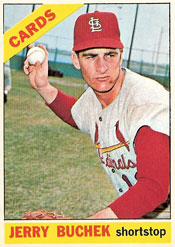
Against Houston, the Cardinals started a lineup that included right fielder Mike Shannon batting cleanup, rookie George Kernek (.143 batting average) playing first base, and Jerry Buchek (.227) at shortstop, Phil Gagliano (.241) at third base and Dal Maxvill (.135) at second base.

All nine Cardinals starters produced at least one RBI in the game. Starting pitcher Nelson Briles had two. His two-run single highlighted a six-run first that chased Astros starter Jim Ray.

The Cardinals scored in every inning except the second and the third. Buchek, batting seventh, had a game-high five RBI. He had a two-run home run against Dave Giusti in the fifth, a RBI-groundout in the seventh and a two-run double in the ninth.

Gagliano and Maxvill each had three RBI. Left fielder Lou Brock and center fielder Curt Flood had four hits apiece. Brock singled twice in the first.

The Cardinals led 16-2 in the seventh. When the game finished in a relatively snappy 2:49, the Cardinals had 19 runs on 19 hits and seven walks. Boxscore

Part Three: Forsch vs. Forsch: Bob had edge in brotherly matchup

Part One: Cardinals first visit to Houston

When the Houston Colt .45s began play in the National League in 1962, one of the most anticipated homestands was the one with the Cardinals.

Houston had been a Cardinals minor-league affiliate from 1921-35 and from 1946-58. Many in the region were Cardinals fans.

The 1962 Cardinals had several close connections to Houston. Cardinals manager Johnny Keane and pitching coach Howie Pollet were Houston residents. Keane had played for Houston (1934-37) and also had managed the club (1946-48). Pollet had pitched for Houston (1939-41).

Also, Cardinals coach Harry Walker had been the last Houston manager (1956-58) while it was a Cardinals affiliate. Top 1962 Cardinals players, such as third baseman Ken Boyer and pitcher Larry Jackson, had played for the Houston farm club.

St. Louis made its first visit to Houston for the second homestand in Colt .45s history (the franchise changed its name to Astros in 1965). The Cardinals and Colt .45s were scheduled for three midweek night games April 24-26.

The Cardinals won one, lost one and tied another. Two games each were decided by a run and the other ended in a tie after 17 innings.

According to Clark Nealon of the Houston Post in a story for The Sporting News, Houston “waited years for the first National League series with the St. Louis Cardinals and when it came it was tremendous.”

Houston 4, Cardinals 3, April 24, 1962

In pre-game ceremonies, The Sporting News reported, each member of the Cardinals was “introduced individually to ringing applause.”

At the end, the cheers were for Houston starter Hal Woodeshick, who pitched a six-hitter.

Houston left fielder Don Taussig, who had played for the Cardinals in 1961, hit a solo home run off Jackson in the sixth.

With one on and two outs in the ninth, Bill White ripped a sinking liner that Houston right fielder Johnny Weekly snared at his shoetops.

Attendance was 19,335 _ impressive for a weeknight at a ballpark that seated about 25,000. Boxscore

Cardinals 5, Houston 5, 17 innings, April 25, 1962

In the afternoon, Keane was honored at a Chamber of Commerce luncheon and presented with a replica of a Colt .45 gun. He told the audience, “We’re a lot better club than we showed you on April 24.”

The Cardinals’ manager again was honored in ceremonies before the game. Among his gifts was a king-sized pass to “the first World Series game in Houston.” (It would be 2005 before Houston made its first World Series appearance.)

The game began at 8:02 p.m. It was halted at 1:15 a.m. because of a local curfew in Houston that forbid starting an inning after 12:50 a.m. The game was replayed on another date but all the statistics counted.

Boyer’s RBI-single to left in the ninth off Turk Farrell scored Julian Javier from second, tying the score 5-5.

Ed Bauta pitched eight scoreless innings for the Cardinals after entering in the 10th.

The Cardinals had runners on first and second with no outs in the top of the 17th, but Doug Clemens struck out and Red Schoendienst hit into a double play.

Six Houston pitchers struck out 18 Cardinals, including Boyer three times. Houston left 16 runners on base and the Cardinals stranded 15. Boxscore

Cardinals 3, Houston 2, April 26, 1962

The Cardinals were spared embarrassment by salvaging a victory in the series. Bob Gibson pitched a two-hitter for his first win of the season and Stan Musial drove in the deciding run with a two-out single in the eighth, scoring Curt Flood from third base. Boxscore

Part Two: Cardinals broke Astrodome hex with 19 RBI in one game

Part Three: Forsch vs. Forsch: Bob had edge in brotherly matchup