Feeds:
Posts
Comments

(Updated Aug. 8, 2019)

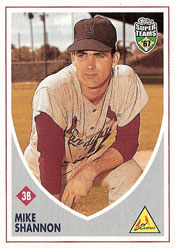
A short, successful stint as a Cardinals catcher revived the big-league career of Mike Shannon.

Shannon opened the 1965 season as the Cardinals’ right fielder, but went hitless in his first 14 at-bats and had one hit in his first 23 at-bats.

Lunging for pitches out of the strike zone, Shannon was batting .095 on June 1 when manager Red Schoendienst moved him to the bench and tried other players in right.

On Aug. 6, 1965, the Cardinals were playing the Giants at St. Louis when Hal Lanier slid into home plate and spiked the left thumb of Tim McCarver as the Cardinals’ catcher attempted to apply a tag. McCarver was replaced by Bob Uecker, the Cardinals’ only other catcher. Boxscore

Two days later, Aug. 8, 1965, Uecker was struck by a foul tip off the bat of the Giants’ Dick Schofield in the first inning. The ball split Uecker’s right thumb, forcing him to leave the game.

McCarver was unable to play, so Schoendienst brought in Shannon to catch. According to The Sporting News, Shannon hadn’t caught in a game since he was a youth in sandlot baseball.

It didn’t take long before Shannon was tested. The Giants had runners on second and third with one out in the first when Willie McCovey lifted a pop-up in foul territory. Shannon made the catch.

In the fourth, Shannon provided “the defensive thrill of the game,” the St. Louis Post-Dispatch reported. Willie Mays was on first with one out when Jim Ray Hart lined a double to center. Curt Flood retrieved the ball and fired it to shortstop Dick Groat, whose relay throw to Shannon was in time to tag out Mays. Hart broke for third base on the play and Shannon alertly threw to third baseman Ken Boyer, who tagged out Hart.

Shannon fielded flawlessly (no errors, one assist, six putouts) in the game and broke his batting slump, with a double, triple, walk, RBI and run scored. The Giants, who won 6-4, didn’t attempt a steal against Shannon. “They respected Shannon’s arm,” said coach Joe Schultz.

The Cardinals used five pitchers, including knuckleballers Barney Schultz and Bob Purkey and a left-handed sinkerballer, Hal Woodeshick. Boxscore

“I wouldn’t be afraid to go with Shannon after what he showed me handling Barney Schultz’s knuckleball and Hal Woodeshick’s sinker,” Schoendienst said.

Shannon said he was helped by having caught during batting practice that season. “I didn’t go into the job exactly cold,” Shannon said.

Schoendienst noted, “You could see Shannon’s signs from the scoreboard in the first inning, but coach Joe Becker showed Mike how to hide his signs after that.”

The Post-Dispatch reported Shannon “did superbly” and the San Francisco Examiner noted he “played a tremendous game.”

“Shannon showed he could do an excellent job as a catcher and that makes him even more valuable,” Schoendienst said.

After the game, the Cardinals called up Dave Ricketts from the minor leagues to be the everyday catcher while McCarver and Uecker mended.

Starting catcher

On Aug. 12, 1965, at Milwaukee, Ricketts got a day off and Shannon got his first start at catcher. He caught 12 innings, committing no errors and making six putouts, and the Braves attempted no steals against him.

“Shannon did a great job behind the plate,” said Braves manager Bobby Bragan, a former catcher. “I don’t think he boxed more than one ball all day long.”

In the seventh, Shannon hit a solo home run against Wade Blasingame. In the 13th, Shannon’s two-out single off knuckleballer Phil Niekro scored Boyer from second in the Cardinals’ 5-4 victory. Boxscore

“Shannon showed he could hit a knuckleball as well as he could catch one,” the Post-Dispatch reported.

Ricketts came in to catch the bottom half of the 13th; Shannon moved to right.

“Mike Shannon hits better wearing a catcher’s mitt,” the Associated Press reported. “Shannon, who played himself out of a starting job in the outfield because of a .193 batting average before he turned catcher, now has four hits in eight trips to the plate as a receiver.”

Said Shannon: “I’m an outfielder, but if Red Schoendienst wants me to become a catcher, I’ll become a catcher.”

Shannon made one more start at catcher, Aug. 14, at St. Louis in the Reds’ 4-2 victory. Shannon made no errors, had nine putouts and kept the Reds from attempting a steal. Boxscore

When McCarver returned to the lineup, Shannon returned to the outfield, though he appeared in one more 1965 game at catcher, replacing McCarver for the final three innings of the Cardinals’ 19-8 victory at Houston Sept. 30. Boxscore

Versatile player

After the season, Shannon reported to the Florida Instructional League to develop his catching skills. In November, The Sporting News reported, “The talented outfielder, ready to do almost anything to get untracked after his miserable 1965 showing, is concentrating on catching and boning up on the strike zone.”

“Shannon has been working on the fundamentals of catching, especially throwing,” Cardinals general manager Bob Howsam said. “He’s done a great job, too. We’re figuring him as an outfielder yet, but this gives him a chance to do many things.”

The Cardinals opened the 1966 season by shifting Lou Brock from left field to right and starting Alex Johnson in left, with Shannon on the bench. Johnson was hitting .186 on May 17 when he was sent to the minor leagues. Brock was moved back to left field and Shannon took over in right. He played well all season, hitting .288 with 16 home runs.

Shannon made one appearance as a catcher in 1966. On June 5, in the Braves’ 14-4 victory at Atlanta, Shannon replaced McCarver in the eighth and caught a flawless inning. It was his last game as a catcher. Boxscore

Shannon’s career statistics as a catcher: five games, 33.2 innings, 24 putouts, one assist, no errors, no stolen bases against and a 1.000 fielding percentage.

After the 1966 season, the Cardinals acquired Roger Maris from the Yankees to play right field and asked Shannon to learn another position: third base. He became the starting third baseman for the Cardinals’ pennant-winning clubs in 1967 and 1968.

Previously: Cardinals came close to dealing Shannon

(Updated April 26, 2023)

Cardinals catchers sometimes make successful baseball broadcasters.

Tim McCarver was named the 2012 Ford C. Frick Award winner for excellence in broadcasting.

McCarver is one of three former Cardinals players to earn the Frick Award. The others, Joe Garagiola (1991) and Bob Uecker (2003), also were catchers.

_ Garagiola played for the Cardinals from 1946-51 and was a member of their 1946 World Series championship team.

_ Uecker played for the Cardinals as McCarver’s backup from 1964-65 and was a member of their 1964 World Series championship team.

_ McCarver played for the Cardinals from 1959-69 and 1973-74, was a member of their 1964 and 1967 World Series championship teams and was the analyst for Fox during its telecasts of the 2011 World Series that yielded the Cardinals their 11th championship.

In a conference call interview arranged by the Hall of Fame, McCarver said, “There is a natural bridge from being a catcher to talking about the view of the game and the view of the other players. It is translating that for the viewers.”

A 20-member committee consisting of 15 Frick Award winners (including Garagiola and Uecker) and five broadcast historians/columnists (including St. Louis resident Bob Costas) voted for the 2012 Frick Award winner.

McCarver first explored a career in broadcasting in 1975. After he was released by the Red Sox on June 23, McCarver, 33, said he figured his playing career was finished. He went to Philadelphia and auditioned for broadcasting jobs with television stations there. The Phillies surprised him by offering him a playing contract. McCarver signed with them July 1.

In 1977, as the Blue Jays prepared for their inaugural season as an American League expansion franchise in Toronto, they contacted McCarver. Writing about it in October 1979 for The Sporting News, Hal Bodley reported, “The Blue Jays offered McCarver a four-year contract as a member of their radio-TV team. He turned it down. At that time, there was an informal agreement that when he finally decided to retire, he would get some type of a position with the (Philadelphia) club.”

In his Hall of Fame conference call, McCarver confirmed that Phillies executive Bill Giles approached him in 1977 and “told me that when my playing days were over there would be a spot for me in the broadcast booth.”

When McCarver retired as a player after the 1979 season, the Phillies did hire him for their broadcast team, primarily to work with Prism, a fledgling cable television company that did about 30 Phillies games each year.

“I have often said that I was very fortunate to get into the business with the likes of (Phillies broadcasters) Andy Musser, Harry Kalas, Chris Wheeler and, of course, the irrepressible Richie Ashburn,” McCarver said.

By all accounts, McCarver, glib and gabby, was a broadcast natural. Yet, he yearned to become just the 10th player to appear in major-league games stretching over four decades. On Sept, 1, 1980, the Phillies activated him. McCarver had five at-bats in six games. His only hit (a two-run double off Steve Ratzer of the Expos) came at Montreal in his final game, Oct. 5, 1980, 11 days shy of his 39th birthday. Boxscore

After three years as a Phillies broadcaster, McCarver joined the Mets’ broadcast team in 1983 and stayed with them through 1998. He also was a broadcaster for the Yankees, Giants and Cardinals, and with NBC, CBS, The Baseball Network and Fox.

With CBS, he was paired with longtime Cardinals broadcaster Jack Buck, another Frick Award winner (1987).

Later, with Fox, McCarver worked with Jack’s son, Joe Buck. In a 2012 interview with Cardinals Magazine, Joe Buck said of McCarver, “As an analyst, he’s the best at first-guessing, the best at looking ahead as to what could happen. I think he’s the best in the history of the medium. I don’t think anybody is better at looking forward or giving the options than Tim McCarver.”

Ron Santo _ deserving of election to the National Baseball Hall of Fame but no more so than his Cardinals peer, Ken Boyer _ usually was on the short end of matchups with Bob Gibson, but he did hit three home runs against him.

Santo, elected to the Hall of Fame Dec. 5, 2011, by the 16-member Golden Era committee, played 15 years in the major leagues as a third baseman for the Cubs and White Sox.

Like the Cardinals’ Ken Boyer, Santo won the Gold Glove Award five times. Boyer (.287) had a higher career batting average than Santo (.277). Santo had more home runs (342) than Boyer (282) and more RBI (1,331) than Boyer (1,141) but also had 688 more at-bats than Boyer. (Boyer received fewer than three votes from the 16 members of the Golden Era committee; Santo received 15).

Santo struck out more times against the Cardinals (156) than he did against any other team. Overall against the Cardinals, Santo batted .269 with 33 home runs and 137 RBI.

Against Gibson, Santo hit .243 (37-for-152) with 35 strikeouts. Of his 37 hits against the Cardinals’ ace, 31 were singles, three were doubles and three were home runs. Santo’s first homer off Gibson was the most significant.

On June 4, 1964, the Cardinals were in third place, 3.5 games behind the National League-leading Phillies, when they faced the Cubs at Chicago. With St. Louis ahead 1-0, the Cubs had Billy Williams on second base with one out in the fourth when Santo came up against Gibson. Santo responded with a two-run home run and that was the difference in Chicago’s 2-1 victory. Boxscore

The setback launched the Cardinals into a four-game losing streak that dropped them into fifth place, a game ahead of the seventh-place Cubs. A week later, still scuffling and having fallen three games below .500, the Cardinals, seeking a spark, traded for Cubs outfielder Lou Brock. The deal was the catalyst in igniting St. Louis’ run to the World Series title that year.

Santo’s other two homers against Gibson came on Sept. 16, 1970 (a fifth-inning solo shot in a game the Cardinals won 8-1 at Chicago Boxscore), and June 26, 1971 (a two-out, three-run blast in the Cubs’ 5-1 victory at St. Louis Boxscore).


(Updated Aug. 29, 2018)

Jim Kaat earned 283 major-league wins, won 16 Gold Glove awards and pitched for the Cardinals’ 1982 World Series championship team.

On Dec. 2, 2011, I interviewed Kaat by email. He was gracious with his time and thoughtful with his answers _ a Hall of Fame-quality person in every way.

Because the interview was for this Cardinals history blog, all the questions were about the Cardinals. The interview is presented here, in its entirety:

Q: It’s ironic you and your first Cardinals manager, Ken Boyer, are on the Golden Era ballot together as candidates for election to the National Baseball Hall of Fame. What are your recollections of Ken Boyer?

Jim Kaat: I always respected Kenny. He was a quiet leader as a manager. He was easy to please and easy to play for.

Q: Ted Simmons was the catcher when you joined St. Louis in 1980. You and Simmons have well-earned reputations for being smart and innovative thinkers. How did you get along with Ted Simmons?

Jim Kaat: Teddy and I became close as batterymates. I enjoyed pitching to him and being his friend and teammate.

Q: Your first win for the Cardinals was a 10-inning shutout against the Mets in New York on June 4, 1980. You had been pitching primarily in relief until then that year. What do you recall about pitching such a gem at 41 years old? Boxscore

Jim Kaat: (The manager) kept asking me from the fifth inning on, “Are you ok?” I said I felt fine. I was getting the hitters out, so let me keep going. It was quite a surprise. I hadn’t started much for a couple of years. (Note: Until then, Kaat had made just one start in 1980 and two starts in 1979).

Q: You were the starting pitcher in Whitey Herzog’s first game as Cardinals manager (June 9, 1980, at Atlanta). What do you recall about Herzog’s arrival and what he said to you and the team that day? Boxscore

Jim Kaat: I honestly don’t recall much except it was something like, “We are out of the pennant race but give me everything you’ve got so I can evaluate where you will fit in next year.”

Q: Bob Forsch was a classy Cardinal whose recent passing saddened many. What are your recollections of Bob Forsch?

Jim Kaat: He was a durable pitcher. Quiet, but a tough competitor. He had a wry sense of humor and was fun to be around. A great teammate.

Q: Besides the obvious talents in players such as Bruce Sutter, Ozzie Smith and Keith Hernandez, what were the intangible qualities that made the 1982 Cardinals a World Series championship club?

Jim Kaat: Selfless players. They were all team-first guys. It’s the most close-knit team I ever played on (in 25 big-league seasons). They broke us up too soon.

Q: As someone who is a successful player as well as a successful broadcaster, could you please share your impressions of longtime Cardinals broadcasters Mike Shannon and the late Jack Buck?

Jim Kaat: Both are legendary broadcasters. Jack, on a national scale. Mike is to St. Louis what Scooter (Phil Rizzuto) was to New York and what Richie Ashburn was to Philadelphia. He’s a genuine guy with a big heart.

Q: How does Albert Pujols compare with all of the great players you have seen?

Jim Kaat: He has to be right at the top with all the all-time greats for doing what he has done over a decade.

Q: Lastly, as a former Cardinal and as a baseball fan, what are your observations about the 2011 Cardinals’ historic late-season surge and dramatic post-season run to a World Series title?

Jim Kaat: I’m happy for them. It was not the greatest quality of play by either (World Series) team, but it was very exciting. It’s always good to see the Cardinals fans get rewarded. It’s the best baseball town in America.

Previously: How Jim Kaat revived both his career and the Cardinals

(Updated April 30, 2020)

At 41, Jim Kaat was an unlikely candidate to be a savior for the Cardinals’ pitching staff in 1980.

The Cardinals bought Kaat’s contract from the Yankees on April 30, 1980.

Before the Cardinals called, Kaat looked to be finished as a player. The Yankees were ready to cut him loose after he posted an 0-1 record and 7.20 ERA in four relief stints for them in 1980.

“I was auditioning for a broadcasting job, cutting a demonstration tape,” Kaat told the St. Louis Post-Dispatch.

Fine fit

The Cardinals were willing to take a chance on Kaat because their bullpen was in tatters. In the Cardinals’ first 17 games, their relievers were 0-5 with a 7.46 ERA. Of the Cardinals’ first 10 defeats, four came in their opponents’ last at-bat and six occurred in the seventh inning or later.

“We want somebody who can put the lid on,” Cardinals manager Ken Boyer told the Post-Dispatch. “Kaat has always had good stuff and he’s a great competitor.”

Said Cardinals pitching coach Claude Osteen: “Age doesn’t apply to Kaat. He’s probably as quick around the mound as anybody in baseball. He has the body of a younger man, certainly not someone in his 40s.”

Kaat told the Post-Dispatch, “I stay in shape. I’ve always treated baseball as a year-round job. With all the weight machines and exercise facilities available to them, there is no reason for baseball players to be out of shape.”

Old reliable

Kaat made an immediate impact with the Cardinals, pitching scoreless relief in his first three outings, retiring 14 batters in a row and lifting the club’s confidence.

The left-hander made his Cardinals debut on the day he was acquired. Relieving starter Pete Vuckovich with one out in the eighth on April 30, 1980, against the Cubs at St. Louis, Kaat retired five Cubs on eight pitches. Using a slider and curve, he struck out Larry Biittner and got the other four on groundouts. Boxscore

“Kaat comes in and gets five outs in his first game,” Cardinals catcher Ted Simmons said to The Sporting News. “That is reassuring and that can carry over.”

It was Kaat’s first appearance since allowing three runs in one inning to the White Sox two weeks earlier with the Yankees.

“When I keep the ball low and have it sink, when batters are hitting the ball on the ground, I know I’m pitching my way,” Kaat told the Post-Dispatch.

Getting it done

With his starting rotation in disarray because of injuries to Bob Forsch, John Fulgham and Silvio Martinez, Boyer turned to Kaat to help fill the void.

“I still think I’m best as a starter,” Kaat said to the Post-Dispatch.

On June 4, 1980, at New York, Kaat pitched a 10-inning shutout, limiting the Mets to seven singles, in the Cardinals’ 1-0 victory. Ken Reitz hit a home run off Neil Allen in the 10th, giving Kaat his first win as a Cardinal. Boxscore

Under the headline “Stubborn Dutchman Jim Kaat Is Up There With Immortals,” columnist Furman Bisher wrote in The Sporting News, “On the day he was 41 years, six months and 27 days old, Kaat pitched 10 shutout innings and beat the Mets, and he still looked at the end as if he could have pitched until dawn.”

The shutout was the 31st and last of Kaat’s big-league career, but it wasn’t his last impressive performance for the Cardinals.

Four days after Kaat’s shutout, the Cardinals fired Boyer and replaced him with Whitey Herzog. In Herzog’s first game, Kaat started, gave up two earned runs in 6.2 innings against the Braves and St. Louis won, 8-5, in 10 innings. Boxscore

On June 23, 1980, Kaat pitched a seven-hitter in the Cardinals’ 6-1 victory against the Pirates. It was Kaat’s 266th career win, tying him with Bob Feller. Kaat also had a stolen base. Boxscore

As columnist Bill Conlin observed, “Jim Kaat is doing everything but stitching up the baseballs.”

Kaat pitched in 49 games, including 14 starts, for the 1980 Cardinals and had an 8-7 record and 3.82 ERA.

He became a key setup reliever for closer Bruce Sutter in the Cardinals’ 1982 World Series championship season. In four seasons with the Cardinals, Kaat was 19-16 with 10 saves and a 3.82 ERA.

(Updated Nov. 17, 2023)

Outfielder Minnie Minoso spent most of his 17-year big-league career with the White Sox and Indians. When Minoso was acquired by the Cardinals after the 1961 season, it was believed he could be the key component in making St. Louis a pennant contender in 1962. Instead, Minoso, injury plagued, was a flop.

The Cardinals traded Joe Cunningham, a first baseman and outfielder, to the White Sox for Minoso on Nov. 27, 1961 _ two days before Minoso’s birthday. Reports varied regarding Minoso’s age. The Associated Press reported Minoso would turn 39 on Nov. 29, 1961, but added “some insist he is at least 42.”

St. Louis had finished 80-74 in 1961, 13 games behind the National League champion Reds. Minoso hit .280 with 28 doubles, 14 home runs and 82 RBI for the 1961 White Sox. The Cardinals saw him as their left fielder, joining an outfield of Curt Flood in center and Stan Musial in right.

Joe Reichler, reporting the trade for the Associated Press, wrote, “Johnny Keane, manager of the Cardinals, was almost as pleased by the acquisition of Minoso as he was when his daughter presented him with his second grandchild last week … Minoso, despite his age, is still one of the fastest men in baseball and swings one of the biggest bats.”

In The Sporting News, Oscar Kahan wrote, “The Cuban Comet, aged as he may be, supplies so many plus factors to the picture that the Redbirds’ outlook has brightened considerably.”

Minoso was a “little bit shocked” by the trade, according to United Press International. The wire service reported Minoso had purchased a $40,000 house in Chicago in 1961 and moved his family there from Cuba. He had been working as a goodwill ambassador for the White Sox during the off-season, selling tickets and promoting the club.

“I don’t know whether I’ll go to the Cardinals,” Minoso said. “I consider myself a free agent. I have a few jobs in mind. I have a lot of friends in Chicago and there are other things I can do in Chicago.”

Minoso eventually relented and opened the 1962 season as the Cardinals’ left fielder. He started two games before pulling a rib muscle in batting practice. It was nearly two weeks before he recovered.

Batting primarily sixth in the order, Minoso struggled, but Keane stuck with him. On May 11, a Friday night in St. Louis, Minoso was in left field when the Cardinals faced the Dodgers. In the sixth inning, with the score 2-2 and the bases loaded, Duke Snider launched a line drive to deep left-center. Minoso chased after it, skidded on the warning track and crashed headfirst into the concrete wall. The ball bounced away for a three-run triple. Boxscore

The collision with the wall left Minoso unconscious. His right eye was completely closed and his head and face were swollen and bleeding, the Associated Press reported. Minoso was carried off on a stretcher and rushed to a hospital. Doctors determined Minoso had a fractured skull and a fractured right wrist. The skull fracture, according to the Associated Press, was three to four inches long above the right ear.

Cardinals center fielder Curt Flood told the Los Angeles Times, “By the time I got to him his right eye already was closing and he was bleeding. He was out cold and didn’t move a muscle. His breathing was labored and I was afraid he’d swallowed his tongue.”

According to The Sporting News, Minoso knew he was quite close to the wall, “but I don’t remember after that.”

Minoso was sidelined for two months before he returned on July 20 and struck out while batting for pitcher Bob Duliba. Boxscore

On Aug. 18, in the second game of a doubleheader against the Mets in New York, Minoso hit his only Cardinals home run, a solo shot off Ray Daviault in a 10-0 St. Louis victory. Boxscore

The next day, batting in the sixth inning, Minoso was hit on the left arm by a pitch from the Mets’ Craig Anderson and was lifted for a runner. Boxscore

Two days later, Aug. 21 at Milwaukee, Minoso appeared as a defensive replacement in left field in the eighth inning against the Braves, but his left arm became swollen. Doctors discovered Minoso had suffered a broken forearm when hit by the Anderson pitch. His season was finished.

In 39 games for St. Louis, Minoso hit .196 with one home run and 10 RBI.

In the book “We Played, the Game,” Cardinals catcher Tim McCarver recalled that Minoso “got so furious at himself after going 0-for-4 that he walked under a cold shower with all his clothes on, including his bat and his spikes. That was a sight.”

Minoso went to spring training with the Cardinals in 1963, hoping to earn a spot as a reserve, but on April 2, a week before the season opener, his contract was sold to the Senators for what The Sporting News reported as “in excess of the $20,000 waiver price.”