Feeds:
Posts
Comments

In his nine seasons with the Dallas Cowboys, running back Walt Garrison scored three touchdowns in a game just once. He did it against the St. Louis Cardinals.

Though used as the No. 2 running back behind the likes of Calvin Hill, Don Perkins and Duane Thomas during his NFL playing days, Garrison was an important member of the Cowboys’ offense.

As Los Angeles Times columnist Jim Murray noted, “He wasn’t fast. He wasn’t big. He was just dangerous.”

An effective receiver and rugged runner, Garrison played in two Super Bowls and helped the Cowboys win their first NFL championship. He also competed in rodeos, roping and wrestling steers. 

College cowboy

Garrison was born in Denton, Texas, and went to high school in Lewisville, a town 10 miles north of the Dallas/Fort Worth International Airport. He started playing football in seventh grade and first competed in rodeos a year later, according to United Press International.

Though a standout high school fullback, Garrison got no interest from the Texas schools in the Southwest Conference, the Denton Record-Chronicle reported. “He was considered too slow for offense and too small for defense in the Lone Star State,” Jim Murray wrote.

Garrison accepted a scholarship offer to play football for the Oklahoma State Cowboys of the Big Eight Conference and major in veterinary medicine.

A linebacker for the freshman team, Garrison was moved to running back when he joined the varsity as a sophomore in 1963 and had a 48-yard touchdown run against Texas.

Garrison was the Big Eight rushing leader (730 yards) as a junior in 1964, finishing ahead of Oklahoma’s Jim Grisham (725) and Kansas’ Gale Sayers (633).

After Garrison rushed for 121 yards versus Nebraska his senior season, Cornhuskers head coach Bob Devaney called him “the best fullback I’ve ever seen in the Big Eight,” according to the Associated Press.

Garrison finished the 1965 season with 924 yards rushing and was second in the conference to Missouri’s Charlie Brown (937).

Big decisions

In 1966, Garrison was drafted in the fifth round by the Dallas Cowboys of the National Football League and in the 17th round by the Kansas City Chiefs of the American Football League. (The Cardinals bypassed Garrison in the fifth round and took Michigan receiver Jack Clancy, who signed with the AFL Miami Dolphins.)

Regarding the Chiefs, “They made me a real good offer and I gave a lot of thought to signing with them, but figured the NFL was the best place to play,” he told the Denton Record-Chronicle. “Its pension plan and other benefits give it the edge.”

The Cowboys sealed the deal with him when they included a horse trailer as part of his bonus, according to the Denton newspaper.

Garrison spent his first three NFL seasons (1966-68) as a backup to Don Perkins, a six-time Pro Bowl selection in his eight years with Dallas. Don Meredith was the Cowboys’ quarterback. Garrison told the Dallas Morning News, “Don used to say, ‘If you need three yards, give the ball to Walt and he’ll get you three yards. If you need 12 yards, give the ball to Walt and he’ll get you three.’ “

Garrison’s main contribution his first two seasons with Dallas was as a kick returner. As a rookie in 1966, he averaged 22.3 yards on 20 kick returns. He was the Cowboys’ leading kick returner (18.3-yard average) in 1967.

On June 30, 1967, after his rookie season, Garrison signed a two-year contract with the Cowboys in the morning and married Pamela Kay Phillips that night at Lovers Lane Methodist Church in Dallas, the Denton Record-Chronicle reported.

Pamela was the daughter of B.F. Phillips, an independent oilman and “one of the nation’s most prominent quarter horse breeders,” according to the Los Angeles Times. Jim Murray called him “one of Texas’ richest men.”

According to the Corpus Christi Caller-Times, Walt and Pamela “met at a horse sale at the Phillips Ranch in Frisco, Texas” and started dating in November 1966. “Pam has ridden in barrel races in rodeo,” the newspaper noted.

Put me in, coach

After Don Perkins retired, rookie Calvin Hill of Yale and Garrison became the Cowboys’ top rushers in 1969.

When the Cowboys played the San Francisco 49ers for the 1970 NFC championship, Garrison came out of the game because of a severely sprained ankle. He also had back spasms, a twisted right knee and a chipped collarbone, according to the Fort Worth Star-Telegram.

Garrison talked head coach Tom Landry into letting him back in and caught a pass from Craig Morton for the winning touchdown. Landry told the Associated Press, “He came up to me and said he was OK, but I knew he was lying. No other player in football would have gone back into the game.” Game stats

Bob Broeg of the St. Louis Post-Dispatch described Garrison as “tough as a worn saddle.” Jim Murray wrote, “He looks like 190 pounds of trouble just sitting there. He’s coiled.”

Two weeks later, before the Cowboys played in the Super Bowl for the first time, team trainer Larry Gardner told the Associated Press how he got Garrison prepared. “That guy has so much tape on him he’s almost a mummy,” Gardner said. “I wrap him with 36 yards of tape and sometimes I have to get out more during the game.”

With Calvin Hill sidelined because of a knee injury, Garrison was the Cowboys’ leading rusher (65 yards on 12 carries), but the Baltimore Colts prevailed in the Super Bowl, 16-13. Game stats

The next season, Garrison led the 1971 Cowboys in receptions (40), finishing ahead of the likes of Bob Hayes (35), Lance Alworth (34) and Mike Ditka (30). The Cowboys returned to the Super Bowl and won their first NFL title with a 24-3 triumph versus the Dolphins. The rushing leaders were Duane Thomas (95 yards) and Garrison (74). Game stats

Real deal

Garrison competed in professional rodeos after each NFL season. He rode broncos and bulls before the Cowboys asked him to stop, but he continued to rope steer and wrestle steer, United Press International reported.

“Ranching and rodeoing are the great life for me,” Garrison told the Denton Record-Chronicle.

Jim Murray wrote, “He was the genuine spurs-on-the-boots, chaps-on-the-Levis, hammered copper-on-the-belt buckle article, the cowboy on the Dallas Cowboys.”

Asked about his Super Bowl ring, Garrison told John Hall of the Los Angeles Times, “I only wear it when I’m traveling. People want to see it, but I take it off around the rodeo guys. They’re not too impressed.”

Garrison also became a promoter of moist snuff, cut tobacco placed in the mouth. The Los Angeles Times described him as “a tidy chewer. No big lump in the cheek, and he swallows the juice. No spitting.”

Big scorer

On Dec. 3, 1972, the Cowboys faced the Cardinals in a cold drizzle at Busch Memorial Stadium in St. Louis.

In the second quarter, with Dallas ahead, 3-0, Craig Morton passed to Garrison on the right flat. Garrison got past strong safety Larry Wilson and then free safety Roger Werhli and went into the end zone for an 18-yard touchdown reception. “A great individual effort,” the Fort Worth Star-Telegram declared.

Garrison had a three-yard touchdown run in the third quarter. Then, with Dallas on the Cardinals’ 26-yard line and ahead, 17-6, in the fourth quarter, Morton again tossed to Garrison in the right flat. He ran untouched into the end zone for his third touchdown. Larry Wilson “just took a chance, went for the down-and-in and Walt outraced him to the goal,” Tom Landry told the Star-Telegram.

Garrison said to the Associated Press, “They were checking our tight end (Mike Ditka) and that left me open. They weren’t paying attention to me.”

The Cardinals fumbled seven times. Dallas recovered four of those, leading to scores each time, and won, 27-6. Game stats

Time to go

In June 1975, Garrison tore knee ligaments in a steer wrestling exhibition at Bozeman, Mont., and underwent surgery. Two months later, Garrison, 31, told the Cowboys he was done playing football.

“Nine years in the NFL. Just about six too many,” Garrison told John Hall of the Los Angeles Times.

Garrison scored 39 regular-season touchdowns _ 30 rushing and nine receiving _ for the Cowboys. He also had two more receiving touchdowns in playoff games. Video

Joe Christopher was from St. Croix, largest of the U.S. Virgin Islands. Once a port of call for pirates, it is known for its exquisite beaches and excellent rum.

Christopher Columbus visited the island in 1493 and named it Santa Cruz (Holy Cross), and over the years, through multiple translations, it derived into St. Croix.

Almost 500 years later, Christopher _ Joe, that is _ played in Columbus, for a baseball team affiliated, naturally, with the Pirates.

An outfielder trained in a Branch Rickey farm system, Joe Christopher played for both a World Series champion (1960 Pirates) and a team with 120 losses (1962 Mets). After making a fielding blunder, Christopher got a letter of encouragement from Jackie Robinson and went on to have the best season of his career.

A .260 hitter in the majors with the Pirates (1959-61), Mets (1962-65) and Red Sox (1966), Christopher was a terror against the Cardinals. He batted .418 against them in 1964, a season when he led the Mets in nearly every hitting category. Three years later, he was playing in the Cardinals farm system.

Path to the pros

A right-handed batter with speed, Christopher, 18, was playing shortstop with a team from St. Croix at the National Baseball Congress amateur tournament in Wichita, Kansas, in 1954 when he drew the attention of Howie Haak, the same Pirates scout who signed second baseman Julian Javier. According to The Pittsburgh Press, Haak convinced Christopher to accept a Pirates offer of $200.

Branch Rickey was Pirates general manager and he made a lasting impression on Christopher. “Branch Rickey enhanced my spirit,” Christopher told author Edward Kiersh in the book “Where Have You Gone, Vince DiMaggio?” “What a courageous man. He knew all about the hidden order and the way to higher realms.”

In 1959, Christopher, 23, was in his fifth year in the minors, playing for the Columbus (Ohio) Jets, when he got called up to the Pirates in May to replace Roberto Clemente, who went on the disabled list.

“It was tough for me when I joined the Pirates,” Christopher recalled to The Pittsburgh Press. “I knew what the fans thought of Clemente and I knew what they expected of me. I was too tense and I just wasn’t ready.”

Christopher went hitless in 12 at-bats, sprained his right hand making a diving catch, jammed an ankle on the base path and was sent back to Columbus in July.

An energizer

At spring training in 1960, Christopher played so well, hitting better than .400, that the Pirates had to put him on the Opening Day roster as a reserve outfielder.

“The only candidate in the last few years to challenge Roberto Clemente as the most exciting player in Pirates camp is Joe Christopher,” The Sporting News declared. “He has speed to burn and has captured the fancy of the fans and his teammates with his head-first slides. He goes from first to third on singles and scores on short sacrifice flies.”

In the 10th inning of a game against the Dodgers on July 1, 1960, Christopher energized the Pirates and the crowd at Forbes Field in Pittsburgh when he scored from second on Clemente’s infield single. The fans “were up screaming at this burst of speed,” The Sporting News reported. Boxscore

Christopher appeared in three games of the 1960 World Series against the Yankees, reached base in his lone plate appearance and scored twice.

After another season with the Pirates as a reserve in 1961, Christopher was chosen by the Mets in the National League expansion draft. “I thought this was the break I was looking for,” Christopher told the Pittsburgh Post-Gazette.

Mets miseries

The 1962 Mets, who would finish the season 40-120, needed talent, and Christopher seemed to be a plus for them, but near the end of spring training he was sent to Class AAA Syracuse to make room on the Opening Day roster for a utility player, rookie Rod Kanehl.

Christopher, 26, resented the demotion. When Syracuse manager Frank Verdi saw him play, he told the Syracuse Post-Standard, “I think he’s the best outfielder the Mets own.”

(According to Dick Young of the New York Daily News, when the Syracuse team went to Atlanta, a Cardinals affiliate in 1962, and checked into the Henry Grady Hotel downtown, Christopher and three black teammates “were told they had to go across town, to the Negro section, where reservations had been made for them. They went, and it was such a fleabag that Christopher refused to check in.”)

Christopher hit .336 with six home runs for Syracuse and was called up to the Mets on May 21 to replace outfielder Gus Bell, who got shipped to the Braves. A week later, in a doubleheader versus the Dodgers, Christopher got three hits against Sandy Koufax in the opener, then tripled and scored versus Johnny Podres in the second game. Boxscore and Boxscore

Another 1962 highlight for Christopher came on Sept. 2 when his two-run single with two outs in the ninth knocked in the winning run against Cardinals reliever Bobby Shantz, a former teammate with the 1961 Pirates. Boxscore

Christopher hit .244 for the 1962 Mets but .346 versus the Cardinals that season. With nine hits and four walks in 30 plate appearances, his on-base percentage against the 1962 Cardinals was .433.

The Mets again sent Christopher to the minors at the end of spring training in 1963. He ended up with more at-bats (295) for Buffalo that year than he did for the Mets (149).

Breakout season

Based on his first two years with the Mets, it’s hard to imagine anyone could have predicted how productive Christopher would become for them in 1964.

He made the team in spring training, hit a home run on Opening Day against the Phillies’ Dennis Bennett and kept on delivering. Christopher batted .375 in April and .321 in May.

On May 8, 1964, he beat the Cardinals’ Bobby Shantz again with a RBI-single in the ninth. Boxscore

In July, Christopher was 7-for-13 at the plate in a three-game series against the Cardinals at New York. A week later, in four games at St. Louis, he was 8-for-18.

Even then, not all went smoothly for Christopher. On July 14, 1964, Billy Cowan of the Cubs lofted a soft fly ball to right at Chicago’s Wrigley Field. It looked to be an easy catch to end the inning, but Christopher struggled to get under the ball. “So crookedly did he run toward the line, any cop worth his badge would have demanded that Christopher take a sobriety test,” Newsday reported.

The ball plopped to the ground, enabling a runner on second to score the winning run and putting Cowan on third with a triple. To Newsday, Mets pitcher Tracy Stallard said of Christopher, “He’s the only .300 hitter I ever saw in my life who hurts a ballclub.” Boxscore

Soon after, Christopher told The Sporting News, “I received a letter from Jackie Robinson in which he wrote that things like that happen in baseball. He told me not to let it bother me but go out and play my game as if nothing had happened. His advice couldn’t have come at a better time. It gave me confidence just when I needed it most.”

On the next-to-last day of the 1964 season, with the Cardinals needing a win to help their bid for a National League pennant, Christopher had three hits, including a home run versus Mike Cuellar, and scored twice in a Mets rout. Boxscore

For the season, Christopher batted .300 and led the Mets in total bases (253), runs scored (78), hits (163), doubles (26), triples (eight), RBI (76), walks (48) on-base percentage (.360) and slugging (.466).

His on-base percentage against the 1964 Cardinals was .431 in 58 plate appearances.

When former Cardinals general manager Bing Devine joined the Mets as assistant to team president George Weiss in October 1964, he told The Sporting News, “Joe Christopher has progressed as a hitter. There’s an example of a fellow who showed what he could do when he got the chance.”

If the spirit’s willing...

Christopher, paid $10,000 in 1964, was offered $12,500 for 1965. He instead wanted a 100 percent raise to $20,000. When he settled for $17,750 on March 9, he was the last Mets player to sign for 1965, the New York Times reported.

His 1965 season was a bust _ he hit .249 and, according to The Sporting News, was “having a fretful time in the field.” _ and when it ended he was traded to the Red Sox for Eddie Bressoud.

After 13 at-bats for the 1966 Red Sox, Christopher was sent in June to the Tigers, who placed him in the minors. He never returned to the big leagues.

In 1967, Christopher, 31, began the season back in the Pirates’ system at Columbus, but on June 10 he was traded to the Cardinals for pitcher Fritz Ackley. The Cardinals assigned Christopher to the Class AAA Tulsa Oilers, whose manager was Warren Spahn. Three years earlier, Christopher hit a home run against Spahn, who was pitching for the 1964 Braves. Boxscore

Christopher joined a Tulsa outfield with another ex-Met, Danny Napoleon. Among the Tulsa pitchers was Christopher’s former teammate and critic, Tracy Stallard.

Christopher hit .273 in 68 games for Tulsa in 1967. He was put on the roster of the Cardinals’ Class AA Arkansas club in 1968. Cardinals farm director George Silvey told the Tulsa World in March 1968 that Christopher would be given a chance to make the Tulsa club, but it didn’t work out. He spent the 1968 season, his last, with a Class AA Phillies farm team at Reading, Pa.

For his 1983 book about former ballplayers, author Edward Kiersh visited Christopher at his Queens, N.Y., apartment. Kiersh described Christopher as a spiritualist involved in astral geometry.

“Through my mathematical system, I can give you the spiritual characterization of any man, or coordinate him to nature,” Christopher said to Kiersh. “Numerology is sacred. You just have to gain entrance into the hidden order, learn the equations, and the potential for any person becomes visible.”

When Kiersh naturally wondered whether Christopher was touting science or hocus-pocus, Christopher told him, “Most people think I’m into some kind of black magic, but baseball spends millions of dollars on a player’s physical attributes while they should be spending it on his spiritual attributes … This isn’t voodoo. This is truth.”

(Updated Dec. 27, 2025)

Even as a NFL rookie, Dick Butkus wreaked havoc on the St. Louis Cardinals. In his first regular-season appearance against them, the Chicago Bears middle linebacker intercepted a pass and got into a fight.

An eight-time Pro Bowl selection in nine seasons (1965-73) with the Bears, Butkus prowled the football field “like a hungry grizzly,” the Dallas Morning News noted. “His vicious hits and ferocious demeanor made the middle linebacker position synonymous with pain.”

The Associated Press called him “the most devastating middle linebacker in pro football” during his time in the NFL.

In his book “Tarkenton,” Minnesota Vikings quarterback Fran Tarkenton said, “Dick Butkus is the greatest football player I have ever seen. Certainly the toughest … He kept his team in a frenzy every game. He was the most dominating single player I’ve ever seen in a football defense … He was a sight. He snorted and cursed and looked like Godzilla’s brother crouching there in front of the center.”

Butkus played in five regular-season games versus the Cardinals, though in one of those he left early because of an injury. He was elected to the Pro Football Hall of Fame in his first year of eligibility.

Humble beginning

Richard Marvin Butkus “was 13 pounds, 6 ounces at birth, the eighth Butkus kid but the first born in a hospital,” according to the Chicago Tribune. He needed to be incubated for a week because his skin turned blue from low oxygen in the blood.

His father, John, an electrician, was a Lithuanian immigrant, according to the Tribune. Mother Emma worked 50 hours a week in a laundry. 

At their four-room home on Chicago’s South Side, Butkus slept in an 8-by-10 room with four brothers, according to the Tribune.

Playing football at Chicago’s Vocational High School, Butkus was a 230-pound fullback and linebacker. He chose the University of Illinois for his college career.

(“Northwestern was … well, they ain’t my kind of people,” Butkus told Sports Illustrated in 1964. “Notre Dame looked too hard.”)

Illini head coach Pete Elliott used him as a linebacker and center. In his junior season, when the Illini were Big Ten Conference champions, Butkus made 145 tackles in 10 games, including 23 versus Ohio State.

The St. Louis Post-Dispatch described him as “a savage tackler whose body slams led to six fumble recoveries for Illinois” in 1963.

On offense, Butkus was an outstanding center, “with his blocks gouging holes in the enemy line for key short yardage plays.”

Staying home

By the end of his senior season in 1964, Butkus was regarded the top defensive player eligible to turn pro. At that time, the National Football League and American Football League were rivals and held separate drafts.

With the first pick in the 1965 NFL draft, the New York Giants said they considered taking Butkus but went instead for Auburn’s Tucker Frederickson “because he is the best all-around fullback in the country,” team executive Wellington Mara told the Chicago Tribune.

The San Francisco 49ers, picking second, selected North Carolina running back Ken Willard.

Counting their lucky stars, the Bears, who had the third and fourth picks in the first round, went with Butkus and Kansas running back Gale Sayers. “We’ve been after Butkus ever since he led Illinois to the Big Ten title,” Bears head coach George Halas told the Tribune. “We’ve got to have him. He’s a great one.”

(With the 12th pick in the first round, the Cardinals took Alabama quarterback Joe Namath. Opting for Broadway rather than Lindbergh Boulevard, Namath signed with the AFL’s New York Jets.)

The Jets had visions of signing both Namath and Butkus. After the Denver Broncos took Butkus in the AFL draft, they gave their rights to him to the Jets.

“Most people think that I am already sewed up for the Bears,” Butkus said to the Tribune. “They can think it if they want to, but it isn’t so. As far as I’m concerned, it’s still wide open.”

Chicago attorney Arthur Morse, who represented Butkus in negotiations, told the Tribune that the Jets made an offer which “I would have to consider more substantial than that of the Bears.”

Butkus signed with the Bears anyway. “I had a big offer from the New York Jets to go to the AFL,” Butkus told the New York Times, “but I accepted less money to play with the Bears just because they were in Chicago where I grew up.”

Seeing Big Red

In the ninth game of his rookie season in 1965, Butkus faced the Cardinals at Wrigley Field in Chicago. He contributed to a defense that harassed quarterback Charley Johnson, who was sacked four times.

In the fourth quarter, Butkus intercepted a Johnson pass and returned the ball 38 yards to the St. Louis 6-yard line. “Butkus was barging over one Cardinal after another until he finally came crashing down in a heap with guard Ken Gray,” the Tribune reported. “Gray and Butkus had been tiffing, mostly with censored language, all afternoon, but on this occasion it went beyond words.”

Butkus and Gray squared off in a fight, the Post-Dispatch reported. The Bears won, 34-13. Game stats

The next year, with the Bears at St. Louis on Halloween night, Butkus got in for only a few plays before he was injured, according to the Post-Dispatch. An understudy, Mike Reilly, replaced him, but, as the Tribune noted, “Nobody backs up the line with Butkus’ violence.” Johnny Roland rushed for two touchdowns and the Cardinals won, 24-17. Game stats

Butkus and the Bears’ defense were at their best on Nov. 19, 1967, against the Cardinals at Wrigley Field. The Bears intercepted seven passes (five on Jim Hart throws and one each on throws from Charley Johnson and Johnny Roland) and recovered two fumbles in a 30-3 victory.

“Hart, pressured by the Bears blitz and often hit hard after he got off his passes, was off target,” the Post-Dispatch reported. “Several times he threw directly to Bears defenders, who could have had a few more interceptions if they had held the ball.”

Years later, recalling the game for Sports Illustrated, Roland said, “I have a bruise under my lip to this day where he (Butkus) shattered my mask.” Game stats

Making of a legend

Stories about Butkus’ bruising antics became part of NFL lore.

A Bears teammate, Doug Buffone, told Dan Pompei of the Tribune, “I used to line up at the outside linebacker position and look inside. I’d see him hulking over the center. He always had a little blood trickling down his face. I don’t know if he would cut himself or what, but I’d always say to myself, ‘Thank you, Lord, he’s on my side.’ “

With about a minute to go in a game the Bears were losing big, the Detroit Lions had first down and were intending to run out the clock. After the first play, Butkus called a timeout.

“We line up,” Buffone recalled. “He is over the top of the center, Ed Flanagan, then takes five steps back. The center snaps it and Dick comes running 100 mph and just smashes the center. Then he jumped up and called timeout again. He just wanted three more cracks at the center before the game ended.”

In a 1969 exhibition game against the Miami Dolphins, Butkus got into a brawl and was ejected by referee Red Morcroft, who accused Butkus of biting his finger during the melee, causing it to bleed. “If I bit his finger,” Butkus said to United Press International, “he wouldn’t have it on his hand now.”

According to the Tribune, during a game versus the Bears, Lions running back Altie Taylor saw Butkus closing in on him and stepped out of bounds to avoid being walloped. Enraged, Butkus kept chasing him around the perimeter of the field. “That man’s crazy,” Taylor told teammate Charlie Sanders.

The image Butkus created helped make him famous, but it wasn’t the full picture. He read Shakespeare after being introduced to the playwright’s work by Robert Billings, a Chicago Daily News reporter. He also got into acting (he spent half his life residing in Malibu, Calif.) and enjoyed watching classic movies. He married his high school sweetheart in 1963 and they remained together.

“Butkus has been caricatured as a monosyllabic creature who communicates only by grunts and groans and savage growls, a half man, half beast,” the Tribune noted. About his persona as a brute, Butkus told the paper, “I was just saying shit to go along with what everybody wanted. It actually was playing a role.”

On the ball

On Sept. 28, 1969, at St. Louis, Butkus blocked a Jim Bakken extra-point attempt (ending the kicker’s streak of converting 97 in a row). Bakken’s left shoulder got battered when Butkus crashed into him. “Sometimes you get mad at that Butkus, but you’ve got to respect him,” Cardinals head coach Charley Winner told the Post-Dispatch. “He makes the big play all the time.”

The Cardinals won the game, 20-17. Game stats

(In an exhibition game between the Bears and Cardinals on Aug. 29, 1970, four 15-yard personal foul penalties were called on Butkus, the Post-Dispatch reported.)

Butkus opposed the Cardinals for the final time on Oct. 29, 1972, at St. Louis. He led a defense that rattled quarterback Tim Van Galder (intercepted three times, sacked twice) in a 27-10 Bears triumph. Game stats

Restricted by a damaged right knee, Butkus, 30, called it quits after the ninth game of the 1973 season.

Butkus had four years remaining on a five-year contract. When he and the Bears were unable to come to terms on a payout, he sued them for breach of contract. In the lawsuit, Butkus said extensive injections of cortisone and other drugs caused irreparable damage to his right knee and that he had not been advised what the long-term effects of the drugs might be, the Associated Press reported.

In 1976, the Bears agreed to pay Butkus $600,000 to settle the suit.

Because of the conflict, Butkus and George Halas didn’t speak for several years. Then, in 1979, Butkus asked Halas, 84, to autograph a copy of the retired coach’s autobiography. According to the Tribune, Halas wrote, “To Dick Butkus, the greatest player in the history of the Bears. You had that old zipperoo.” Video highlights

A right-handed knuckleball specialist, Tim Wakefield had 200 wins in the majors. The first came against the Cardinals. It was the only time he beat them.

The Cardinals and St. Louis were involved in two other prominent games in Wakefield’s career:

_ His only World Series appearance, for the Red Sox in 2004, was a start against the Cardinals in Game 1.

_ His only selection to an All-Star Game was in 2009 at St. Louis.

Wakefield pitched 19 seasons in the majors _ two with the Pirates; 17 with the Red Sox _ and supported many charities, including those helping children with cancer.

Change in course

Born and raised on the Space Coast in Melbourne, Fla., 25 miles from Cape Canaveral, Wakefield learned how to throw a knuckleball during backyard tosses with his father, Stephen, according to Florida Today.

Attending a hometown college, Florida Tech, Wakefield was a first baseman for the baseball team. His 22 home runs and .798 slugging percentage as a sophomore in 1987 remain single-season school records.

Picked by the Pirates in the eighth round of the 1988 draft, Wakefield went to their farm club in Waterford, N.Y., and hit .189 as a first baseman. The adjustment from metal bats in college to wood ones in the pros was one reason Wakefield struggled. Another was the loss of a grandfather, Lester Wakefield, who died of cancer at 71 in June 1988 soon after Wakefield was drafted. “After that, I had a problem dealing with baseball and life in general,” Wakefield recalled to The Sporting News. “After a while, I thought about quitting the game.”

Assigned to Augusta, Ga., in 1989, Wakefield hit .235 in 11 games and was demoted to Welland, Canada, a club managed by former Royals shortstop U.L. Washington. Wakefield was tried at second base and third base, but it didn’t help his hitting.

Playing catch on the sidelines, Wakefield fooled around with the knuckleball taught by his father. Wanting to know whether he could throw the pitch for strikes, the Pirates made him a pitcher. “It was a hard thing to do at first because you feel like you failed as a hitter,” Wakefield told the St. Louis Post-Dispatch, “but it’s not often you get a second chance to redeem yourself.”

Wakefield pitched in 18 games for Welland and the Pirates liked what they saw. He worked his way up the farm system. In 1992, Pirates minor league pitching instructor Pete Vuckovich, the former Cardinal, tabbed Wakefield as a potential big-league prospect, The Sporting News reported.

During spring training in March 1992, White Sox knuckleballer Charlie Hough, 44, was asked by a Pirates staffer to meet with Wakefield and offer advice. Hough and Wakefield chatted for 20 minutes and played catch in jeans and T-shirts behind a fence at the White Sox training camp in Sarasota, Fla. “He showed Wakefield a few things from his own grip,” the Boston Globe reported.

Assigned to the Class AAA Buffalo Bisons in 1992, Wakefield was 10-3 in 20 starts. When Pirates pitcher Zane Smith went on the disabled list in late July, Wakefield got promoted to Pittsburgh to replace him.

Prime time

Wakefield’s big-league debut against the Cardinals at Pittsburgh’s Three Rivers Stadium came on a Friday night, July 31, 1992, two days before he turned 26.

With St. Louis starting right-hander Jose DeLeon, former Cardinal Mike LaValliere (who batted left-handed) normally would be the Pirates catcher, but Pittsburgh manager Jim Leyland opted instead for Don Slaught, who had experience catching Charlie Hough’s knuckleball when both played with the Rangers.

It was a windy night in Pittsburgh and that made Wakefield’s knuckleball especially elusive. “I was actually diving for balls that were (called) strikes,” Slaught said to the Post-Dispatch.

Pirates center fielder and ex-Cardinal Andy Van Slyke told the St. Louis newspaper that he had trouble anticipating where a batter would hit Wakefield’s knuckler. “His pitch was moving so much I sometimes had to break twice,” Van Slyke said. “I’d break to left-center and then I’d break to right-center.”

In the second inning, the Cardinals had runners on first and third, none out, but Wakefield struck out Luis Alicea and Tom Pagnozzi, and then Slaught threw out Todd Zeile attempting to swipe second.

The Cardinals had two on with one out in the third, but the threat fizzled when Ray Lankford and Felix Jose were retired.

With the help of an error, the Cardinals scored twice in the fifth and had the bases loaded with two outs, but Wakefield struck out Zeile looking on a 3-and-2 knuckler. “When they got guys in scoring position, he stuck with his knuckleball and threw it for strikes,” Slaught told the Post-Dispatch.

Backed by home runs from Barry Bonds and Jay Bell, Wakefield went the distance and the Pirates won, 3-2. Wakefield issued five walks and threw three wild pitches, but he also struck out 10, including Zeile and Ozzie Smith twice each. “You can be embarrassed by a knuckleballer,” Zeile told the Post-Dispatch. Boxscore

The Cardinals were not alone in being baffled by the rookie. Wakefield was 8-1 with a 2.15 ERA for the 1992 Pirates, who won a division title. Asked to name his club’s pitching rotation for the playoffs, Pirates general manager Ted Simmons told the Associated Press, “(Doug) Drabek, (Danny) Jackson and The Miracle.”

In the National League Championship Series versus the Braves, Wakefield worked his wonders. Matched against future Hall of Famer Tom Glavine in Games 3 and 6, Wakefield won both. Boxscore and Boxscore

Former Braves knuckleballer Phil Niekro told The Sporting News, “You don’t hit a good knuckleball. If you do, it’s by luck.”

Feeling lost

Wakefield threw a lot of bad knuckleballs in 1993. He was winless in May and his ERA for June was 7.62. In July, the Pirates sent him to the minors.

“The magic of Wakefield’s knuckleball deserted him,” the Pittsburgh Post-Gazette observed. “When he had his good knuckleball, he couldn’t seem to throw it for strikes. When his pitch wasn’t moving, it was hit hard.”

Wakefield was assigned to the Class AA Carolina Mudcats because their pitching coach was the aptly named Spin Williams, “who helped him most when he developed his knuckleball in the minor leagues,” the Post-Gazette reported.

The Pirates brought Wakefield back in September 1993 and he lost three consecutive starts, including one against the Cardinals, Boxscore but then he closed with shutouts of the Cubs and Phillies. For the season, Wakefield was 6-11 with a 5.61 ERA with Pittsburgh.

Afterward, Wakefield had surgery to remove bone chips from his right elbow. He was ineffective at spring training in 1994. “After the surgery, I just lost a feel for the knuckleball,” he told the Post-Gazette. “When you cut somebody open, a lot of muscle memory is lost.”

He spent the 1994 season in the minors, with Buffalo, and was 5-15 with a 5.84 ERA. Wakefield was 28 when the Pirates released him in April 1995.

Striking it rich

Red Sox general manager Dan Duquette was the only one to put in a claim for Wakefield. The Red Sox hired Phil Niekro and his brother, fellow knuckleball master Joe Niekro, to work with Wakefield. They noticed Wakefield was aiming instead of throwing the knuckler. “You’ve got to be a gorilla when you throw the knuckleball,” Phil Niekro told Florida Today. “Mentally, inside, you’ve got to have that edge.”

Wakefield went to the minors, pitched well and was called up to the Red Sox in May 1995.

Then the magic, like a miracle, came back. In his first 17 starts for the 1995 Red Sox, Wakefield was 14-1 with a 1.65 ERA.

“No one, not Hoyt Wilhelm, not Phil Niekro, not anyone, was ever as unhittable while throwing a knuckleball as Wakefield was from late May to mid August of 1995,” columnist Bob Ryan exclaimed in the Boston Globe.

(Note: Knuckleball reliever Barney Schultz had a 1.64 ERA in 30 appearances after being called up from the minors in August, helping the 1964 Cardinals become World Series champions.)

When Florida Today reporter David Jones went to Boston in August 1995 to report on Wakefield’s phenomenal comeback, he noted that the knuckleballer “is more like a rock star than a major league baseball player … Wakefield is a hotter dish than lobster and clam chowder this summer.”

Marveling at the club’s good fortune in acquiring Wakefield, Red Sox left fielder Mike Greenwell told Florida Today, “There was a pile of rocks and we found gold.”

Highlight reel

Wakefield had double-digit win seasons 11 times in his 17 seasons with the Red Sox. (His career record: 200-180.) Video

He started Game 1 of the 2004 World Series against the Cardinals at Boston and was ineffective, allowing five runs in 3.2 innings. The Red Sox broke a 9-9 tie in the eighth and won, 11-9. Boxscore

In 2007, when Wakefield was a 17-game winner, a shoulder injury prevented him from pitching in the World Series that fall against the Rockies.

Wakefield was named an all-star for the only time in 2009, but was not one of the eight pitchers used by manager Joe Maddon in the American League’s 4-3 triumph at St. Louis. Boxscore

Helping others

Wakefield’s popularity in New England had as much to do with his persona _ humble, accessible, generous _ as it did with his success on the mound.

In 2003, Florida Today’s Peter Kerasotis wrote, “Wakefield has donated six figure sums to the Space Coast Early Intervention Center. (Later renamed the Space Coast Discovery Academy for Promising Futures.) He also has donated six figures to Florida Tech, basically keeping baseball a sport there. Up in Boston, he stays active, too, not only helping children with cancer, but also donating money to the Make-A-Wish Foundation every time he strikes someone out or gets a victory.”

In a fitting tribute, Florida Tech’s Web site described Wakefield as “a gifted athlete and compassionate soul whose magic with the baseball was surpassed only by his generosity, kindness and selfless service to his native Space Coast and adopted New England home.”

In a special game that featured the best Latino players in the majors, Cardinals second baseman Julian Javier did as well as anyone on the field.

On Oct. 12, 1963, the last baseball game played at the Polo Grounds in New York was a charity event called the Latin American Major League Players Game.

Part of the proceeds from the game were targeted for the Hispanic-American Baseball Federation, a group committed to developing baseball programs for Spanish-speaking youth in the United States.

Growing market

New York sportscaster Guy LeBow was the director of the Latin American charity game. He hoped to make it an annual event, the Bayonne (N.J.) Times reported.

LeBow was a “schmaltzy, do-everything sportscaster,” according to Phil Mushnick of the New York Post. He called hockey, basketball and baseball games, boxing and wrestling matches, hosted a popular bowling show and was a local news TV sports anchor in New York. As a child, he was bedridden with polio for two years. He walked with a limp the rest of his life. LeBow also played a sportscaster in the Woody Allen film “Radio Days.”

(In LeBow’s online obituary, Mets radio broadcaster Howie Rose left this comment: “I learned a lot from you _ some of it has even been put to good use, and I say that lovingly. You were an original.”)

George Schreier, a former Jersey Observer sports reporter who was hired by LeBow to help promote the Latin American game, told the Bayonne Times, “A new crop of promoters has risen today, one very much interested in the Spanish language market, a tremendous one in the greater (New York) metropolitan area.”

The event organizers put together two teams _ one of Latino American Leaguers and the other of Latino National Leaguers. Each player was paid $175 to participate, according to the Society for American Baseball Research.

Though the game was not sponsored by Major League Baseball, it had the approval of commissioner Ford Frick.

The Polo Grounds, most recently the home of the New York Mets, was awaiting to be demolished and replaced by a housing project. Promoters of the Latin American event touted it as a chance to see the last baseball game played at the venerable ballpark.

Talent galore

Played on a Saturday afternoon, the Latin American game drew 14,235 spectators. They were treated to pregame entertainment from bandleaders Tito Rodriguez and Tito Puente, and singer La Lupe.

The starting lineup for the American League squad: shortstop Luis Aparicio, first baseman Vic Power, right fielder Tony Oliva, left fielder Hector Lopez (also the manager), catcher Joe Azcue, center fielder Roman Mejias, third baseman Felix Mantilla, second baseman Zoilo Versalles and pitcher Pedro Ramos.

(Vic Power “was a favorite with the fans because of his one-handed catches of pop fouls,” the New York Times noted.)

For the National League team: shortstop Leo Cardenas, third baseman Tony Taylor, left fielder Felipe Alou, first baseman Orlando Cepeda, center fielder Tony Gonzalez, right fielder Roberto Clemente (also the manager), second baseman Julian Javier, catcher Cuno Barragan and pitcher Juan Marichal.

Six of the players _ Aparacio, Oliva, Cepeda, Clemente, Marichal and an American League reserve, outfielder Minnie Minoso _ would be elected to the Baseball Hall of Fame. (Minoso, 39, a former Cardinal, “received warm applause” when introduced to the Polo Grounds crowd, the New York Times reported.)

Javier, the only Cardinals player in the game, was coming off a successful 1963 season. He was the National League starting second baseman in the All-Star Game, led the league’s second basemen in putouts, produced 160 hits and scored 82 runs.

Javier was in the mix when the Latin American National Leaguers scored three runs in the fourth against Ramos. With the National Leaguers ahead, 1-0, Cepeda and Gonzalez singled. Then Javier drove in Cepeda with a single. Later in the inning, Gonzalez and Javier scored on a single by Manny Mota, who was batting for Marichal.

Al McBean, who relieved Marichal, provided the most entertaining play of the game. Batting in the sixth, the pitcher from the Virgin Islands ripped a deep drive. “There was a Listerine sign in left field (422 feet from home plate) and that’s where I hit the ball,” McBean told Rory Costello of the Society for American Baseball Research.

As Minnie Minoso chased the ball in left, McBean streaked around the bases. He reached third safely as Minoso threw to shortstop Luis Aparicio. Trying for a home run inside the park, McBean continued toward the plate, but Aparacio’s relay to catcher Joe Azcue was strong and McBean was out by five feet.

The Latino National Leaguers won, 5-2. Javier was 2-for-2 with a RBI, a run scored and a stolen base before he was lifted for a pinch-hitter, Chico Fernandez, in the sixth. (The Polo Grounds often was a tough venue for Javier. During the 1963 season, he batted .194 in 31 at-bats in the Polo Grounds. For his career, Javier was a .200 hitter in 70 at-bats there.)

Others with two hits in the Latin American game were Mota and Gonzalez for the National Leaguers and Tony Oliva for the American League side.

Oliva, 25, a Cuban who was in New York for the first time, recalled to MLB.com, “I was very timid.”

He told Adrian Burgos of La Vida Baseball, “I think very fondly of that game because that was where I actually first met Cepeda, Marichal, Clemente and all the others, and we have become friends, like brothers, since then.”

Cepeda said to MLB.com’s Michael Clair, “I was very happy to all get together. For me to be able to participate and to spend some time together with so many great players like Roberto Clemente, Vic Power, Zoilo Versalles _ that was a great day.”

Gate receipts were between $25,000 and $50,000, according to the Society of American Baseball Research. Boxscore

Despite the goodwill generated, the game never was held again.

As a youth in south St. Louis County, Sonny Siebert was a fan of second baseman Red Schoendienst and the hometown baseball teams, Cardinals and Browns. Years later, Siebert played for Schoendienst when he managed the Cardinals.

A right-hander with the skill to pitch a no-hitter or belt a home run, Siebert was acquired by the Cardinals from the Rangers on Oct. 26, 1973, when he was at the back end of his playing career.

After achieving double-digit win totals in eight of his 10 seasons in the American League, Siebert was up to the challenge of switching to the National League. He pitched a shutout in his Cardinals debut and punctuated his 1974 season with a win in an epic marathon during the September title chase.

At home on the hardwood

Named after his father, a foreman at a lead company, Wilfred Siebert (better known as Sonny) was an infielder for the Bayless High School baseball team in St. Louis and a high jumper for the track squad, but he got the most attention for his basketball abilities. Described by the St. Louis Post-Dispatch in February 1953 as a “sprout who is the pride of the Bayless fans,” Siebert got selected to the South County League all-star basketball team his sophomore season.

When Siebert was 15, he attended a Cardinals tryout camp. “They put me at shortstop,” he said to the Post-Dispatch. “Four balls were hit to me and I fielded all of them perfectly and flipped perfectly underhand to first base. I was quite proud. Red Schoendienst had been my idol and I copied his underhanded flip.”

The Cardinals told him to stay home. “They said I didn’t throw hard enough and I ought to forget about baseball,” Siebert said to the Post-Dispatch.

Experiencing a growth spurt, Siebert was 6-foot-2 when he reported for his junior basketball season in high school. (He eventually grew another inch.) He was a prolific scorer, popping jump shots from all ranges. Siebert topped 1,000 points for his varsity career early in his senior year. On Jan. 14, 1955, his 18th birthday, Siebert scored 43 points against Eureka.

“I don’t think there is a shot in the book that Sonny didn’t make that night,” Bayless coach Clyde Ficklin told the Post-Dispatch. “Jump shots, hook shots, drive-ins, layups, fall-away shots _ you name ’em.”

The Post-Dispatch noted, “Wilfred Siebert is an unobtrusive, retiring sort of high school boy who does average-well in class and seldom makes himself noticed. There is almost nothing out of the ordinary about him except when he puts on a basketball uniform for the Bayless High team. Then Wilfred becomes Sonny Siebert, a running, shooting demon who drives opponents batty.”

A two-time Class B all-state selection, Siebert accepted a basketball scholarship to the University of Missouri in June 1955. As a sophomore in his first varsity season, Siebert averaged 13.4 points a game. His 308 total points broke the Missouri sophomore record held by Norm Stewart (256).

Playing in a conference dominated by Wilt Chamberlain of Kansas and Bob Boozer of Kansas State, Siebert averaged a team-high 16.7 points for Missouri as a junior. He scored 27 in an upset victory against Indiana and his free throw with four seconds left gave Missouri a one-point triumph versus Marquette.

Missouri coach Sparky Stalcup called Siebert the “league’s best shot,” United Press reported. The wire service also observed that Siebert “is troubled by myopia, an eye condition making distant objects blurry.” Siebert was taking “pupil dilation treatment” for his eyes.

Change in plans

Siebert didn’t play baseball at Missouri as a sophomore but he did his junior year. A first baseman, he hit .368 with eight home runs in the regular season. Missouri reached the championship game of the 1958 College World Series before losing to University of Southern California, 8-7, in 12 innings on June 19. Two days later, Siebert, 21, got married.

Receiving interest from professional baseball teams, Siebert decided to skip his senior year at Missouri. The Cleveland Indians brought him to their ballpark for workouts that summer under the supervision of talent evaluators Hoot Evers and Bob Kennedy.

“(Outfielder) Rocky Colavito was there then and he worked with me every day, teaching me how to make the throw from the outfield,” Siebert recalled to The Sporting News. “Evers and Kennedy seemed to like the way I threw the ball, so they decided to make an outfielder out of me.”

Siebert signed with the Indians on July 16, 1958, and received a $48,000 bonus, the Post-Dispatch reported. He was one of three St. Louis athletes who left University of Missouri early for pro baseball deals in 1958. The others, football players Charlie James and Mike Shannon, signed with the Cardinals.

Sent to a Class B farm club in Burlington, N.C., Siebert struggled in the outfield, didn’t hit (.147) and was dropped to Class D Batavia, N.Y. “On the last day of the season, we didn’t have any pitchers left, so I pitched two innings of relief and I did all right,” Siebert told The Sporting News. “I think the batters were afraid to stand in there against me. It was the first time I was ever on the mound.”

Still an outfielder in 1959 with the Class C Minot (N.D.) Mallards, Siebert broke an ankle and was limited to 185 at-bats. After the season, he went to the Indians’ Florida Instructional League team. Asked to pitch batting practice, Siebert impressed coach Spud Chandler, the former Yankees pitcher, who urged him to stick with pitching.

(Siebert then accepted an invitation to try out for the NBA St. Louis Hawks. He participated in their training camp before the 1959-60 season but didn’t make the team.) 

An outfielder at spring training in 1960, Siebert got frustrated when instructors tried to change his batting style. According to The Sporting News, he “was ready to quit,” but then, remembering Chandler’s advice, asked to become a pitcher.

On the rise

Success was not immediate but Siebert persevered. He was 27 when he reached the majors with the 1964 Indians.

In 1965, Siebert had 16 wins and a 2.43 ERA for Cleveland. He struck out 15 in shutting out the Washington Senators. Boxscore

The next year, Siebert won 16 again, including a no-hitter versus the Senators. Boxscore

He got to pitch in St. Louis for the first time as a professional, appearing in the 1966 All-Star Game at Busch Memorial Stadium. Siebert retired all six batters he faced _ Jim Ray Hart, Willie Mays, Roberto Clemente, Hank Aaron, Willie McCovey, Ron Santo. Boxscore

Experienced pro

In April 1969, Siebert was traded to the Red Sox. He had 15 wins for them in 1970 and 16 in 1971. He also hit .266 with six home runs for the 1971 Red Sox. Two of those homers came in a game versus Pat Dobson of the Orioles, who were shut out by Siebert. Boxscore

“Sonny Siebert has the best stuff on the staff,” Red Sox pitcher Bill Lee said to The Sporting News.

In 1973, Siebert had a falling out with Red Sox manager Eddie Kasko, who banished him to the bullpen. The Rangers, managed by Whitey Herzog, acquired Siebert in May 1973 and he became their ace.

In his Rangers debut, Siebert pitched five scoreless innings to beat Catfish Hunter and the Athletics. Boxscore On June 20, Siebert shut out the Twins and ended Rod Carew’s 18-game hitting streak. Boxscore Five days later, he pitched six scoreless innings in a win versus Ken Holtzman and the A’s. Boxscore

Mike Shropshire of the Fort Worth Star-Telegram wrote, “When Sonny Siebert pitches, the Rangers’ games take on a peculiar air of dignity and sophistication. Instead of the usual orgy of runs, it’s strictly a matter of law and order.”

In July, with his ERA at 2.10 for the Rangers, Siebert suffered a shoulder separation and was sidelined for a month. When he returned, he lost five decisions in a row. Herzog was fired in September and replaced by Billy Martin.

Headed for home

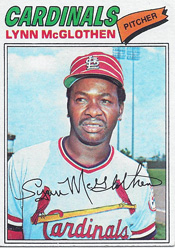
The Cardinals acquired Siebert (for outfielder Tommy Cruz) to join a revamped starting rotation that included two other former Red Sox pitchers, John Curtis and Lynn McGlothen, and holdovers Bob Gibson and Alan Foster.

At 1974 spring training, Siebert, 37, pitched well and Schoendienst declared him the No. 2 starter behind Gibson. “Siebert has been our best pitcher down here,” Schoendienst told the Post-Dispatch. “In fact, he might also be our best hitter.”

Making his National League debut in the Cardinals’ second game of the season against a Pirates lineup with Willie Stargell and Dave Parker, Siebert pitched a four-hit shutout and drove in two runs with a single. Boxscore

In May, Siebert made five starts and had a 1.66 ERA for the month. He pitched consecutive shutouts against the Cubs and Padres. Boxscore and Boxscore

After he won his fourth straight decision on June 5 versus the Giants, giving up one unearned run in 8.2 innings, Siebert had a season record of 6-3 with a 1.95 ERA for the Cardinals. Boxscore

The bubble burst when Siebert went on the disabled list on July 4 because of an inflamed tendon in his right elbow. He returned on July 28, went winless in August and was moved to the bullpen in September.

Siebert’s last win for the Cardinals came in a doozy of a game _ a 25-inning endurance test with the Mets. Siebert, the Cardinals’ seventh pitcher, performed a high-wire act for 2.1 scoreless innings.

Relieving Claude Osteen with two on and two outs in the 23rd, Siebert walked Felix Millan to load the bases, then got Cleon Jones to fly out to right.

In the 24th, the Mets had the bases loaded with two outs, but Siebert got Rusty Staub to ground out.

The Cardinals broke the 3-3 tie in the 25th when Bake McBride scored from first on a wild pickoff throw by pitcher Hank Webb. Siebert gave up a single to Brock Pemberton (his first big-league hit) in the bottom half of the inning but then shut down the Mets. Boxscore

In 28 games, including 20 starts, for the 1974 Cardinals, Siebert was 8-8 with a 3.84 ERA. After the season, he was traded to the Padres.

Siebert, 38, finished his career with the 1975 Athletics, winning four times for a team that finished with the best record in the American League (98-64) and secured its fifth consecutive West Division title.

His career record was 140-114 with 16 saves. Of his 114 hits, 12 were home runs.