Feeds:
Posts
Comments

If not for Rafael Furcal, Rick Ankiel would have won the National League Rookie of the Year Award.

Furcal, acquired by the Cardinals from the Dodgers July 31 in a trade for minor-league outfielder Alex Castellanos, earned the NL’s top rookie honor in 2000 when the shortstop hit .295 with 40 stolen bases for the Braves.

Furcal received 25 of 32 first-place votes from members of the Baseball Writers Association of America. He also had six second-place votes and one third-place vote, giving him 144 total points in the balloting.

Ankiel, a left-handed pitcher, was 11-7 with a 3.50 ERA for the 2000 Cardinals. He struck out 194 in 175 innings and yielded only 137 hits.

Finishing second to Furcal in the rookie of the year balloting with 87 points, Ankiel received six first-place votes, 17 seconds and six thirds. Mets outfielder Jay Payton (.291, 17 home runs) was a distant third, with 37 points.

Though Ankiel had an epic meltdown in the 2000 postseason (nine wild pitches and 11 walks in four innings), that performance didn’t impact the rookie of the year balloting because all votes were submitted before the playoffs began.

Furcal, the first middle infielder to win the NL Rookie of the Year Award since Steve Sax of the Dodgers 18 years earlier, had come to spring training as a non-roster player in 2000 and was issued a uniform with the number 78.

He led NL rookies in runs scored (87), walks (73) and on-base percentage (.394).

“He’s got a lot of confidence,” said Braves outfielder Andruw Jones when asked about Furcal in November 2000. “I’m not saying he’s cocky, but he knows when he does his best he can be successful.”

Said Furcal in a statement to reporters after learning he had won the award, “There were a lot of other rookies who had great years, and for me to win this means my hard work has paid off.”

Ankiel never would regain the pitching skills he showed in the 2000 regular season, and was converted to an outfielder. At the time of the rookie honor, though, many thought he would recover from the wildness that plagued him in the playoffs.

“He’s a young kid and he’s tough as nails,” Cardinals pitching coach Dave Duncan told the Associated Press. “He’s going to be fine.”

Said Pirates manager Gene Lamont of Ankiel: “He’s probably the best-looking young pitcher in baseball, at least in our league. When he starts throwing that curveball and change-up across (the plate), they’ll start talking about him like they did about (the Cubs’) Kerry Wood.”

After Ankiel was named the surprise starter of Game 1 of the 2000 NL Division Series against the Braves at St. Louis, the first batter he faced was Furcal, who singled and then was caught attempting to steal. In the third, after Furcal popped out to first base, Ankiel threw the first of his five wild pitches in the inning. Boxscore

Furcal made a big impression on the Cardinals in his first game against them. On Aug. 4, 2000, at St. Louis, Furcal was 2-for-2 with three walks, two RBI, two steals and two runs scored against Andy Benes and reliever Matt Morris in a 6-4 Braves victory. Boxscore His career batting average against the Cardinals is .344 (83-for-241).
 

(Updated Dec. 27, 2024)

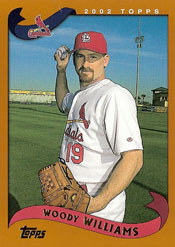
In August 2001, the Cardinals began a transformation from underachievers to postseason qualifiers when they acquired pitcher Woody Williams from the Padres for outfielder Ray Lankford.

After winning the National League Central championship in 2000, the Cardinals were expected to contend in 2001, but they entered August in third place at 53-51 _ 8.5 games behind the first-place Cubs and four behind the Astros.
With the emergence of rookie Albert Pujols, the Cardinals had a surplus of outfielders, including Jim Edmonds, J.D. Drew and Lankford. Complaining about a lack of respect, Lankford, 34, was falling out of favor with team management. It didn’t help that he was hitting .235 with 105 strikeouts in 264 at-bats. Lankford had missed on 36 percent of his swings.

On Aug. 2, 2001, the Cardinals sent Lankford (who agreed to waive his no-trade clause) and more than $2.8 million to the Padres for Williams. Andy Benes was struggling (7.06 ERA entering August) and the Cardinals needed a fifth starter to join a rotation of Matt Morris, Darryl Kile, Dustin Hermanson and Bud Smith.

“We’re extremely happy,” Cardinals general manager Walt Jocketty said to the St. Louis Post-Dispatch. “Woody Williams is a quality pitcher and a quality person.”

Williams, who would turn 35 Aug. 19, didn’t appear to be the obvious solution. He was 8-8 with a 4.97 ERA for the Padres, yielding 170 hits in 145 innings.

“I’m going to use this as a steppingstone that will allow me to get back to where I want to be,” Williams said.

Relying on a change of speeds and sharp location, Williams made his first Cardinals start on Aug. 4, 2001, against the Marlins at St. Louis and pitched six shutout innings. He left the game to a standing ovation from the crowd of 42,312. Luther Hackman and Gene Stechschulte combined to pitch three shutout innings in relief, preserving the win for Williams in a 3-0 victory. Boxscore

Starting with that game, the Cardinals went 38-16 the remainder of the season, finishing in a tie for first place with the Astros at 93-69 and qualifying for the playoffs for a second consecutive season.

The Cardinals couldn’t have done it without Williams, who was 7-1 with a 2.28 ERA for them, limiting batters to 54 hits in 75 innings.

Looking back on his Cardinals days, Williams told Stan McNeal of Cardinals Magazine in 2024, “When I got to St. Louis, I’d had a problem with giving up the long ball in my career … In St. Louis, my mentality became, ‘I’m going to attack the zone and keep the ball in the ballpark.’ I’ll be doggone if those guys behind me didn’t support me like crazy and make me look like a much better pitcher.”

(Updated July 22, 2019)

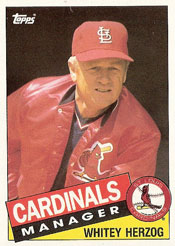
The intensity got turned up to maximum levels when Whitey Herzog managed the Cardinals against counterpart Roger Craig of the Giants.

On July 22, 1986, a scuffle involving the Cardinals and Giants in St. Louis was sparked by a war of words between Herzog and Craig.
The Cardinals, powered by an eight-run fourth inning, led, 10-2, in the bottom of the fifth when their speedster, Vince Coleman, swiped second and third.

After a walk to Ozzie Smith, reliever Juan Berenguer threw a wild pitch to Willie McGee. As Coleman broke for home plate, catcher Bob Melvin recovered the ball and threw to Berenguer, who applied a hard tag on Coleman. Berenguer voiced his displeasure with Coleman for stealing bases with his team ahead by eight runs.

When Coleman next batted in the seventh, reliever Frank Williams spun him away from the plate with an inside pitch. Umpire Bob Davidson issued a warning to both teams. With his next delivery, Williams hit Coleman in the left leg.

Herzog and Craig, a former Cardinals pitcher, had a heated exchange at home plate and “got shoves in as umpire John McSherry tried to restrain them,” the St. Louis Post-Dispatch reported. Craig accused Herzog of ordering Coleman to steal in order to embarrass the Giants.

“Whitey is a great manager,” Craig said to the San Francisco Examiner, “but I told him that was bush.”

Herzog told the Post-Dispatch, “I guess he thinks he invented the damn game or something.”

Both benches emptied and skirmishes broke out.

Giants pitcher Mike Krukow butted Coleman with his head and Coleman wrestled him to the ground, according to The Sporting News. When Giants utility player Joel Youngblood tackled Cardinals pitcher Ricky Horton, Herzog grabbed Youngblood by the neck. Giants infielder Randy Kutcher tried to pry Herzog off Youngblood, and Herzog tangled with Kutcher.

According to the Post-Dispatch, Herzog said to Kutcher: “Oh, you want some of me?”

Someone spiked Cardinals second baseman Tommy Herr in the face and neck. He needed eight stitches to close the wound.

Craig, Williams and Giants third baseman Chris Brown were ejected.

“It’s an outrage,” Herzog told the Associated Press. “I’m talking about Roger Craig. It’s bush league. If he wants us to stop running, he can send over a note promising to stop trying to hit home runs.”

Replied Craig: “I’m glad it happened. It showed me what (the Giants) are made of.”

The players followed the lead of their managers.

“Vince is going to run regardless of what point of the game we’re in,” Herr said. “That’s his game.”

Said Cardinals outfielder Any Van Slyke: “To throw at Vince for running is like throwing at Mickey Mantle for hitting home runs.”

Said Youngblood: “You never want to humiliate your opponent. If you do, you have to be prepared to accept the consequences. It’s almost like an unwritten rule. It’s baseball.”

Giants first baseman Bob Brenly said to the Post-Dispatch, “They were kicking the snot out of us. There was no need to rub it in. I feel (Coleman) was trying to show us up.”

Said Coleman: “I wasn’t there to show anybody up.”

The fracas seemed to inspire the Giants. After pulling to within three runs, 10-7, the Giants had two runners on base with two outs in the ninth before Todd Worrell got Candy Maldonado on a flyout to right. Boxscore and Video

“They had the tying run at the plate in the ninth,” Herzog told The Sporting News. “That’s why we run.”

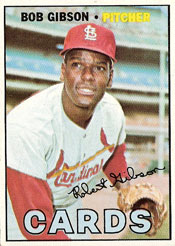
From 1964 through 1966, Bob Gibson compiled a 12-1 record against the Mets. His only loss in that period was by the score of 1-0.

Gibson posted records against the Mets of 4-1 in 1964, 5-0 in 1965 and 3-0 in 1966.

Here is a look at Gibson’s wins in that stretch:

1964

Cardinals 5, Mets 1, May 9, at New York: Gibson had a shutout until catcher Jesse Gonder hit a home run in the eighth. Gibson, who improved to 3-0, also singled, walked and scored a run. Boxscore

Cardinals 3, Mets 1, July 10, at New York: After a RBI-single by Joe Christopher gave the Mets a 1-0 lead in the first, Gibson outdueled Jack Fisher. The Mets had one extra-base hit (a double by Ed Kranepool) and five singles. Boxscore

Cardinals 7, Mets 6, July 19, at St. Louis: The Cardinals erased a 6-3 Mets lead by scoring four runs in the ninth and salvaging a split of a Sunday doubleheader. Dick Groat’s RBI-single off Mets reliever Darrell Sutherland broke a 6-6 tie. Gibson struck out 11, including Gonder three times after the catcher belted a two-run homer in the first. Boxscore

Cardinals 11, Mets 5, Oct. 4, at St. Louis: Two days after Gibson had pitched eight innings in a 1-0 loss to Al Jackson and the Mets, the Cardinals entered the last day of the regular season in a first-place tie with the Reds. With St. Louis trailing 3-2 in the fifth, Gibson relieved Curt Simmons, pitched four innings, held New York to two hits and two runs, and earned the win. With the Reds losing 10-0 that day to the Phillies, St. Louis clinched its first pennant since 1946. Boxscore

1965

Cardinals 4, Mets 3, May 11, at New York: Warren Spahn, 44, was matched against Gibson, and the Mets staked the left-hander to a 3-0 lead through six innings. Sparked by Lou Brock’s two-run homer off Spahn, the Cardinals rallied, enabling Gibson to boost his record to 6-0 despite allowing 10 hits and six walks. Boxscore

Cardinals 6, Mets 3, July 2, at New York: Gibson struck out 13, matching what was then his career high. Twice, he struck out the side in order (in the second and in the fourth). Boxscore

Cardinals 8, Mets 5, July 16, at St. Louis: The Cardinals erased a 4-2 Mets lead with a six-run sixth. Gibson went seven innings and allowed four home runs. Charlie Smith, Jesse Gonder, Johnny Lewis and Jim Hickman all went deep for New York. Boxscore

Cardinals 8, Mets 1, Aug. 20, at New York: Gibson pitched a three-hitter and struck out 11. Charlie Smith’s homer accounted for the New York run. In the fifth, two innings after Gibson had hit Mets shortstop Roy McMillian with a pitcher, Al Jackson hit Gibson with a pitch. After advancing to second on a single, Gibson swiped third and scored on catcher Jimmie Schaffer’s throwing error. Boxscore

Cardinals 3, Mets 0, Sept. 5, at. St. Louis: In a Sunday doubleheader opener that lasted just 2:01, Gibson pitched a two-hit shutout. The Mets got singles by Johnny Lewis in the first and Joe Christopher in the fourth. After being held to one hit (an infield single by Curt Flood) through seven innings by Mets rookie starter Tug McGraw, the Cardinals struck for three unearned runs in the eighth. Boxscore

1966

Cardinals 5, Mets 4, April 21, at New York: Curt Flood’s two-run, two-out home run in the ninth off ex-Cardinal Gordon Richardson overcame a 4-3 New York lead before a Thursday afternoon gathering of only 4,261 at Shea Stadium.  Gibson struck out 11 and held New York to one earned run on four hits. Boxscore

Cardinals 4, Mets 1, Aug. 7, at New York: Ed Kranepool’s eighth-inning homer was the only run against Gibson in the first game of a Sunday doubleheader. With one on and one out in the ninth, Hal Woodeshick relieved Gibson and got Cleon Jones to ground into a double play. Boxscore

Cardinals 9, Mets 6, Aug. 13, at St. Louis: The Cardinals built leads of 5-1 in the second and 8-3 in the sixth as Gibson cruised to his 15th win of the season. Gibson contributed a single and a stolen base. Boxscore

Carl Taylor and Roger Freed are the only Cardinals to achieve one of the rarest of big-league baseball feats: the ultimate grand slam, a game-ending, four-run home run that erases a three-run deficit with one swing.

Big thrill

Taylor, acquired by the Cardinals from the Pirates in October 1969 for pitcher Dave Giusti and catcher Dave Ricketts, was expected to compete for the starting right field position in 1970. Instead, the job went to Leron Lee and Taylor primarily was used as a pinch-hitter.

On Aug. 11, 1970, the Padres led the Cardinals, 10-7, in the ninth inning at St. Louis. With two outs, the bases loaded and pitcher Harry Parker due to bat, Cardinals manager Red Schoendienst sent in Taylor.

Padres reliever Ron Herbel delivered a thigh-high fastball and Taylor drove it about two feet beyond the left-field wall, giving the Cardinals an 11-10 victory.

“I figured he’d go to the fastball to try getting ahead of me,” Taylor told the Associated Press. “It’s got to be the biggest thrill I’ve ever had, because this one won the ballgame. Heck, it’s my first grand slam ever, even in Little League.”

It also was the last big-league homer Taylor would hit in a six-year career. Boxscore

“I hit the ball off the end of the bat,” Taylor told the St. Louis Post-Dispatch. “I thought it might be another one that would just reach the warning track. I hit a lot of those in batting practice, so many that the guys rib me about it.”

Making a contribution

Nine years later, on May 1, 1979, the Astros and Cardinals were involved in a see-saw game at St. Louis.

In the top of the 11th, with a 3-3 score, the Astros struck for three runs and led, 6-3.

Left-hander Joe Sambito loaded the bases with one out in the bottom half of the 11th, but when Garry Templeton struck out for the second out, the Cardinals’ hopes dimmed.

Jerry Mumphrey was due up next, and he hit right-handers better than he did left-handers, so manager Ken Boyer sent Freed to bat for him.

Freed, hitless in five at-bats that season, was keenly aware of reports his demotion to the minors could be imminent.

Sambito got ahead on the count, 1-and-2, but Freed worked the count back to his favor.

“My knees were shaking and sweat kept pouring into my eyes,” Freed told United Press International. “I asked the ump (Dave Pallone) for time and took a few deep breaths. I felt a bit strange because I’d only been up two or three times in the last three weeks.”

Freed launched Sambito’s 3-and-2 pitch over the left-field fence, giving the Cardinals a 7-6 victory. Boxscore

“This is the biggest, most pleasing experience anyone could have in a lifetime,” Freed said to the Post-Dispatch. “Something like this really makes me feel like a part of the ballclub, like I’m an asset to the team. You get to feeling like dead weight when you’re not contributing in some way.”

Freed said Sambito’s full-count pitch “was away, but out over the plate. I’m sure he got more of the plate, maybe four or five inches, than he wanted.”

(Updated May 16, 2020)

Halfway into May, the 1997 Cardinals had experienced much disappointment, including six consecutive losses to open the season and a mid-April stretch in which they never scored more than two runs in five straight games, but Alan Benes may have absorbed the cruelest blow of all.

Matched against Greg Maddux in a scoreless duel, Benes held the Braves hitless for 8.2 innings on May 16 in Atlanta until Michael Tucker doubled.

In the 13th, Tucker created more havoc when he scored from third on an infield dribbler by Andruw Jones off John Frascatore. Atlanta won, 1-0.

In command

Benes was 3-4 with a 3.08 ERA when he faced the defending National League champions. From the first pitch, he threw hard and with command. “All in all, it’s probably the best I’ve ever pitched,” Benes told the St. Louis Post-Dispatch.

The right-hander struck out 11 and walked three. After retiring the first two batters in the ninth, Benes threw a strike to Tucker, a left-handed batter. Tucker crushed the next pitch, a hanging breaking ball, for a double to left-center, ruining the no-hit bid.

“When the game gets into the late innings, you look for him to make a mistake and he did,” Tucker told the Post-Dispatch.

Benes struck out Fred McGriff to end the inning and turned the game over to the St. Louis bullpen.

“We feel terrible we couldn’t get him a run,” Cardinals outfielder Willie McGee said.

In his previous two starts, Benes lost by scores of 2-1 and 2-0.

Fluke hit

After Maddux held the Cardinals scoreless for eight innings, relievers Mark Wohlers, Mike Bielecki, Paul Byrd, Alan Embree, Brad Clontz and Joe Borowski combined to shut out St. Louis for five innings.

In the bottom of the 13th, Tucker singled versus Frascatore with one out, stole second and advanced to third on a flyout. McGriff was walked intentionally, bringing up Andruw Jones.

Jones told the Atlanta Constitution he thought T.J. Mathews, the pitcher he faced in the 11th inning, not Frascatore, was on the mound.

Fooled by Frascatore’s pitch, Jones checked his swing. The ball struck his bat and rolled slowly between the mound and first base. Tucker streaked across the plate as Jones reached first. “I was looking for a fastball, but he threw me a slider and I almost broke my wrist,” Jones said.

Said Cardinals manager Tony La Russa: “This is a really cruel way to lose. I’d rather lose any way than the way we did _ on a darned check swing.” Boxscore

According to the Atlanta Constitution, it was the first time the Braves won a 1-0, 13-inning game since May 26, 1959, when they beat Harvey Haddix of the Pirates after he pitched 12 perfect innings.

Benes’ older brother, Cardinals pitcher Andy Benes, told The Sporting News his sibling is “the type of guy who can go out and throw a no-hitter every five days because he throws the ball so hard and because of his breaking pitches.”

At the end of July, with a 9-9 record and 2.89 ERA, Alan Benes went on the disabled list because of a right shoulder injury. He sat out the remainder of the season, and all of the 1998 season, and never regained his peak form.
