Feeds:
Posts
Comments

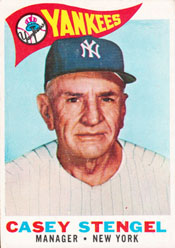
Besides ranking among the most successful managers, Tony La Russa and Casey Stengel have something else in common: Each had to leave his team during a season to receive treatment for a medical condition described as a virus.

At 66, La Russa, the Cardinals manager, sat out a six-game road trip to Chicago and Cincinnati in May 2011 to receive testing and treatment for shingles, a viral infection of the nerve roots.

At 69, Stengel, the Yankees manager who led them to 10 American League pennants and seven World Series titles, missed 12 games in 1960 when he entered a hospital for treatment of a virus condition that settled in his kidneys.

Known as “The Old Professor,” Stengel became ill on May 28, 1960.

When he was released from a New York hospital June 5, The New York Times reported the next day, “Casey Stengel, victorious in his battle with a low-grade virus, yesterday left Lenox Hill Hospital, where he had been confined since last Tuesday … Stengel, who first became ill on May 28, has been advised to rest for at least 24 more hours before resuming his job with the Bombers.”

Yankees coach Ralph Houk was acting manager in Stengel’s absence. The Yankees were 6-6 in the games Houk managed, including two doubleheaders.

Stengel returned to the Yankees on June 7. Dick Young of the New York Daily News described the scene at Yankee Stadium for The Sporting News: “He put on the white flannel uniform, and it felt good. For more than a week, he had worn nothing but silk pajamas or those baggy nightgowns they give you at the hospital, the ones that look shapeless enough to be Dior creations.”

Stengel met with reporters in the dugout before the Yankees faced the White Sox. Here is part of Dick Young’s account:

“You look good,” said a newspaperman, telling a little white lie.

“Well, I’ll tell you something,” said Casey. “They examined all my organs.

“Some of them are quite remarkable, and others are not so good. A lot of museums are bidding for them.”

Everybody laughed, including Stengel.

The Yankees, 22-21 when Stengel returned, beat the White Sox, 5-2, that night, sparking a seven-game winning streak. New York went on to win the American League pennant, finishing 97-57.

Cardinals shortstop Garry Templeton experienced a first-half funk during the 1978 season.

Templeton was booed by Cardinals fans for poor shortstop play that contributed to St. Louis’ dismal first three months of the season.

Jim Russo, a Baltimore Orioles scout based in St. Louis, said the Cardinals should demote Templeton to the minors “until he gets his head screwed on.”

Templeton, 22, made eight errors during a stretch in which the Cardinals lost 16 of 17 games from May 12 to May 29. As the Cardinals entered the all-star break on July 10, Templeton had committed 27 errors. He would finish the season with 40, a team record for a shortstop.

Templeton reached rock bottom on July 9 in the Cardinals’ last game before the break.

Playing in St. Louis against the Pirates, the Cardinals took a 1-0 lead into the seventh inning. Pittsburgh loaded the bases with one out against Bob Forsch, who induced Ken Macha to hit a routine grounder to Templeton for what appeared to be an inning-ending double play. Templeton booted the ball for an error and two runs scored, opening the door to a six-run inning for Pittsburgh. The Pirates won, 6-1. Boxscore

“It’s frustrating to get an effort like that from Forsch and then kiss it away,” Cardinals manager Ken Boyer told The Sporting News. “One play turned the whole game around.”

After receiving advice from his father, Templeton improved in the season’s second half, though he still made 13 errors. In early August, Boyer said, “For the last three weeks, (Templeton) has played shortstop better than I’ve seen it played. After making that bad play behind Bob Forsch a few weeks ago, he began to realize he had to play good defense if his pitcher was to win.”

In October, Boyer hired Dal Maxvill, the shortstop on the Cardinals’ pennant winners of 1967 and 1968, to join St. Louis’ coaching staff and instruct Templeton.

“When you’re young, you’re inclined to hurry throws or throw too hard,” Maxvill said. “Often, you’re not concentrating on who’s the batter or who’s coming up next. Garry is bound to become a superstar _ it’s just a matter of experience with him.”

Said Boyer, after the Cardinals finished 69-93 in 1978: “The one thing that will make this a better ballclub is to take Garry Templeton and make him think defense first … I don’t think he’s fully got the impact of how important a shortstop is to a team.”

Though displaying brilliant stretches of play during his six seasons with St. Louis, Templeton remained error-prone, only once making fewer than 20 errors in a season:

YEAR               GAMES AT SHORTSTOP           ERRORS

1976                 53                                                     24

1977                 151                                                   32

1978                 155                                                   40

1979                 151                                                   34

1980                 115                                                   29

1981                 76                                                     18


(Updated April 17, 2022)

John Tudor earned wins in each of his first four starts for the 1990 Cardinals.

Tudor, who pitched for the Cardinals from 1985 until an August 1988 trade to the Dodgers, was reacquired by St. Louis as a free agent in December 1989. After having elbow, shoulder and knee surgeries following the 1988 season, Tudor was limited to 14.1 innings in six games for the Dodgers in 1989.

The Athletics, managed by Tony La Russa, were among the teams that expressed interest in signing the free agent, but Tudor chose St. Louis, in part, because “I considered it coming home … This is where I’ve been successful in the past, and this is where I felt I could be successful again,” he told The Sporting News.

Tudor, 36, opened the 1990 season as a starter in a Cardinals rotation with Joe Magrane, Bryn Smith, Jose DeLeon and Greg Mathews.

A look at Tudor’s first four wins:

_ April 13, 1990, Cardinals 11, Phillies 0, at Philadelphia: Using changeups away and fastballs in, Tudor retired the first six in a row and limited the Phillies to three hits over six innings. Bob Tewksbury pitched the final three innings for the save. Boxscore

_ April 18, 1990, Cardinals 3, Pirates 0, at Pittsburgh: Going seven innings, Tudor stretched to 13 his scoreless innings streak to open the season. Barry Bonds, batting leadoff, went 0-for-3 against Tudor. Boxscore

_ April 23, 1990, Cardinals 7, Pirates 4, at St. Louis: Jeff King hit a two-run double in the first inning, but Tudor recovered and held Pittsburgh to three runs and five hits over eight innings. Boxscore

_ April 28, 1990, Cardinals 5, Giants 0, at San Francisco: Tudor limited the Giants to five hits in seven scoreless innings, lowering his ERA to 0.96. Boxscore

“He’s so precise with his pitching,” said Cardinals center fielder Willie McGee. “It’s always just enough on the outside where you can’t get a good piece of it.”

Tudor told Cardinals Magazine, “I was always confident in the fact that I could throw strikes. I could make them put the ball in play, and if I could make them put the ball in play, we had a pretty darn good defense here that really helped out in some tough situations.”

In 25 appearances, Tudor finished 12-4 with a 2.40 ERA for a last-place 1990 Cardinals team.

“Most people figured he had been through too much to come back,” wrote columnist Bob Hertzel, “but Whitey Herzog, the Cardinals’ manager, knew the doctors had operated on Tudor’s knee, shoulder and elbow, not his heart.”

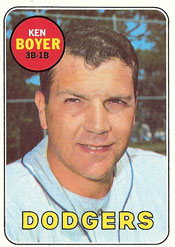
Ken Boyer’s unselfishness played an important role in the 31-game hitting streak of Dodgers outfielder Willie Davis in 1969.

On July 21, 1969, in the Pirates’ 2-1 victory over the Dodgers in 15 innings, Davis was 0-for-6, dropping his batting average to .260. Boxscore

One of Davis’ teammates that year was Boyer, who had been the Cardinals’ standout third baseman from 1955-65. Boyer was in the last season of a 15-year big-league career and primarily was being used as a pinch hitter by the Dodgers.

Entering a four-game series against the Cardinals at St. Louis, Davis “put down his slim-handled whip of a bat and picked up a heavier model, one Ken Boyer had been using,” John Kuenster wrote in Baseball Digest magazine.

“He choked up four inches on the knobless handle and started to hit.”

Davis, a left-handed batter, embarked on a 31-game hitting streak, stretching from Aug. 1 in St. Louis to Sept. 3 in Los Angeles, using Boyer’s 38-ounce Louisville Slugger U1 model. It was the longest hitting streak in the National League since Tommy Holmes’ 37-game stretch for the Braves in 1945.

Writing in 2011 for Examiner.com, Jim Smiley reported, “Boyer stopped using his own bats when his supply dwindled down to only two. After all, a teammate with a long hitting streak comes first.”

In a September 1969 interview with Charles Maher of the Los Angeles Times, Davis said, “I choke up about four inches to get more bat control. And I never try to pull the ball. Nine times out of 10, I’ll be trying to hit through the middle or to the opposite side.

“I’m not going to stop using Boyer’s bats … I think I broke one of them and he’s got two left. I don’t think Kenny’s even using them now. He knows I want to use them.”

Boyer understood the importance of teamwork and the elements needed to grow a hitting streak. Boyer had a 29-game hitting streak for the Cardinals in 1959.

Davis faced the Cardinals seven times during his streak:

_ Aug. 1, Cardinals 7, Dodgers 2, at St. Louis: In Game 1 of the streak, Davis went 1-for-4, hitting a double against Steve Carlton. Boxscore

_ Aug. 2, Cardinals 7, Dodgers 6, at St. Louis: Davis had an RBI-single against Mike Torrez and a two-run double against Joe Hoerner. Boxscore

_ Aug, 3, Dodgers 5, Cardinals 0, at St. Louis: Chuck Taylor yielded a double and a single to Davis. Boxscore

_ Aug. 4, Cardinals 2, Dodgers 1, at St. Louis: Davis singled against Nelson Briles, who pitched a complete-game seven-hitter. Boxscore

_ Aug. 11, Cardinals 4, Dodgers 2, at Los Angeles: In his final at-bat of the game, Davis hit an RBI-single off Steve Carlton in the eighth. Boxscore

_ Aug. 12, Dodgers 5, Cardinals 2, at Los Angeles: After starting 0-for-2, Davis singled in the sixth against Ray Washburn and singled in the eighth against Joe Hoerner. Boxscore

_ Aug. 13, Cardinals 5, Dodgers 0, at Los Angeles: Chuck Taylor pitched a six-hit shutout, but Davis had two of those hits _ singles in the seventh and ninth innings. Boxscore

Davis didn’t face Cardinals ace Bob Gibson during the streak. Gibson was 20-13 with a 2.18 ERA in 1969. Davis had a .320 (40-for-125) career batting average against Gibson.

(Updated Oct. 20, 2018)

Seven Cardinals have hit a home run from each side of the plate in a game.

The seven who achieved the feat:
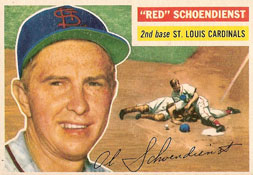
RED SCHOENDIENST

Schoendienst may have been an unlikely candidate to become the first Cardinal to hit home runs from the left and right sides in the same game.

Schoendienst didn’t hit a home run in the first 56 games he played in 1951. He ended the skid in Game 2 of a July 8 doubleheader against the Pirates at Pittsburgh.

In the sixth inning, Schoendienst, batting left-handed, hit a solo home run against Ted Wilks, a former teammate.

An inning later, facing rookie Paul LaPalme, Schoendienst switched to the right side and hit a two-run home run, helping St. Louis to a 9-8 victory. Boxscore

TED SIMMONS

Simmons twice hit a home run from each side of the plate in games for the Cardinals.

On April 17, 1975, after the Mets scored six runs in the first against Lynn McGlothen at Busch Stadium, Simmons, batting right-handed, hit a three-run home run against Jerry Koosman in the bottom of the inning.

In the fifth, Simmons, batting left-handed against Rick Baldwin, launched a solo shot, becoming the first National League player to hit a home run from each side of the plate in a game since Pete Rose of the Reds in 1967. Despite Simmons’ efforts, the Mets won, 14-7. Boxscore

Simmons did it again on June 11, 1979, at Los Angeles, hitting a grand slam right-handed against former teammate Jerry Reuss in the third, and snapping a 7-7 tie with a two-run shot in the ninth while batting left-handed against another ex-Cardinal, Lerrin LaGrow, giving St. Louis a 9-7 victory. Boxscore

REGGIE SMITH

Like Simmons, Smith twice hit a home run from each side of the plate as a Cardinal. His second effort yielded three home runs.

On May 4, 1975, at St. Louis, Smith went 5-for-5, including two solo home runs _ a fourth-inning shot, batting right-handed, against Geoff Zahn of the Cubs, and a fifth-inning shot, batting left-handed, against Oscar Zamora _ but the Cardinals blew a 4-2 lead after six innings and lost, 8-6. Boxscore

Smith hit two home runs right-handed and another left-handed in lifting the Cardinals to a 7-6 victory at Philadelphia on May 22, 1976. He hit a three-run home run against left-hander Jim Kaat in the fifth. His solo shot off right-hander Ron Reed in the seventh tied the score, 6-6. In the ninth, his two-out home run against left-hander Tug McGraw was the game-winner. Three weeks later, Smith was traded to the Dodgers. Boxscore

MARK WHITEN

One week after he hit four home runs left-handed in a game at Cincinnati, Whiten hit a seventh-inning solo shot against the Expos’ Kirk Rueter while batting right-handed, and followed with an eighth-inning, three-run shot off Mel Rojas while batting left-handed on Sept. 14, 1993, at St. Louis. Despite Whiten’s efforts, Montreal won, 12-9. Boxscore

GERONIMO PENA

Pena, who hit 30 home runs in his big-league career, hit his first two of 1994 in a game at St. Louis against the Padres on April 17 _ 19 years to the day Ted Simmons first hit a home run from each side of the plate.

A second baseman batting second in the order, Pena hit a solo shot from the left side against Andy Ashby in the third, and added another from the right side against Mark Davis in the seventh, leading St. Louis to a 5-0 victory. Boxscore

LANCE BERKMAN

Culminating his return to Houston for the first time since the Astros traded him to the Yankees in July 2010, Berkman hit a three-run home run against Fernando Abad while batting right-handed in the sixth, and lofted a solo homer while batting left-handed against Aneury Rodriguez in the ninth in the Cardinals’ 11-7 victory on April 28, 2011. Boxscore

Berkman repeated the feat on June 30, 2011, in a 9-6 Cardinals triumph over the Orioles at Baltimore. Batting right-handed, Berkman hit a two-run home run against starter Brian Matusz in the third. Leading off the seventh and batting left-handed, Berkman hit a solo home run against Alfredo Simon. Boxscore

CARLOS BELTRAN

Beltran achieved the feat three times with the Cardinals. The first time was on Sept. 30, 2012, in a 10-4 Cardinals victory over the Nationals at St. Louis.

Batting second in the order, Beltran hit a two-run home run from the right side off Ross Detwiler, a St. Louis native, in a five-run Cardinals second. Batting left-handed, Beltran hit another two-run shot in the fourth against Chien-Ming Wang. Boxscore

Beltran matched the feat twice in 2013.

On April 26, 2013, against the Pirates at St. Louis, Beltran hit a first-inning solo homer from the right side off Jonathan Sanchez. He hit a two-run shot from the left side off Jeanmar Gomez in the fifth, helping the Cardinals to a 9-1 triumph. Boxscore

Two months later, Beltran did it again. On June 15 at Miami, Beltran hit a pair of solo home runs in a 13-7 Cardinals victory over the Marlins. Beltran hit one from the left side off Tom Koehler in the second and another from the right side against Edgar Olmos in the ninth. Boxscore
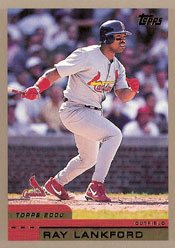
Like the Cardinals, Ray Lankford was having an uninspired season in 1995 when he suddenly jump-started it with a sizzling September.

As part of a 16-game hitting streak from Aug. 29 to Sept. 16, Lankford had multiple hits in seven consecutive games (Sept. 4 to Sept. 11).

As reported by Fox Sports Midwest in a story carried by Cardinals Best News Links, Lankford was the last Cardinal to achieve a multiple-hit streak of seven games until Lance Berkman matched it this year.

In a season that began late with the threat of using replacement players and included the firing of manager Joe Torre and the trading of popular first baseman Todd Zeile to the Cubs, the Cardinals had a 48-66 record the morning of Aug. 29. Lankford, 1-for-14 in his last four games, was batting .258.

The center fielder then hit safely in five consecutive games before entering a three-game series at Atlanta against the Braves. Facing three of the best pitchers of that era _ John Smoltz, Greg Maddux and Tom Glavine _ Lankford launched into his unlikely multiple hits stretch.

Sept. 4 at Atlanta, Braves 6, Cardinals 5: Lankford went 2-for-3. Both hits came against John Smoltz _ a leadoff home run in the fourth and a one-out double in the sixth. Boxscore

Sept. 5 at Atlanta, Braves 1, Cardinals 0: Lankford had a double and two singles against Greg Maddux. But, with two on and two out in the third, Lankford struck out _ the only time Maddux retired him in the game. Boxscore

Sept. 6 at Atlanta, Braves 6, Cardinals 1: A left-handed batter, Lankford singled twice against left-hander Tom Glavine. Boxscore

Sept. 7 at St. Louis, Cardinals 5, Padres 2: Facing another left-hander, Glenn Dishman, Lankford solved him with a run-scoring double in the first and a two-run triple in the fifth. Boxscore

Sept. 8 at St. Louis, Cardinals 5, Padres 2: Lankford led off the fifth with a homer against starter Joey Hamilton and added a seventh-inning single against reliever Andres Berumen. Boxscore

Sept. 9 at St. Louis, Cardinals 7, Padres 5: Lankford lifted a two-out, fourth-inning homer against starter Willie Blair. In the eighth, Lankford greeted rookie left-handed reliever Ron Villone with a run-scoring single. Boxscore

Sept. 10 at St. Louis, Cardinals 13, Giants 4: After he contributed a two-RBI single against starter Jamie Brewington in a six-run second, Lankford smacked a homer against left-handed reliever Joe Rosselli, leading off the fourth. Boxscore

Lankford extended his hitting streak in the next game, hitting a home run in his fourth consecutive game, a shot off Giants starter Mark Leiter, but it was his only hit, ending the multiple hits stretch.

“I’m just … trying to make good contact and drive the ball,” Lankford told the Associated Press. “Fortunately, I’m hitting them out of the ballpark. The balls that I’ve been hitting out, I’ve been hitting on a line.”

After the hitting streak reached 16 games, Lankford went 0-for-3 against Ismael Valdez of the Dodgers on Sept. 17 at St. Louis.

In a syndicated column, Gordon Edes reported Lankford’s hitting streak “coincides with the recovery of his 1-year-old daughter (Racquel) from second-degree burns suffered last month in Los Angeles when she pulled a room service coffee container onto herself.”

“I knew I loved my daughter before,” Lankford said. “But now I realize how lucky I really am to have her.”

Lankford finished the 1995 season with a .277 batting average, 25 home runs and 82 RBI.