Feeds:
Posts
Comments

Like the Cardinals, Ray Lankford was having an uninspired season in 1995 when he suddenly jump-started it with a sizzling September.
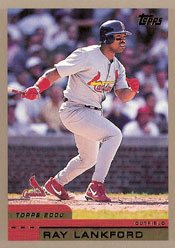
As part of a 16-game hitting streak from Aug. 29 to Sept. 16, Lankford had multiple hits in seven consecutive games (Sept. 4 to Sept. 11).

As reported by Fox Sports Midwest in a story carried by Cardinals Best News Links, Lankford was the last Cardinal to achieve a multiple-hit streak of seven games until Lance Berkman matched it this year.

In a season that began late with the threat of using replacement players and included the firing of manager Joe Torre and the trading of popular first baseman Todd Zeile to the Cubs, the Cardinals had a 48-66 record the morning of Aug. 29. Lankford, 1-for-14 in his last four games, was batting .258.

The center fielder then hit safely in five consecutive games before entering a three-game series at Atlanta against the Braves. Facing three of the best pitchers of that era _ John Smoltz, Greg Maddux and Tom Glavine _ Lankford launched into his unlikely multiple hits stretch.

Sept. 4 at Atlanta, Braves 6, Cardinals 5: Lankford went 2-for-3. Both hits came against John Smoltz _ a leadoff home run in the fourth and a one-out double in the sixth. Boxscore

Sept. 5 at Atlanta, Braves 1, Cardinals 0: Lankford had a double and two singles against Greg Maddux. But, with two on and two out in the third, Lankford struck out _ the only time Maddux retired him in the game. Boxscore

Sept. 6 at Atlanta, Braves 6, Cardinals 1: A left-handed batter, Lankford singled twice against left-hander Tom Glavine. Boxscore

Sept. 7 at St. Louis, Cardinals 5, Padres 2: Facing another left-hander, Glenn Dishman, Lankford solved him with a run-scoring double in the first and a two-run triple in the fifth. Boxscore

Sept. 8 at St. Louis, Cardinals 5, Padres 2: Lankford led off the fifth with a homer against starter Joey Hamilton and added a seventh-inning single against reliever Andres Berumen. Boxscore

Sept. 9 at St. Louis, Cardinals 7, Padres 5: Lankford lifted a two-out, fourth-inning homer against starter Willie Blair. In the eighth, Lankford greeted rookie left-handed reliever Ron Villone with a run-scoring single. Boxscore

Sept. 10 at St. Louis, Cardinals 13, Giants 4: After he contributed a two-RBI single against starter Jamie Brewington in a six-run second, Lankford smacked a homer against left-handed reliever Joe Rosselli, leading off the fourth. Boxscore

Lankford extended his hitting streak in the next game, hitting a home run in his fourth consecutive game, a shot off Giants starter Mark Leiter, but it was his only hit, ending the multiple hits stretch.

“I’m just … trying to make good contact and drive the ball,” Lankford told the Associated Press. “Fortunately, I’m hitting them out of the ballpark. The balls that I’ve been hitting out, I’ve been hitting on a line.”

After the hitting streak reached 16 games, Lankford went 0-for-3 against Ismael Valdez of the Dodgers on Sept. 17 at St. Louis.

In a syndicated column, Gordon Edes reported Lankford’s hitting streak “coincides with the recovery of his 1-year-old daughter (Racquel) from second-degree burns suffered last month in Los Angeles when she pulled a room service coffee container onto herself.”

“I knew I loved my daughter before,” Lankford said. “But now I realize how lucky I really am to have her.”

Lankford finished the 1995 season with a .277 batting average, 25 home runs and 82 RBI.
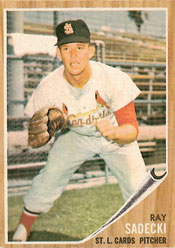
In 1962, the Atlanta Crackers, a Cardinals farm club, made an incredible stretch drive to win the International League championship and Junior World Series title.

Managed by Joe Schultz, the 1962 Crackers had a lineup that included Cardinals prospects such as catcher Tim McCarver, outfielder Mike Shannon, second baseman Phil Gagliano, shortstop Jerry Buchek and pitcher Ray Sadecki.

After a slow start, the Crackers were stuck in sixth place on Aug. 19, 1962.

“Most of the season, the Crackers were characterized by faint bullpen hearts and limp offense in crises,” Atlanta columnist Furman Bisher wrote in The Sporting News.

Though the Crackers rallied and finished the regular season in third place at 83-71, qualifying them for the four-team International League playoffs, several publications reported the Cardinals had decided to fire Schultz after the postseason and replace him with Harry Walker.

To the surprise of most, the Crackers eliminated Toronto in six games in the first round of the best-of-seven playoff series and advanced to face Jacksonsville.

Atlanta and Jacksonville split the first six games of the league championship series, putting the spotlight squarely on Sadecki, a talented but erratic left-hander who had developed a tag as a “problem child.”

Sadecki, 21, had opened the 1962 season with the Cardinals, but he had missed most of spring training in a contract dispute and never got untracked.

On June 5, 1962, in a relief stint in St. Louis against the Reds, Sadecki faced five batters, allowed five runs, committed two errors and was booed off the field. After the game, he was fined $250 by manager Johnny Keane, who called Sadecki’s performance “the worst display of effort I’ve ever seen on a big-league diamond.”

Sadecki continued to struggle, and on July 31, 1962, with a 6-8 record and 5.54 ERA, he was demoted to Atlanta.

The wake-up call worked. Sadecki was 7-1 with a 2.55 ERA in nine appearances during the regular season for Atlanta.

Needing an ace to start the deciding Game 7 against Jacksonville, Schultz chose Sadecki.

Sadecki was protecting a 3-0 lead with two outs in the eighth when he “was hit on the face by a liner off the bat of Jacksonville’s Tony Martinez,” The Sporting News reported.

“Fortunately, the ball struck Sadecki a glancing blow on the wrist first, slowing it considerably,” according to The Sporting News.

After Jacksonville filled the bases on two singles and a walk in the ninth, Sadecki was relieved by Ed Bauta, who retired the side, clinching a 3-1 Crackers win and moving them into the Junior World Series against the American Association champions, the Louisville Colonels.

With Sadecki accounting for two of the Crackers’ four wins, Atlanta clinched the seven-game Junior World Series.

With a 5-1 postseason mark, Sadecki finished with a 12-2 record in his two months with Atlanta.

Two years later, he was a 20-game winner, helping the Cardinals earn the 1964 National League pennant and World Series title.

Schultz was rewarded for Atlanta’s successful 1962 finish by being named to the coaching staff of the Cardinals.

“I’ve managed about 20 clubs in 13 years, counting winter leagues, and I’ve never had a team make such a terrific comeback,” Schultz said.

(Updated April 13, 2025)

Nolan Ryan and Danny Frisella, two pitchers Joe Torre hit well in his career, combined to stop the Cardinals third baseman’s April hitting streak.

Torre hit safely in each of the Cardinals’ first 22 games of the 1971 season.

Torre’s streak gave him a .386 batting average entering a game against the Mets on April 29, 1971, in St. Louis.

Batting fourth, Torre went 0-for-3 with a walk against Ryan and Frisella. “In a way, I’m relieved,” Torre told the St. Louis Post-Dispatch.

Ryan and Frisella, both right-handers, were unlikely candidates to end Torre’s streak. For his career, Torre hit .318 (7-for-22) against Ryan and .500 (7-for-14) against Frisella.

Facing Ryan in the first inning with two runners on base and one out, Torre rapped into a 6-4-3 double play.

In the fourth, Ryan got Torre on a pop-up to shortstop Bud Harrelson.

Torre led off the sixth with a walk, one of eight Ryan issued in the game.

Frisella, who relieved in the seventh, struck out Torre leading off the eighth.

“At least it was another Italian who stopped me,” Torre told the Post-Dispatch.

The Mets won, 7-0, as Ryan and Frisella combined to limit the Cardinals to three hits. Boxscore

With the streak broken, Torre experienced a brief skid, going hitless in four of five games (1-for-15) and seeing his batting average drop to .340.

He went on to lead the National League in batting that season with a .363 average and 230 hits.

Ken Boyer, hitting coach for the 1971 Cardinals, cited Torre’s “short stride, quick stroke and great stength” for his success. Another Cardinals coach, George Kissell, told The Sporting News that Torre was able to focus on hitting when the Cardinals settled on him as their third baseman.

“For the first time since he joined the club (in 1969), he was able to have a closed mind about playing one position,” Kissell said. “Before, he had to be thinking about first base and catching as well as third base.”

Recalling 1971, Torre told Cardinals Yearbook in 2014, “It was magical, no question. I used to go to sleep at night, knowing which pitcher I would see the next day, and, in my mind, I knew which pitch I wanted to hit off him.”

(Updated Oct. 26, 2024)

Here are the top 5 with the most regular-season career grand slams as Cardinals:

_ Albert Pujols, 13 grand slams with the Cardinals. Pujols hit five of his grand slams in 2009, tying Ernie Banks of the 1955 Cubs for the National League single-season record. His 13th grand slam for the Cardinals came on Aug. 18, 2022, versus the Rockies’ Austin Gomber. With the three grand slams Pujols hit for the Angels, he totaled 16 in his career in the major leagues.
_ Stan Musial, 9 grand slams with the Cardinals. Musial hit his first grand slam in 1942 and his last in 1961.

_ Ken Boyer, 7 grand slams with the Cardinals. Not included in that total is Boyer’s most famous grand slam: a sixth-inning shot against Al Downing of the Yankees in Game 4 of the 1964 World Series, giving St. Louis a 4-3 victory. Boxscore

_ Ted Simmons, 7 grand slams with the Cardinals. On June 11, 1979, at Los Angeles, Simmons wiped out a 3-0 Dodgers lead with a third-inning grand slam against former teammate Jerry Reuss. In the ninth, Simmons launched a two-run shot against another former St. Louis teammate, Lerrin LaGrow, snapping a 7-7 tie and giving the Cardinals a 9-7 victory. Simmons totaled nine grand slams: seven for the Cardinals and one each for the Brewers and Braves. Boxscore

_ Yadier Molina, 7 grand slams with the Cardinals. Molina got his first grand slam on April 5, 2010, against Reds reliever Nick Masset. One of Molina’s grand slams was hit against a future Hall of Famer, Roy Halladay of the Phillies, on May 27, 2012, at St. Louis. Boxscore


If hindsight is 20-20, we should have known in advance that the Cardinals would win National League championships in 1928, 1946, 1964 and 1982.

In researching Cardinals history, I found an item in the Jan. 10, 1970, edition of The Sporting News that stunned and amazed.

In an article by Neal Russo in that 1970 magazine, Cardinals fans Sam and Mike Antonacci predicted the Cardinals would win the pennant in 1982.

They based their prediction on a rare combination of numbers in the 20th century calendar.

According to the Antonaccis, only four times in the 20th century do the sums of even-numbered years add up to 20: 1928, 1946, 1964 and 1982.

The first two numbers in each of those years (1 and 9) equal 10. The last two numbers in each of those years (2 and 8, 4 and 6, 6 and 4, and 8 and 2) also equal 10. The four numbers combined add up to 20.

Because the Cardinals had won pennants in 1928, 1946 and 1964, the Antonaccis guaranteed the Cardinals would win another pennant in 1982.

They were right.

Twelve years after their prediction, the Cardinals in 1982 won their first pennant since … 1964.

Indeed, there was magic for the Cardinals in the number 20 in the 20th century.

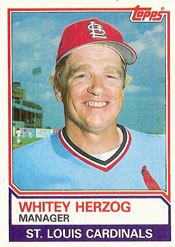
Led by manager Whitey Herzog, the Cardinals clinched their final World Series championship of the 20th century on 10-20-1982.

The Cardinals played at Dodger Stadium in Los Angeles for the first time on May 18, 1962.

Bill White drove in three runs and Ken Boyer drove Dodgers starter Johnny Podres out of the game. The Cardinals won, 8-3.  Boxscore

In the first inning, with Red Schoendienst on first and two outs, Boyer hit a drive that struck Podres in the left forearm.

Podres threw three pitches out of the strike zone to the next batter, Gene Oliver, and walked off the field, unable to pitch. Stan Williams relieved and threw ball four to Oliver, loading the bases.

Charlie James followed with a two-run single and the Cardinals were on their way to a fruitful weekend.

The Cardinals won all three games in the series and never used a reliever. Larry Jackson, Ray Sadecki and Curt Simmons pitched successive complete-game victories.

Podres went to the hospital, where X-rays revealed no fracture. Six days later, he started against the Mets and Podres went on to enjoy a 15-win season.