Feeds:
Posts
Comments

(Updated Nov. 20, 2024)

Stan Musial, the greatest Cardinals player, rates the Cleveland Indians’ Bob Feller as the greatest pitcher of his time.
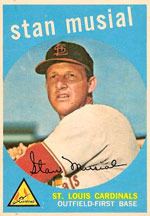
In his book “Stan Musial: The Man’s Own Story,” Musial said of Feller, “I hit against Feller only in exhibition games, but I’d say he probably was the greatest pitcher of our era. He had blinding speed, later developed a great curveball and finally a good slider. Feller took baseball most seriously and was one of the first players I knew who punished himself physically with exercises, recognizing the need for prime conditioning.”

As a youth in Iowa, Feller’s favorite player was another Cardinal, Rogers Hornsby.

In the book “Voices From Cooperstown,” Feller told author Anthony J. Connor, “My first glove was a Rogers Hornsby glove, the old three-fingered glove. Used it for years. Every two years, I’d buy a new one … Hornsby was my first idol … I even took up second base as my first position because that was where he played.”

(In the only regular-season matchup against Feller, on April 24, 1937, Hornsby, then with the Browns, drew a bases-loaded walk, struck out and reached on an error by the third baseman. Hornsby was 41 and Feller was 18. Boxscore)

Feller began his Hall of Fame career with the Indians in 1936 when he was 17. “I signed for one dollar and an autographed baseball,” Feller recalled to Anthony J. Connor. “I’m glad I didn’t receive a big bonus. I believe you should get paid after you do your job, not before. I was very confident that I’d make good.”

Feller pitched until 1941, served in World War II, resumed his playing career in 1945 and retired after the 1956 season with 266 wins. He led the American League in strikeouts seven times.

Musial began his Hall of Fame career with the Cardinals in 1941, played through 1944, served in the Navy in 1945, resumed his playing career in 1946 and retired after the 1963 season.

Fact vs. myth

Before big-league baseball integrated in 1947, barnstorming clubs of major leaguers would play stars from the Negro League during the off-season in the 1930s and 1940s.

On Sunday Oct. 5, 1941, an all-star team named for Cardinals coach Mike Gonzalez and led by Feller played an exhibition against the Kansas City Monarchs, champions of the Negro National League, at Sportsman’s Park in St. Louis.

Musial, who had made his major-league debut a few weeks before, on Sept. 17, 1941, against the visiting Boston Braves, is said to have played in that exhibition. According to the book “Musial, From Stash to Stan the Man” by James Giglio, Musial hit a home run off Satchel Paige in the exhibition. Giglio cites as his source the book “Don’t Look Back: Satchel Paige in the Shadows of Baseball.”

However, an account of the exhibition in the Oct. 9, 1941, edition of The Sporting News makes no mention of a home run by Musial. Game reports in the three St. Louis newspapers _ Globe-Democrat, Post-Dispatch and Star-Times _ don’t mention Musial either. In the book “Satch, Dizzy & Rapid Robert,” author Timothy M. Gay states, “Despite persistent claims to the contrary in books and articles over the years, Cardinals rookie Stan Musial did not play that afternoon.”

(I couldn’t find any evidence that Musial played in the game. The Globe-Democrat published a box score and Musial isn’t listed).

According to the Globe-Democrat, three Cardinals played for the all-stars: Johnny Hopp, Frank “Creepy” Crespi and Walker Cooper.

Johnny Lucadello and Johnny Wyrostek each drove in two runs for the all-stars in a 4-1 win over the Monarchs, the Globe-Democrat reported.

Feller and Paige were the starting pitchers. Feller struck out three, walked three and yielded a run on two hits in five innings. Paige, described by the Star-Times as “the Negro Dizzy Dean,” struck out four, walked two and yielded four runs on five hits in four innings.

“The magnet of a duel between Bob Feller, Cleveland fireball mound ace, vs. Satchel Paige, king of all Negro pitchers, attracted a paid crowd of 10,124 to Sportman’s Park,” The Sporting News reported. According to the “Satch, Dizzy & Rapid Robert” book, “several thousand African-American fans sat in the segregated right-field bleachers.”

Musial joins tour

Musial did play for the Bob Feller All-Stars when Feller organized a barnstorming tour in 1946. Feller and Paige were the main pitching attractions.

It was quite a boost to the tour when Feller got Musial to agree to play. Musial was the National League batting champion in 1946.

The book “Satch, Dizzy & Rapid Robert” confirms Musial joined Feller’s barnstorming squad after the 1946 World Series. Eight future Hall of Famers played on the tour. Besides Feller, Musial and Paige, the others were Bob Lemon, Phil Rizzuto, Hilton Smith, Monte Irvin and Willard Brown.

On Oct. 16, 1946, the day after the Cardinals won Game 7 of the 1946 World Series at St. Louis, Musial joined the Feller All-Stars in Los Angeles and played in the game that night. He went hitless, including 0-for-2 versus Paige, and drew a walk, according to the “Satch, Dizzy & Rapid Robert” book.

Musial stayed with the tour as it barnstormed up and down the West Coast and finished in Hawaii.
(Updated Nov. 20, 2024)

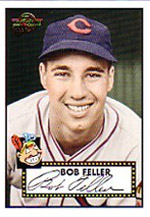
Bob Feller pitched against major leaguers for the first time when he faced the Cardinals as a 17-year-old.

Feller is hailed as one of the great pitchers in baseball history and the Cardinals were the first big-league opponents to glimpse his greatness.

On July 6, 1936, the Cardinals played an exhibition against the Indians at Cleveland during the All-Star Game break. Interleague play didn’t exist then, so any matchup between National League and American League teams was an event.

The Indians, who signed Feller because of his fastball, wanted to test him against big-league batters and the exhibition provided an ideal opportunity.
Feller, who a month earlier completed his junior year of high school in Iowa, entered in relief of starter George Uhle in the fourth inning with the score 1-1. In his 1990 book, “Now Pitching, Bob Feller,” Feller said he wasn’t scared of facing a team he’d seen play two years earlier in the 1934 World Series at St. Louis.

“Not in my entire pitching career was I ever scared of any hitter or any situation,” Feller said.

In the book “Baseball When the Grass Was Real,” Feller told author Donald Honig, “I never had any concern about the hitters as long as I could get that ball over the plate. My only concern that day was the crowd. I’d never seen so many people before in my life.”

Cleveland manager Steve O’Neill, a former big-league catcher celebrating his 45th birthday, wanted to see Feller firsthand and decided to catch when Feller came into the game. He told the teen to just throw fastballs. Feller was flattered the manager would make such an effort.

“He wanted to give me his personal treatment because he thought I had the potential to make it big,” Feller said.

Cardinals manager Frankie Frisch intended to play second base, but after watching Feller sail a fastball over the catcher and against the backstop in warmups, he changed his mind. “I’m getting too old to get killed in the line of duty,” Frisch said, according to author Bob Broeg in the book “Memories of a Hall of Fame Sportswriter.”

Feller said to author Donald Honig, “If anybody was nervous that day, it was the Cardinals. I was very wild and had them scared half to death.”

The first batter to face Feller was Bruce Ogrodowski.

“My first pitch to Ogrodowski was a called strike, and it made something of a smacking sound as it hit O’Neill’s mitt,” Feller said. “Ogrodowski turned to O’Neill and said, ‘Let me out of here in one piece.’ He was serious and he laid the next pitch down, bunting down the third-base line.”

Third baseman Odell Hale fielded the ball and threw out Ogrodowski. “He achieved the purpose — he got out of there in one piece,” Feller said.

The next batter was Leo Durocher. According to the book “Bob Feller: Ace of the Greatest Generation,” written by John Sickels, Durocher stepped to the plate, glared at Feller and growled, “Keep the ball in the park, busher.”

One of Feller’s fastballs sailed over Durocher’s head. Another went behind his back. According to Feller, Durocher stepped out of the batter’s box and said to the plate umpire, “I feel like a clay pigeon in a shooting gallery.”

With the count at 2-and-2, Durocher went into the dugout and “pretended to hide behind the water cooler,” Feller said.

After umpires ordered him to return to the plate, Durocher struck out swinging.

The next batter, Art Garibaldi, also struck out.

“I had a big windmill windup and a habit of glancing into left field and then flashing my eyes past third base as I turned toward the plate,” Feller said. “It scared the hitters even more.”

Cleveland scored in the bottom of the fourth.

In the fifth, Feller struck out Les Munns before Terry Moore singled to left and Stu Martin walked. Attempting to rattle Feller, Frisch called for a double steal. Feller rushed the pitch and his fastball eluded O’Neill. Moore raced home, tying the score 2-2, and Martin advanced to third.

The Cardinals had two of their top veterans due up next, but Feller collected himself and struck out Pepper Martin and Rip Collins.

In the sixth, Ogrodowski led off with a double near the foul line before Feller struck out Durocher, Charlie Gelbert and Munns.

Impressed, O’Neill lifted Feller. In three innings, eight of the nine outs he recorded were strikeouts. Cleveland won, 7-6.

In the book “Voices From Cooperstown, Feller said to author Anthony J. Connor, “That day, I was as fast as I’ve ever been.”

Plate umpire Red Ormsby said Feller is “the best pitcher I have seen come into the American League in all my experience,” the St. Louis Post-Dispatch reported.

“He showed me more speed than I have ever seen uncorked by an American League pitcher,” Ormsby said. “I don’t except Walter Johnson either.”

According to the John Sickels book, a photographer asked Cardinals ace Dizzy Dean to pose with Feller afterward. “If it’s all right with him (Feller), it’s all right with me,” Dean replied. “After what he did today, he’s the guy to say.”

Feller said Dean told him, “You sure poured that ol’ pea through there today.”

Feller said “praise from Dizzy Dean was approval from the baseball gods.”

Feller’s outing convinced the Indians he was major-league ready. Two weeks later, on July 19, 1936, Feller made his big-league debut with an inning of relief against the Senators. Boxscore

It was the start of a Hall of Fame career.

(Updated March 21, 2017)

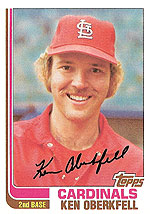
A disciple of the Whitey Herzog school of managing, Ken Oberkfell, third baseman on the Cardinals’ 1982 World Series championship club, was bench coach on Mets manager Terry Collins’ staff in 2011.

Before that, Oberkfell had been a minor-league manager for 17 years. In an interview for the 2010 Cardinals yearbook, Oberkfell discussed the advice he received from Herzog.

“When I started managing, I talked to Whitey a little bit,” Oberkfell said. “He just said, ‘You’ve got to have your own identity, your own way of managing things. You can take what you can from other managers you’ve had, but you have to be yourself.’

“And he also said, ‘If you make a decision, don’t second-guess yourself.’ And I’ve taken that to heart.”

Oberkfell began his managerial career in 1995 in the independent Northeast League. After managing there again in 1996, Oberkfell became a manager in the Phillies’ system. He managed Piedmont of the Class A South Atlantic League from 1997-99 and Clearwater of the Florida State League in 2000.

One of his players at Piedmont was 18-year-old shortstop Jimmy Rollins, who reached the majors in 2000, won the Gold Glove Award four times and a National League Most Valuable Player Award.

Rollins was the first of several outstanding prospects who were nurtured under Oberkfell’s care. Others include shortstop Jose Reyes, third baseman David Wright and outfielder Jason Bay. All became all-stars in the major leagues.

In 2001, Oberkfell joined the Mets organization. He managed Capital City of the South Atlantic League in 2001, St. Lucie of the Florida State League in 2002-03, Binghamton of the Eastern League in 2004, Norfolk of the International League in 2005-06, New Orleans of the Pacific Coast League in 2007-08 and Buffalo of the International League in 2009-10.

He was named minor league manager of the year by Baseball America magazine in 2005. In an article about the award, Oberkfell cited Herzog’s positive influence on his managing style. Story

“I learned a lot from Whitey in terms of handling players and communicating, especially with extra players,” Oberkfell told the magazine. “He always had a way of keeping them positive, keeping them ready. That’s so important if you want to have success at any level.

“And just like Whitey, I like to run. I like to be aggressive on the bases. I’m a pretty laid-back guy until we have runners on base.”

It was with the Cardinals that Oberkfell broke into the major leagues in 1977 as a second baseman. He played for Vern Rapp and Ken Boyer before Herzog joined the Cardinals in June 1980.

An outstanding fielder _ he led National League second basemen in fielding percentage (.985) in 1979 _ Oberkfell made a successful conversion to third base after Herzog traded incumbent Ken Reitz to the Cubs in December 1980.

Oberkfell led NL third basemen in fielding percentage in 1982 (.972) and 1983 (.960). His game-winning single off Gene Garber in Game 2 of the NL Championship Series gave the Cardinals a 4-3 victory over Atlanta. Boxscore Oberkfell batted .292 (7-for-24) with four runs scored in the 1982 World Series.

When Terry Pendleton proved ready to handle the third base job, Oberkfell was dealt to the Braves on June 15, 1984, for pitcher Ken Dayley and first baseman Mike Jorgensen.

From 1977-84 with St. Louis, Oberkfell batted .292 with a .364 on-base percentage.

(Updated Feb. 14, 2022)

The Cardinals almost dealt Bob Gibson to the Washington Senators.

In December 1960, the Cardinals and the Pirates had trade talks with the Senators regarding left-handed reliever Bobby Shantz.

“I wanted Shantz to cement our bullpen as the second man behind Lindy McDaniel, just as the Pirates wanted him behind Roy Face,” Cardinals general manager Bing Devine told Oscar Kahan of The Sporting News.

The Senators asked the Cardinals for right fielder Joe Cunningham, Devine said.

“When I would not make the deal,” Devine told Kahan, “they expressed interest in Bob Gibson.”

Gibson, 25, was unhappy with the way he was being utilized by Cardinals manager Solly Hemus. Gibson pitched in 27 games for the 1960 Cardinals, posting a 3-6 record and 5.61 ERA.

The Senators “said it would take a lot more than Gibson to get Shantz,” Devine told the St. Louis Post-Dispatch.

Kahan, citing an anonymous source, reported in the Dec. 28, 1960, edition of The Sporting News the Cardinals offered the Senators three players for Shantz:

1. Bob Gibson

2. Either pitcher Ron Kline or outfielder Walt Moryn.

3. Any one of these minor leaguers: pitchers Ed Bauta, Willard Schmidt and Dean Stone, and outfielders John Glenn and Ben Mateosky.

“Ron Kline and Bob Gibson, each of whom would be a starter for the Senators, have been mentioned as possible trade bait for Shantz,” the St. Louis Globe-Democrat reported.

Devine thought it was an offer the Senators couldn’t refuse. “I think I wound up offering more than they got from the Pirates, but we could not get together,” Devine said.

Senators manager Mickey Vernon had been a Pirates coach during the 1960 season and became impressed by several Pittsburgh prospects, especially first baseman R.C. Stevens.

The Senators swapped Shantz to Pittsburgh for Stevens, outfielder Harry Bright and pitcher Bennie Daniels.

Pirates general manager Joe Brown “beat me to the draw on Shantz,” Devine told the Post-Dispatch. “I feel that maybe I blew the thing, but we were ready to make a similar deal with Washington with players off our (big-league) roster.”

It was a deal the Senators would regret.

_ Stevens, who hit 37 home runs with 109 RBI for Class AAA Salt Lake City in 1960, played in 33 games for the Senators in 1961, with no homers and two RBI. He never played another season in the big leagues.

_ Bright, who hit 27 homers with 119 RBI for Salt Lake City in 1960, played two seasons with the Senators before he was traded to the Reds.

_ Daniels had a 37-60 record and 4.14 ERA in five seasons with the Senators.

When the Cardinals replaced Hemus with Johnny Keane in July 1961, Gibson blossomed into an ace, becoming the greatest Cardinals pitcher and leading St. Louis to two World Series championships and three pennants.

And, Devine ended up acquiring Shantz, after all.

After one season with Pittsburgh, the Pirates lost Shantz to the Houston Colt .45s in the expansion draft. On May 7, 1962, Houston traded Shantz to the Cardinals for outfielder Carl Warwick and pitcher John Anderson.

In three years with St. Louis, Shantz had a 12-10 record, 15 saves and a 2.51 ERA.

A final twist: While many recall pitcher Ernie Broglio was the key player Devine traded to the Cubs on June 15, 1964, for outfielder Lou Brock, what often gets overlooked is Shantz also was part of the deal.

So, instead of trading Gibson for Shantz, Devine ended up keeping Gibson, acquiring Shantz and trading him for Brock. Today, Gibson and Brock are members of the National Baseball Hall of Fame.

(Updated Aug. 11, 2024)

On Dec. 9, 1980, in a trade that successfully altered the course of the franchise, the Cardinals acquired closer Bruce Sutter from the Cubs for first baseman Leon Durham, third baseman Ken Reitz and utility player Ty Waller.

Sutter gave the Cardinals the reliable closer they had been lacking. With Sutter as the anchor, manager Whitey Herzog built a deep bullpen that handcuffed the opposition and took pressure off the starting staff.
Sutter, who would be elected to the National Baseball Hall of Fame, was a key to turning the Cardinals from underachievers throughout the 1970s to World Series champions in 1982.

In his first year with St. Louis, the strike-hampered 1981 season, Sutter had a National League-leading 25 saves. In 1982, he led the NL in saves again, with 36.

In the five years before Sutter’s arrival, no Cardinals reliever had recorded more than 13 saves in a season.

In his book, “White Rat: A Life in Baseball,” Herzog said, “Relief pitchers like Bruce Sutter are worth their weight in gold.”

Wheeling and dealing

At the 1980 baseball winter meetings in Dallas, Herzog, who had the dual role of general manager and manager, completed a multiplayer deal in which he acquired closer Rollie Fingers from the Padres. He still wanted Sutter, who had won the 1979 National League Cy Young Award. Herzog viewed Fingers as insurance in case a deal with the Cubs couldn’t be completed.

Herzog called Fingers “the great relief pitcher I needed, but not the one I really wanted. The guy I was really after was Bruce Sutter.”

The Cubs were willing to deal Sutter because he had been awarded a $700,000 yearly salary, about twice as much as the club wanted to pay, in an arbitration ruling the year before.

When Herzog first approached the Cubs about Sutter, their general manager, Bob Kennedy, wanted Durham, Waller and second baseman Tom Herr, Herzog said.

Regarding Durham, Herzog told the St. Louis Post-Dispatch, “I hate to give him up. Durham is one of the top five prospects in the game.”

Cardinals scout Fred McAlister told the Chicago Tribune, “Quite frankly, in Durham, the Cubs may be getting another Dave Parker. If this guy ain’t a prospect, then nobody is.”

Herzog said he tried to get the Cubs to accept a package of players excluding Durham and Herr, but Kennedy responded, “No Durham, no Sutter.”

Herzog offered first baseman Keith Hernandez instead of Herr.

“I offered them Hernandez in a package deal,” Herzog said in the book, “You’re Missin’ A Great Game.” “But … Kennedy didn’t want to take on that big salary.”

When the Cardinals countered with an offer of Durham, Reitz and Waller, the Cubs accepted.

Upping the ante

Herzog was ready to part with Reitz, who he deemed “a fine-fielding third baseman but a streak hitter and maybe one of the slowest runners I’ve seen.” He hoped to shift Ken Oberkfell from second to third and put Herr at second.

Reitz, however, had a no-trade clause in his contract and wasn’t eager to approve a move to the Cubs. According to the Post-Dispatch, Reitz finally consented when the Cubs offered to increase his salary and the Cardinals agreed to compensate him for waiving the no-trade clause. Herzog said the Cardinals gave Reitz $50,000 to approve the trade. Newspapers reported the price was $75,000.

Chicago Tribune columnist Bob Verdi wrote, “It would have been nice had Kennedy held out for Ted Simmons, whose average for 81 games in Wrigley Field might have bordered on astronomical.”

Because he had signed free-agent catcher Darrell Porter, Herzog wanted to move Simmons from catcher to first base and put Hernandez in left field.

When Simmons balked at moving to first base, Herzog shipped Simmons, Fingers and pitcher Pete Vuckovich to the Brewers for pitchers Dave LaPoint and Lary Sorensen and oufielders David Green and Sixto Lezcano.

Good as expected

“The Cardinals have a chance to win the pennant with Bruce,” Kennedy told the Chicago Tribune, “but we have to rebuild, and he couldn’t win the pennant for us.”

Sutter said he was glad to leave the Cubs.

“I just don’t see any chance of the Cubs becoming a winner,” Sutter told the Chicago Tribune. “There’s not much in their minor-league system and it’s pretty obvious we didn’t have enough talent up here. It seems like the minute you become good around here, and they have to pay you for being good, they get rid of you because they don’t want to pay you. You just can’t operate that way.”

Sutter added, “The ballclub I’m going to is going to be a winner, and that matters more than anything.”

Using a split-fingered pitch Herzog described as looking “like a rock skipping on water _ tough to pick up, let alone hit,” Sutter was the stopper Herzog desired.

“When I got to St. Louis, I was sure I got myself a top-flight closer,” Herzog said. “…I realized it was smarter to start building my staff at the back, with that one potent guy, and move forward from there. I’d get that guy who could shut the door the last two innings, cut the other guy’s chance from 27 (outs) to 21, and hope my starters were good enough to get me through the sixth (inning).”

Sutter changed the dynamics of the game for the Cardinals. “Sutter might be the most important pitcher I ever had,” Herzog said. “He was sure the best relief pitcher I ever saw.”

Sutter led the league in saves in three of his four seasons with St. Louis. In the 1982 World Series, in which the Cardinals won four of seven games against the Brewers, Sutter had a win and two saves, closing out the decisive Game 7. Video

In an interview for the 2006 Baseball Hall of Fame yearbook, Sutter said, “I had a great time playing there. Whitey Herzog was the best. I learned a lot of baseball from Whitey Herzog.”

Claude Osteen, who pitched and coached in the big leagues, said most hitters couldn’t resist swinging at Sutter’s split-fingered pitch.

“So many times I’ve seen him come in to pitch and not be sharp and the majority of his out pitches are balls,” Osteen told the Philadelphia Daily News in 1985, “but the pitch just looks so appealing to the hitter that they can’t lay off of it. I’ve only seen one of two hitters _ Mike Schmidt is one and Ted Simmons was one of the best _ who were good at laying off of that pitch. Those two hitters constantly have Sutter behind in the count because they don’t swing at that pitch. That’s the secret to it.”

(Updated on Sept. 13, 2025)

In 2011, a committee elected Ron Santo to the National Baseball Hall of Fame.

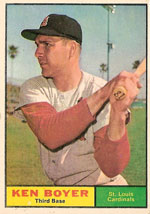
Santo, former Cubs third baseman, was deserving of election, but voters should do the right thing and elect former Cardinals third baseman Ken Boyer, too. To elect one without the other is an injustice.

The 16-person committee failed to elect Boyer when it met in 2011 and again in 2014, 2021 and 2024.

The committee considers players whose primes were between 1950 and 1969. Boyer and Santo each won the Gold Glove Award five times (Boyer, 1958, 1959, 1960, 1961 and 1963; Santo, 1964, 1965, 1966, 1967 and 1968).

Both were equals as fielders. The same was true as hitters.

Some give Santo the edge because he had more career home runs and RBI than Boyer, but Santo also had almost 700 more at-bats (8,143 for Santo and 7,455 for Boyer). The career numbers:

BOYER:  .287 batting average, 2,143 hits, 282 HR, 1,141 RBI.

SANTO: .277 batting average, 2,254 hits, 342 HR, 1,331 RBI.

Santo (.362) had a higher on-base percentage than Boyer (.349) and their slugging percentages were nearly equal _ .464 for Santo and .462 for Boyer.

In June 1963, Cardinals consultant Branch Rickey, generally considered a top evaluator of talent, told The Sporting News that Boyer is “the best third baseman in baseball today, with the bat, the arm and the legs. He’s the most underrated fielder. Take his bat away and this big fellow still is a great third baseman.”

A cover story by Dave Anderson in the 1965 season preview edition of Dell Sports magazine captured how highly regarded Boyer was during his prime. Boyer was named winner of the National League Most Valuable Player Award in 1964 when he led the Cardinals to the World Series championship. (Santo never played in a World Series.) Dell Sports assigned Anderson to do a piece about Boyer and the Orioles’ Brooks Robinson, with the angle that the duo might be the best third basemen of all-time.

“Take a good look this season at Ken Boyer and Brooks Robinson,” Anderson wrote. “Appreciate them now, while they’re at their peak. They’re two of the best third basemen in baseball history. Possibly the best ever. Surely they’re the two best ever to compete in the same era.

“Many old-timers consider it heresy to rate any of the current stars as the best ever at their positions, but Ken Boyer of the St. Louis Cardinals and Brooks Robinson of the Baltimore Orioles demand such recognition. None of the other current stars have invaded the history of their position the way Boyer and Robinson have at third base.”

Anderson interviewed former Pirates third baseman Pie Traynor, who was elected to the Hall of Fame in 1948 after excelling as a fielder and hitter (.320 batting average) from 1920-37.

Traynor told Anderson, “Boyer is a steady, great ballplayer. He’s the punch of the Cardinals. If he doesn’t drive in all those runs (119 in 1964), they don’t win the pennant last season, and if he doesn’t drive in runs in the World Series, they don’t win that.”

When Anderson noted Boyer had put together 10 spectacularly steady seasons, Traynor replied, “(Brooks) Robinson must do that. He had a big season last year (1964), but can he keep it up like Boyer?”

Robinson did have a wonderful career with Baltimore and was elected to the Hall of Fame in 1983, one year after Boyer died of cancer at 51.

In the book “Few and Chosen,” Ken Boyer’s brother, Clete Boyer, who played in five World Series during eight years with the Yankees, said, “If we changed places and Ken played in New York (during his prime), he’d be in the Hall of Fame.”