Feeds:
Posts
Comments

Tom Underwood’s time with the Cardinals was brief _ 19 games pitched in 1977 _ but he was an integral part of two trades that significantly shaped the St. Louis team.
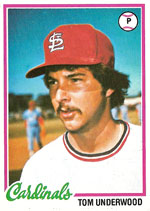
A left-handed pitcher, Underwood was the centerpiece of a controversial trade by the Cardinals that sent outfielder Bake McBride and pitcher Steve Waterbury to the Phillies on June 15, 1977. In addition to Underwood, the Cardinals got outfielders Dane Iorg and Rick Bosetti.

McBride was popular with Cardinals fans and players, but he feuded with first-year St. Louis manager Vern Rapp. McBride was the first Cardinal to defy Rapp’s hair-length code and he bristled at Rapp’s demand that McBride trim his mutton chop sideburns.

Because McBride had undergone knee surgery in 1976, Rapp wanted to move him from center field to right field and place Tony Scott in center. When McBride balked at the move, it triggered the trade to Philadelphia.

The Cubs thought they had a deal to acquire Underwood from the Phillies for outfielders Jose Cardenal and Greg Gross. When the Cardinals made McBride available, the Phillies dealt with St. Louis instead.

McBride, who batted .307 in five years with St. Louis, helped the Phillies to three division titles and the 1980 World Series championship.

Underwood was 6-9 with a 4.95 ERA (17 starts, two relief appearances) with St. Louis. He walked (57) almost as many as he struck out (66).

The Cardinals wanted Underwood because their only left-handed starter, Pete Falcone, was struggling and two other rotation members (Larry Dierker and John Denny) were slowed by injuries. At the time of the trade, Underwood was 23 and coming off consecutive winning seasons for the Phillies. The Cardinals envisioned him as a pitcher who could pay dividends for years.

As a Cardinal, Underwood was effective against left-handed batters (he held them to a .186 batting average with no home runs). Right-handed batters pounded him for a .299 batting average and seven homers.

In his nine losses with St. Louis, Underwood had a 7.82 ERA and opponents batted .363 against him.

Underwood’s best-pitched game for the Cardinals came against the Cubs in Wrigley Field on Sept. 6, 1977. He pitched a complete game, yielding six hits and a run while striking out eight in a 3-1 Cardinals victory. Catcher Ted Simmons homered, singled, walked, scored a run and drove in two.  Boxscore

On Dec. 6, 1977, Underwood and picher Victor Cruz were traded by the Cardinals to the Blue Jays for pitcher Pete Vuckovich and outfielder John Scott.

Vuckovich, a tough right-hander, pitched well (39-31, 3.21 ERA) in three years with St. Louis. He, along with Simmons and reliever Rollie Fingers, were dealt by the Cardinals to the Brewers in December 1980 for pitchers Dave LaPoint and Lary Sorensen and outfielders David Green and Sixto Lezcano. That trade was critical to the construction of the Cardinals and Brewers into pennant winners in 1982.

Underwood went on to pitch for the Blue Jays, Yankees, Athletics and Orioles. In an 11-year big-league career, he was 86-87 with a 3.89 ERA.
(Updated Nov. 25, 2019)

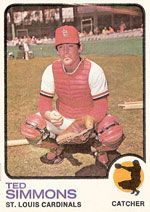
On Aug. 14, 1971, a Saturday night in Pittsburgh, Ted Simmons caught Bob Gibson’s no-hitter, produced four hits, scored three runs and drove in one in the Cardinals’ 11-0 victory. Boxscore

It was the only no-hitter in the career of the franchise’s best pitcher.
Simmons became the only catcher in franchise history to collect four hits while catching a no-hitter.

Simmons’ performance went a long way toward validating him as a quality catcher in the view of Gibson and others.

In control

Since early in his career, when he surrended a home run on a fastball he was ordered to throw by Carl Sawatski, Gibson never again let a catcher select a pitch for him.

“When I want to throw a pitch, that’s what I’m going to throw,” Gibson said in the book “Sixty Feet, Six Inches.” “If the catcher wants to fight about it, we’ll fight about it, but I’m not going to throw something I don’t want to throw.”

Regarding the pitcher and catcher relationship, Gibson said he believed the player with the most experience should “take the lead” in controlling a game. With Simmons, that meant Gibson always was in charge.

“Ted Simmons used to drive me crazy when he was a young catcher,” Gibson said. “One day he called time and came out to ask if I was giving him a hard time … I said, ‘I’m trying to win the ballgame. I don’t have the luxury of giving you a hard time.’ ”

Simmons caught 135 of Gibson’s starts. Only Tim McCarver (197) caught more. Simmons also caught 13 of Gibson’s shutouts. McCarver caught the most, 29.

“Simmons was a bright guy and he learned,” Gibson said. “It took him a while, but he caught on. As a rookie, all he thought about was hitting line drives, which he did very well. You can forgive a catcher for a lot of sins when he clears the bases with a double.”

In a June 1973 article by Bob Broeg for Baseball Digest, Simmons said, “Gibson is a picnic to catch because he works rapidly and is always around the plate with his pitches.”

In a November 2019 interview with Cardinals broadcaster Dan McLaughlin, Simmons recalled having trouble giving signs in his early encounters with Gibson.

“I was having difficulty, frankly,” Simmons said. “I’d never seen a guy pitch at that pace with such great stuff. So, trying just to get the fingers down and coordinate it throughout the game was a task for me.

“Finally, Gibson came to me and said, ‘Look, I only throw two pitches _ fastball, slider. You put down whatever you want. If I’m shaking, go to the other.’ So, if I put down fastball and he was shaking his head, I knew the pitch was going to be slider. That way, I wasn’t disrupting his pace.”

Heat is on

In his no-hitter against the Pirates _ the first in Pittsburgh since 1907 _ Gibson struck out 10 and walked three.

“He had two unhittable pitches (fastball and slider) and they couldn’t hit either one,” Simmons recalled in a 2020 interview with Stan McNeal of Cardinals Gameday Magazine.

Simmons contributed a RBI-single off Bob Johnson in the first, a double against Bob Moose in the fifth, and singles in the sixth and eighth off Bob Veale.

When Pirates slugger Willie Stargell struck out looking for the final out, Simmons raced to the mound, leaped and threw his arms around Gibson’s neck.

“That was the greatest thrill of my life, catching a no-hitter,” Simmons said to the St. Louis Post-Dispatch. “Man, he was throwing fire.”

Simmons had a premonition Gibson would get the no-hitter against the Pirates.

“Two nights ago, (teammate) Chris Zachary and I were having dinner, and I told him, ‘Gibson is going to pitch a no-hitter Saturday night,’ ” Simmons said. “I don’t know why, I just said it.”

(Updated Nov. 17, 2019)

On Nov. 17, 2010, four days before his 90th birthday, Stan Musial got an early gift with the White House announcement that he would be awarded the Presidential Medal of Freedom in 2011.

The greatest Cardinals player deserved the honor for many reasons. What made it extra special was the connection the award had to President John F. Kennedy.

President Harry Truman established the award in 1945 to honor exceptional World War II service. Kennedy reintroduced the award in 1963 to recognize civilian achievement.

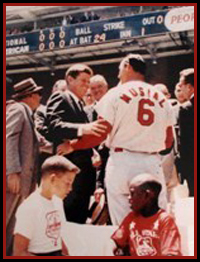
Musial and Kennedy bonded during the 1962 All-Star Game in Washington, D.C.

Before the game, JFK summoned Musial to his box seat at D.C. Stadium. Musial reminded the president they first met in September 1959 when Senator Kennedy was campaigning in Milwaukee for the 1960 Democratic presidential nomination.

“I was standing in front of the hotel, waiting for the bus for the game,” Musial told Joe King of The Sporting News, “and a man came up to me and said, ‘You are Stan Musial and I’m glad to meet you. I’m Jack Kennedy.’

“Of course I knew him,” Musial said. “And then he said, ‘You’re too old to play ball and I’m too young to be president, but maybe we’ll fool ’em.’

“I reminded the President of that remark when I went over to visit him, and he said he thought both of us probably were doing a good job.”

Musial, 41, appearing in his 22nd All-Star Game, batted for pitcher Juan Marichal in the sixth inning and lined a single to right on a two-strike curve from Camilo Pascual. Maury Wills ran for Musial, swiped second and scored the first run of the game on Dick Groat’s single. The National League won, 3-1.

Musial, wife Lillian and daughter Janet were given a VIP tour of the White House the next day and met with Kennedy.

The president presented Musial with a PT 109 tie pin and an autographed picture.

According to a report by The Sporting News, Kennedy and Musial talked baseball. Musial was asked about his home run total and whether he would surpass Ty Cobb for the all-time hits record.

When Musial was congratulated by White House staffers for his single in the All-Star Game, he replied, “I got a bigger kick out of the handshake with the President before the game.”

Told that Kennedy applauded his hit, Musial said with a smile, “The President is my buddy. When I shook hands with him, he told the people in his party what a good job of campaigning I did for him.”

In January 1964, after his retirement, Musial was named by President Lyndon Johnson as special consultant to the President’s Council on Physical Fitness, a program started in 1956 by President Dwight Eisenhower and popularized during the term of the youthful President Kennedy.

Former Cardinals catcher Ted Simmons was inducted into the St. Louis Sports Hall of Fame on Nov. 16, 2010. Before a crowd of 1,500 at a downtown St. Louis hotel, Simmons was part of the hall’s second induction class, joining former Cardinals pitcher Dizzy Dean and former Browns first baseman George Sisler.

Simmons told the St. Louis Post-Dispatch the honor was “staggering.”
He also was interviewed by television station KSDK. Among the highlights of the KSDK interview:

_ Asked about his approach to hitting and why he became known for line drives, Simmons said he adopted a stroke similar to teammate Matty Alou by making a “top down” swing on pitches and trying to avoid hitting high fly balls into the spacious outfield of Busch Stadium.

_ Regarding the St. Louis Hall of Fame induction, Simmons said “it means I’ve basically been accepted in this community after being here for 35 years.” He called it “a very special honor for me.”

Simmons also concluded his first season as manager of the Peoria Saguaros in the Arizona Fall League, an experience that enhanced his reputation as a talent evaluator.

In an article by Jack Magruder of FOXSportsArizona.com, Simmons talked about his first managerial effort and how much he enjoyed working  from the third-base coaching box while his team was at bat.

Among those interviewed for the article was Kevin Towers, general manager of the Diamondbacks, who said of Simmons, “He has a great baseball mind, an incredible baseball mind … He’s a good man. Very loyal. Tough.”

(Updated Jan. 16, 2019)

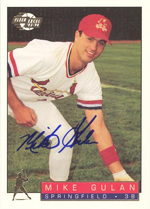
Third baseman Mike Gulan was the first prospect named Cardinals minor league player of the year when the award was introduced in 1995.

In 122 games combined for Class AA Arkansas and Class AAA Louisville, Gulan had 17 home runs, 26 doubles and 77 RBI in 1995.

When Gulan followed that with another 17 home runs for Louisville in 1996, there was talk he could be the successor to Cardinals third baseman Gary Gaetti.

Gulan, however, injured his right elbow during a winter workout after the 1996 season. As he prepared to leave his Steubenville, Ohio, home for spring training in 1997, he reinjured the elbow while lifting a suitcase. When he reported to camp at St. Petersburg, Fla., he learned he had torn ligaments in the elbow.

Slowed by the injury, Gulan was sent back to Louisville for the 1997 season.

He was hitting .222 with two home runs for Louisville when he got a pleasant surprise on May 13, 1997. The Cardinals, decimated by injuries, promoted him to the major leagues.

Gulan made his big-league debut the next night, May 14, 1997, in a game at Philadelphia. Starting at third base and batting sixth, he went 0-for-5 with two runs scored and a RBI. In the fifth inning, with runners on first and third and one out, Gulan grounded into a forceout, scoring Ray Lankford from third. Boxscore

“He has some ability,” Cardinals manager Tony La Russa said to the St. Louis Post-Dispatch. “He has nice hands, a nice arm and he has extra-base pop in his bat. So he’s a legitimate prospect.”

Gulan appeared in five games for the 1997 Cardinals, going hitless in nine at-bats, before being returned to Louisville.

In April 1998, the Cardinals released him. A month later, he signed with the Marlins. He spent more than three seasons in their minor-league system before getting a second chance at the majors. He went hitless again (0-for-6) in six games with Florida in 2001.

After playing in Japan in 2002, Gulan returned to the U.S. and played in the farm systems of the Pirates and White Sox. At 33, his playing career ended when he was released by the White Sox in July 2004.

(Updated Jan. 30, 2024)

Ted Simmons was elected to the National Baseball Hall of Fame on Dec. 8, 2019.

Here are 10 reasons the former Cardinals catcher deserved to be elected:

1. Among players whose primary position was catcher, Simmons ranks second all-time in each of three significant hitting categories: hits (2,472), RBI (1,389) and doubles (483). He trails only Yogi Berra (1,430) in RBI. Ivan Rodriguez leads in hits (2,844) and doubles (572).

Hall of Famer Paul Molitor, a teammate of Simmons with the Brewers, told “Memories and Dreams” magazine, “I played with Teddy and knew how he influenced the team, and his leadership, but it wasn’t until I took a good look at his career numbers and how they compared to other players that I realized what a great career he had.”

2.  Simmons was named to the all-star team eight times, six as a Cardinal.

3. Simmons had 90 or more RBI in a season eight times, six as a Cardinal. He led the Cardinals in RBI in seven consecutive seasons (1972-78). From 1971 through 1980, Simmons had more RBI than all but one player, Johnny Bench, in the National League, according to Cardinals Gameday Magazine.

In a 2020 interview with Stan McNeal of Cardinals Gameday Magazine, Simmons said of Bench, “We were different. Let’s say you were down three runs in the eighth and two men were on, then you might want Bench hitting. If you’re trailing by one with a man on second and two outs in the eighth, you might not want him. You might want me.”

4. A durable, tough athlete who toiled most of his summers in St. Louis’ searing heat, Simmons played in 150 or more games seven seasons (1972-78) in a row. He caught in 130 or more games in seven of his St. Louis seasons.

According to Cardinals Gameday Magazine, Simmons led the major leagues in games caught during the 1970s.

“The fact I caught as many games for as many years as I did in the St. Louis climate was my most memorable accomplishment as a player,” Simmons told Cardinals Gameday Magazine.

5. Simmons had a slugging percentage of .500 or better three seasons in a row (1977-80). That is remarkably consistent high-level production. Neither Bench nor Berra nor Carlton Fisk, for example, achieved .500 or better slugging percentages three straight years.

Al Hrabosky, a Cardinals reliever in the 1970s, told Cardinals Gameday Magazine, “Teddy was as pure a hitter as there was in the 1970s.”

6. He ranks third in career total bases (3,793) by a player whose primary position was catcher. Only Rodriguez (4,451) and Fisk (3,999) have more.

In the book “Late Innings,” Simmons talked hitting with author Roger Angell and explained that there is more than one kind of slider.

“If a pitcher holds the ball with his forefinger and middle finger between the wide part of the seams, out at that horseshoe-shaped part of the ball, you see a big, wide white spot when it’s pitched, sort of a flickering,” Simmons said to Angell. “The white one tends to hang. You can read the white one when it’s about three feet out of the pitcher’s hand.

“The better slider comes when he grabs the ball where the seams are close together. Then the red laces on the ball make a little red spot out there. That’s because the ball is spiraling so hard that it’s like the tip of a football that’s just been passed. The red dot sliders are the hard ones to hit _ like J.R. Richard’s. The red dot I can pick up about five feet from his hand.”

7. In 1975, Simmons established the National League single-season record at the time for most hits by a catcher. He hit .332 that year and 188 of his 193 hits came while in the lineup as a catcher.

8. In a franchise rich with success (11 World Series titles) and notable catchers (Roger Bresnahan, Walker Cooper, Tim McCarver, Darrell Porter, Tony Pena and Yadier Molina), Simmons is the best hitter of the bunch.

“What a hitter,” McCarver told Cardinals Gameday Magazine. “In 1973, he hit more line drives than anybody I have ever seen. He must have hit 400 balls on the button that year.”

9. While he wasn’t a great defensive catcher, he was much better than generally recognized. He twice (1972 and 1978) led NL catchers in assists, and twice (1976 and 1978) led NL catchers in number of runners caught attempting to steal.

Don Hood, who pitched 10 seasons in the major leagues, including with the 1980 Cardinals, told Larry Harnly of The State Journal-Register of Springfield, Ill.: “I respected Ted Simmons a lot. I believe in him. He worked well with me and mixed up the pitches well.”

In 2020, Hrabosky told the Baseball Hall of Fame Yearbook, “He could motivate me better than anybody I’ve ever been around. You wanted him catching you because he was going to win the game with his bat. Offensively, he was going to carry the load for us. He was as tough an out in the National League as there was in the 1970s.”

Pitcher Pete Vuckovich, a teammate of Simmons with the Cardinals and Brewers, told “Memories and Dreams” magazine, “If you were pitching to him, you didn’t have to think. Just bang the glove. He wasn’t given enough credit for that.”

10. In his book, “Tales from the Cardinals Dugout,” pitcher Bob Forsch touted Simmons for the Hall of Fame. Forsch said Simmons hit productively even though “he didn’t get leg hits, and we had nobody in the lineup to protect him.” (Simmons twice led the NL in intentional walks). As for Simmons’ defense, Forsch said, “He didn’t have a strong arm, but he got rid of the ball quick … and Teddy called a good game.”

Simmons caught Forsch’s 1978 no-hitter against the Phillies and he also caught Bob Gibson’s 1971 no-hitter versus the Pirates.

“Catching two no-hitters still ranks as a career highlight,” Simmons told Cardinals Gameday Magazine. “Somebody has to be back there, and I’m glad it was me. When pitchers are on like they were, the catcher just needs to make sure he doesn’t screw up.”