(Updated May 3, 2026)
Hall of Fame left-hander Warren Spahn never pitched for the Cardinals, but his final games as a pitcher were with the St. Louis organization.
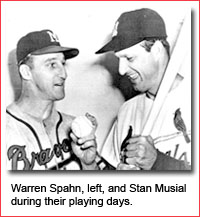 Spahn, who had 363 big-league wins, primarily with the Braves, got his first try at being a manager in 1967 with the Cardinals’ Class AAA Tulsa Oilers.
The Oilers were a team of former big-league veterans (pitcher Tracy Stallard, outfielder Joe Christopher) and a few prospects (pitchers Mike Torrez and Wayne Granger).
By August, Spahn’s pitching staff was weakened by injuries. So, at 46, he placed himself on the active roster and into the starting rotation.
Spahn had made his last big-league appearance in 1965, with the Giants. He pitched in three games with the Mexico City Tigers in 1966.
Former Braves catcher Joe Torre told Cardinals Yearbook in 2014, “Spahn was easy to catch, a walk in the park, because his control was impeccable.”
As Jim Brosnan noted in his book, “Great Baseball Pitchers,” when Spahn was in his prime “the path of his pitches was seldom straight. They wiggled, they sailed, they sank, they curved. Sometimes they looked faster than they were, for Spahn … changed the speed of his pitch without changing his motion during the delivery.”
On Aug. 7, 1967, a Monday night in Tulsa before a crowd of 4,238, Spahn started against the Hawaii Islanders and their 30-year-old right-hander, Bill Haywood. Catching for Tulsa was Pat Corrales.
Tulsa scored four times in the first. When Spahn held Hawaii scoreless through the first three innings, it appeared the old master was headed for a successful comeback. Then it fell apart. Hawaii scored a run in the fourth and four in the fifth, taking a 5-4 lead. After Spahn departed with one out in the fifth, the game unraveled in the hands of the bullpens. Tulsa won, 14-13.
Spahn’s line: 4.1 innings, 4 hits, 4 runs (3 earned), 4 walks and 4 strikeouts.
Five nights later, Aug, 12, Spahn started again, at Oklahoma City against the 89ers before a gathering of 1,028. When he left after two innings, Oklahoma City led, 3-0, and went on to win, 3-2, handing Spahn the loss in the last start of his professional career.
Spahn’s line: 2 innings, 3 hits, 2 runs, 1 walk, 1 strikeout.
Spahn also made a relief appearance, consisting of two-thirds of an inning, for Tulsa. In his three games for the Oilers, Spahn was 0-1 with a 6.43 ERA.
Spahn remained as Tulsa manager until 1971, but he never pitched again.
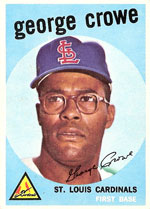 Acquired by the Cardinals from the Reds in an October 1958 trade, Crowe was 37, a veteran who had played in the Negro National League and who broke into the majors in 1952 with the Boston Braves.
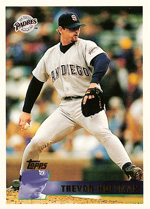 Against teams whom he faced at least 10 times in his career, Hoffman’s ERA was highest vs. St. Louis (4.09 in 51 regular-season games).
 Of the 257 regular-season home runs Gibson yielded in his career, 67 were hit by fellow Hall of Famers.
 Duren was a hard-throwing, hard-drinking pitcher with the Yankees from 1958-61. In 1964, he was 35 and a middle-innings reliever with the Reds.
 RetroSimba