Feeds:
Posts
Comments

Don Baylor filled a void by becoming the Cardinals’ hitting coach in 1992.

In 1991, the Cardinals went without a hitting coach. The duties were shared by manager Joe Torre and bench coach Red Schoendienst.
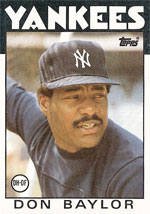
After the 1991 season, Torre and Baylor were participating in infielder Jose Oquendo’s golf tournament in Puerto Rico. Baylor had spent the 1990 and 1991 seasons as a coach on Brewers manager Tom Trebelhorn’s staff. When the Brewers fired Trebelhorn, Baylor applied to become manager and appeared to be a leading candidate, but the job went to Phil Garner.

Torre quietly approached Baylor at Oquendo’s golf tournament and invited him to become the Cardinals’ hitting coach. Baylor hit 338 home runs and had 1,276 RBI in a 19-year American League playing career (1970-88).

According to a report by Rick Hummel in The Sporting News, Baylor had interviewed for the Cardinals managerial job in 1990 before it went to Torre. Baylor was impressed Torre wouldn’t feel his job security was threatened by having him on the staff.

Baylor’s impact was substantial. Outfielders Ray Lankford and Bernard Gilkey, in particular, blossomed under Baylor’s instruction. Lankford, who hit .251 with nine home runs and 69 RBI in 1991, improved to .293, 20 homers and 86 RBI under Baylor in 1992. He led the Cardinals in 13 offensive categories that season. Gilkey’s batting average jumped from .216 in 1991 to .302 in 1992.

The 1992 Cardinals led the National League in batting average (.262) and hits (1,464) and ranked third in on-base percentage (.323).

After the season, the expansion Rockies hired Baylor to be their first manager. “We will miss his leadership and expertise,” Cardinals general manager Dal Maxvill said. “His importance to the Cardinals was demonstrated by the development of our young hitters last season, especially Lankford.”

The Cardinals replaced Baylor with Chris Chambliss.
(Updated Jan. 9, 2019)

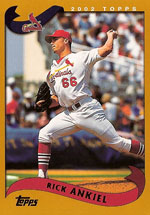
In October 2010, Rick Ankiel joined Babe Ruth and Smoky Joe Wood as the only big-league players since 1900 to appear in postseason games as starting pitchers and as starters at another position.

Ankiel started in center field for the Braves on Oct. 7, 2010, in Game 1 of the National League Division Series at San Francisco.

It was the first time Ankiel had started a postseason game at a position other than pitcher. Ankiel appeared in two games as a pinch-hitter for the Cardinals in the 2009 NL Division Series against the Dodgers, but didn’t start a game.

Ankiel’s first postseason starts were as a pitcher for the Cardinals in the 2000 NL Division Series against the Braves and in the 2000 NL Championship Series against the Mets.

Those performances were the start of Ankiel’s stunning slide from pitching phenom to flop.

After posting an 11-7 record and striking out 194 in 175 innings during the regular season, Ankiel got the start in Game 1 of the 2000 Division Series at St. Louis. The Cardinals struck for six runs in the first and kept a 6-0 lead heading to the third before Ankiel unraveled.

The rookie left-hander gave up four runs, four walks and five wild pitches in the inning before being lifted with two outs. Boxscore

St. Louis held on for a 7-5 win and eventually swept the series, advancing to face New York for the pennant.

In Game 2 of the NL Championship Series at St. Louis, Ankiel got the start, lasted two-thirds of an inning and yielded two runs, three walks, a hit and two wild pitches. The Mets won, 6-5, and went on to clinch the series in five games. Boxscore

Though Ankiel made a relief appearance in Game 5 of the series, his career as a pitcher was in tatters. He pitched in 11 more big-league games before successfully converting into a power-hitting outfielder.

The Society for American Baseball Research confirmed Ruth and Wood, like Ankiel, made postseason starts as pitchers and as outfielders.

Ruth started Game 2 of the 1916 World Series for the Red Sox against Brooklyn. He pitched 14 innings and earned the win, outdueling Sherry Smith in Boston’s 2-1 victory. Boxscore

Ruth also was the starting pitcher for Boston in two games of the 1918 World Series against the Cubs before he went on to star as baseball’s iconic slugging outfielder in seven World Series for the Yankees.

Wood started three games as a pitcher for the Red Sox against the Giants in the 1912 World Series. Eight years later, his pitching career cut short by a severe shoulder injury, he was the starting right fielder for the Indians in Game 1 of the 1920 World Series against Brooklyn. Boxscore

Ninety years later, Ankiel equaled the feat.

When Ankiel hit a home run for the Braves in Game 2 of the 2010 NL Division Series against the Giants Boxscore, he and Ruth became the only big-league players to both start a postseason game as a pitcher and hit a home run in the postseason as a position player.

Ankiel hit his postseason home run in the 11th inning on a fastball from Ramon Ramirez, snapping a 4-4 tie and carrying the Braves to a victory.

In his 2017 book “The Phenom,” Ankiel said, “The contact was so pure I could barely feel the ball off the bat … I don’t recall being happier on a baseball field than I was that October night in San Francisco.”

(Updated Dec. 8, 2024)

Tom Niedenfuer yielded two of the most famous home runs in Cardinals history.

As the closer for the Dodgers in 1985, Niedenfuer gave up the game-winning home run to Ozzie Smith in the ninth inning of Game 5 of the National League Championship Series, leading to broadcaster Jack Buck’s memorable call of “Go crazy, folks. Go crazy.”
With the score tied at 2-2, Niedenfuer relieved starter Fernando Valenzuela in the bottom of the ninth. He retired Willie McGee on a pop-up, but then threw a pitch down and in that Smith golfed over the fence in right for a 3-2 Cardinals win.  Boxscore

In a 2010 interview with Jerry Crowe of the Los Angeles Times, Niedenfuer said the pitch was supposed to be up and in. He said the homer by Smith was a fluke because it was the shortstop’s first in the big leagues while batting left-handed. Story

(Recalling the homer in a 2016 interview with Cardinals Yearbook, Smith said, “When I walked to the plate, my intention was not to hit the ball out of the ballpark because that’s not what I do. My job was to get myself in scoring position and let the big guys drive me in. {Niedenfuer} supplied the power and I supplied the technique.”)

Two days after the Smith homer, the Dodgers led 5-4 after eight innings of Game 6 at Los Angeles. Though Niedenfuer already had pitched 1.2 innings in relief of Orel Hershiser, manager Tommy Lasorda sent Niedenfuer to pitch the ninth.

After Cesar Cedeno struck out, McGee singled and swiped second. Smith walked. When Tom Herr grounded out to first, McGee and Smith each advanced a base. With first base open and the Dodgers an out away from squaring the series, Jack Clark, the Cardinals’ top power hitter, strode to the plate.

Niedenfuer told the Times he and Lasorda never considered issuing an intentional walk to Clark because a left-handed batter, Andy Van Slyke, was on deck, and because Niedenfuer had struck out Clark in the seventh on a fastball off the plate. Niedenfuer wanted to start off Clark with the same pitch.

This time, Clark ripped it 450 feet to left for a three-run homer that gave St. Louis a 7-5 lead. When Ken Dayley retired the Dodgers in order in the bottom of the inning, the Cardinals were National League champions and Niedenfuer was the goat. Boxscore

Afterward, describing Clark’s homer to The Sporting News, Niedenfuer said, “The only way that thing would have stayed in the park was if it had hit the Goodyear blimp and dropped straight down.”

Two days later, a resilient Niedenfuer played golf with Hall of Fame pitcher Sandy Koufax, “and then I started working out for next year.”

Niedenfuer, though, never was the same. The Dodgers dealt him to the Orioles in May 1987. He signed with the Mariners as a free agent for 1989. When Seattle released him in April 1990, the Cardinals signed him.

In 52 appearances, Niedenfuer was 0-6 with two saves and a 3.46 ERA for a St. Louis team that finished in last place in the East Division.

It would be Niedenfuer’s final season in the major leagues.

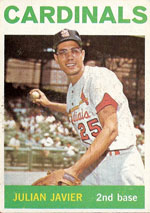
If not for the timely hitting of the Cardinals’ Julian Javier, baseball fans would have been talking about the third no-hitter in postseason history, not the second, when Roy Halladay pitched his gem on Oct. 6, 2010, for the Phillies against the Reds.

Javier, St. Louis’ second baseman, doubled with two outs in the eighth inning in Game 2 of the 1967 World Series to break up the no-hit bid of Boston’s 25-year-old ace, Jim Lonborg.

Until Halladay pitched his no-hitter in Game 1 of the National League Division Series, Lonborg had come closest to pitching a hitless game in the postseason since Don Larsen did it for the Yankees against the Dodgers in Game 5 of the 1956 World Series.
Lonborg retired the first 19 batters before Curt Flood walked on a 3-and-2 pitch with one out in the seventh in that second game of the World Series at Boston on Oct. 5, 1967. He then got Roger Maris on a flyout and Orlando Cepeda on a groundout to end the inning.

In the eighth, with anticipation building and a light rain falling, Tim McCarver and Mike Shannon grounded out. Lonborg was four outs from a no-hitter.

Javier, a right-handed batter, stepped to the plate. A .257 career hitter, Javier had produced one of his best seasons in 1967, hitting .281. Lonborg’s first pitch to him was a “high slider that hung up a bit.” Javier ripped it into the left field corner.

Bobby Tolan followed with a groundout, and Lonborg retired the Cardinals in order in the ninth, giving the Red Sox a 5-0 win and evening the series. Boxscore

Lonborg later revealed he achieved the one-hitter despite developing a blister on his right thumb that kept him from getting a proper grip on his breaking pitches. “If I hadn’t gotten the blister, I might have been able to get Javier,” Lonborg told The Sporting News.

Lonborg pitched effectively inside. Cardinals manager Red Schoendienst complained that Lonborg purposely was delivering brushback pitches, a charge Lonborg denied.

Despite Lonborg’s dominance, the Cardinals were reluctant to praise him. “He’s not quick, but he keeps the ball in good spots,” said St. Louis speedster Lou Brock. “He’s no Juan Marichal or Gaylord Perry.”

In Game 5, Lonborg pitched a three-hitter, winning 3-1. The Cardinals got the upper hand in Game 7, winning 7-2 behind Bob Gibson and knocking out Lonborg after 6 innings. The decisive blow: Javier’s three-run home run off Lonborg.

(Updated Dec. 16, 2019)

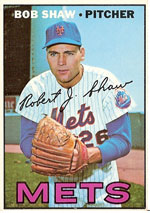
Bob Shaw outdueled Sandy Koufax in a World Series game, taught Gaylord Perry how to throw the spitball and frustrated the Cardinals after he joined the Mets.

Shaw started Game 5 of the 1959 World Series for the White Sox and beat Koufax and the Dodgers, 1-0, before more than 92,000 spectators at the Los Angeles Memorial Coliseum. Boxscore
Five years later, Shaw was with the Giants and became a mentor to Perry, a future Hall of Famer.

In his book “Me and the Spitter,” Perry said Shaw’s spitball was “one of the best I’ve ever seen.” After seeing how Shaw’s spitball fooled batters, Perry said, “I knew how Tom Edison felt when he discovered the electric light.”

“Bob and I worked for hours,” Perry said. “I studied his every movement. The old dew drop takes total dedication, like any new pitch you learn, only more so.”

On June 10, 1966, the Giants sold Shaw’s contract to the Mets.

Three days, later, on June 13, 1966, he made his Mets debut in a start against the Cardinals in Game 1 of a Monday night doubleheader at Shea Stadium and pitched a five-hitter, beating the Cardinals, 5-2. Shaw allowed one extra-base hit, a triple by Phil Gagliano. Using the bat of teammate Ken Boyer, Shaw also singled twice in three at-bats against Al Jackson. Boxscore

Shaw said he was motivated to pitch a complete game because he had something to prove to the Giants and their pitching coach, Larry Jansen, “who didn’t think I could go more than six innings,” Shaw told The Sporting News.

Eight nights later, on June 21, 1966, in St. Louis, Shaw started against the Cardinals again and beat them, 2-1, on a four-hitter, walking none and striking out nine. Tim McCarver’s solo home run in the seventh cut in half the Mets’ 2-0 lead, but Shaw retired the Cardinals in order in the eighth and ninth. Boxscore

The Cardinals said Shaw threw a spitball and repeatedly asked the umpire to check the ball.

“It’s a psychological advantage,” Shaw said to the New York Daily News. “If you get them thinking that way, it’s the greatest thing in the world.”

Cardinals manager Red Schoendienst told the St. Louis Post-Dispatch “there’s no question that Shaw throws a spitter,” but said, “You just have to learn to hit it, wet or not.”

Cardinals pitcher Tracy Stallard said, “Spitball or not, Shaw pitched quite a game. You’ve got to admire him. He battles you and that’s the name of the game.”

Said Cardinals shortstop Dal Maxvill: “The way Shaw was throwing tonight, he wouldn’t give his own mother a good pitch to hit.”

Shaw went on to post an 11-10 record and 3.92 ERA in 25 starts for a Mets team that finished in ninth-place at 66-95.

The next year he pitched for the Mets and Cubs, ending an 11-year big-league career that began in 1957 with the Tigers.

Shaw became a successful commercial real estate developer and youth baseball coach in Jupiter, Fla. He managed a team from Jensen Beach, Fla., to the American Legion World Series championship in 1986.

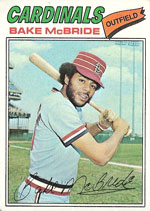
The passing of former Phillies pitcher Wayne Twitchell on Sept. 16, 2010, brought to mind one of the most electrifying performances in the career of Cardinals speedster Bake McBride.

In the Phillies’ home opener on April 11, 1975, McBride sparked the Cardinals to a 6-3 victory with a three-run inside-the-park home run to center field against Twitchell. Boxscore

McBride, a left-handed batter, went 4-for-5 with four RBI and two runs scored that night. Against Twitchell, who started and lasted five innings, McBride was 3-for-3.  He singled in the first, homered in the third and singled again in the fifth.

His home run came after Lou Brock singled and Ted Sizemore walked. McBride then drove a Twitchell pitch into center field and circled the bases.

McBride tormented Twitchell throughout his career, hitting .480 (12-for-25) against him.

In a twist of fate, the Phillies made trades involving McBride and Twitchell within minutes of one another on June 15, 1977.

After falling short in an aggressive bid to acquire pitcher Tom Seaver from the Mets (Seaver was dealt to the Reds instead), the Phillies traded Twitchell and catcher Tim Blackwell to the Expos for catcher Barry Foote and pitcher Dan Warthen.

With the trade deadline rapidly approaching, the Phillies then acquired McBride and pitcher Steve Waterbury from the Cardinals for pitcher Tom Underwood and outfielders Dane Iorg and Rick Bosetti.

The deal upset the Cubs, who thought they had a commitment from the Phillies to send them Underwood for outfielders Jose Cardenal and Greg Gross.

McBride became expendable because first-year Cardinals manager Vern Rapp preferred Tony Scott in center field and because the Cardinals were concerned about McBride being slowed by shoulder and knee problems. McBride also had clashed with Rapp over the club’s ban on facial hair and long sideburns.

McBride gave the Phillies an effective leadoff batter. He helped them to division titles in 1977 and 1978, and to a World Series championship in 1980.

Twitchell, a 6-foot-6 right-hander, had been named to the 1973 National League all-star team. Writing about the trades in the July 2, 1977, edition of The Sporting News, Ray Kelly suggested the Phillies “were reluctant to let him (Twitchell) go because he’s one of the hardest throwers around.”

Twitchell went from the Expos to the Mets and then the Mariners.

His last big-league season was 1979 and he finished his career with a 48-65 record.