Feeds:
Posts
Comments

(Updated April 18, 2020)

Which pitcher had the most impressive big-league debut for the Cardinals?
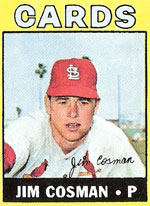
The answer may be Jim Cosman.

Cosman, a right-hander, pitched a two-hit shutout in his first major-league game, a 2-0 Cardinals win over the Cubs on Oct. 2, 1966, in St. Louis.

Cosman’s line: 9 innings, 2 hits, 0 runs, 2 walks, 5 strikeouts and 1 batter hit by pitch.

The Cubs’ only hits were singles by Ron Santo in the second inning and by Glenn Beckert in the ninth. Beckert’s hit knocked the glove off Cosman’s hand, the St. Louis Post-Dispatch reported. Among those held hitless were Billy Williams (0-for-3 and a walk) and Ernie Banks (0-for-3).

The game, the season finale for both clubs, was played in 1 hour, 46 minutes. Boxscore

Cosman, who was 10-2 for minor-league Tulsa in 1966 before being called up to the Cardinals in September, was a surprise choice of manager Red Schoendienst to start against the Cubs.

“I was running in the outfield when I first found out I was supposed to pitch, about 45 minutes before game time,” Cosman told the Post-Dispatch.

A hard thrower, “Cosman’s primary needs are improved control and better breaking stuff,” The Sporting News noted.

Cosman appeared in just 11 more big-league games _ 10 in 1967 for the Cardinals and one in 1970 for the Cubs. He was 1-0 with a 3.16 ERA for the 1967 Cardinals, but had more walks (24) than strikeouts (11) and also hit five batters with pitches in 31.1 innings.

In an effort to help him with his command, Cardinals pitching coach Billy Muffett had Cosman try pitching without a windup. “Cosman had to do something about his wildness,” Muffett said. “The no-windup enabled him to keep his eye on the target.”
(Updated Sept. 1, 2018)

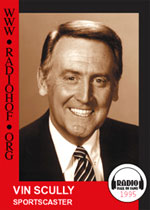
On a Cardinals pregame radio show from Los Angeles June 9, 2010, Mike Shannon had Dodgers broadcaster Vin Scully as his guest. When Shannon asked Scully about the long rivalry between the Dodgers and Cardinals, Scully launched into a story to illustrate the intensity that existed in the series.

According to Scully, Brooklyn’s Carl Furillo lined a shot that struck Cardinals pitcher Cloyd Boyer in the throat. Scully told how Boyer dropped to the ground and reached for his throat as if trying to pry an imaginary pair of hands that were strangling him.
As Furillo went up the line toward first base, he apparently was jawing at Boyer. Furillo supposedly was yelling, “Choke, you so-and-so. Choke!” Scully said.

The incident occurred on July 17, 1950, in Game 1 of a doubleheader at Sportsman’s Park in St. Louis. Boxscore

How impressive it was to hear Scully tell the tale 60 years after he witnessed it.

Boyer entered the game in the eighth inning in relief of starter Gerry Staley and the first batter he faced was Furillo, who hit a line drive toward the pitcher. The ball struck Boyer “hard on the right thumb, glanced off and slammed against his throat,” Dick Young of the New York Daily News reported.

Although Boyer retrieved the ball and threw to first base in time to get Furillo, “he almost fainted a moment later, gasping for breath,” the Daily News reported. “His mates had him lie on the hill for several minutes, regaining his wind.”

Once he was certain he could breathe freely, Boyer got to his feet and was able to walk off the field.

X-rays of the thumb disclosed no fracture, “but a ruptured blood vessel at the heel of his hand will keep him idle for perhaps a week,” the Daily News reported. “At that, he’s lucky he’s alive. Getting his hand in the way of Furillo’s comeback bullet just in time to prevent it from tearing into his neck probably saved the guy’s life, or at least his voice.”

Boyer “barely escaped worse injury when a Carl Furillo line drive glanced off his hands and struck him on the Adam’s apple,” Baseball Digest reported. “But the gallant hurler scrambled to his feet, threw out the batter and then collapsed.”

The Sporting News called Boyer a “hard-luck rookie right-hander” and reported Furillo’s liner “bruised his right hand at the base of the thumb and glanced against his windpipe, momentarily taking the kid’s wind.”

(Updated Jan. 7, 2019)

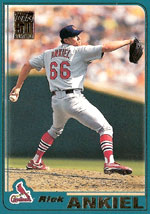
Rick Ankiel was a highly regarded pitching prospect and his major-league debut with the Cardinals was much anticipated.

Ankiel, 20, made his debut on Aug. 23, 1999, at Montreal against the Expos. His official line: five innings, five hits, three runs, two walks and six strikeouts.
It should have been good enough to win, but it wasn’t.

After facing one batter in the sixth inning, Ankiel was lifted with a 4-2 lead. Reliever Heathcliff Slocumb allowed the inherited runner to score, and Slocumb and Rich Croushore combined to yield eight more runs. The Expos won, 11-7.  Boxscore

Ankiel allowed one home run, a solo shot by Vladimir Guerrero.

Impressed by Ankiel, Expos manager Felipe Alou told the St. Louis Post-Dispatch, “He’s for real … God willing that he stays healthy, I think he’s going to be some kind of pitcher.”

Ankiel went on to make nine appearances for the 1999 Cardinals and was 0-1 with a 3.27 ERA and 39 strikeouts in 33 innings.

In his book “The Phenom,” Ankiel said of his 1999 stint in the big leagues, “None of it felt like it was too much. I didn’t feel too young or too raw. I certainly wasn’t nervous. Not ever.”

In spring training 2010, ESPN reported the possibility of an Albert Pujols-for-Ryan Howard trade. It wasn’t the first time a spectacular trade report was linked to a Cardinals franchise player.

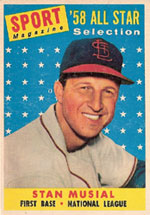
In August 1959, The Sporting News pubished a trademarked Page 1 story by publisher J.G. Taylor Spink reporting the Cardinals would trade Stan Musial to the Yankees for catcher and St. Louis native Yogi Berra.

Given the reputation of The Sporting News as “the Bible of baseball” and of Spink, who is in the writers’ wing of the Baseball Hall of Fame, the report had credibility.

Under the headline “Musial to Yanks — Berra a Redbird,” Spink wrote in the Aug. 26, 1959, edition that “Musial will go from the Cardinals for Yogi Berra … Both clubs may deny that the deal is in process or that there is any thought of it. But The Sporting News’ authority states convincingly that the trade already is in the works.”

A Cardinals spokesman confirmed Eddie Stanky, player development director and special assistant to general manager Bing Devine, was in New York, scouting the Yankees, in August 1959.

The trade never happened, but it makes one wonder about the possibilities. The Yankees would have had an all-star outfield of Musial in left, Mickey Mantle in center and Roger Maris in right. Musial played four more seasons (1960-63) for the Cardinals. The Yankees won pennants in all four of those seasons, primarily with Hector Lopez in left field.

Devine said The Sporting News story was “ridiculous” and Musial laughed about it, the St. Louis Post-Dispatch reported.

The Sporting News said Musial, 38, didn’t fit into the 1960 plans of Cardinals manager Solly Hemus, but Hemus told the Associated Press, “Stan definitely fits into our plans and I feel sure he will do us some good.”

In a brief followup on Page 8 of the Sept. 2, 1959, edition, The Sporting News said Cardinals owner Gussie Busch issued a “special statement” declaring Musial never would be traded.

“When Stan retires from baseball, it will be in a Cardinal uniform,” Busch said. “… Stan Musial is and always will be a Cardinal.”

(Updated Jan. 6, 2025)

Johnny Mize played six seasons for the Cardinals (1936-41) and never for a championship team in St. Louis, but he left a legacy as a slugger supreme.

Mize was the first to hit three home runs in a game four times as a Cardinal.

Mize achieved the feat in two seasons: doing it twice in 1938 and twice in 1940.
Here’s a look at how he did it:

_ July 13, 1938: Entering the game with just five home runs for the season and only one since June 5, Mize hit three consecutive homers against Jim Turner of the Braves, but Boston won, 10-5, at St. Louis. Mize hit a two-run shot in the fourth, a solo homer in the fifth and a two-run homer in the eighth. Boxscore

_ July 20, 1938: In Game 2 of a doubleheader at St. Louis, Mize hit two home runs off starter Slick Castleman (in the first and third innings) and another off Bill Lohrman (in the eighth) in a 7-1 Cardinals victory before a home crowd that included Missouri governor Lloyd Stark and St. Louis mayor Bernard Dickmann.

“Mize sent the crowd into ecstacies of joy by hitting three home runs in one game for the second time in eight days,” the St. Louis Globe-Democrat reported. Boxscore

_ May 13, 1940: Played on a Monday afternoon at Crosley Field in Cincinnati, this was one of the most unusual games in Cardinals history. Boxscore

The game was called because of darkness with the score 8-8 after 14 innings. All statistics counted, but the tie didn’t count in the standings and the game was replayed as part of an Aug. 11 doubleheader.

Although there were lights at Crosley Field, a National League rule prohibited lights from being turned on to finish a day game.

Mize hit homers off Reds ace Johnny Vander Meer in the second and third innings. His 13th-inning homer off Milt Shoffner gave the Cardinals an 8-7 lead. Cincinnati scored in the bottom of the 13th.

“Mize is a grand hitter in anybody’s ballpark,” the Dayton Herald declared, “but he has a great fondness for staging field days at the Crosley lot.” (Mize hit 22 career homers at Crosley Field.)

_ Sept. 8, 1940: In Game 1 of a doubleheader at St. Louis, Mize slugged home runs in three consecutive at-bats, but the Pirates won, 16-14.

According to the St. Louis Star-Times, “Those three straight mighty Mize blasts onto the pavilion roof afforded the crowd a good excuse for straw-hat throwing and loud vocal demonstration.” Boxscore

Mize had two other three-homer games: for the Giants in 1947 and for the Yankees in 1950.

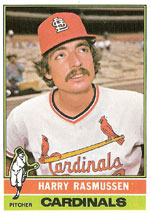
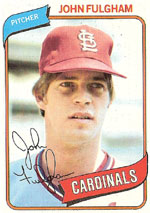
When P.J. Walters earned his first big-league victory for the Cardinals at San Diego on May 27, it reminded me of listening on KMOX in the 1970s to a couple of other Cardinals pitchers, Eric Rasmussen and John Fulgham, do the same.

Harry Rasmussen 1976 ToppsI researched it this week and found that Walters is the fourth Cardinals pitcher to get his first major-league win at San Diego against the Padres. Here’s a look at the other three:
_ July 21, 1975, Cardinals 4, Padres 0, at San Diego. Harry Rasmussen, a right-hander, made his big-league debut for the Cardinals and pitched a complete-game shutout (Rasmussen legally changed his first name from Harry to Eric about two years later).

Rasmussen yielded seven hits and a walk, and struck out seven. Two Hall of Famers, Dave Winfield and Willie McCovey, were in the lineup for San Diego. Winfield went 0-for-4 and McCovey went 1-for-3.

_ June 19, 1979, Cardinals 7, Padres 2, at San Diego. John Fulgham, a right-hander, made his big-league debut for the Cardinals and pitched a complete game.
Both Padres runs were unearned. Fulgham allowed eight hits and a walk, and struck out six. Dave Winfield went 1-for-4; another Hall of Famer, Ozzie Smith, was 0-for-3.

A fun twist: the Padres starter and losing pitcher was … Eric Rasmussen.

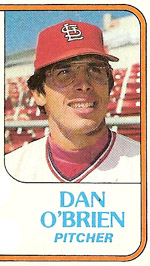
_ August 31, 1979, Cardinals 8, Padres 7, 15 innings, at San Diego. Dan O’Brien, a right-hander, pitched two scoreless innings of relief to earn the win. It was his first and only big-league victory.

After Jerry Mumphrey singled and scored on a double by Keith Hernandez in the top of the 15th, O’Brien retired Ozzie Smith, Gene Tenace and Dave Winfield in order in the bottom half of the inning.

The Cardinals catcher in all three of those games: Ted “Simba” Simmons.

Here are links to boxscores of those games, courtesy of retrosheet.org:

July 21, 1975, Cardinals 4, Padres 0

June 19, 1979, Cardinals 7, Padres 2

August 31, 1979, Cardinals 8, Padres 7