Feeds:
Posts
Comments

Diego Segui brought much-needed relief to the Cardinals.
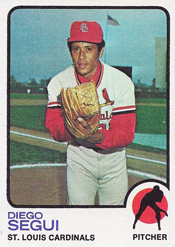
On June 7, 1972, the Cardinals bought the contract of Segui from the Athletics.

A right-hander whose best pitch was a forkball, Segui gave the Cardinals a quality closer. Before acquiring him, the 1972 Cardinals totaled one save. The year before, their save leader had eight.

As the St. Louis Post-Dispatch noted, Segui “arrived to breathe life into a bullpen that had been horrible.”

From ranch to diamond

Segui was born and raised in southeastern Cuba near the seaport city of Santiago. His father was a ranch foreman who taught his son to rope horses and cattle. “I was pretty good with a lasso,” Segui told the Post-Dispatch.

The work strengthened his hands and helped Segui become a pitcher able to grip a variety of pitches.

He was 20 and pitching for the Tucson Cowboys of the Arizona-Mexico League when the Kansas City Athletics signed him on the recommendation of their scout, former big-league outfielder Al Zarilla. Segui entered their farm system in 1959 and reached the majors with the Athletics in 1962.

While with Kansas City, Segui met the woman he married, Emily. They were introduced by the mother of Athletics catcher Joe Azcue.

Segui developed a forkball, so named because the ball was held in the fork of the hand, between the forefinger and middle finger.

“A pitcher must have reasonably long and flexible fingers to throw the forkball, which is one reason it is not a common pitch,” the Kansas City Star noted. “The forkball is thrown with the same motion as a fastball, but the velocity is much slower and the ball breaks down as it reaches the plate.”

Segui pitched at a deliberate pace. As the Oakland Tribune observed, “He rubs up the ball between every pitch _ even during intentional walks _ straightens out the Virgin Mary medallion he wears around his neck, counts his fielders, steps off the mound to blow on his hand, and smooths the dirt in front of the rubber.”

Come and go

Segui pitched for Kansas City from 1962-65, got traded to the Senators, spent 1966 with them and was reacquired by the Athletics.

After two more seasons with the Athletics, Segui was selected by the Seattle Pilots in the American League expansion draft, pitched in their first regular-season game and finished the season with 12 wins and 12 saves. Boxscore

The Athletics, who had relocated to Oakland, reacquired him again, and Segui posted a 2.56 ERA, best in the American League, for them in 1970.

Rich with starting pitching (Catfish Hunter, Vida Blue, Ken Holtzman) and relievers (Rollie Fingers, Bob Locker, Darold Knowles) in 1972, their first of three consecutive World Series championship seasons, the Athletics didn’t have enough work for Segui, prompting the deal with the Cardinals.

When informed he’d be leaving the Athletics for the third time, Segui told the Oakland Tribune, “Maybe I’ll get a chance to pitch for St. Louis, but I would rather have stayed on this club and not pitched.”

Good impression

Segui’s perspective changed after he experienced immediate success with the Cardinals. In his National League debut, he pitched three scoreless innings against the Giants and got the win. Boxscore

“He has a hard slider that breaks at the last second,” Cardinals catcher Ted Simmons told the San Francisco Examiner. “His forkball is murder on a left-handed batter, dropping off the table.”

Two nights later, Segui got his first Cardinals save with 1.2 scoreless innings versus the Padres. Boxscore

“When a guy can throw strikes and has an out pitch like his forkball, you’re in business,” Simmons told the Post-Dispatch. “Segui has a fantastic forkball. It looks like a fastball to the batter, and before you know it, wham, the ball is by you.”

Orioles scout Jim Russo told columnist Bob Broeg, “In Segui, they’ve got one of their best pickups of late. He’s a nice guy, a good man on a club, and he knows how to pitch.”

Segui, who turned 35 two months after joining the Cardinals, finished the 1972 season as the team leader in saves (nine) and relief outings (33). He was 3-1 with a 3.07 ERA. Batters hit .184 against him with runners in scoring position. Video at 30-second mark

Say hey, Segui

Segui followed up with a strong season for St. Louis in 1973. He led the club in saves (17) and games pitched (65), posting a 7-6 record and 2.78 ERA. He struck out 93 in 100.1 innings and allowed a mere 78 hits.

“You wish you had 25 men like him,” Cardinals player personnel director Bob Kennedy told the Post-Dispatch. Kennedy was Segui’s manager with the 1968 Athletics.

“You couldn’t ask for a better guy,” Kennedy said. “He’s one of the finest men I’ve known in baseball.”

Segui had a couple of interesting matchups in 1973 with Willie Mays, 42, who was with the Mets in the final season of his Hall of Fame career.

On July 26 at St. Louis, with the Cardinals ahead, 2-1, in the ninth, the Mets had a runner on base, two outs, when Segui struck out Mays on a forkball to end the game. Boxscore

A week later, on Aug. 3 at New York, Mays, batting .207 for the season, faced Segui in the seventh, with two on, two outs and the Mets ahead, 4-3. Mays got a low inside fastball from Segui and hit it over the wall in center for a three-run home run. Boxscore

“I was just looking for something fast, and there it was,” Mays said to the Associated Press.

The home run was the 659th of Mays’ career. He hit his last, No. 660, two weeks later against Don Gullett of the Reds.

Family and fishing

After the season, the Cardinals swapped Segui, pitcher Reggie Cleveland and infielder Terry Hughes to the Red Sox for pitchers John Curtis, Mike Garman and Lynn McGlothen.

“Segui really did a job for us,” Cardinals manager Red Schoendienst told the Boston Globe, but he said Segui became expendable with the emergence of Al Hrabosky as a potential closer.

Segui pitched in a World Series with the Red Sox in 1975.

His final season in the majors was in 1977 with the expansion Seattle Mariners. Segui, who turned 40 that year, was their Opening Day starting pitcher. Naturally, he was called the “Ancient Mariner.” Boxscore

Segui is the only player to appear in games for both the Seattle Pilots and Seattle Mariners.

He continued to pitch professionally until 1984, when he turned 47 and earned 10 wins for Leon, a Mexican League team managed by ex-Cardinal Benny Valenzuela.

Diego and Emily Segui raised four children. One of them, David, played 15 seasons in the majors, just like his father did. Primarily a first baseman, David hit .291 for his career.

When David was a youngster, his father played baseball all year, including winters in the Caribbean. To fill the void, Emily would “play catch in the backyard and hit fungoes to David to help him work on his defensive skills,” the New York Times reported.

“All the credit must go to my wife,” Diego told the New York Daily News. “If my wife never takes him to play, and hitting ground balls, he would never be what he is.”

After seven years as a minor-league pitching coach for the Giants, Diego Segui retired in Kansas City and pursued his lifelong passion for fishing. He became an accomplished bass fisherman who excelled in local tournaments.

“In March, I won $2,200 for catching one fish,” Segui told the Kansas City Star in 1998. “When I broke into the big leagues, I made $6,000 a year. I made more in one cast than I would make in four months back in those days.”

One look at Jimmie Reese was all it took for the Cardinals to entrust him with a position held by a future Hall of Famer.

On June 4, 1932, the Cardinals purchased Reese’s contract from the minor-league St. Paul Saints.
On his first day with the Cardinals, Reese fielded so well at second base that manager Gabby Street kept him there the rest of the season and shifted Frankie Frisch to third.

A scrapper who energized the lineup, Reese had a short stint with the Cardinals, but a long career in baseball.

Hymie to Jimmie

Hyman Solomon was born in New York City in October 1901, a “son of an Irish mother and a Jewish father,” according to Red Smith of the St. Louis Star-Times.

The father suffered from tuberculosis and the family moved to Los Angeles when Hymie was 5. Hymie’s dad died a year later, according to the Star-Times.

The mother remarried and Hymie changed his name. Hymie was anglicized into Jimmie, and Solomon was dropped in favor of the last name of his mother’s second husband, Reese, the Orange County Register reported.

Jimmie Reese had a passion for baseball. In 1917, when he was 15, he became a bat boy for the minor-league Los Angeles Angels of the Pacific Coast League. From then until 1994, when he died at 92, Reese was employed in professional baseball over nine decades.

A left-handed batter, Reese was a second baseman with the Oakland Oaks of the Pacific Coast League before his contract was purchased by the Yankees.

Babysitter for Babe

In 1930, Yankees manager Bob Shawkey assigned Reese to be the road roommate of Babe Ruth because he hoped the clean-cut rookie might be a good influence on the notorious playboy. Ruth liked Reese and treated him well, but didn’t change his lifestyle. As Reese fondly said, “I roomed with his suitcase.”

Reese excelled as a pinch-hitter and backup at second to future Hall of Famer Tony Lazzeri. Reese hit .346 overall in 1930 and had a .519 on-base percentage as a pinch-hitter (12 hits, two walks, 27 plate appearances).

Just as impressively, Reese earned the respect of his star-studded teammates for his professionalism and demeanor. “A prince among good fellows,” Lou Gehrig wrote on a photo he autographed for Reese.

After wrenching a knee in spring training and hitting .241 in 1931, Reese was traded by the Yankees to St. Paul.

Dazzling debut

Being sent back to the minors “knocked me out,” Reese told the Star-Times. “I was broken-hearted and I couldn’t get the old spirit back. I was a complete flop in St. Paul.”

When told during a road trip to Milwaukee that his contract had been purchased by the Cardinals, “I never was so happy in my life,” Reese said.

Reese departed Milwaukee by train the night of June 4, 1932, and arrived in St. Louis the next day, just in time for the Cardinals’ doubleheader against the Reds.

With Frisch out because of leg ailments, Reese started at second base in both games, singled in his first at-bat as a Cardinal, and dazzled on defense.

With a runner on first, the Reds’ Mickey Heath “hit a sharp grounder toward second base. It looked like a sure hit, but Reese raced over for a pretty stop, stepped on the bag and then, still in full stride, cocked an eye toward first and flipped the ball to Rip Collins for a double play,” the St. Louis Post-Dispatch reported. Boxscore

For the doubleheader, Reese handled 18 chances without an error, turned five double plays, totaled two hits and a walk, and scored a run. Boxscore

Displaying desire

When Frisch returned to the lineup June 8, he moved to third base and Reese stayed at second. Three days later, Reese collided with Dodgers catcher Al Lopez and tore shoulder ligaments. After sitting out 10 days, Reese “came back, his shoulder lumpy with bandages, and played courageously despite the pain,” the Star-Times reported.

Reese played “with a grin as broad as a south side cop’s shirtfront, a pair of legs that are brothers to the west wind, and a heart simply groaning under its load of ambition,” Red Smith wrote.

His style fit well with the Cardinals, who were the reigning World Series champions and developing their Gashouse Gang persona. 

Regarding Frisch, Reese told the Los Angeles Times, “What a money player. He wasn’t as good when there was nothing at stake.”

Reese also saw similarities between Babe Ruth and Cardinals pitcher Dizzy Dean. “Dean thought he could get any human being out, and Ruth thought he could hit any human being,” Reese said. “Dean and Pepper Martin, they were pranksters, but they never hurt anybody. They were kids at heart.”

Reese’s contributions to the 1932 Cardinals included:

 _ A two-run walkoff double to beat the Cubs. Boxscore

_ Four RBI in a game against the Giants. Boxscore 

_ Four hits in a game versus the Dodgers. Boxscore

“He uses his head at the plate, waits out the pitcher, chokes his bat and slices line singles over the heads of the infielders,” the Star-Times noted.

Described by Smith as “a scintillating defensive player,” Reese made 71 starts at second base for the 1932 Cardinals and had a mere nine errors in 645 innings. He hit .265.

Gentleman of the game

After the season, the Cardinals couldn’t resist signing Rogers Hornsby, who was released by the Cubs. Hornsby, the former Cardinal and future Hall of Famer, was projected to be a pinch-hitter and backup to Frisch at second base.

Seeing he wasn’t in the Cardinals’ plans, Reese asked for permission to make a deal for himself with another club, the St. Louis Globe-Democrat reported. The Cardinals agreed. In February 1933, Reese’s contract was purchased by his hometown Los Angeles Angels of the Pacific Coast League.

Reese never again played in the majors, but he stayed in baseball the rest of his life. After his playing career, he primarily was a scout and minor-league coach. He tried managing in the minors but didn’t like it. “Ballplayers can be like children,” he told the Los Angeles Times, “and I just couldn’t get tough. When I was managing, all I did was worry.”

Reese was 70 when he became a big-league coach for the first time with the 1972 Angels. He continued to serve in uniform for the Angels until his death 22 years later. Los Angeles Times columnist Mike Penner pegged Reese “the spirit-lifter” for the club.

“He elevated the status of those around him simply by his presence,” Penner wrote. “He generated more goodwill and publicity for this team in a single day than a thousand spin-doctoring press conferences.”

Reese was a mentor and friend to several players, including Nolan Ryan, who named his second son Reese in honor of the coach. “There are special people in your life who make an impact on you,” Ryan told the Los Angeles Times. “Jimmie was that to me. He helped me on and off the field.”

Reese amazed players with his ability to place a ball almost anywhere he wanted with a fungo bat. He created the bats from hickory or oak, one side rounded, the other flat, in a workshop behind his house. He also had a hobby of making wood picture frames and giving them to friends, the Orange County Register noted.

At the memorial service for Reese in July 1994, uniforms from the Yankees, Cardinals and Angels were displayed. The Angels retired his uniform No. 50.

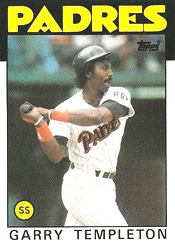
On the weekend he returned to St. Louis for the first time as an opponent of the Cardinals, shortstop Garry Templeton got booed, but he also got the last laugh.

In May 1982, Templeton was with the Padres when they played a series versus the Cardinals at Busch Memorial Stadium. Templeton hadn’t been to St. Louis since being traded by the Cardinals for Ozzie Smith after the 1981 season.
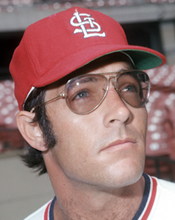
Templeton’s departure from St. Louis was prompted by his outburst in August 1981 when he made obscene gestures to fans at a home game.

Welcome back

On May 28, 1982, a Friday night crowd of 31,733 gathered for Templeton’s return. “The moment Templeton took batting practice, the hecklers went to work,” the St. Louis Post-Dispatch reported.

During the game “each time he batted, fielded ground balls, or merely stepped out of the dugout, he was booed and harassed,” according to the Post-Dispatch.

Two spectators unfurled a banner that declared, “To forgive is human, to error is Templeton.”

“The fans were what I thought they’d be,” Templeton said to the Post-Dispatch. “I played here before, and there was no change … Common sense should have told you what to expect.”

Batting third in the Padres’ order, Templeton was hitless in four at-bats versus Bob Forsch, who boosted his record to 6-1 in the Cardinals’ 5-2 victory. Rookie Willie McGee, playing in his third home game, scored three times. Boxscore

Running wild

Templeton got satisfaction in Game 2 of the series on Saturday night May 29. In addition to scoring a run and driving in another, he had a key role in a bizarre play involving Ozzie Smith.

In the eighth inning, with the score tied at 2-2, one out and none on, Cardinals pitcher Joaquin Andujar lined a single against Padres starter and former Cardinal John Curtis.

Smith followed with a groundball single into right field. Andujar rounded second but “stopped dead in his tracks when Sixto Lezcano’s throw came in quickly behind him,” the Post-Dispatch reported.

Templeton took the throw and tossed to third baseman Luis Salazar, who tagged out Andujar.

Before Salazar could fire to second, where Smith was headed, Andujar swiped at the ball and knocked it from Salazar’s grasp, according to the Los Angeles Times. As the ball rolled toward the dugout near third base, catcher Terry Kennedy and left fielder Alan Wiggins chased after it.

Smith sped to third and rounded the bag, but Templeton came up behind him, took a throw from Wiggins and tagged out Smith, ending the inning.

In a baseball rarity, Smith had singled into a double play.

“If you are keeping score, the play went 9-6-5-7-6,” the Los Angeles Times noted.

“That was the weirdest double play I’ve ever been in,” Templeton said.

In the ninth, the Padres scored twice for a 4-2 lead. Leading off the bottom half of the inning against reliever Eric Show, McGee laced a sinking liner that Templeton caught near his shoestrings, preventing the ball from bounding into the outfield for an extra-base hit.

Fans booed Templeton for making the play, prompting Padres manager Dick Williams to tell the Los Angeles Times, “How do people boo a play like that? I’m ashamed to admit I was born in St. Louis. It was totally embarrassing.”

Show retired the next two batters, Lonnie Smith and Keith Hernandez, to seal the Padres’ victory. Boxscore

Cardinals manager Whitey Herzog lamented the base running mistakes that contributed to Smith’s rally-killing double play in the eighth.

“Even if Ozzie stays on third, we’ve got a crack at a run,” Herzog said. “If we go ahead, I bring (closer) Bruce Sutter in, but we never got the chance.”

Lowell Palmer had a penchant for the fast lane. A right-handed pitcher, he mostly threw fastballs. Off the field, he drove a Corvette convertible, rode a Triumph motorcycle, worked as a private investigator, and dated the manager’s daughter.

Palmer wore shades when he pitched, not to look cool, but because his eyes were highly sensitive to light. To a batter peering from the plate to the mound, the sight of a hard thrower with erratic control in a pair of black sunglasses could be unsettling, if not intimidating.
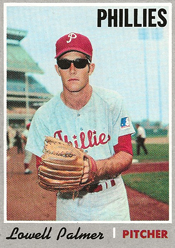
On May 16, 1972, the Cardinals acquired Palmer from the White Sox for pitcher Santiago Guzman.

Palmer’s stint with the Cardinals was unsatisfying and brief, but not forgettable.

Born to be wild

Born and raised in Sacramento, Palmer struck out 127 batters in 67 innings as a high school senior, according to the Sacramento Bee. He also walked 21 in a game _ and won.

“I had no idea where that ball was going,” Palmer said to the Bee. “Sometimes, I didn’t give a damn. There were times I wanted to throw the ball so hard, I didn’t care where it went.”

Or, as he told The Sporting News, “I could throw it through a brick wall, but I didn’t know which wall.”

Palmer was 18 when he was signed by Eddie Bockman, a Phillies scout who also got for them another Sacramento native, shortstop Larry Bowa.

When he was 20, Palmer was with the Phillies at spring training, saw a young woman poolside at the team hotel, and asked her for a date. She accepted.

She was Leanne Mauch, daughter of Phillies manager Gene Mauch.

“All I know is that I took her out one night, and the next morning I was sent to the minors,” Palmer told The Sporting News.

Fast worker

In 1969, Mauch was managing the Expos and Palmer was with the Phillies’ farm club in Eugene, Ore. After producing an 8-1 record, he was called up to the Phillies in June. His first big-league win was a shutout of Mauch’s Expos in Montreal. Seated behind home plate and keeping score was his date for the weekend, Leanne Mauch. Boxscore

“She’s a terrific girl,” Palmer told the Philadelphia Daily News, “but don’t go starting any romance rumors, like I’m getting married or something. I don’t have the money to get married.”

Phillies officials rated Palmer’s fastball the best in the organization. According to The Sporting News, he threw fastballs “90 percent of the time.”

“He has the kind of fastball that breaks bats and rules,” Stan Hochman wrote in the Philadelphia Daily News.

Palmer said, “When my fastball is right, it moves in and out without me knowing which way it’s going. Sometimes it runs like a slider, and other times it tails off and hits the corner.”

Palmer faced the Cardinals for the first time on July, 9, 1969, at Connie Mack Stadium in Philadelphia. He gave up 12 hits, including home runs by Joe Torre, Vada Pinson and Lou Brock. Boxscore

Three months later, on Oct. 1, 1969, Palmer relieved in the ninth against the Cardinals. With the score tied at 5-5, two outs and none on, he walked Torre, and Ted Simmons followed with a walkoff RBI-triple to left-center. Boxscore

“He threw me a fastball, high and away, and I went with the pitch,” Simmons told the St. Louis Post-Dispatch. “If I’d pulled it, I probably would have popped it up.”

Undercover work

In 1970, Palmer appeared on a Topps baseball card wearing dark sunglasses.

“He has sensitive eyes, so he wears dark glasses that look as though they were carved out of chunks of bituminous coal when he pitches,” Stan Hochman wrote in the Philadelphia Daily News.
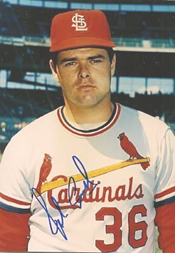
Palmer told the newspaper, “I was born missing a cover over my eyes that you’re supposed to have to help filter out light. My eyes are ultra-sensitive to light, even on cloudy days.”

On May 12, 1970, Dick Allen, facing the Phillies for the second time since they traded him to the Cardinals, walloped a Palmer pitch into the upper deck seats above the Stadium Club windows in left at Busch Memorial Stadium in St. Louis. Boxscore

“He jumped on Palmer’s fastball and pulled the stitches off it,” Bill Conlin wrote in the Philadelphia Daily News. “The ball soared over diners in the plush Stadium Club, melting their Baked Alaskas.”

After the season, Palmer joined his stepfather in forming a private investigation agency in Sacramento, The Sporting News reported. Driving a Corvette convertible, Palmer was a private eye for multiple years, according to the Sacramento Bee.

Summer in St. Louis

At spring training in 1971, Palmer had shoulder trouble, prompting the Phillies to propose surgery. Palmer credited his motorcycle for altering the plan.

“I bought a Triumph, a shaky one, though I didn’t know that at the time,” Palmer told the Post-Dispatch. “The vibrations broke up the (calcium) deposits in my shoulder. I didn’t need any surgery.”

After the season, the Phillies traded Palmer to the White Sox, who projected him as a reliever. At spring training in 1972, when reminded that Palmer had dated Gene Mauch’s daughter, White Sox manager Chuck Tanner quipped to The Sporting News, “I’d give up a daughter for a good relief pitcher anytime. Good relievers are hard to find.”

Tanner kept his daughter, and Palmer began the season in the minors. After pitching in eight games for Tucson, the White Sox dealt Palmer, 24, to the Cardinals. He was assigned to their Tulsa farm team, started two games and was called up to St. Louis.

Manager Red Schoendienst used Palmer as a reliever. On July 11, he entered in the 15th inning against the Braves and loaded the bases. With two outs, Palmer threw two fastballs for strikes to Oscar Brown, then tried a slider. “The pitch bounced into the dirt and away from catcher Ted Simmons,” the Post-Dispatch reported, enabling Gil Garrido to score from third with the winning run. Boxscore

“To be truthful, I haven’t been sharp since I’ve been here,” Palmer said.

During his summer in St. Louis, Palmer met KSD-TV’s Dianne White, the first black weathercaster in America, and they began a collaboration on a book, The Sporting News reported.

“Then somebody broke into her car and stole all the tapes and stuff, and it just kind of died,” Palmer told the Post-Dispatch.

In 16 appearances for the 1972 Cardinals, Palmer was 0-3, walking more batters (26) than he struck out (25). 

With two weeks left in the season, the Cardinals placed him on waivers and he was claimed by the Indians.

Take that!

Palmer was with the Indians’ Oklahoma City farm team, managed by former Phillies manager Frank Lucchesi, in 1973 and led American Association pitchers in strikeouts (203 in 196 innings).

“Maybe this means I’m a prospect again, not a suspect,” Palmer said to The Sporting News.

In 1974, he pitched for the Yankees’ Syracuse affiliate, managed by future Hall of Famer Bobby Cox, and was 5-1 in eight starts before returning to the majors that season with the Padres.

On Aug. 13, 1974, the Padres’ Vicente Romo, making his first start of the season, injured his pitching arm in the first inning against the Cardinals at St. Louis. Palmer relieved, pitched 8.1 innings allowed one run and got his last win in the majors, relying almost exclusively on fastballs. Boxscore

“He threw one speed all night,” Schoendienst moaned to the Post-Dispatch. “We’ve got to hit him.”

Palmer’s career mark in the majors was 5-18 with a 5.29 ERA.

In 1975, Palmer, 28, pitched in his hometown for the Sacramento Solons, a Brewers farm club, After the season, he tried out for the football team at Sacramento City College, where he studied political science, and made the squad as a defensive end and punter.

“They call me Old Man,” Palmer told the Post-Dispatch. “Most of them don’t even know my name. Just Old Man.”

John Cumberland was a teenager from Maine who yearned to play professional baseball. A Cardinals scout took him to dinner and launched him on a path to becoming a big-league pitcher and coach.

A left-hander, Cumberland made his debut in the majors with the Yankees. He later joined Juan Marichal and Gaylord Perry as a starter for the division champion Giants, and got his last win in the big leagues as a reliever with the Cardinals.
As a coach, Cumberland mentored 18-year-old Dwight Gooden in the minors, and was the first big-league pitching coach for Zack Greinke with the Royals. 

Bargain player

Born and raised in Westbrook, Maine, Cumberland was a high school baseball and football player. Though he wasn’t selected in the amateur baseball draft, Cumberland’s ability to throw hard impressed Cardinals scout Jeff Jones. According to the St. Louis Post-Dispatch, Jones bought Cumberland a steak dinner and got him to sign with the Cardinals in 1966.

“I got 52 scholarships out of high school, mostly for football, but the opportunity came up for baseball, so I signed for a steak dinner,” Cumberland recalled to the Clearwater (Fla.) Times. “What a dummy. If I’d waited a little longer, I could have gotten $30,000 or $40,000, even back then. I was anxious, though, for the publicity and all.”

Cumberland was assigned to the Eugene (Ore.) Emeralds, a minor-league club stocked with Cardinals and Phillies prospects. According to the Post-Dispatch, his roommate at Eugene was another future big-league pitcher, Reggie Cleveland.

After posting a 4-1 record for Eugene, Cumberland was taken by the Yankees in the November 1966 minor-league draft.

Two years later, he made his big-league debut for the Yankees against the Red Sox. The first batter he faced, Carl Yastrzemski, grounded a comebacker to Cumberland, who threw to first baseman Mickey Mantle for the out. Boxscore

After making two appearances with the 1969 Yankees, Cumberland got a chance to stick with them in 1970. He got his first big-league win, pitching 6.1 innings of relief against the Senators, and also stroked his first big-league hit, a single that scored Thurman Munson, in that game. Boxscore

The performance earned him a spot in the starting rotation. A month later, in a start against the Indians at Cleveland, Cumberland became the first Yankees pitcher to give up five home runs in a game. Ray Fosse and Tony Horton hit two apiece, and Jack Heidemann slugged the other. Boxscore

In his next start, against the White Sox at Yankee Stadium, Cumberland recovered and pitched his first complete game in the majors, a 3-1 victory. Boxscore

In July 1970, the Yankees traded him to the Giants for pitcher Mike McCormick.

Wakeup call

Soon after joining the Giants, Cumberland was demoted to the minors “with instructions to lose 15 pounds and gain a new pitch,” the New York Daily News reported.

“Getting sent down was the big blow,” Cumberland told reporter Phil Pepe. “It shook me up. I was kind of complacent until that happened. It made me think about my future.”

Cumberland worked on improving his curveball. Called up by the Giants in September, he was 2-0 with a 0.00 ERA in five relief appearances that month.

Pleasant surprise

In 1971, Cumberland entered spring training 15 pounds lighter than he was the previous year, and earned an Opening Day roster spot as a reliever.

When Frank Reberger got injured, Giants manager Charlie Fox chose Cumberland to start against the Cubs on June 22. He beat Ferguson Jenkins in a 2-0 duel. Boxscore

Cumberland remained in the rotation, and on July 3 he pitched a four-hitter, beating Steve Carlton and the Cardinals. Boxscore

“Cumberland is perhaps the most unartistic-looking left-handed pitcher since Hal Woodeshick went into retirement,” San Francisco columnist Wells Twombley observed.

The results, though, were effective. Cumberland was 9-6 for the 1971 Giants, who won a division title. He ranked second on the team in ERA (2.92) and third in innings pitched (185).

“He’s been the biggest surprise of the season,” Fox told United Press International. “What I like best about him is the way he battles the batters. He’s a real bulldog.”

Winding down

At spring training in 1972, teammate Juan Marichal worked with Cumberland on developing a screwball. After posting a 1.61 ERA in 28 exhibition game innings _ “My best spring training ever,” he told the Post-Dispatch _ Cumberland seemed poised to succeed in the regular season, but the opposite happened.

Cumberland was 0-4 with an 8.64 ERA for the Giants when they arrived in St. Louis on June 16, 1972, for a series with the Cardinals. Before the game that night, the Giants swapped Cumberland to the Cardinals for minor-league infielder Jeffrey Mason.

“He’s only 25 and has good control,” Cardinals manager Red Schoendienst told the Post-Dispatch. “If he can come along with that screwball, he could really help us.”

In his St. Louis debut, a start versus the Expos and former Cardinal Mike Torrez, Cumberland gave up six runs in 3.1 innings. Boxscore

After that, Schoendienst used Cumberland as a reliever.

On Aug. 19, facing the Giants in San Francisco, Cumberland pitched three innings and got the win, his last in the majors. Boxscore

“I can’t think of any club I’d rather beat,” Cumberland told the Oakland Tribune.

In 14 games with the 1972 Cardinals, Cumberland was 1-1 with a 6.65 ERA. After the season, they dealt him and outfielder Larry Hisle to the Twins for reliever Wayne Granger.

Helping hand

Cumberland’s final season in the majors was 1974. Eight years later, the Mets hired him to be a coach in the minors.

At the Lynchburg, Va., farm club in 1983, teen phenom Dwight Gooden got off to a mediocre start and was challenged by Cumberland.

“I just told him I didn’t think he wanted to win, and that he wasn’t much of a competitor,” Cumberland told the Newport News Daily Press.

According to Cumberland, Gooden responded, “You were right. I was too timid. That will never happen again.”

Gooden finished 19-4 with 300 strikeouts in 191 innings for Lynchburg.

At the Florida Instructional League after the season, Cumberland helped Gooden develop a changeup and worked with him to shorten his motion.

Cumberland coached in the Mets system from 1982-90. Others he mentored included Rick Aguilera, Randy Myers and Calvin Schiraldi.

“He was the best pitching coach we had in the minor leagues,” Mets scouting director Joe McIlvaine told the Boston Globe. “He toughened the kids up. He worked better with the mind of the player than with the body of the player. That’s a hard thing to get. When we sent a pitcher to John Cumberland in the minor leagues, he was always better for the experience.”

In addition to stints as a minor-league coach for the Padres and Brewers, Cumberland coached in the big leagues with the Red Sox and Royals.

When he was Red Sox pitching coach in 1995, the staff included Roger Clemens, and future Cardinals pitching coaches Derek Lilliquist and Mike Maddux. Derek Lowe transformed from starter to closer while Cumberland was Red Sox bullpen coach from 1999-2001.

Cumberland was Royals pitching coach for manager Tony Pena from 2002-04. When Zack Greinke, 20, made his big-league debut in 2004, he reminded Cumberland of Gooden at a similar age.

“Dwight was more of a power pitcher,” Cumberland told the Kansas City Star, “but the two have the same type of makeup: ‘Here I am. I’m not intimidated. Stand in the box. I’m going to get you out.’ That’s the way Dwight was at 18, just like this kid.”


(Updated June 12, 2022)

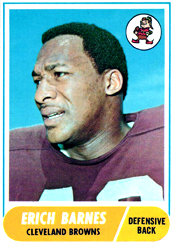
Erich Barnes was a formidable foe of the St. Louis football Cardinals. He was an intimidating, savvy defensive back who played 14 seasons in the NFL. In seven games against the Cardinals, he intercepted six passes.

Two of Barnes’ most significant clashes with the Cardinals occurred in consecutive seasons (1966 and 1967) at St. Louis. The first illustrated his fiery intensity. The second showed his smarts.

An all-pro, Barnes totaled 45 interceptions with the Chicago Bears (1958-60), New York Giants (1961-64) and Cleveland Browns (1965-71).

Rough stuff

Barnes played college football at Purdue and earned a bachelor’s degree. The Bears selected him in the fourth round of the 1958 NFL draft.

In January 1961, the Bears sent Barnes to the Los Angeles Rams for quarterback Bill Wade. The Rams then flipped Barnes to the Giants for defensive back Lindon Crow, who had threatened to retire unless the Giants traded him to a team near his California home.

“We gave up a class A player in Barnes,” Bears head coach George Halas told the Chicago Tribune, “but you must give up a class A player to get one in return.”

“Often matched against the league’s best wide receivers,” the New York Times noted, Barnes helped the Giants reach the NFL title game in three consecutive seasons (1961-63).

Bobby Mitchell of the Washington Redskins said of Barnes, “When a man can hold me down playing man-to-man defense, he’s doing a tremendous job.”

Barnes developed a reputation for making hard hits “with an exuberance that drew penalties or warnings,” the Associated Press reported. In a 1963 game against the Bears, he was assessed a penalty for roughing another tough guy, tight end Mike Ditka.

“Throughout Barnes’ career, his method of operation was simple: You come across the middle, you get busted in your chops,” the Akron Beacon Journal observed.

Barnes displayed an uncanny knack for arriving at the same time a pass reached a receiver, and then whacking the ball from the recipient’s arms with a motion similar to a butcher wielding a cleaver.

“He was very intense on the field,” Barnes’ teammate, Giants offensive lineman Roosevelt Brown, told the Akron newspaper. “Off the field, he was very laid back. That’s when you wanted to meet him. You didn’t want to meet up with him on the football field.”

Barnes had 18 interceptions in four seasons with the Giants. 

Like the Bears four years earlier, the Giants were in desperate need of an experienced quarterback in August 1965, and Barnes had trade value. The Giants sent Barnes to the Browns for linebacker Mike Lucci, then swapped Lucci and guard Darrell Dess to the Detroit Lions for quarterback Earl Morrall.

Danger zone

On Dec. 17, 1966, the Browns and Cardinals played at Busch Memorial Stadium. Late in the fourth quarter, with the Browns ahead by 28, backup quarterback Jim Ninowski threw a sideline pass to pint-sized Walter “The Flea” Roberts. The pass was incomplete, but Cardinals rookie defensive back Bobby Williams followed Roberts out of bounds and knocked him toward the Browns’ bench.

Roberts got up and “wanted to fight,” Williams said to the Associated Press. “He jumped on me. Then Barnes came over. Then it seemed like the whole Browns team was around me.”

Barnes told the St. Louis Post-Dispatch, “I guess I was the first one to reach Williams, and I gave him a shove.”

Barnes then kicked, or attempted to kick, Williams while he was down, witnesses told United Press International.

“I swung my foot, but I’m not even sure I touched him,” Barnes said to the Cleveland Plain Dealer. “It was more of a chastising gesture. I had no intention of hurting him.” Video courtesy of Cardinals football historian Bob Underwood

Emotions were raw. Some spectators left their seats, gathered on top of a dugout and shouted at the Browns players on the sidelines.

“Ushers were unable to control the unruly bunch,” the Jacksonville (Ill.) Daily Journal reported, “and policemen with nightsticks were rushed to the scene.”

Bruce Alford, a line judge on the officiating crew, feared the mob would storm the field. “I thought there might not be enough policemen when the trouble started,” Alford told the Fort Worth Star-Telegram.

During a timeout, a spectator broke loose, approached Barnes from behind and struck him in the back of the head, knocking him to the ground.

“The first thing I know, I’m flat on my back,” Barnes recalled to the Post-Dispatch, “and I see our other players pushing some fan away from me.”

The assailant was handcuffed by police and taken away. Game stats

Two plainclothes police officers were assigned to escort Barnes from the locker room to the team bus, according to the Post-Dispatch.

After reviewing film, NFL commissioner Pete Rozelle fined Barnes $250 for making “a major contribution to an inflammatory sideline incident.”

Experience matters

A year later, when the Browns returned to Busch Memorial Stadium on Dec. 10, 1967, “Barnes was booed vociferously when he was introduced” before the game, the Dayton Daily News reported.

Unfazed, Barnes responded with an outstanding performance. “Can’t play this game to win popularity contests,” Barnes told the Dayton newspaper.

In the third quarter, with the Browns ahead, 10-9, Cardinals tight end Jackie Smith took a handoff from Jim Hart on an end-around play.

“We’d studied films of that play all week,” Barnes told the Post-Dispatch.

When Barnes saw Smith take the ball, it was his responsibility to leave the receiver he was covering, Bobby Joe Conrad, and advance toward Smith, but Barnes’ instincts told him something was amiss.

“I say to myself, ‘Why is Bobby Joe Conrad running by me so hard?’ ” Barnes told the Post-Dispatch. “Most pass receivers don’t really run unless they think they’re going to get the ball.

“I say, ‘Erich, ain’t no pass receiver going to run that hard on a fake.’ That’s how I guessed Jackie Smith might plan to throw on that end-around. So I stay with Conrad.”

Sure enough, Smith stopped, looked downfield and tossed a pass toward Conrad. It was the first pass Smith attempted in a NFL game. Barnes intercepted it and ran 40 yards to the Cardinals’ 21. A few minutes later, Lou Groza kicked a field goal for a 13-9 Browns lead. Video courtesy of Cardinals football historian Bob Underwood

Barnes’ pickoff and return “put the Cardinals in a hole for the entire third quarter,” the Post-Dispatch reported. “The play served to turn the game in Cleveland’s direction.”

Barnes came up big again on the last play of the game.

With the Browns ahead, 20-16, Hart connected with Smith on a pass to the Cleveland 18. Six seconds remained when Smith caught the ball. Barnes blocked Smith’s path to the sideline so that he couldn’t get out of bounds and stop the clock. Forced to run down the field, Smith was tackled by middle linebacker Dale Lindsey as time expired. Game stats