In the span of eight months, Bob Cain was the starting and winning pitcher in two of the most unusual baseball games _ one against the St. Louis Browns and the other for them.
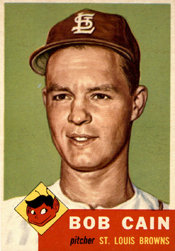 On Feb. 14, 1952, Cain was acquired by the Browns in a trade with the Tigers.
Six months earlier, when baseball’s greatest showman, Browns owner Bill Veeck, devised the stunt of sending 3-foot-7 Eddie Gaedel to bat in a game versus the Tigers, Cain was the pitcher who stood on the mound in disbelief.
The following spring, as a member of Veeck’s Browns, Cain used artistry instead of antics to make a mark, prevailing against Bob Feller in a duel of one-hitters.
Cain is able
Born in Longford, Kansas, Cain was a youth when his family moved 35 miles south to Salina, Kansas, the heart of wheat country. His father operated a taxicab company. Cain impressed in amateur baseball and was 18 when he signed with the Giants.
A left-handed pitcher, Cain played one season of minor-league ball at the Class D level in 1943 before serving two years (1944-45) in the military. When he returned, the Giants kept him in their farm system until he was traded to the White Sox in June 1949.
Called up by the White Sox in September 1949, Cain, 24, made his debut with three scoreless innings of relief against the Red Sox. He struck out Ted Williams the first time he faced him. In the book “We Played the Game,” Cain recalled, “He was surprised a rookie would throw a 3-and-2 curveball.” Williams would hit .200 in 10 career at-bats versus Cain. Boxscore
In May 1951, Cain was traded to the Tigers. A month later, he pitched a shutout against a Yankees lineup featuring Mickey Mantle, Joe DiMaggio and Yogi Berra. It was the first time the Yankees failed to score that season. Boxscore
Two weeks later, Cain held the Indians to two runs, but was a hard-luck loser. The opposing starter, Bob Feller, pitched a no-hitter. Boxscore
Then came the encounter with Eddie Gaedel.
Show time
Cain was the Tigers’ starter against the Browns in the second game of a doubleheader on Aug. 19, 1951, at Sportsman’s Park in St. Louis.
The Browns posted a lineup with rookie Frank Saucier as the leadoff batter, but, when it came time for him to bat in the first inning, Bill Veeck, always eager to upstage the buttoned-down Cardinals, sprung his surprise with Eddie Gaedel.
Wearing a uniform with the fraction one-eighth as his number and holding a toy bat, Gaedel, 26, who worked in Chicago as a courier for a livestock business journal, approached the plate with strict instructions from Veeck to not swing at any pitches.
When plate umpire Ed Hurley saw Gaedel in the Browns uniform of 9-year-old Bill DeWitt Jr. (the current Cardinals owner who was the son of Browns general manager Bill DeWitt Sr.), he went toward the Browns’ dugout and demanded an explanation from manager Zack Taylor. After Taylor showed Hurley the paperwork proving Gaedel had signed a Browns contract that was sent to the American League office, Hurley permitted Gaedel to bat.
“You should have seen the look on the face of Bob Cain,” Gaedel told The Sporting News. “His jaw dropped and his eyes almost popped out of his head.”
Cain called out to his catcher, Bob Swift, “Got any idea what to do with this fellow?”
Swift, who, like Cain, hailed from Salina, Kan., went to the mound for a conference with his pitcher.
When Swift went back behind the plate, he stretched out on his stomach to give Cain a low target, but Hurley told him to get up. So Swift knelt on both knees.
Gaedel crouched in the batter’s box, making the strike zone microscopic. Standing in against Cain was a risk for any batter. He finished second in the league that year in most batters hit by pitches (14).
In “We Played the Game,” Cain said, “I didn’t know whether to throw the ball underhanded or overhanded to Gaedel. I just wanted to be careful not to hit him. Dizzy Trout told me later that if he’d been the pitcher he’d have thrown the ball right between his eyes.”
While Swift was urging him to get the ball lower, Cain threw four overhanded pitches, all high, and Gaedel was awarded first base.
“The balls I threw to him, they were over his head, even though they’d have been strikes on normal batters,” Cain told the Salina Journal. “He was bending over to where the strike zone was only about an inch.”
In “We Played the Game,” the left-hander said, “I’d have given my right arm just to have gotten one strike on him.”
Gaedel later told Bob Broeg of the St. Louis Post-Dispatch that as he made his way to first, “For a minute, I felt like Babe Ruth.”
Gaedel was lifted for pinch-runner Jim Delsing and Cain settled down. He allowed no earned runs in 8.1 innings and got the win in the Tigers’ 6-2 victory. Boxscore
Cain was 11-10 for the 1951 Tigers. He ranked second on the club in wins, but his ERA was 4.70 and he totaled more walks (82) than strikeouts (58).
Pair of aces
Looking to shake up the roster after finishing 73-81 in 1951, the Tigers traded Cain, pitcher Gene Bearden and first baseman Dick Kryhoski to the Browns in February 1952 for pitcher Dick Littlefield, first baseman Ben Taylor, outfielder Cliff Mapes and catcher Matt Batts.
“Cain was the most valuable parcel the Tigers gave up in the deal,” the Detroit Free Press declared.
The last-place Browns (52-102) were happy to get a pitcher of Cain’s caliber. Veeck told The Sporting News, “He’s a bona fide starter. Just what we need.”
Cain liked the Browns because Veeck gave him the salary he wanted. In “We Played the Game,” Cain said, “Veeck was one of the nicest, most honest men in baseball, a great guy to play for.”
Cain’s first regular-season start for the Browns came against his former team, the Tigers, at Detroit. He yielded one run in nine innings and got the win. Boxscore
A week later, Cain was matched in a start versus Bob Feller for the first time since Feller pitched his no-hitter against him the year before.
Cain pitched a one-hitter. So did Feller.
The win went to Cain, who pitched a shutout in a 1-0 Browns victory at St. Louis.
“I owed this one to Feller,” Cain told The Sporting News. “It was just my turn to get the good break.”
It was the second time two pitchers achieved one-hitters in the same game in the majors. In 1906, the Cubs’ Mordecai Brown and the Pirates’ Lefty Leifield did it in a 1-0 Cubs triumph. Boxscore
The Browns got their run against Feller in the first inning. Bobby Young led off with a triple over the head of left fielder Jim Fridley. Marty Marion followed with a hard grounder to third baseman Al Rosen, who bobbled the ball for an error, enabling Young to score. Boxscore
It was the 11th of Feller’s 12 one-hitters in the majors, and the only one he lost. Feller also pitched three no-hitters.
The Indians’ lone hit was a single by Luke Easter in the fifth inning. Easter tormented Cain, hitting .368 with five home runs against him in his career.
In “We Played the Game,” Cain said, “I’d like people to remember how I pitched against Bob Feller. Being able to pitch against someone I knew would be a Hall of Famer gave me inspiration.”
Cain finished the 1952 season with a 12-10 record for the Browns. He and Satchel Paige, 48, tied for the team lead in wins.
The next year, his last in the majors and the last for the Browns in St. Louis, Cain was 4-10 with a 6.23 ERA.
After his playing career, Cain worked for Kraft Foods.
In June 1961, when Eddie Gaedel died at 36, Cain and his wife drove from their home near Cleveland to attend the funeral in Chicago. Veeck was ill and unable to be there. Cain was the only baseball person who went.
“I never even met him,” Cain said, “but I felt obligated to go.”
 On Feb. 7, 2012, Cora signed a minor-league contract with the Cardinals, who invited him to spring training to compete for a spot on their Opening Day roster.
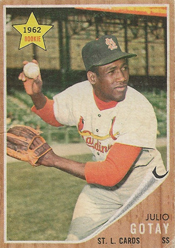 In 1962, Gotay was the Cardinals’ starting shortstop.
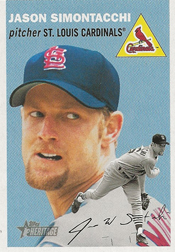 On Jan. 21, 2002, free-agent pitcher Jason Simontacchi signed a minor-league contract with the Cardinals.
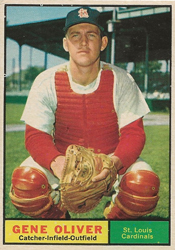 In 1962, Oliver was the Cardinals’ starting catcher. He got the job because the Cardinals thought he could hit with consistent power and drive in runs. Instead, he finished fourth on the club in home runs (14) and sixth in RBI (45).
 Busch, the Cardinals’ owner,
 RetroSimba