Feeds:
Posts
Comments

In the last regular-season game he played in the NFL, running back Jim Brown was ejected for fighting with a St. Louis Cardinals defensive lineman.
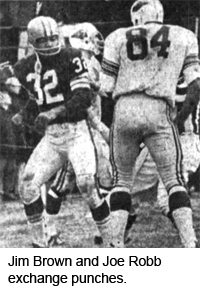
The incident occurred on Dec. 19, 1965, in the regular-season finale between the Cardinals and Cleveland Browns at Busch Stadium in St. Louis.

Just before halftime, Brown and Cardinals defensive end Joe Robb hit and kicked one another. The referee tossed both from the game. Brown still finished as the NFL rushing leader for the eighth time in nine seasons.

Despite a stellar performance by Cardinals safety Larry Wilson, who intercepted three passes and returned one 96 yards for a touchdown, the Browns won, 27-24, and advanced to the NFL championship game against the Green Bay Packers. Video

Brown, 29, played in the title game, won by the Packers, and then retired from football, launching an acting career with a role in the film “The Dirty Dozen.”

Tough guy

Joe Robb was born and raised in the east Texas town of Lufkin, near the Davy Crockett National Forest. His father was a professional wrestler.

Described by the Waco News-Tribune as “a carefree sort unused to a tight harness,” Robb played on the defensive line at Texas Christian University with future Pro Football Hall of Fame tackle Bob Lilly.

A rangy 6 feet 3 and 215 pounds, Robb was chosen by the Chicago Bears in the 14th round of the 1959 NFL draft. He was cut from the roster near the end of training camp and claimed by the Philadelphia Eagles.

A year later, Robb, who bulked up to about 240 pounds, was a starting defensive end for the Eagles when they won the 1960 NFL championship. In the title game against the Packers, Robb was matched against the future Hall of Fame offensive tackle, Forrest Gregg.

“Robb is a tough, hard-nosed kid,” Gregg told the Philadelphia Daily News. “He was charging the same on the last play as he was the first.”

When it came time to discuss a contract for the 1961 season, Robb said, “I went in and asked for $13,000. (General manager) Vince McNally said I was asking for a quarterback’s salary.”

The Eagles traded Robb to the Cardinals for defensive end Leo Sugar and linebacker John Tracey.

Trench battles

In joining the 1961 Cardinals, Robb and Jim Brown nearly became teammates. The Cardinals claimed they turned down a trade offer of Brown for running back John David Crow.

Wally Lemm became the Cardinals’ head coach in 1962 and Robb thrived in the system designed by defensive coordinator Chuck Drulis. Robb had 8.5 sacks in 14 games in 1963. “I really learned something about football at St. Louis,” Robb told the Fort Worth Star-Telegram. “Chuck Drulis taught me everything I know.”

The Eagles’ Bob Brown, the future Hall of Fame offensive tackle, said Deacon Jones of the Los Angeles Rams, the Packers’ Willie Davis and Robb were the toughest defensive linemen to block. Regarding Robb, Bob Brown told The Sporting News, “There’s bad blood between us. We just don’t like each other.”

Before the December 1965 game against the Cardinals, Cleveland’s Jim Brown had been ejected once since entering the NFL in 1957. It happened on Oct. 27, 1963, when he tried to block blitzing New York Giants linebacker Tom Scott on a play in the closing minute of the game. Brown and Scott traded punches and were ejected for fighting.

In an interview with author Alex Haley for Playboy magazine, Brown said he had been gouged in the eye “seven or eight times until I was half blinded” in an earlier game against the Giants.

“I made up my mind that if anybody ever again came deliberately close to my eyes, I would retaliate in spades,” Brown said. “So when I felt Scott’s fingers grabbing for me, I just swung on him and we had that little scuffle.”

Rough stuff

Jim Brown seemed headed toward a stellar performance against the Cardinals in the 1965 regular-season finale. He ran for a touchdown early in the second quarter and was averaging better than five yards per carry in the game.

Just before halftime, with Cleveland ahead, 17-7, Brown took a handoff from Frank Ryan and was hit by Robb.

“Robb hit me with a clothesline blow,” Brown told the Mansfield News-Journal.

The clothesline hit usually is defined as a strike to the head or neck with an extended stiff arm.

Robb told the Fort Worth Star-Telegram, “I tried to clothesline him. I missed.”

Brown said Robb hit him a second time _ in the back of the head with an elbow when Brown was returning to the huddle.

“He hit me twice,” Brown told Alex Haley. “I didn’t mind being hit _ that’s part of the game _ but he hit me for no reason, no reason at all, and that I did mind.”

Come and get it

On the next play, a deep pass, with Brown assigned to stay in the backfield to block, he motioned for the offensive linemen to let Robb advance unimpeded.

“When they came out of the huddle, he pointed his finger and said he was going to get me,” Robb told the Fort Worth Star-Telegram.

As Robb rushed into the backfield, Brown met him and raised his forearm. “It hit Joe like a machete,” the Fort Worth Star-Telegram reported.

Robb struck back and hit Brown.

“Brown swung again at Robb and landed,” the Fort Worth newspaper reported.

Robb said, “I grabbed his face mask with my left hand and busted his lip with the other.”

“He hit me on the jaw,” Brown told the Associated Press.

Brown knocked down Robb and kicked him. “I’ve got two cleat marks on the inside of my thigh,” Robb said to the Fort Worth newspaper.

“It was boom, boom, boom,” Brown said to the Mansfield News-Journal.

The two were kicking one another on the ground when the officials intervened and ejected them.

Robb said, “I told Brown, ‘Well, it’s over now, let’s shake hands.’ He didn’t want to, but he did.”

Brown said, “There’s no bad blood between us. We shook hands.”

Brown told the Mansfield newspaper he shouldn’t have let Robb anger him.

“I’m very disappointed when anything like this occurs,” Brown said. “An offensive man should not be looking for trouble. Every man is a cog in the team. I eliminated myself. It was a failure on my part. An offensive player should school himself to take such things.”

Career change

The Browns played the second half without Jim Brown and their top receiver, Gary Collins, who suffered a rib injury in the second quarter, but rallied to win after the Cardinals took a 24-17 lead.

Jim Brown finished the game with 12 carries for 74 yards, giving him 1,544 rushing yards for the season. The touchdown he scored was his career-high 21st of the season. Game stats

The Browns advanced to face the Packers in the NFL championship game on Jan. 2, 1966. Led by Paul Hornung, who had 105 yards rushing and a touchdown, the Packers won, 23-12. In what turned out to be his last game, Jim Brown had 50 yards rushing and 44 yards receiving but didn’t score.

The next summer, while acting in “The Dirty Dozen” in London with Lee Marvin, Brown announced his retirement from football. He followed “The Dirty Dozen” with another classic action film, “Dark of the Sun” with Rod Taylor.

Moving on

In June 1968, after he was traded to the Detroit Lions for linebacker Ernie Clark, Robb told the St. Louis Post-Dispatch, “I think there is a mutual lack of respect between players and management” on the Cardinals.

Asked about dissension that plagued the 1967 Cardinals under head coach Charley Winner, Robb said to the Fort Worth Star-Telegram, “It was just a bad situation. In fact, you could call it terrible. Most of the players were simply demoralized … A head coach’s job is to get his team psychologically prepared to play and Winner was incapable of that.”

Robb played for the Lions from 1968-71. He and former baseball Cardinals outfielder Carl Warwick went into the real estate business together in Texas.

In 1974, when he made a comeback at age 37 with the Houston Texans of the World Football League, Robb told the Philadelphia Daily News he had broken his nose 15 times while playing football and had undergone three knee operations. He was 50 when he died in 1987.

During a stretch in the 1960s, Jim Maloney was as overpowering as National League contemporaries Bob Gibson and Sandy Koufax, but by the early 1970s, when the Cardinals took a chance on him, Maloney’s pitching skill no longer was the same.

On Jan. 4, 1972, the Cardinals signed Maloney, hoping he could join a starting rotation with Gibson, Steve Carlton and Jerry Reuss.

Three months later, Maloney was gone, and so, too, were Carlton and Reuss.

Fresno fireballer

Maloney was born and raised in Fresno, Calif. For most of his youth, the Cardinals had a farm club in Fresno and Maloney attended the games. He got to see Cardinals pitching prospects such as Larry Jackson (28-4 for Fresno in 1952) and Tom Hughes (20-6 in 1955).

At Fresno High School, Maloney was the shortstop on a team that included a couple of other future big-leaguers: catcher Pat Corrales and pitcher Dick Ellsworth. (Tom Seaver, four years younger, went to Fresno High School after Maloney did.)

On the recommendation of Reds scout Bobby Mattick, Maloney converted from shortstop to pitcher at Fresno City College. The Reds signed him in April 1959 and he got to the majors with them the next year.

A right-hander, Maloney had exceptional velocity.

In his 1968 book “From Ghetto to Glory,” Gibson said, “I don’t throw as hard as Jim Maloney. Nobody throws as hard as Maloney. He’s the only guy who can simply overpower you. You know he’s going to throw the fastball, you set for it, but you still can’t catch up with it.”

Maloney had 15 wins or more for the Reds each season from 1963-68. He remains the Reds’ franchise leader in career strikeouts (1,592).

In 1963, when he turned 23, Maloney was 23-7 with a 2.77 ERA and 265 strikeouts. On May 21 against the Braves, Maloney struck out 16 batters, including eight in a row, in 8.1 innings. “He was faster than anyone else I’ve seen this season,” Hank Aaron told The Cincinnati Post. “Yes, he was faster than Sandy Koufax.” Boxscore

Three months later, after Maloney pitched a two-hit shutout against the Giants, their manager, Al Dark, called him a “right-handed Sandy Koufax,” according to the Dayton Daily News. Boxscore

In the book “We Played the Game,” Reds pitcher Jim O’Toole said, “Maloney had such a great fastball and curve that he was unhittable if he got them both over. He was as good as Koufax.”

In the 1963 season finale, Maloney gave up a pair of singles to Stan Musial, who was playing his last career game with the Cardinals. Afterward, Maloney went to the Cardinals clubhouse to congratulate Musial. When Musial saw him, he said aloud, “Here’s a real tough guy. He had me worried.” Said Maloney to reporters: “I was glad to see him go out hitting.” Boxscore

Hard to hit

In 1965, Maloney finished 20-9 with a 2.54 ERA and 244 strikeouts.

On June 14, he held the Mets hitless for 10 innings before a former Cardinal, Johnny Lewis, led off the 11th with a home run. Maloney struck out 18, but the Mets won, 1-0. Boxscore

Two months later, on Aug. 19 against the Cubs, Maloney got the first of his two no-hitters. He walked 10, hit a batter and struck out 12 in a 1-0 victory in 10 innings. The losing pitcher was Larry Jackson, the former Cardinal who Maloney used to watch pitch for minor-league Fresno. Boxscore and Video

“Basically, every time I went out I told myself I was going to throw a perfect game,” Maloney said to The Cincinnati Post.

Maloney pitched his second no-hitter in 1969 against the Astros, striking out 13. Boxscore (The next Reds pitcher to achieve a no-hitter was Tom Seaver, Maloney’s fellow Fresno High School alumnus, in 1978 against the Cardinals.)

Maloney also pitched five one-hitters in the majors.

Johnny Edwards, the Reds’ catcher before joining the Cardinals in 1968, told The Cincinnati Post, “Jim had what you’d call a light fastball, really easy to catch, because it was a rising fastball, but you’d look at your hand after the game and you’d have a bone bruise.”

Though the Cardinals won three National League pennants during Maloney’s prime years, he was 14-5 against them in his career. In 1968, Maloney was 3-0 with a 1.88 ERA versus the National League champions.

Rough time

An injury on April 16, 1970, sent Maloney’s career into a spiral. In trying to beat the throw of the Dodgers’ Maury Wills on a grounder to deep short, Maloney lunged toward first base and felt intense pain in his left foot. He’d ruptured the Achilles tendon that connects the muscles in the calf to the heel bone.

Fans at Crosley Field booed Maloney as he was carried off the field. “A sad night for Cincinnati baseball,” Bob Hertzel wrote in the Cincinnati Enquirer. Boxscore

Maloney didn’t pitch again for the Reds until September. In seven total appearances for them in 1970, he was 0-1 with an 11.34 ERA. He told The Sporting News, “When I started throwing again in September, I was within a fraction of being my old self. I’m sure I can be just as good as I was before.”

The Reds didn’t want to wait to find out. They offered Maloney to the Cardinals, who were interested “but didn’t feel they could afford what the Reds were after then _ a couple of young prospects,” the St. Louis Post-Dispatch reported.

In December 1970, the Reds traded Maloney to the Angels for pitcher Greg Garrett. Angels manager Lefty Phillips was a friend and mentor to Reds manager Sparky Anderson. “I told Lefty that Maloney is capable of winning the division for them,” Anderson informed the Cincinnati Enquirer.

Instead, the 1971 Angels finished 76-86. Maloney, sidelined by a groin pull, pitched in 13 games and was 0-3 with a 5.04 ERA. Lefty Phillips and general manager Dick Walsh were fired, and Maloney was released.

Tumultuous time

Maloney, 31, contacted the Cardinals and asked for a chance. Fred Koenig, hired by the Cardinals to manage in their farm system after being an Angels coach in 1971, vouched for Maloney. In his last four appearances for the Angels, covering a total of seven innings, Maloney allowed one run. “Koenig said Maloney threw as well as he ever threw,” Cardinals general manager Bing Devine said to The Sporting News.

Admitting it was “a kind of shaking the dice,” Devine signed Maloney and projected him to compete in spring training with Al Santorini, Santiago Guzman and Jim Bibby for the fifth spot in the Cardinals’ starting rotation. The Cardinals’ top four starting spots appeared set with Bob Gibson, Steve Carlton, Jerry Reuss and Reggie Cleveland.

“I have more velocity on my pitches than three-fourths of the pitchers in the majors leagues,” Maloney told The Sporting News.

He reported two weeks early to Cardinals camp and made an effort to be in top shape, walking two to five miles daily and jogging on the beach.

The spring of 1972 turned into a time of upheaval for the Cardinals. In February, Steve Carlton was traded to the Phillies for Rick Wise after club owner Gussie Busch became upset with Carlton’s salary demands. In April, Jerry Reuss was traded to the Astros for Scipio Spinks after Busch became upset with Reuss for growing a moustache.

In four spring training games totaling 13.2 innings, Maloney was 0-3 with a 7.07 ERA and was released by the Cardinals on April 9.

Maloney signed with the Giants, who sent him to their Phoenix farm club. He was 5-1 with a 2.61 ERA in seven appearances for Phoenix, but when no team showed interest in bringing him to the big leagues, he retired in June 1972, soon after turning 32.

After leaving baseball, Maloney said he started drinking too much. “I sort of had a hard time sliding back into society,” he told The Cincinnati Post.

The Giants hired him to manage their Fresno farm team in 1982, but the club finished 50-90 and Maloney was out of baseball again. In 1985, he underwent treatment for alcoholism. He completed the program and went on to become director of Fresno’s Alcoholism and Drug Abuse Council.

Cardinals manager Red Schoendienst had the self-confidence to make a bold decision when he thought it would give his team its best chance to win.

A prime example of how Schoendienst put team ahead of individual occurred on July 22, 1968, when the Cardinals trailed the Phillies by two runs in the bottom of the ninth inning.

With two on and none out, Orlando Cepeda was due to bat for the Cardinals. Cepeda was the cleanup hitter and the most recent winner of the National League Most Valuable Player Award, but he hadn’t been producing lately with runners in scoring position.

Schoendienst chose to let Lou Brock bat for Cepeda. The move stunned Cepeda, who never had been removed for a pinch-hitter, but the decision to let one future Hall of Famer bat for another turned out well.

Setting the table

Sparked by a three-run home run from Don Lock against Steve Carlton, the Phillies led the Cardinals, 4-2, entering the last of the ninth at Busch Memorial Stadium in St. Louis.

The Cardinals’ first batter was Julian Javier. Using a bat borrowed from Curt Flood, he fought off an inside fastball from Phillies left-hander Woodie Fryman and blooped a single into shallow right, breaking the bat.

“It was my sweet stroker,” Flood told the St. Louis Post-Dispatch when asked about the bat. “I had used it a couple of weeks.”

John Boozer, a right-hander with a 1-0 record and five saves, relieved Fryman. The first batter he faced, Flood, noticed that third baseman Tony Taylor was playing back on the infield and guarding the line against an extra-base hit. Flood made the decision to try for a bunt single.

“Flood laid down a gorgeous drag bunt,” the Philadelphia Daily News reported.

Taylor charged in, grabbed the ball and threw high to first. Flood easily beat the throw for a single, and Javier advanced to second.

Phillies manager Bob Skinner, a former Cardinals teammate of Flood, said, “Give the guy credit for making the play. It’s a do or die play.”

Rare opportunity

With runners on first and second, none out, the situation seemed ideal for Cepeda, who had 111 RBI for the Cardinals the previous year, but Schoendienst had other ideas.

Cepeda had produced a mere two RBI for the month and none since July 13. (He ended up with five RBI for July.) Cardinals fans booed him the day before when he was 0-for-4 with three strikeouts versus Mets left-hander Jerry Koosman.

Though Cepeda hit well against Boozer in his career (.375 with two home runs), it was a different story in 1968. Cepeda would go hitless in four at-bats versus Boozer for the year.

Schoendienst liked the notion of having Brock, a left-handed batter, face Boozer. (Brock would hit .391 versus Boozer in his career and go 3-for-5 against him in 1968. Also, left-handed batters would hit .352 versus Boozer for the season.) Plus, Schoendienst figured Brock was less likely to hit into a double play. (Cepeda grounded into a team-high 13 double plays in 1968 compared with four by Brock.)

With the Phillies starting a left-hander (Fryman), Schoendienst had intended to give Brock, who complained of leg muscle soreness, a day off, but with the game on the line and Boozer on the mound, the manager couldn’t resist making a move.

“You don’t always have a Brock sitting on your bench in such a situation,” Schoendienst said to the Post-Dispatch. “If there was no Brock, I wouldn’t have used anyone to pinch-hit.”

Right stuff

Cepeda told the Post-Dispatch he never had been lifted for a pinch-hitter at any level of amateur or professional baseball. When Schoendienst sent Brock to bat for him, Cepeda flung his helmet and stormed into the clubhouse.

“Anyone who knows this proud Puerto Rican must realize what a severe blow it was to his pride,” The Sporting News noted.

Brock was seeking his first hit versus the Phillies in 1968. He had gone hitless in 17 at-bats against them.

Using a bat borrowed from Javier, Brock grounded a 2-and-1 pitch from Boozer into right field for a single, scoring Javier and narrowing the Phillies’ lead to 4-3. Flood advanced to third on the play.

It was Brock’s only hit in three appearances as a pinch-batter in 1968. (For his career, Brock batted .258 with 33 hits as a pinch-batter.)

Mike Shannon followed and belted a 2-and-0 pitch from Boozer over Lock’s head in right. The ball bounced into the seats for a ground-rule double. The hit drove in Flood, tying the score at 4-4, and moved Brock to third.

Left-hander Grant Jackson replaced Boozer. Tim McCarver, a left-handed batter, smacked Jackson’s first pitch to deep center, a sacrifice fly that scored Brock with the winning run. Boxscore

Learning experience

Soon afterward, Schoendienst went to the clubhouse and met with Cepeda.

“Cepeda was mad, and it’s good that he was mad because it shows he wants to play,” Schoendienst told the Post-Dispatch.

Cepeda said, “This is a new experience for me. I wanted to bat. I was mad at first, but you never stop learning in this game. The manager made the right move. I haven’t been hitting. You know Brock is not going to hit into many double plays. He’s been hitting well.”

The next night, Cepeda had two hits and scored three runs in a Cardinals rout of the Phillies.

After hitting .325 with 25 home runs and 111 RBI in 1967, Cepeda finished at .248 with 16 homers and 73 RBI in 1968. For the season, he hit .217 with runners in scoring position, but the Cardinals still won their second consecutive National League pennant.

In March 1969, the Cardinals traded Cepeda to the Braves for Joe Torre.

Tino Martinez and Tony La Russa had much in common: Both were born and raised in Tampa, graduated from the same high school, went into the major leagues and helped teams get to the World Series.

On Dec. 18, 2001, Martinez joined La Russa on the Cardinals.

A free-agent first baseman, Martinez had been a consistent run producer for the Yankees, who won five American League pennants and four World Series titles in his six seasons with them.

La Russa had managed the Athletics to three American League pennants and one World Series championship before becoming Cardinals manager.

Though La Russa eventually would win three National League pennants and two World Series crowns with the Cardinals, Martinez wouldn’t get to be a part of that success.

Path to majors

A left-handed batter, Constantino Martinez attended Tampa Catholic High School and helped its baseball team win a state championship in 1982.

After his sophomore year, he transferred to Tampa Jefferson High School. More than 20 years earlier, in 1962, La Russa, a classmate of Martinez’s father, had batted .479 as a shortstop for Jefferson High School. La Russa was signed by the Athletics to a package worth $100,000 the same night he received his high school diploma.

Martinez was a first baseman for Jefferson High School. His friend, Luis Gonzalez, was the second baseman. Gonzalez went on to play 19 seasons in the majors as an outfielder, primarily with the Astros and Diamondbacks.

With Martinez and Gonzalez on the team, Jefferson High School reached the state final before losing to Miami Hialeah.

While attending the University of Tampa, Martinez was selected by the Mariners in the first round of the 1988 amateur baseball draft. Martinez entered the big leagues with the Mariners in August 1990. He played six seasons for them, including 1995, when he produced 31 home runs and 111 RBI.

In December 1995, the Mariners dealt Martinez to the Yankees, who needed a first baseman after the retirement of Don Mattingly.

Playing for manager Joe Torre, who joined the Yankees after being ousted by the Cardinals, Martinez generated 105 or more RBI in five of six seasons with the Yankees. His best year was 1997 when he had 44 home runs and 141 RBI.

In 2001, the Yankees played the Diamondbacks in the World Series. The Diamondbacks’ top hitter was Martinez’s friend and former prep teammate, Luis Gonzalez, who had 57 home runs and 142 RBI that year.

With two outs in the bottom of the ninth inning of World Series Game 4, Martinez hit a two-run home against Byung-Hyun Kim, tying the score. The Yankees won in the 10th on Derek Jeter’s walkoff home run versus Kim. Boxscore and Video

In the bottom of the ninth inning of Game 7, Gonzalez, playing in his lone World Series, drove in the winning run with a single against Mariano Rivera, giving the Diamondbacks the championship. Boxscore

Match game

After the World Series, Yankees general manager Brian Cashman called Martinez’s agent and informed him the club planned to sign free agent Jason Giambi to be their first baseman in 2002. For the first time in his career, Martinez, a month away from turning 34, also was a free agent.

When first baseman Mark McGwire told the Cardinals he was retiring, Martinez saw an opportunity. “St. Louis was my first choice,” he told the Tampa Tribune.

Before the start of the baseball winter meetings in December 2001, Martinez called Cardinals general manager Walt Jocketty.

“I asked them to consider me in their plans if I’d fit in,” Martinez told the St. Louis Post-Dispatch. “I wanted to make sure I initiated something so they could keep my name in their minds.”

Jocketty recalled, “With him calling like that, it impressed me a lot. He said he really liked what he saw here and what he perceived this organization to be.”

Thrilled by Martinez’s interest, La Russa told the St. Petersburg Times, “I knew his dad. His family knows our family. I know not just what kind of player he is, I know the character of the player. He’d be a great fit for us.”

Meet me in St. Louis

The Cardinals also were bidding for free-agent outfielder Moises Alou. If they got Alou, they planned to put him in left field and shift Albert Pujols to first base. The club budget allowed for the signing of Alou or Martinez, not both.

Martinez drew interest from the Athletics, Braves and Orioles, but he chose the Cardinals when they offered a three-year contract worth $21 million. The deal also included a club option for a fourth year. The Cubs got Alou with a three-year offer worth $27 million.

According to the Tampa Tribune, the first call Martinez got after signing came from Luis Gonzalez. “He was about as excited as I was,” Martinez said.

La Russa told the Post-Dispatch, “He’s going to be good for our players. He’s got his priorities right. It isn’t about stats and money. It’s about competing and winning.”

In an analysis of the signing, columnist Bernie Miklasz noted, “La Russa covets Tino’s presence and a little dose of that Yankees magic,” but also cautioned that Martinez’s “stroke was custom-fitted for the short dimension down the right-field line at Yankee Stadium.”

Production drop

The first signs of trouble showed at spring training. Martinez hit .180 with no home runs and two RBI in Florida Grapefruit League exhibition games. “Scouts say his bat looked slow in spring training,” The Sporting News reported.

When the season began, Martinez hit .198 in his first 116 at-bats. Published reports noted he repeatedly lunged at low off-speed pitches.

Though his hitting improved in the second half of the 2002 season and his fielding was strong, Martinez fell short of expectations. He hit 21 home runs but had his lowest RBI total (75) since the strike-shortened 1994 season. He hit .246 with runners in scoring position and a mere .207 overall versus left-handers.

Martinez later said he played much of the 2002 season with an inflamed left rotator cuff that prevented him from fully extending for outside pitches, The Sporting News reported.

The Cardinals won a division title in 2002, but fell short in their quest for a pennant. In 2003, Martinez produced 15 home runs and 69 RBI. He hit .210 with runners in scoring position. The Cardinals finished third in a six-team division.

After the season, the Cardinals traded Martinez to the Rays, giving him a chance to play for his hometown team.

During the Great Depression, the Cardinals played the baseball trade market like bond investors.

On Dec. 9, 1931, the reigning World Series champion Cardinals acquired outfielder Hack Wilson and pitcher Bud Treachout from the Cubs for pitcher Burleigh Grimes.

Wilson and Grimes, a pair of future Hall of Famers, were the principals. A year earlier, in 1930, Wilson established a major-league record for RBI in a season (191) and a National League mark for home runs (56). Grimes earned 17 wins for the 1931 Cardinals, then was the winning pitcher in Games 3 and 7 of the World Series versus the Athletics.

The Cardinals made the trade as much for financial, rather than baseball, reasons. In dealing Grimes, the Cardinals removed from the payroll their highest-paid pitcher. In acquiring Wilson, they got an asset whom they were able to swap a month later for a substantial amount of cash.

Big production

Listed at 5 feet 6 and 200 pounds, Lewis Wilson was nicknamed “Stouts” in the minor leagues and then became known as “Hack” because his short, broad build reminded some of wrestler George Hackenschmidt, the St. Louis Globe-Democrat reported.

Wilson began his professional baseball career as a catcher in the minors. With Martinsburg, W.Va., in 1921, he broke a leg on Opening Day. When he recovered, he couldn’t squat in a catcher’s position, and was converted into an outfielder.

Wilson was called up to the Giants in September 1923 and played for them in 1924 and 1925 before being sent to the Toledo Mud Hens farm team in August 1925. Left off the Giants’ roster, Wilson was drafted by the Cubs.

Playing for Cubs manager Joe McCarthy, Wilson led the National League in home runs four times _ 1926 (21), 1927 (30), 1928 (31) and 1930 (56) _ and twice was the league’s RBI leader: 1929 (159) and 1930 (191).

The good times for Wilson changed when the former Cardinal, Rogers Hornsby, became the Cubs’ manager, replacing McCarthy, who left for the Yankees in 1931.

Big trouble

Hornsby and Wilson were a toxic match. Described by the United Press wire service as the “roly-poly playboy of the majors,” Wilson enjoyed the nightlife. Hornsby objected to Wilson’s carousing and inattention to conditioning, and after Wilson slumped early in the 1931 season (no home runs in April and two in May) Hornsby often benched him.

“His usefulness had been greatly impaired by what club officials said was a lack of training and a lack of respect for the more righteous social pursuits,” the Chicago Tribune noted.

Wilson sulked when Hornsby kept him out of the lineup. The slugger also was miffed because Hornsby ordered him not to swing at pitches when the count was 2-and-0 or 3-and-1.

“They took that bat right out of my hands,” Wilson said to the Chicago Tribune.

Tensions reached a boiling point on Sept. 5, 1931, when the Cubs boarded a train for Chicago after a loss in Cincinnati. Wilson confronted three newspaper reporters in the vestibule of the train and complained about their coverage. Pitcher Pat Malone joined them and, goaded by Wilson, slugged two of the newspapermen, according to the Chicago Tribune.

The Cubs suspended Wilson without pay for the rest of the season, and club owner William Wrigley said Wilson never would play for the Cubs again.

“He can be as good a player as he wants to be, but he’ll have to change his conduct and his habits,” Hornsby told The Sporting News.

Wilson produced a mere 13 home runs and 61 RBI for the 1931 Cubs after his 1930 output of 56 homers and 191 RBI. “An all-America bust,” The Sporting News declared.

The Chicago Tribune concluded, “Wilson rose to the heights among the greatest in the game, then through the medium of self-neglect, he plumbed the depths, experiencing his most disappointing year.”

Change of mind

Asked whether they were interested in trading for Wilson, the Cardinals repeatedly said no.

“We don’t want Wilson,” Cardinals owner Sam Breadon informed the St. Louis Star-Times.

Cardinals vice-president Branch Rickey told the St. Louis Post-Dispatch, “We’re not making any offer for Wilson and we’re not in the bidding for him.”

The Cardinals’ stance changed when they got to the baseball winter meetings in December 1931 and found three clubs _ Braves, Dodgers and Reds _ vying for Wilson. Seeing there was a competitive market for him, the Cardinals sensed an opportunity and entered the bidding at the 11th hour.

“Properly handled, an investment in Wilson could be made a profitable one,” Rickey told the Post-Dispatch.

The Cubs offered Wilson and cash for outfielders George Watkins and Ernie Orsatti, but the Cardinals said no, the Associated Press reported.

According to the Chicago Tribune, the Cardinals countered by offering the Cubs their choice of one of three players: Watkins, Orsatti or Burleigh Grimes. The Cubs pounced at the chance to get Grimes, who was 5-0 against them in 1931.

Wheel and deal

Because Grimes was a World Series hero and because Breadon and Rickey had said Wilson wasn’t a player they wanted, the trade was “unexpected,” the St. Louis Star-Times reported. The Post-Dispatch called it “a big surprise.”

The Cardinals’ reasons for trading Grimes were:

_ Breadon said Grimes was the highest-paid pitcher on the team “and we had to cut down on our expenses,” the Globe-Democrat reported. Grimes was paid $20,000 in 1931.

_ Grimes was 38 and the Cardinals suspected he was approaching the downside of his career.

_ Pitching prospects Dizzy Dean and Tex Carleton were deemed ready to come up from the minors and join the Cardinals’ starting rotation in 1932.

Within hours of acquiring Wilson, the Cardinals tried to trade him.

“Our buying of Wilson is like the purchase of a good bond,” Rickey said to the Post-Dispatch. “The market is always good for a player like Wilson, the same as the stock market is for a good bond.”

As the Globe-Democrat put it, Wilson, 31, “will be used as bait.”

Sales tactics

When the Cardinals shopped Wilson to the Braves, Dodgers and Reds, the proposed return wasn’t what they’d hoped. Wilson’s value “is at an absolute lowest low on the market,” the Post-Dispatch reported.

The Cardinals worked to change that. They had Wilson take an eye exam and made a show of heralding the results, which rated his vision as excellent. Then Breadon and Rickey told the newspapers they might keep Wilson on the team.

Sid Keener of the Star-Times called their bluff. “It is my opinion that Breadon and Rickey are employing salesmanship methods on spreading this ballyhoo,” Keener wrote. “They are trying to increase his value in trade negotiations by publicly admitting they intend retaining the outfielder.”

The Braves offered $15,000 for Wilson, the Post-Dispatch reported, but the Cardinals figured they could do better.

The Cardinals sent Wilson a contract for $7,500. Wilson, who was given a salary of $37,500 by the Cubs in 1931, returned the contract unsigned. Wilson told the Post-Dispatch he expected to take a salary cut, perhaps as much as 50 percent, but nothing like the amount the Cardinals offered.

Published speculation was the Cardinals made the low offer because they had no intention of signing Wilson, but by offering him a contract it showed prospective suitors they were serious about keeping him.

Pay day

The Dodgers, who had been rebuffing the Cardinals’ offers of Wilson for either pitcher Watty Clark or Dazzy Vance, came back with a cash proposal.

On Jan. 23, 1932, the Cardinals sent Wilson to the Dodgers for $45,000 and a minor-league first baseman, Bob Parham.

“I expected it all along,” Wilson told the Associated Press. “That move to the Cards was nothing more than a stopover.”

For the Cardinals, it was a bonanza.

According to the U.S. Bureau of Labor Statistics, $45,000 in January 1932 was the equivalent of $857,000 in December 2021. The $20,000 the Cardinals saved by moving Burleigh Grimes was the equivalent of $381,000 in 2021.

Thus, by dealing Grimes and Wilson, the Cardinals improved their Depression Era bottom line by $65,000, or the equivalent of about $1.2 million in 2021 value.

Rickey had a personal incentive to trade players for cash because his contract called for him to get a percentage of the sale.

Wilson, who got a contract of $16,500 from the Dodgers, had his last big season for them, hitting .297 with 23 home runs and 123 RBI in 1932.

Burleigh Grimes was 6-11, including 1-3 versus the Cardinals, in 1932, but the Cubs won the National League pennant. Released by the Cubs in July 1933, Grimes came back to the Cardinals.

(Updated Dec. 20, 2024)

Soon to be 35, Carlos Beltran wanted to play outfield, not be a designated hitter, for a contender. A free agent, he had multiple offers, but only one provided precisely what he sought.

On Dec. 23, 2011, Beltran signed a two-year contract worth $26 million to be the Cardinals’ right fielder.

A switch-hitter with power, Beltran was an important acquisition for the reigning World Series champions, who were looking to reload after the departure of first baseman Albert Pujols.

Still a factor

Beltran began the 2011 season with the Mets and was traded to the Giants in July for pitching prospect Zack Wheeler.

“By trading for Beltran, the Giants picked up their most prominent hitter since Barry Bonds,” the San Francisco Examiner declared.

Late in the season, Beltran switched agents, dropping Scott Boras and going with Dan Lozano, who also represented Albert Pujols.

Beltran’s final totals for the year were impressive: .300 batting average, 39 doubles, 22 home runs and 84 RBI. His on-base percentage was .385.

Granted free agency in October 2011, Beltran received offers from four American League clubs: Blue Jays, Indians, Rays and Red Sox, according to the St. Louis Post-Dispatch.

When Pujols, also a free agent, signed with the Angels, the Cardinals joined in the bidding for Beltran.

With Pujols gone and outfielder Allen Craig unavailable until May 2012 because of knee surgery, the Cardinals needed an run producer. They envisioned Beltran joining an outfield with Matt Holliday in left and Jon Jay in center. Lance Berkman, who played right field in 2011, would shift to the first base spot Pujols vacated.

Complete player

Beltran had knee surgery in January 2010, and though he thought his performance for the Mets and Giants in 2011 showed he was agile enough to play the outfield, the American League clubs pursuing him wanted to split his time between being a designated hitter and an outfielder.

Nick Cafardo of the Boston Globe wrote, “From a pure hitting point of view, Beltran would be perfect, but scouts question his ability to patrol right field.”

The Cardinals didn’t share those concerns. They were quite familiar with Beltran. In two playoff appearances, 2004 with the Astros and 2006 with the Mets, Beltran excelled against the Cardinals.

In the 2004 National League Championship Series, Beltran batted .417, hit four home runs and scored 12 runs in seven games. His on-base percentage for the series was .563.

In the 2006 National League Championship Series, Beltran batted .296, hit three home runs and scored eight runs in seven games. His on-base percentage for the series was .387. His strikeout with the bases loaded and two outs in the ninth inning of Game 7, however, overshadowed his overall production.

Cardinals general manager John Mozeliak told the Post-Dispatch that Beltran “was on top” of the list of free agents the club wanted to sign in December 2011.

“One of the exercises we were doing at the winter meetings was definitely looking at what the world might look like if we weren’t able to keep Albert,” Mozeliak said to MLB.com. “So … we had a pretty good idea of what we were going to do and how we were going to do it. Didn’t actually know if we could pull it off.”

In an interview that appeared in the Post-Dispatch on Christmas Day 2011, Beltran explained to Derrick Goold why he signed with St. Louis: “I’m looking for an opportunity to win a championship … I believe the Cardinals are a club that can do it again.”

Also in the Cardinals’ favor was their willingness to let Beltran, a three-time Gold Glove Award winner, play in the outfield. Beltran told the Post-Dispatch, “I want to play in the field at this stage of my career. I feel I can still make a difference in the field.”

Right move

Beltran’s signing by the Cardinals generally was well-received.

“By adding Beltran, you get a player who is confident in the postseason and is going to (impact) the lineup,” Matt Holliday told the Post-Dispatch.

Columnist Bernie Miklasz called it “an aggressive, smart move by the Cardinals. They successfully recruited one of the top five position players available.”

According to Richard Justice of MLB.com, “The Cards may have gotten a player who is an absolutely perfect fit for the situation they find themselves in … From the moment Pujols signed with the Angels, Beltran was the single guy who made the most sense.”

Hard feelings

Cardinals catcher Yadier Molina, though, had a different view. He developed a dislike for Beltran as an opponent because of how Beltran battered Cardinals pitching. “I hated him, honest,” Molina recalled to Stan McNeal of Cardinals Yearbook in 2019.

At 2012 spring training, Beltran could tell Molina wasn’t fond of him. At Beltran’s suggestion, manager Mike Matheny and coach Jose Oquendo arranged a meeting with the two players. According to Beltran, when he told Molina he was the same person as a Cardinal that he’d been as an opponent, Molina unhappily replied, “OK then, there is nothing else to talk about.”

“You could sense a little anger with the way he was raising his voice,” Beltran recalled to Stan McNeal.

It took a while for the relationship to improve. Over time, Molina saw Beltran had a positive impact on the team. One day, during the second half of the 2012 season, Molina sat beside Beltran on a team flight. Beltran recalled to McNeal, “He said to me, ‘Hey, man, I have to say I apologize … You are a good man. I respect you. I have treated you wrong.’ “

Molina said to McNeal, “I asked him to forgive me because I wasn’t a good person to him. I told him he was one of the best professionals I have ever met, and I apologized.”

Big bopper

Beltran, who turned 35 in April 2012, had 32 home runs and 97 RBI for the 2012 Cardinals. Primarily batting in the No. 2 spot in the order, he followed that with 24 home runs and 84 RBI in 2013 when the Cardinals won the National League championship. Video Beltran had a .400 on-base percentage in the 2013 World Series versus the Red Sox.

Beltran had more hits, home runs and RBI in his two seasons with the Cardinals than Pujols did in his first two seasons with the Angels. The Cardinals reached the playoffs, including a World Series, in those two seasons and the Angels did not.

After the 2013 World Series, Beltran became a free agent and signed with the Yankees. After a brief stint with the 2016 Rangers, Beltran, 40, finished his playing career with a World Series championship as a member of the 2017 Astros.

He was the first player to have four consecutive seasons of 20 or more home runs, 100 or more runs scored, 100 or more RBI and 30 or more stolen bases. Beltran did it from 2001 through 2004.

For his career, Beltran totaled 2,725 hits, 435 home runs, 1,587 RBI and 312 stolen bases.