During the Great Depression, the Cardinals played the baseball trade market like bond investors.
 On Dec. 9, 1931, the reigning World Series champion Cardinals acquired outfielder Hack Wilson and pitcher Bud Treachout from the Cubs for pitcher Burleigh Grimes.
Wilson and Grimes, a pair of future Hall of Famers, were the principals. A year earlier, in 1930, Wilson established a major-league record for RBI in a season (191) and a National League mark for home runs (56). Grimes earned 17 wins for the 1931 Cardinals, then was the winning pitcher in Games 3 and 7 of the World Series versus the Athletics.
The Cardinals made the trade as much for financial, rather than baseball, reasons. In dealing Grimes, the Cardinals removed from the payroll their highest-paid pitcher. In acquiring Wilson, they got an asset whom they were able to swap a month later for a substantial amount of cash.
Big production
Listed at 5 feet 6 and 200 pounds, Lewis Wilson was nicknamed “Stouts” in the minor leagues and then became known as “Hack” because his short, broad build reminded some of wrestler George Hackenschmidt, the St. Louis Globe-Democrat reported.
Wilson began his professional baseball career as a catcher in the minors. With Martinsburg, W.Va., in 1921, he broke a leg on Opening Day. When he recovered, he couldn’t squat in a catcher’s position, and was converted into an outfielder.
Wilson was called up to the Giants in September 1923 and played for them in 1924 and 1925 before being sent to the Toledo Mud Hens farm team in August 1925. Left off the Giants’ roster, Wilson was drafted by the Cubs.
Playing for Cubs manager Joe McCarthy, Wilson led the National League in home runs four times _ 1926 (21), 1927 (30), 1928 (31) and 1930 (56) _ and twice was the league’s RBI leader: 1929 (159) and 1930 (191).
The good times for Wilson changed when the former Cardinal, Rogers Hornsby, became the Cubs’ manager, replacing McCarthy, who left for the Yankees in 1931.
Big trouble
Hornsby and Wilson were a toxic match. Described by the United Press wire service as the “roly-poly playboy of the majors,” Wilson enjoyed the nightlife. Hornsby objected to Wilson’s carousing and inattention to conditioning, and after Wilson slumped early in the 1931 season (no home runs in April and two in May) Hornsby often benched him.
“His usefulness had been greatly impaired by what club officials said was a lack of training and a lack of respect for the more righteous social pursuits,” the Chicago Tribune noted.
Wilson sulked when Hornsby kept him out of the lineup. The slugger also was miffed because Hornsby ordered him not to swing at pitches when the count was 2-and-0 or 3-and-1.
“They took that bat right out of my hands,” Wilson said to the Chicago Tribune.
Tensions reached a boiling point on Sept. 5, 1931, when the Cubs boarded a train for Chicago after a loss in Cincinnati. Wilson confronted three newspaper reporters in the vestibule of the train and complained about their coverage. Pitcher Pat Malone joined them and, goaded by Wilson, slugged two of the newspapermen, according to the Chicago Tribune.
The Cubs suspended Wilson without pay for the rest of the season, and club owner William Wrigley said Wilson never would play for the Cubs again.
“He can be as good a player as he wants to be, but he’ll have to change his conduct and his habits,” Hornsby told The Sporting News.
Wilson produced a mere 13 home runs and 61 RBI for the 1931 Cubs after his 1930 output of 56 homers and 191 RBI. “An all-America bust,” The Sporting News declared.
The Chicago Tribune concluded, “Wilson rose to the heights among the greatest in the game, then through the medium of self-neglect, he plumbed the depths, experiencing his most disappointing year.”
Change of mind
Asked whether they were interested in trading for Wilson, the Cardinals repeatedly said no.
“We don’t want Wilson,” Cardinals owner Sam Breadon informed the St. Louis Star-Times.
Cardinals vice-president Branch Rickey told the St. Louis Post-Dispatch, “We’re not making any offer for Wilson and we’re not in the bidding for him.”
The Cardinals’ stance changed when they got to the baseball winter meetings in December 1931 and found three clubs _ Braves, Dodgers and Reds _ vying for Wilson. Seeing there was a competitive market for him, the Cardinals sensed an opportunity and entered the bidding at the 11th hour.
“Properly handled, an investment in Wilson could be made a profitable one,” Rickey told the Post-Dispatch.
The Cubs offered Wilson and cash for outfielders George Watkins and Ernie Orsatti, but the Cardinals said no, the Associated Press reported.
According to the Chicago Tribune, the Cardinals countered by offering the Cubs their choice of one of three players: Watkins, Orsatti or Burleigh Grimes. The Cubs pounced at the chance to get Grimes, who was 5-0 against them in 1931.
Wheel and deal
Because Grimes was a World Series hero and because Breadon and Rickey had said Wilson wasn’t a player they wanted, the trade was “unexpected,” the St. Louis Star-Times reported. The Post-Dispatch called it “a big surprise.”
The Cardinals’ reasons for trading Grimes were:
_ Breadon said Grimes was the highest-paid pitcher on the team “and we had to cut down on our expenses,” the Globe-Democrat reported. Grimes was paid $20,000 in 1931.
_ Grimes was 38 and the Cardinals suspected he was approaching the downside of his career.
_ Pitching prospects Dizzy Dean and Tex Carleton were deemed ready to come up from the minors and join the Cardinals’ starting rotation in 1932.
Within hours of acquiring Wilson, the Cardinals tried to trade him.
“Our buying of Wilson is like the purchase of a good bond,” Rickey said to the Post-Dispatch. “The market is always good for a player like Wilson, the same as the stock market is for a good bond.”
As the Globe-Democrat put it, Wilson, 31, “will be used as bait.”
Sales tactics
When the Cardinals shopped Wilson to the Braves, Dodgers and Reds, the proposed return wasn’t what they’d hoped. Wilson’s value “is at an absolute lowest low on the market,” the Post-Dispatch reported.
The Cardinals worked to change that. They had Wilson take an eye exam and made a show of heralding the results, which rated his vision as excellent. Then Breadon and Rickey told the newspapers they might keep Wilson on the team.
Sid Keener of the Star-Times called their bluff. “It is my opinion that Breadon and Rickey are employing salesmanship methods on spreading this ballyhoo,” Keener wrote. “They are trying to increase his value in trade negotiations by publicly admitting they intend retaining the outfielder.”
The Braves offered $15,000 for Wilson, the Post-Dispatch reported, but the Cardinals figured they could do better.
The Cardinals sent Wilson a contract for $7,500. Wilson, who was given a salary of $37,500 by the Cubs in 1931, returned the contract unsigned. Wilson told the Post-Dispatch he expected to take a salary cut, perhaps as much as 50 percent, but nothing like the amount the Cardinals offered.
Published speculation was the Cardinals made the low offer because they had no intention of signing Wilson, but by offering him a contract it showed prospective suitors they were serious about keeping him.
Pay day
The Dodgers, who had been rebuffing the Cardinals’ offers of Wilson for either pitcher Watty Clark or Dazzy Vance, came back with a cash proposal.
On Jan. 23, 1932, the Cardinals sent Wilson to the Dodgers for $45,000 and a minor-league first baseman, Bob Parham.
“I expected it all along,” Wilson told the Associated Press. “That move to the Cards was nothing more than a stopover.”
For the Cardinals, it was a bonanza.
According to the U.S. Bureau of Labor Statistics, $45,000 in January 1932 was the equivalent of $857,000 in December 2021. The $20,000 the Cardinals saved by moving Burleigh Grimes was the equivalent of $381,000 in 2021.
Thus, by dealing Grimes and Wilson, the Cardinals improved their Depression Era bottom line by $65,000, or the equivalent of about $1.2 million in 2021 value.
Rickey had a personal incentive to trade players for cash because his contract called for him to get a percentage of the sale.
Wilson, who got a contract of $16,500 from the Dodgers, had his last big season for them, hitting .297 with 23 home runs and 123 RBI in 1932.
Burleigh Grimes was 6-11, including 1-3 versus the Cardinals, in 1932, but the Cubs won the National League pennant. Released by the Cubs in July 1933, Grimes came back to the Cardinals.
 On Dec. 23, 2011, Beltran signed a two-year contract worth $26 million to be the Cardinals’ right fielder.
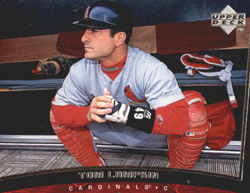 On Dec. 19, 1996, the Cardinals acquired Lampkin from the Giants for a player to be named. Two months later, the Giants chose pitcher
 On Dec. 9, 1981, the Cardinals signed Vicente Romo and invited him to their major-league spring training camp.
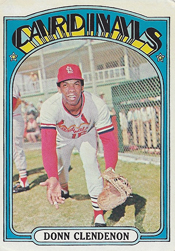 In December 1971, Clendenon connected with the Cardinals. Released by the Mets, the slugging first baseman worked out a deal to play for St. Louis.
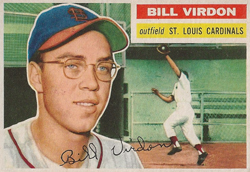 Bill Virdon was an outfielder with the Yankees’ minor-league American Association club in Kansas City in 1953. Johnny Keane, managing the Cardinals’ Columbus, Ohio, club in the American Association, was impressed by Virdon’s defense, speed and throwing, and rated him ready for the big leagues.