Only one of the 267 career home runs hit by George Hendrick in the big leagues stayed in the park, and it enabled the Cardinals to beat Fernando Valenzuela the first time they faced him.
 On June 11, 1981, Hendrick’s two-run inside-the-park home run against Valenzuela provided the margin of victory in the Cardinals’ 2-1 triumph over the Dodgers at St. Louis.
The next day, major-league players went on strike and play wouldn’t resume for two months.
Dodger in danger
A left-hander with an exceptional screwball, Valenzuela debuted in the majors with the Dodgers as a reliever in September 1980. He earned a spot in the Dodgers’ starting rotation in 1981 and gained national prominence when he won his first eight decisions.
Valenzuela, 20, was scheduled to make his first career appearance against the Cardinals on Thursday, June 11, in the finale of a three-game series at Busch Memorial Stadium.
His first visit to St. Louis was highly anticipated, but it took a dark turn on June 10 when Valenzuela received a death threat. He was taken that night from Busch Memorial Stadium by FBI agents and placed under round-the-clock protection, the Los Angeles Times reported.
Despite the threat, Valenzuela, 20, made his start versus the Cardinals the following night. A crowd of 39,250 turned out for the matchup of Valenzuela (9-3) against the Cardinals’ Silvio Martinez (1-4).
Extra security was provided for Valenzuela because St. Louis police chief Eugene Camp said the FBI had received information of a plot to kidnap the pitcher, the St. Louis Post-Dispatch reported. Camp said undercover St. Louis police officers were assigned to keep watch over Valenzuela.
Cardinals capitalize
Those in attendance wouldn’t have known from Valenzuela’s performance that he had been threatened. He pitched with poise and command against the Cardinals.
His only trouble on the field came in the first inning. With two outs and none on, Keith Hernandez coaxed a walk. George Hendrick followed and looped a liner to right field.
“It appeared to be an ordinary single,” the Post-Dispatch noted.
Right fielder Pedro Guerrero charged the ball, hoping for a catch, but it landed five feet in front of him, skipped past him and bounced to the wall. Hernandez and Hendrick circled the bases, giving the Cardinals a 2-0 lead.
“I thought I had a chance,” Guerrero said to the Los Angeles Times. “I just couldn’t get it. No excuses.”
Valenzuela told the Post-Dispatch, “It was a very strange home run.”
Fulfilling expectations
The Dodgers got a run in the sixth when Ken Landreaux scored from first on Dusty Baker’s two-out double, but Silvio Martinez allowed nothing more. Bruce Sutter relieved with one out in the eighth and shut down the Dodgers the rest of the way, preserving the win, the last for Martinez in the big leagues.
Valenzuela went seven innings, yielding three hits, walking three and striking out nine, before he was relieved. Hendrick’s fluke home run and singles by Gene Tenace and Tito Landrum accounted for the Cardinals’ hits. Boxscore
“Fernando is everything they said he was,” Tenace told the Post-Dispatch. “Besides having tremendous poise, he has four pitches and he’s not afraid to throw any of them in any situation. He has two great screwballs, a hard one and a slow one. He has an excellent curve, plus a good fastball.”
Landrum said, “By having two speeds on his screwball, he really keeps you off balance. One is a kind of fadeaway. The other breaks hard.”
Keith Hernandez added, “He’s got the best screwball I’ve ever seen. The Lord blesses a select few and he was definitely blessed.”
After the game, six men, all of them either police officers or FBI agents, escorted Valenzuela from the ballpark through a private exit, the Post-Dispatch reported.
Silly seasons
The victory moved the Cardinals (30-20) to within 1.5 games of the first-place Phillies (34-21) in the National League East. The players went on strike the next day.
Before play resumed on Aug. 10, baseball declared the games completed before the strike would count as one season, and the games completed after the strike would count as a second season. Those teams with the best division records in each season would advance to the playoffs.
The Phillies were declared champions of the National League East Division in the first season.
Baseball made the decision even though, because of scheduling inconsistencies, all teams were not playing the same amount of games.
After the strike, the Expos (60-48) finished atop the National League East in the second season and the Cardinals (29-23) placed second.
The Phillies and Expos were the National League East teams that went to the playoffs, even though overall in 1981 the top three records in the division belonged, in order, to the Cardinals (59-43), Expos (60-48) and Phillies (59-48).
The Dodgers, who finished atop the National League West in the first season of 1981, became National League and World Series championships.
Pedro Guerrero overcame his gaffe against the Cardinals and hit .300 for the Dodgers. He was named World Series most valuable player, hitting .333 with two home runs versus the Yankees.
Valenzuela finished 13-7 with eight shutouts in 1981 and won both the National League Cy Young Award and Rookie of the Year Award. He was 1-0 in the World Series, pitching a complete game.
Guerrero and Valenzuela both eventually played for the Cardinals.

 A switch-hitting outfielder, Scheinblum was acquired by the Cardinals to help in their quest for a division title late in the 1974 season. Scheinblum was adept at pinch-hitting and the Cardinals wanted him solely for that role.
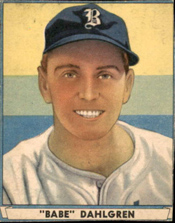 In 1965, the Cardinals hired Dahlgren, 52, to be director of filming. He took 16-millimeter movie film of the Cardinals at spring training and during regular-season games and then worked with manager Red Schoendienst and coaches to analyze swings of the batters.
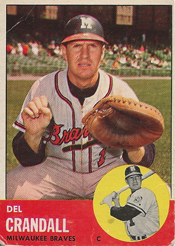 On April 24, 1957, Crandall clouted a walkoff home run in the ninth inning, giving the Braves an 8-7 victory over the Cardinals at Milwaukee.
 Torre led the Cardinals in triples in 1970 and 1971, and ranked second on the club in 1969 and 1972.
 RetroSimba