Feeds:
Posts
Comments

Even when he was their teammate, Stan Rojek was battered and bruised by Cardinals pitching.
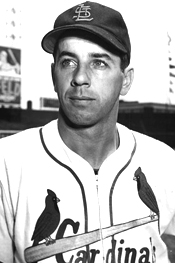
On May 17, 1951, the Cardinals acquired Rojek, a shortstop, from the Pirates for outfielder Erv Dusak and first baseman Rocky Nelson.

Two years earlier, while with the Pirates, Rojek was hit by pitches twice in a game against the Cardinals. The second one struck him in the head and put him in the hospital.

After he got sent to the Cardinals, the danger didn’t dissipate. One of their pitchers plunked him during batting practice, cracking a shoulder blade and ending his season.

Pirate in pain

Born and raised in North Tonawanda, N.Y., near Buffalo, Rojek signed with the Dodgers in 1939 and made his debut with them three years later, but he wasn’t going to displace Pee Wee Reese at shortstop.

In November 1947, the Dodgers dealt Rojek to the Pirates and he became their shortstop. Rojek batted .290 for the 1948 Pirates and ranked third in the National League in hits (186).

The next year, on April 27, 1949, in the Pirates’ first visit of the season to St. Louis, Rojek was hit in the back by a Gerry Staley pitch in the fifth inning. In the bottom half of the inning, while turning a double play, Rojek’s low, underhand toss to first came close to striking baserunner Red Schoendienst. The Cardinals accused Rojek of trying to hit Schoendienst, but Rojek laughed at the suggestion, according to The Pittsburgh Press.

In the seventh, Cardinals baserunner Joe Garagiola slid into Rojek at second and Rojek stepped on him with his spikes, The Sporting News reported.

When Rojek batted in the ninth, the first pitch from Ken Johnson was high and inside, brushing him off the plate.

“I didn’t think he’d try to knock me down a second time after brushing me back on the first pitch,” Rojek said, according to The Pittsburgh Press. “So I dug in for what I thought would be a pitch on the outside corner.”

Instead, Johnson’s second pitch headed toward Rojek’s head. “When I saw the ball coming at me, it was too late to duck out of the way,” said Rojek.

The ball hit Rojek flush on the left ear. He wore neither a batting helmet nor a protective lining in his cap.

According to The Sporting News, Rojek dropped his bat and staggered toward the first-base line “with blood coming out of his ear.” As Pirates rushed from the dugout to his aid, Rojek was a few feet from the plate when he fell into the arms of teammate Eddie Stevens, who gently laid him on the ground.

As the Pirates waited for a stretcher to arrive, they confronted Johnson and Garagiola, accusing the pitcher and catcher of conspiring to bean Rojek.

According to The Sporting News, Johnson replied, “I’m only the pitcher.” To some, his response indicated Garagiola called the pitch. Garagiola “was so nervous and afraid that he almost cried,” The Sporting News reported.

Rojek was taken into the clubhouse to await an ambulance. When the game ended, Cardinals manager Eddie Dyer went to see Rojek and said, “I’m sorry, Stan. I hope it’s nothing serious.”

According to The Pittsburgh Press, a groggy Rojek replied, “Thanks, Eddie.”

Some Pirates were unmoved and exchanged harsh words with Dyer. Outfielder Wally Westlake told Dyer, “Get the hell out of here with your apologies,” The Pittsburgh Press reported. Boxscore

Owning the plate

At the hospital, X-rays showed Rojek suffered a concussion, but no fracture. He had swelling under his ear and two stitches were required to close the wound.

Johnson called Rojek at the hospital the next morning and said he never intended to hurt him.

Some suggested Rojek put himself at risk because of a batting stance “in which his head is almost over the inside corner of the plate,” The Pittsburgh Press noted.

Phillies pitcher Schoolboy Rowe told The Sporting News that Rojek “hogs the plate, leans over it as if he were trying to count the specks of dust on it.”

National League president Ford Frick said umpires determined Johnson was not throwing at Rojek. “They even pointed out that the ball was almost a strike, but because Rojek was crouched over the plate, it hit him in the head,” Frick said. “Stan just froze up there, they said.”

Rojek returned to the Pirates’ lineup a week later. For the season, he hit .244.

In 1950, the Pirates platooned Rojek and Danny O’Connell at shortstop. The next year, at spring training, George Strickland won the shortstop job and Rojek was deemed expendable.

Bad break

The Cardinals needed help at shortstop in 1951. Marty Marion, who played the position from 1940-50, became their manager in 1951 and was unable to continue playing because of a knee ailment.

At spring training, reserve second baseman Solly Hemus volunteered to play shortstop. The Cardinals opened the season with him, but when he struggled to hit they sought an alternative.

The Cardinals acquired Rojek, 32, at Marion’s request.

Platooning with Hemus, Rojek took advantage of the opportunity, hitting safely in 13 of the first 14 games he played for the Cardinals.

Three months later, during batting practice on Aug. 8, Cardinals pitcher Red Munger hit Rojek with a pitch, cracking his left shoulder blade. Done for the season, Rojek was sent home. He hit .274 in 51 games for the Cardinals and .319 with runners in scoring position.

Hemus surged after Rojek departed and hit .281 for the season.

Projecting Hemus to remain their shortstop in 1952, the Cardinals sent Rojek to the Browns for the $10,000 waiver price in January 1952.

(Updated June 9, 2024)

The Whitey Herzog style of baseball was capsulized in the 10th inning of a game at the Astrodome.

On May 12, 1981, a squeeze bunt by Tommy Herr scored Gene Tenace with the go-ahead run, and Jim Kaat retired the side in order in the bottom half of the inning, carrying the Cardinals to a 3-2 victory over the Astros.

Baserunning, sacrificing, advancing runners and lockdown relief pitching were essential elements in the blueprint Herzog devised to make the Cardinals contenders.

Clear philosophy

Herzog became Cardinals manager in June 1980. Given the additional role of general manager soon after, he began to transform the Cardinals, who hadn’t won a pennant since 1968, into a fundamentally sound unit. Their approach became known as Whiteyball.

When Herzog was a Yankees prospect in the 1950s, manager Casey Stengel mentored him and influenced the methods Herzog brought to the Cardinals.

Though Stengel’s Yankees clubs were known for power hitting, “they based their dynasty on being the best defensive team and best baserunning team in the league,” Herzog said in his 1999 book “You’re Missin’ a Great Game.”

“Casey’s Yankees understood something our game has just about forgotten: that baseball, more than anything else, is a game of intelligence, craft and doing the little things right,” Herzog said in his book.

In describing the approach he took to rebuilding the 1980s Cardinals, Herzog said, “First, in the modern game, with all its specialization, you had to have that great stopper in the bullpen.

“Second, to shrink a huge ballpark like Busch Stadium down to size, you needed good athletes with speed. You also needed pitchers who threw strikes and let the other team make contact. Forget strikeouts. Their hitters wouldn’t be able to put many over the wall, and your track stars could run down the balls that stayed in.

“Finally, because that turf is so fast, you wanted batters who hit the upper half of the baseball, smacked it on the ground and took off. That would create new ways to get on base, stir up trouble and score runs.”

Herzog correctly concluded, “The right personnel at Busch Stadium wouldn’t look like much. They wouldn’t have to be big. They’d have to be smart.”

Fundamentally smart

One of the players who epitomized the caliber of baseball Herzog wanted was the second baseman, Tommy Herr. After trading Ken Reitz to the Cubs in the deal that brought closer Bruce Sutter to the Cardinals in December 1980, Herzog shifted Ken Oberkfell to third base to open a spot for Herr at second.

In “You’re Missin’ a Great Game,” Herzog described Herr as having “a fine mind for the game” and someone who would “make a hell of a coach.”

As a fielder, Herr “was never out of defensive position his whole time with me,” Herzog said. “Fundamentally, he was such a smart player. He never screwed up a ground ball or a play that he should have made. He never made a mental mistake.”

At the plate, Herr was “the most amazing hitter I had those years” in St. Louis, Herzog said.

“I can’t think of a better example of how having a plan, a sense of the situation you’re in, can help you succeed,” said Herzog. “If there was one guy I managed that I would want hitting for me in the stretch drive, it’d be hard to pick between (the Royals’) George Brett and Tommy.”

Herzog told Cardinals Magazine, “Herr was steady as a rock and as good a clutch ballplayer as I’ve ever seen.”

Whitey’s way

The 1981 Cardinals were 15-7 entering a three-game series against the Astros at Houston. The opener became a showcase for how Herzog changed the Cardinals’ culture. In the fourth inning, Keith Hernandez singled, stole second, advanced to third on an error and scored on Sixto Lezcano’s sacrifice fly.

The Astros countered in the bottom half of the inning with a two-run home run by Jose Cruz, the former Cardinal, but those were the only runs allowed by starter Bob Forsch. In seven innings, Forsch struck out just one, but allowed no hits from the fifth through seventh.

In the eighth, the Cardinals tied the score against starter Bob Knepper. Oberkfell singled and stole second. With two outs, Garry Templeton, batting right-handed, grounded a single to the opposite field, driving in Oberkfell. “I placed it pretty good,” Templeton told the St. Louis Post-Dispatch.

Sutter relieved Forsch and held the Astros scoreless in the eighth and ninth.

Getting it done

In the 10th, left-handed Astros closer Joe Sambito relieved Knepper. First up for the Cardinals was Gene Tenace, a right-handed batter.

Acquired from the Padres in December 1980, Tenace was adept at reaching base (.388 career on-base percentage) and played for three World Series championship Athletics clubs.

“You put my name on the lineup card and the only thing I’ll guarantee you is 100 percent,” Tenace told the Post-Dispatch.

Tenace hit a double to the base of the wall in left-center. Oberkfell moved him to third with a sacrifice bunt placed between the pitcher and third baseman.

Up next was Herr. When the count got to 2-and-1, Herzog called for the suicide squeeze.

“I wasn’t really expecting it,” Herr told Rick Hummel of the Post-Dispatch.

Tenace said, “Once you get the sign, you try to maintain your composure. If you trigger it too soon, it’s going to backfire. If you break too quick or too early, it’s not going to work. The runner makes the play. You’ve got to time the pitcher. When he puts his leg up, you break.”

Herr decided he would try to bunt the ball toward the middle of the diamond. “Usually, you try to bunt to either first base or third base, but in that situation, if you just get it on the ground, it’s going to score a run,” he said.

Herr bunted toward the mound and Tenace barreled down the line. “The ball had a little backspin,” Herr said. “The backspin deadened it enough.”

Sambito gloved the ball and flicked it to catcher Alan Ashby, but Tenace dived safely across the plate, giving the Cardinals a 3-2 lead. Ashby threw wildly to first base and Herr scurried to second on the error.

After lifting Sutter for a pinch-hitter, Herzog turned to 42-year-old Jim Kaat to protect the lead. Kaat did the job, retiring all three batters he faced. Boxscore

The 1981 Cardinals went on to achieve the best overall record in the East Division at 59-43, but didn’t get to the playoffs because of the lame decision by baseball officials to award split-season division titles _ one based on records before the players’ strike and another based on records after the strike.

(Updated May 8, 2021)

As managers, Red Schoendienst and Dallas Green led teams to World Series championships. As players, they faced one another with the outcome of a game on the line.

On April 28, 1961, Schoendienst, a pinch-hitter, stroked a two-run double against Green in the 11th inning, lifting the Cardinals to a 10-9 walkoff victory versus the Phillies at St. Louis.
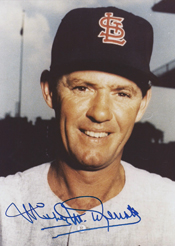
Schoendienst, 38, was in his first season back with the Cardinals after being traded by them in June 1956. Green, 26, was in his second season in the majors and trying to overcome persistent shoulder and arm ailments.

After their playing careers, Schoendienst managed the Cardinals to a World Series title in 1967 and Green did the same for the Phillies in 1980.

Heading home

A second baseman of Hall of Fame caliber with the Cardinals, Giants and Braves, Schoendienst was at a career crossroads in 1961. He sat out most of the 1959 season while recovering from tuberculosis and was released by the Braves in October 1960.

Angels general manager Fred Haney, who managed the Braves to a World Series championship in 1957 when Schoendienst was the second baseman, offered him a contract to play for the American League expansion team in 1961. Schoendienst almost accepted, but opted instead for an invitation to spring training with the Cardinals.

Schoendienst was issued uniform No. 16 because the No. 2 he wore for most of his first stint with the Cardinals belonged to catcher Hal Smith. Smith voluntarily gave No. 2 back to Schoendienst.

“When Red was with the Cardinals the first time, he wore No. 2 and had two children,” Smith told the St. Louis Post-Dispatch. “When he was with the Braves, he wore No. 4 and had four children. When he came back to the Cardinals, he was given No. 16, so ….”

Schoendienst made the Opening Day roster, accepting a role as pinch-hitter and backup to second baseman Julian Javier.

“Don’t write me off,” Schoendienst said to The Sporting News. “This is too much fun. I’m not ready to throw in the towel.”

Clutch hit

A switch-hitter, Schoendienst had a sizzling start to the 1961 season, hitting .348 in April.

Dallas Green also did well early for the Phillies. A right-hander, he earned a spot in the starting rotation and pitched a shutout against the Giants in his first appearance of the season.

“For the first time in several years, I can throw without pain,” Green told The Sporting News. “You just can’t imagine what a feeling it is to be able to let go again.”

When the Phillies and Cardinals played on April 28, a raw, chilly Friday night at Busch Stadium, the starting pitchers were Robin Roberts and Ernie Broglio. The Cardinals led 6-1 after four innings, but the Phillies rallied. The game went to extra innings and the Phillies went ahead, 9-8, in the 11th.

Green, the Phillies’ seventh pitcher of the game, was working his third inning when the Cardinals loaded the bases with one out in the 11th.

Sent to bat for pitcher Al Cicotte, Schoendienst lined a double into the right-field corner, scoring Carl Sawatski and Alex Grammas.

“A good pitch, a slider, I think,” Schoendienst said to the Post-Dispatch. Boxscore

Getting it done

Three months later, on July 6, when the Cardinals fired manager Solly Hemus and replaced him with coach Johnny Keane, Schoendienst was added to the staff as player-coach.

Schoendienst led by example, becoming “one of the best pinch-hitters in the business,” the Post-Dispatch noted.

For the season, Schoendienst hit .347 as a pinch-hitter and .300 overall. In 54 plate appearances as a pinch-hitter, his on-base percentage was .407.

In 133 plate appearances overall in 1961, Schoendienst had six strikeouts, or one out of 22 times. No other Cardinal whiffed so infrequently in 1961, The Sporting News reported. Only once did he hit into a double play during the season. 

Schoendienst continued as a player-coach for Keane in 1962, hitting .306 as a pinch-hitter and .301 overall.

He began the 1963 season in the same role, but after going hitless in six plate appearances, the Cardinals opted to remove Schoendienst from the player roster. According to Cardinals Gameday Magazine, general manager Bing Devine informed Schoendienst he could remain with the Cardinals as a coach or make his own deal to sign with another club as a player.

“I’ve talked to five clubs,” Devine told Schoendienst. “They all said they want you.”

Schoendienst chose to stay as a coach, ending his playing days. 

For his big-league career, Schoendienst had better numbers as a pinch-hitter (.305 batting average and .371 on-base percentage) than he did overall (.289 batting average and .337 on-base percentage).

San Francisco was the site of the best and worst days pitcher Mickey McDermott experienced with the Cardinals.

On April 23, 1961, at Candlestick Park, McDermott got a three-run pinch-hit double in the top of the ninth, giving the Cardinals the lead, and stayed in the game to pitch the bottom half of the inning, setting down the Giants in order for the save.
“Certainly few, if any, players have filled both roles in more heroic fashion than McDermott did,” The Sporting News declared.

Three months later, McDermott was humiliated when manager Johnny Keane banished him from the team in front of teammates at a meeting in the Candlestick Park clubhouse.

Pitching phenom

McDermott was taught baseball by his father, who played a season in the minors with Lou Gehrig at Hartford in 1924.

A slender left-hander, McDermott was a standout high school pitcher in Elizabeth, N.J., and was signed by the Red Sox in March 1945, a month before he turned 16. A hard thrower, he pitched a pair of no-hitters in the minors for Scranton.

On April 24, 1948, five days before his 19th birthday, McDermott made his Red Sox debut at Yankee Stadium. The first batter he faced, King Kong Keller, struck out. The next, Joe DiMaggio, flied out. Boxscore

McDermott had the fastball to get out big-league hitters, but not the command. In his third appearance, he walked 11 Indians batters in 6.2 innings. Boxscore

“He could make the ball look very, very small _ when he could get it over the plate,” the Boston Globe noted.

Wild thing

Though he had brilliant performances _ a 16-inning complete-game win against the Indians in 1951 and a one-hit shutout versus the Senators in 1952, for instance _ McDermott’s wildness on and off the field kept him from becoming a big winner in his first five seasons with the Red Sox.

Some teammates thought the club should make McDermott a first baseman or outfielder because of his hitting. The Red Sox used him often as a pinch-hitter.

A sharp dresser who favored zoot suits, McDermott enjoyed the night life and mingling with celebrities. He dated Rosemary Clooney. Frank Sinatra was a friend. 

In his memoir, “A Funny Thing Happened on the Way to Cooperstown,” McDermott said carousing kept him from reaching his potential.

“My knees are gone,” McDermott told the Associated Press. “It’s an occupational hazard, falling off barstools.”

McDermott was a natural as a singer as well as a ballplayer. Vocalist Eddie Fisher encouraged him to pursue a singing career, The Sporting News reported.

In October 1952, McDermott got a two-week engagement in the Vienna Room at the popular Boston nightspot, Steuben’s. According to The Sporting News, McDermott displayed “a surprisingly good voice and exceptional stage presence,” and got raves for his rendition of “Ol’ Man River.”

McDermott often poked fun at his singing ability. He told broadcaster Jim Woods he sang in nightclubs “only if I can find an orchestra that plays loud.” He told Knight-Ridder Newspapers he quit singing “when I got sober and heard myself.”

The truth was he loved to sing and was a good crooner.

“He’d rather be singing at Steuben’s than be the best pitcher who ever lived,” Red Sox teammate Walt Dropo told the Boston Globe.

High and low notes

McDermott had his best season in 1953 (18-10 as a starting pitcher and .301 batting average) and was in demand as a singer, but, with his value at its peak, the Red Sox traded him to the Senators. He was 7-15 for the 1954 Senators and soon the nightclub billings ended.

“Max and Joe Schneider owned Steuben’s and I remember one of them saying, ‘At 18-10, you could sing. At 7-15, you can’t sing,’ ” McDermott told writer Bob Ryan.

McDermott was traded to the Yankees in 1956 and one of the players the Senators got in return was Whitey Herzog.

Staying out late and drinking hard, McDermott played for three teams _ Yankees, Athletics and Tigers _ from 1956-58 before being demoted to the minors. He “too often has had nightclub smoke in his eyes rather than on his fastball,” Bob Broeg of the St. Louis Post-Dispatch observed.

After the 1960 season, the Tigers released McDermott at his request, making him a free agent. Residing in Miami, he showed up at the Cardinals’ early spring training camp in Homestead, Fla., in 1961 and asked for a tryout. Manager Solly Hemus gave McDermott a look, liked what he saw and invited him to full training camp in St. Petersburg.

McDermott pitched well in Grapefruit League exhibition games and earned a berth on the Cardinals’ 1961 Opening Day roster. He became a teammate of Bob Nieman, who 10 years earlier, in his debut with the Browns, hit home runs against McDermott in his first two at-bats.

Getting it done

On April 17, 1961, McDermott got his first Cardinals save, striking out Wally Moon with two outs and the bases loaded in the ninth. Boxscore

A week later at Candlestick Park, with the Giants ahead, 4-3, the Cardinals loaded the bases with two outs in the ninth. McDermott, batting for pitcher Lindy McDaniel, hit a double to left-center against Jim Duffalo, clearing the bases and giving the Cardinals a 6-4 lead. Red Schoendienst followed with a single, scoring McDermott and putting the Cardinals ahead by three.

McDermott pitched the bottom of the ninth and got the save. Boxscore

“I’m more or less a pitcher now,” McDermott told The Sporting News. “I was a thrower before.”

McDermott had a 1.74 ERA in seven relief appearances in April. He earned a win and a save in June and got another save on July 4.

Two days later, the Cardinals fired manager Solly Hemus and replaced him with coach Johnny Keane.

Made an example

Keane met with the players and told them there would be a 1 a.m. curfew after day games on the road. He warned them he’d enforce the rules. McDermott had been fined $500 for violating regulations the week before Keane took over.

On July 8, the Cardinals played a Saturday day game at Candlestick Park. When Keane made bed checks “long after the 1 a.m. curfew,” the Post-Dispatch reported, the only player absent was McDermott.

When the Cardinals gathered in the Candlestick Park clubhouse on Sunday, Keane confronted McDermott in front of his teammates. He said McDermott hadn’t been in his hotel room for four consecutive nights.

In his book “Oh, Baby, I Love It,” catcher Tim McCarver recalled Keane pointed to McDermott and said, “You came to spring training and were broke. We gave you a job. I will not have guys like you tear down the tradition of this organization.”

According to McCarver, when Keane finished, “the clubhouse was as quiet as an ancient church.” McDermott finally spoke and said, “John, if you feel that way, maybe I ought to take my uniform off.”

Keane responded, “That’s exactly what you’ll do.”

McDermott, 32, was suspended indefinitely and sent home to Miami.

Keane told the St. Louis Globe-Democrat he needed to make an example of McDermott because “if he got away with it, my authority would go out the window and respect of the players for me with it.”

To the Post-Dispatch, Keane said, “Mickey has had a lot of chances in his career and the Cardinals gave him one this year. I’m sorry he didn’t take it.”

In 19 relief appearances for the Cardinals, McDermott was 1-0 with four saves.

Two weeks later, the Athletics acquired McDermott on waivers. He pitched his final four games in the majors for them and finished with a career mark of 69-69.

McDermott’s life turned in 1990 when his wife, Betty, won $5.7 million in the Arizona lottery, the Boston Globe reported. “I feel like I just fanned DiMaggio in the ninth inning with the bases loaded,” McDermott said.

Redbirds ventured into the place where the Birdman of Alcatraz once was cooped.

In 1960 and 1961, Cardinals players and coaches visited inmates in the federal penitentiary at Alcatraz.

The first group to make the goodwill tour on June 3, 1960, consisted of Cardinals players Ken Boyer, Alex Grammas, Curt Simmons and Hal Smith.

A year later, on April 21, 1961, the visitors were Cardinals players Stan Musial and Red Schoendienst, and coaches Johnny Keane, Howie Pollet and Harry Walker.

The groups went there while the Cardinals were in San Francisco to play the Giants.

Known as The Rock, Alcatraz was where some of the most notorious criminals served their sentences, though when the Cardinals visited, convicted murderer Robert Stroud, known as the Birdman of Alcatraz, no longer was there. He was moved to the Medical Center for Federal Prisoners in Springfield, Mo., in 1959.


Lawless legend

Alcatraz got its name when Spanish explorer Juan Manuel de Ayala sailed into San Francisco Bay in 1775 and called the rocky island “La Isla de los Alcatraces,” the island of seabirds.

The U.S. Army built a fort on Alcatraz Island in the 1850s and the facility later was made into a military prison.

From 1934-63, the island was the site of a federal penitentiary. Prisoners included gangsters Al Capone and George “Machine Gun” Kelly.

Robert Stroud was at Alcatraz for 17 years (1942-59) but didn’t have birds there. He became a bird expert during his 30 years of incarceration (1912-42) at the Leavenworth federal penitentiary in Kansas.

Burt Lancaster got an Academy Award nomination for best actor for his portrayal of Stroud in the 1962 movie “Birdman of Alcatraz.” Also nominated for Oscars from the film were Thelma Ritter for best supporting actress and Telly Savalas for best supporting actor. Film clip

According to the FBI, 36 convicts tried to escape from Alcatraz in the 29 years it was a federal prison. Nearly all were caught or died trying. A handful were declared missing and never found, most notably Frank Morris and brothers John Anglin and Clarence Anglin. In June 1962, the trio escaped through loosened air vents in their cells and left the island on a rubber raft. They never were found and the FBI, which closed the case in December 1979, concluded the three men probably died in the frigid water and dangerous currents of the bay.

Play ball!

Among the activities available to Alcatraz inmates were handball, table games and softball.

According to the National Park Service, inmates were allowed two hours of yard time each Saturday and Sunday. Softball was played on a patch of lawn, and balls, bats and gloves were provided.

Balls hit over the wall were considered outs, not home runs.

The softball games were well-organized. Individual and team statistics were kept and two leagues were formed. The leagues were based on talent level. The most talented players belonged to a league with four teams: Cardinals, Cubs, Giants and Tigers. The other league had four teams named for minor-league baseball clubs: Bees, Oaks, Oilers and Seals.

In 1938, one of the best softball players at Alcatraz was Lorenzo Murrieth, who was serving 40 years for assault and theft. He batted .402 for the 1938 Alcatraz Cardinals. Murrieth and another top player, William Lucas, led the Alcatraz Cardinals to a .778 winning percentage, best in the league in 1938, according to the National Park Service.

Unlike professional baseball at that time, the Alcatraz softball teams were integrated.

Many Alcatraz prisoners were avid baseball fans. According to the National Park Service, radio jacks were installed in cells on Oct. 4, 1955, and inmates listened on headphones to the broadcast of Game 7 of the World Series between the Dodgers and Yankees.

“Baseball allowed inmates to mentally escape their confinement and experience a brief moment of freedom,” the National Park Service noted.

Fan club

On Thursday, June 2, 1960, Ken Boyer hit a home run, helping the Cardinals to a 4-3 victory over the Giants at San Francisco. The next day, Boyer joined teammates Alex Grammas, Curt Simmons and Hal Smith on the visit to Alcatraz.

The players were familiar names to the Alcatraz audience. Twenty-eight inmates were subscribers to The Sporting News, the magazine reported.

“Most of the prisoners are either violently for the Giants or violently against them,” Simmons said.

One inmate complained to Boyer that Giants owner Horace Stoneham “must have had rocks in his head” when he traded Daryl Spencer and Leon Wagner to the Cardinals for Don Blasingame.

Some prisoners told Smith they lost their allotments of three packs of cigarettes a week by betting on the Cardinals, The Sporting News reported.

When an inmate spoke to Grammas in Greek and Grammas responded in kind, a guard ordered them to talk in English and wanted to know what they had said to one another in the foreign language.

The players told the St. Louis Post-Dispatch that the question they were asked most often by the prisoners was, “Where’s Stan the Man?”

Stepping up

A year later, Musial gave the inmates their wish, joining Red Schoendienst, Johnny Keane, Howie Pollet and Harry Walker for the April 1961 visit the day after the Cardinals arrived in San Francisco for a weekend series.

“One of the inmates comes from East St. Louis and he told me he ate in my restaurant once,” Musial said to the Post-Dispatch.

Keane said, “A lot of them like the Cardinals and they know all about the players, too. They get to hear the Dodgers’ games as well as the Giants through earphones in their cells. No television of any kind.”

In an editorial, The Sporting News saluted the Cardinals for meeting with the prisoners: “This was a simple act of charity and the men involved are to be congratulated for taking the time.”

(Updated Dec. 8, 2024)

Like a pinball careening across a slick surface, Ray Lankford dived, slid and sped his way into and around the bases, culminating his hyperactive journey with a colossal crash.

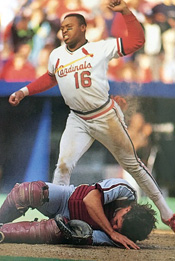
On April 21, 1991, Lankford scored the winning run for the Cardinals against the Phillies when he raced from second base to the plate on an infield out, barreling into Darren Daulton and jarring the ball loose from the mitt of the dazed catcher.

The play, reminiscent of the Gashouse Gang Cardinals of the 1930s, became the signature of Lankford’s career.

Hit and run

Lankford brought a football player’s attitude to the Cardinals, who chose him in the third round of the 1987 amateur draft. In addition to playing baseball, he was a starting running back in high school and at Modesto Junior College in California.

An outfielder and left-handed batter, Lankford was in his fourth season in the minors when he got called up to the Cardinals in August 1990. He became their center fielder the following season.

For the Phillies vs. Cardinals game on Sunday afternoon, April 21, at Busch Memorial Stadium in St. Louis, Lankford batted third and had a single and a double in two of his first three plate appearances.

In the seventh, with the Phillies ahead, 6-1, Lankford ignited a comeback with a run-scoring triple against ex-Cardinals reliever Joe Boever. The Cardinals scored four times in the seventh and once in the ninth, tying the score at 6-6.

Game of inches

With one out and none on in the 10th, Lankford faced Phillies closer Mitch Williams, a left-hander. When the count got to 2-and-2, Williams threw a slider he thought was strike three, but umpire Randy Marsh disagreed. Lankford drew a walk on the next pitch.

Felix Jose was next, but Williams focused on Lankford. He made a throw to first that “appeared to have Lankford picked off,” the Philadelphia Inquirer reported.

“We seemed to have him cold,” Phillies manager Nick Leyva said.

Lankford, though, eluded the tag of first baseman John Kruk and got back to the bag safely. “He just slid around me,” Kruk told the Philadelphia Daily News.

Given a reprieve, Lankford stole second. Williams gave an intentional walk to Jose, setting up a forceout or double play possibility with Gerald Perry at the plate.

Going for broke

Perry rapped a hard grounder between first and second. Kruk snared the ball and threw to shortstop Dickie Thon, covering second, for the forceout of Jose.

Thon looked to first, prepared to make a throw to complete an inning-ending double play, but no one was there. Williams, whose pitching motion took him to the third-base side of the mound, failed to cover the bag at first.

As Thon held the ball, Lankford rounded third and headed for the plate, never looking to see whether coach Bucky Dent was giving the stop sign. “From the start, I just decided I was going,” Lankford said to the St. Louis Post-Dispatch.

Hung out to dry

Phillies second baseman Randy Ready told the Philadelphia Inquirer, “Lankford was hustling … I started screaming at Dickie to throw home.”

Thon’s throw to Daulton arrived ahead of Lankford, who lowered his shoulder and slammed into the catcher “with the force of an 18-wheeler hitting a brick wall,” the Philadelphia Inquirer reported.

Daulton toppled and the ball fell from his glove, enabling Lankford to score the winning run for a 7-6 victory. Boxscore

Lankford separated Daulton “from both the baseball and his senses,” wrote Paul Hagen of the Philadelphia Daily News. Video

“He got me pretty good,” Daulton said. “It was bang-bang.”

Feeling woozy, Daulton said, “I saw him out of the corner of my eye and then I don’t remember.”

Lankford told the Post-Dispatch it was his first plate collision. “I’ll do anything to win a game,” Lankford said. “It’s not that I want to hurt anybody or anything, but I’ll do whatever I have to do to score.”

Recalling the play for an interview with the 2016 Cardinals Yearbook, Lankford said, “It was really a base-running mistake, but it ended up paying off for us.”