Feeds:
Posts
Comments

(Updated March 6, 2023)

Chuck Dressen thumbed his nose at being tossed.

On June 6, 1951, at Ebbets Field in Brooklyn, Dressen, the Dodgers’ manager, was ejected in the fifth inning for complaining about ball and strike calls while Peanuts Lowrey batted for the Cardinals.

After plate umpire Artie Gore motioned for Dressen to take a hike, the manager stormed out of the dugout, kicked dirt around the plate and gesticulated wildly.

The performance ended when Dressen departed down the dugout steps, but it was just the first act in an afternoon of theatrics.

Costume party

According to the New York Daily News, Dressen went “to the cubicle beneath the stands, where it is possible to do a little bootleg managing.”

Unsatisfied with that arrangement, Dressen dreamed up a different scheme. According to The Sporting News, Dressen put on a groundskeeper’s cap and jacket and slipped into a corner of the Dodgers’ dugout, hoping he wouldn’t be noticed. He was about to pick up a rake to enhance the disguise when Cardinals manager Marty Marion spotted him and informed Gore.

“Marty turned me in when I was giving out instructions from the dugout,” Dressen told The Sporting News.

After being ordered by Gore to leave the dugout, Dressen headed for the clubhouse, but he wasn’t done.

Sitting pretty

In the seventh inning, Dressen, wearing street clothes, positioned himself in a box seat next to the Dodgers’ dugout on the first-base side.

Ever vigilant, Marion detected Dressen and again informed Gore. According to Marion, Gore replied, “There is nothing wrong with that, but if you see him doing anything to run the team from there, you let me know and I’ll chase him,” the New York Daily News reported.

Marion saw shortstop Pee Wee Reese, the Dodgers’ captain, go over to Dressen’s seat.

“Dressen was giving the signs and motioned for Reese to get some pitchers warmed up,” Marion told The Sporting News. “He was making a joke of the game.”

When Marion advised Gore what he had seen, Gore told Dressen to leave. Dressen watched the rest of the game from team owner Walter O’Malley’s private perch under the mezzanine behind home plate.

Asked whether he was giving instructions to Reese, Dressen “grinned and said he wasn’t that dumb,” the Brooklyn Daily Eagle reported.

“I just told Pee Wee to find out from Gore what Marion was complaining about,” Dressen said. “I wouldn’t try to relay signs right out there in the open.”

According to the St. Louis Globe-Democrat, Dressen said he sat in the box seat at the request of a photographer. Dressen told the Brooklyn Daily Eagle the photos were for a shoe polish ad.

Some nerve

The Dodgers won, 3-2. Roy Campanella drove in all the Dodgers’ runs and Ralph Branca pitched a complete game. Boxscore

Marion protested the game on the grounds that Dressen broke the rules when he didn’t stay away after being ejected in the fifth inning.

National League president Ford Frick fined Dressen $100 for “failure to leave the bench when ejected and for masquerading in the dugout,” but denied the protest.

Miffed that Marion turned him in to Gore, Dressen told The Sporting News, “If I ever get the chance, you can bet I’ll pour it on him good. I don’t appreciate what he did to me.”

(According to writer Roger Kahn, Dressen was a “nutcake” who proposed crackpot ideas as Dodgers manager. For instance, Dressen said it was bad for pitchers to receive oral sex. “If you get blowed, it makes you sweat in hot weather,” Dressen said to Kahn. “I got guys on my staff can’t beat the Cardinals in St. Louis because they get blowed. It starts them sweating and after a while they can’t stand up to the heat that comes up from the river.”)

Nearly 50 years later, on June 9, 1999, in a night game against the Blue Jays, Mets manager Bobby Valentine returned to the dugout disguised in sunglasses and a fake moustache after being ejected. Valentine said he was fined $5,000 and suspended for two games for the prank. Video

Eight months after his “shot heard around the world” won the pennant for the Giants, Bobby Thomson shocked the Cardinals with another walkoff home run.

On June 16, 1952, Thomson hit a grand slam in the bottom of the ninth, erasing a 7-4 Cardinals lead and lifting the Giants to an 8-7 victory at the Polo Grounds in New York.

It was Thomson’s first walkoff home run since his three-run shot in the bottom of the ninth on Oct. 3, 1951, at the Polo Grounds. That home run, against the Dodgers’ Ralph Branca, carried the Giants from a 4-2 deficit to a 5-4 triumph in the decisive game of a playoff series to determine the National League champion. Boxscore and video

Though the walkoff grand slam versus the Cardinals didn’t clinch a championship, it had a magic of its own.

Hit and miss

The Monday afternoon game between the Cardinals and Giants was poorly played. Giants pitchers gave up 16 hits, four walks and hit two batters. The Giants also made three errors. The Cardinals could have had more than a three-run lead entering the ninth, but they hit into five double plays and stranded 10.

Rookie right-hander Eddie Yuhas, working his fifth inning in relief of starter Harry Brecheen, was the Cardinals’ pitcher in the bottom of the ninth. He walked the leadoff batter, Hank Thompson.

George Wilson followed with a line drive. Second baseman Red Schoendienst grabbed it backhanded “with a graceful leap to his right,” the St. Louis Post-Dispatch reported.

Schoendienst whirled and fired to first baseman Dick Sisler in an attempt to nail Hank Thompson, who had ventured far off the bag, but the throw was high and wild. Hank Thompson advanced to second on the error.

The next batter, Davey Williams, grounded sharply to right. Schoendienst broke the wrong way and the ball skipped into the outfield for a single, advancing Hank Thompson to third.

Mix and match

With Whitey Lockman, a left-handed batter, coming up next, Cardinals manager Eddie Stanky wanted a left-hander to pitch. Stanky lifted Yuhas and brought in Bill Werle. Lockman walked, loading the bases and bringing Bobby Thomson to the plate.

A right-handed batter, Thomson was hitless in his last 17 at-bats. Stanky, who eight months earlier was the Giants’ second baseman when Thomson hit his walkoff home run against the Dodgers, wanted a right-hander to face his former teammate.

Stanky brought in rookie Willard Schmidt, who earned a save against the Giants the day before.

“Thomson and everybody in the park knew Schmidt, with three on base, was not going to go cute,” The Sporting News noted. “He was coming in with the fastball to get the first strike if possible.”

Sure enough, Schmidt’s first pitch was a fastball. Thomson leaned into it “like a man who knew his business,” United Press International reported.

Far and fair

Thomson pulled the pitch down the left field line, “a vicious, high drive,” the Post-Dispatch reported.

The ball curled around the foul pole and “cleared the left field roof, not more than four feet from the foul line,” the New York Daily News noted.

Augie Donatelli, umpiring at third, carefully followed the ball’s track and signaled the ball stayed fair. Cardinals catcher Del Rice argued otherwise, to no avail.

As Thomson circled the bases and approached the plate following the three runners ahead of him, “it looked like Pennant Day all over again,” the Daily News observed. “The entire team was there to greet him, shake his hand and pound his back.”

Schmidt “stood on the mound as though paralyzed,” the Daily News noted. Boxscore

Fantastic feat

Fans and media marveled at Thomson’s knack for delivering dramatic endings.

_ “Yes, children, there is a miracle man,” International News Service wrote as its lead to the game story.

_ “This is an act which cannot be improved.” declared The Sporting News.

_ “Had the game been in a World Series or in a crucial pennant stretch drive, the finish would have been immortalized just as was that golden victory that clinched a pennant for the Giants over Brooklyn last October,” United Press International concluded. “As it was, folks who saw it won’t forget it for a long time.”

In his book “The Giants Win The Pennant,” Thomson said, “I can remember leaving the clubhouse early. I was walking across center field and some diehard fans who were still in the stands gave me a great ovation. I’m sure a lot of them were remembering my homer the year before. It was as if I was continuing the heroics.”


(Updated March 19, 2021)

From the first game he pitched in the National League to the last, Stan Williams had a significant connection to the Cardinals.

A right-hander with a reputation for intimidating batters, Williams played in the majors for 14 seasons.

He was 21 when he made his big-league debut for the Dodgers against the Cardinals at St. Louis in July 1958. He was 35 when he pitched his final National League game as a Cardinals reliever in September 1971.

Williams’ time with the Cardinals was brief, but successful. He made 10 relief appearances for them and was 3-0 with a 1.42 ERA.

Big and fast

Born in New Hampshire, Williams was a toddler when his family moved to Denver. He played organized baseball for the first time in high school and attracted scouts because of his fastball. “I was a Stan Musial fan and kept track of his hits every day,” Williams said in the book “We Played the Game.”

Williams was 17 when the Dodgers signed him in 1954 and sent him to the minors.

It was at Newport News in 1955, he said, that he got the reputation for being mean. The Dodgers taught pitchers “that when you got ahead of a hitter you kept him off the outside corner by pitching him in and knocking him back or down,” Williams told author Danny Peary.

“I just started rearing back and throwing it as hard as I could at their chins and let them get out of the way.”

Williams, who grew to 6 feet 5 and 230 pounds, was imposing and erratic. In 242 innings for Newport News, he struck out 301, walked 158 and hit 16 batters.

After a teammate, catcher Bob Schmidt, taught him to throw a slider during winter ball in the Dominican Republic, Williams progressed. He was in his fifth season in the minors when he got called up to the Dodgers in 1958.

Joltin’ Joe

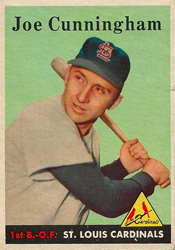
Williams made his debut in the majors on May 17, 1958, at St. Louis. Entering in the fifth, he worked two scoreless innings before giving up three runs in the seventh. Joe Cunningham hit a two-run home run against him. Boxscore

A left-handed hitter, Cunningham battered Williams throughout his career. In 36 plate appearances versus Williams, Cunningham had 13 hits, eight walks and twice was hit by pitches _ an on-base percentage of .639. His career batting average against Williams was .500.

That’s entertainment

Two months after his debut versus the Cardinals, Williams had a noteworthy encounter with them. 

On Aug. 15, 1958, at Los Angeles Memorial Coliseum, Williams, 21, was matched against the Cardinals’ Sal Maglie, 41, a former Dodger nicknamed “The Barber” for the close shaves he gave batters with pitches.

According to the St. Louis Post-Dispatch, the Cardinals were “highly irritated” by the amount of time Williams was taking to deliver pitches. When Williams came to bat in the fourth, Maglie “took off his shoe, emptied it of dirt and slowly put it on again, tying his laces with much care.”

As the crowd roared, Williams backed out of the box and “kicked some imaginary mud from his cleats,” the Los Angeles Times noted.

Then Williams stepped back in and hit Maglie’s first pitch over the high screen in left for a home run, his first in the majors. Boxscore

Teddy bear

“Nobody in the league has a better fastball than Stan Williams,” Cardinals slugger Ken Boyer told the Los Angeles Times in 1960.

As part of a Dodgers rotation that featured Don Drysdale and Sandy Koufax, Williams’ signature pitch was the knockdown.

“In all the years I played, he was the only guy who ever scared me _ and he was on my team,” Ron Fairly, a first baseman for the Dodgers and Cardinals, told the San Francisco Examiner. “The thing about Stan, he was so big and strong, and he threw as hard as Koufax. The difference was Sandy was not mean. Stan was very mean.”

Roger Craig, a former Dodgers and Cardinals pitcher, said, “He was the meanest pitcher I ever saw. Everyone thought Drysdale was so mean, but Stan was far worse.”

One year, Williams had a clause in his contract calling for a $500 bonus if he kept his season walk total to less than 75. According to the San Francisco Examiner, as he neared the mark, he plunked a batter when the count got to ball three rather than risk a walk.

“It was a game of intimidation in those days,” Williams said. “I was never a headhunter. I never pitched with the idea of hurting anyone. I don’t think I’ve ever been mean. What I had was a very competitive streak. That helped give me an edge. So I took advantage of it.”

Cardinals pitcher Bob Gibson could relate. In his book “Stranger to the Game,” Gibson said, “Guys like Don Drysdale, Stan Williams and Sandy Koufax raised the level of competition by claiming their territory and daring you to take it from them.

“The fact is,” said Gibson, “knockdowns were commonplace in my day, and guys like Drysdale and Stan Williams employed them more liberally than I did.”

Big hurt

In August 1960, Williams was matched against Lew Burdette of the Braves. “Burdette used to dig a hole in front of the mound” with his foot, Williams told The Sporting News. “To avoid it, I pitched from the side of the rubber. On a pitch to Lee Maye, I slipped and my back went one way and my arm the other. I felt something snap.”

Williams said he thinks he tore a muscle in his right arm or shoulder, but he kept pitching. He had win totals for the Dodgers of 14 in 1960, 15 in 1961 and 14 in 1962, but he said the pain got progressively worse.

“I pitched with tears running down my cheeks many a time after I hurt my arm in 1960,” Williams told the Minneapolis Star-Tribune

The Dodgers traded Williams to the Yankees after the 1962 season, but “there were times when I couldn’t raise my arm, so I started throwing from the hip,” he said. 

The Yankees shipped Williams to the Indians in March 1965. He spent most of that season and all of 1966 in the minors.

Williams was with Class AAA Portland in 1967 “when the adhesions popped again and I regained my strong arm.”

Called up to the Indians in July 1967, Williams posted six wins and a 2.62 ERA. The next year, he won 13 and had a 2.50 ERA.

The Twins acquired Williams after the 1969 season and made him a reliever. He was 10-1 with 15 saves and a 1.99 ERA in 1970, helping them win a division title.

Perfect record

On Sept. 1, 1971, the Twins traded Williams to the Cardinals for outfielder Fred Rico and pitcher Danny Ford.

Cardinals scout Joe Monahan, who recommended Williams, told the Post-Dispatch, “He’s not going to be overwhelmed by a pennant race.”

On Sept. 7, 1971, Williams got a win against the Phillies in the completion of a game suspended from Aug. 1. Boxscore

He also got relief wins against the Cubs and Mets. Boxscore and Boxscore

The Cardinals released Williams in April 1972. He surfaced in the American League with the Red Sox and pitched his final three games in the majors.

Coach and dad

Williams was a coach for pennant-winning Red Sox (1975) and Yankees (1981) clubs, and the 1990 World Series champion Reds. 

When Williams was the Reds’ pitching coach, they developed a trio of intimidating relievers called the “Nasty Boys.”

In 1976, Williams’ son, Stan Jr., a high school pitcher and outfielder, was chosen by the Cardinals in the 11th round of the amateur baseball draft. Stan Jr. opted to attend the University of Southern California. He signed with the Yankees after they drafted him in the 38th round in 1981 and pitched for two seasons in their farm system.

A disciple of a master instructor, Steve Braun used plate discipline and situational hitting skill to become a valuable role player for the Cardinals.

On March 3, 1981, the Cardinals signed Braun, a free agent, to a minor-league pact. A left-handed batter, Braun, 32, hoped to earn a spot with the Cardinals as a backup outfielder and pinch-hitter.

Whitey Herzog, who had the dual role of Cardinals manager and general manager, was an important ally. Herzog managed Braun with the Royals in 1978 and 1979.

It was with the 1978 Royals that Braun became influenced by hitting coach Charlie Lau. Applying Lau’s theories, Braun developed into a pinch-hitter who got on base at an impressively high rate.

Frame of mind

Braun got to the big leagues with the Twins in 1971. A left fielder and third baseman, he hit .280 or better in five of his six seasons (1971-76) with the Twins.

In 1975, teammate Rod Carew introduced Braun to Harvey Maisel, a hypnotist, or, as Braun preferred to call him, a mind trainer. Braun credited Maisel with helping him in his approach to hitting.

“The idea is to get yourself relaxed, to think relaxing thoughts so that you give yourself positive suggestions,” Braun told the St. Louis Post-Dispatch.

Braun hit .302 that year, the only time he reached the .300 mark in the majors.

Disenchanted with Twins management, Braun asked to be made available in the November 1976 American League expansion draft. He was selected by the Mariners and batted third in the order as their Opening Day left fielder when they debuted in 1977. Boxscore

Braun said he was surprised when the Mariners traded him to the Royals on June 1, 1978.

In the zone

Charlie Lau, who drew praise from the likes of George Brett and Lou Piniella for his hitting instruction, went to work on Braun, who was batting .230 when the Royals acquired him. With Lau’s help, Braun learned strike zone discipline and how to adapt his approach to what was needed in each at-bat.

“I learned more about hitting in that one season with Lau than I had in all my years of baseball before that,” Braun told the Post-Dispatch.

“He’s the one who really got me thinking about what I should be doing as a hitter.”

Braun became a premier pinch-hitter. He had an on-base percentage of .429 as a pinch-hitter for the 1978 Royals, who were division champions under Herzog.

“I came to the ballpark every night expecting and knowing I’ll get the hit when we need it,” Braun told The Sporting News. “I’ve never had confidence like that. I just know I can get on base and do something to help this club. I’ve changed my hitting style. I’m going with the pitch instead of pulling everything.”

Lau departed the Royals for the Yankees in 1979, but Braun’s success continued under Herzog. Braun had an on-base percentage of .394 as a pinch-hitter for the 1979 Royals.

After the season, Herzog was fired and replaced by Jim Frey. Braun was released in June 1980 and signed with the Blue Jays. As a pinch-hitter for the Blue Jays, he had an on-base percentage of .429 and delivered three game-winning hits.

Right attitude

Granted free agency, Braun contacted Herzog. The Cardinals had no room on their 40-man winter roster, but Herzog offered Braun a chance to compete for a job at spring training. Herzog told the Post-Dispatch he viewed Braun as “a little insurance” in case a roster player got injured or slumped.

Herzog, in his first spring training with the Cardinals, was looking for players who knew how to reach base and advance runners. Braun, who did that better than most, earned a spot on the Opening Day roster as a pinch-hitter.

He made his Cardinals debut in the season opener and delivered a pinch-hit double against the Phillies’ Dick Ruthven. Boxscore

“My goal is to help in at least 10 victories by getting on base leading off an inning, or by moving a runner along, or by driving in a run or more,” Braun said. “Herzog likes to have me lead off an inning because I also get a lot of walks.”

Getting it done

In his five seasons with St. Louis, Braun had 60 pinch-hits, according to the Cardinals’ media guide. The only player with more career pinch-hits as a Cardinal is Gerald Perry (70).

Braun produced these on-base percentages as a Cardinals pinch-hitter: .412 in 1981, .383 in 1982, .433 in 1983, .389 in 1984 and .382 in 1985.

In the 1982 World Series, Braun had two important plate appearances.

In Game 2, with the score tied at 4-4, Braun batted as a pinch-hitter with the bases loaded in the eighth inning and drew a four-pitch walk, driving in the winning run. Boxscore and video at 2:52 mark.

In Game 7, Braun’s RBI-single in the eighth inning extended the Cardinals’ lead over the Brewers to 6-3 and gave Bruce Sutter a comfortable cushion to close out the decisive ninth. Boxscore and video at 2;20 mark.

“He’s got a good knowledge of the strike zone,” Herzog told The Sporting News. “I know he’s going to put the ball in play or go to a 3-and-2 count when he’s leading off an inning.”

Regarding his approach to situational hitting, Braun told the Post-Dispatch, “You have to recognize the situation you’re in. What can I do? What do I have to do? Sometimes you need a baserunner. Sometimes you need a pulled ball. Sometimes you need an extra-base hit and sometimes you need a home run.”

One noteworthy home run Braun hit for the Cardinals came in a game on July 21, 1985. His two-run homer in the 10th inning against Dodgers reliever Tom Niedenfuer gave the Cardinals a 4-2 victory and foreshadowed more heartache for the pitcher. Boxscore

Three months later, in the National League Championship Series, Ozzie Smith hit a game-winning home run for the Cardinals against Niedenfuer in Game 5 and Jack Clark followed with a pennant-clinching home run against him in Game 6.

Pupil turned teacher

Despite his success, Braun was a non-roster player at three consecutive Cardinals spring trainings (1981-83) and made the team each time. He finally was rewarded with roster spots at spring trainings in 1984 and 1985.

Braun finished his playing career with 115 pinch-hits in the majors, according to retrosheet.org.

He was a Cardinals minor-league hitting instructor from 1986-89 and the hitting coach for the big-league club in 1990. After Herzog quit as manager in 1990, Braun became a minor-league hitting instructor with the Red Sox and Yankees.

St. Louis was a special place for Juan Pizarro. He got his first and 100th wins in the majors there against the Cardinals.

A left-hander, Pizarro pitched 18 seasons in the big leagues. He was 20 when he got his first win in the majors for the Braves in a start versus the Cardinals at Busch Stadium. He also got his first big-league hit, a home run, in that game.

The Cardinals thought so highly of Pizarro that they tried to trade for him that season.

Ten years later, Pizarro, 30, got his 100th win in the big leagues for the Pirates in a start versus the Cardinals at Busch Memorial Stadium.

Prime prospect

Born and raised in Puerto Rico, Pizarro was signed by Braves scout Luis Olmo, the former outfielder.

In 1956, his first season in the minors, Pizarro, 19, was 23-6 with a 1.77 ERA for Jacksonville, a Class A club in the South Atlantic League. With future Cardinals pitching coach Mike Roarke doing most of the catching, Pizarro struck out 318 batters in 274 innings.

Rollie Hemsley, a former catcher who managed Charlotte in the South Atlantic League, told Sports Illustrated that Pizarro is “the nearest thing to Bob Feller I’ve ever seen.”

Bill Terry, the Hall of Fame first baseman who was president of the South Atlantic League, said, “He could be just as great as Warren Spahn.”

Big leap

While playing winter baseball in Puerto Rico, Pizarro said teammate Ruben Gomez, a Giants pitcher, taught him to throw the screwball. Pizarro added the pitch to an arsenal that included a fastball and curve. He reported to spring training with the Braves in 1957, trying to make the leap from Class A ball to the majors.

The Miami News declared Pizarro the most exciting rookie in spring training: “His every pitch is being watched with high expectancy.”

Pizarro posted a 3.31 ERA in five spring training games and made the Braves’ Opening Day roster. “He has proved to me he can pitch major-league ball,” Braves manager Fred Haney told The Sporting News.

After Pizarro’s final exhibition game, Haney said, “He’ll be another Warren Spahn some day.”

First win

The Braves opened the 1957 season on April 16, but Pizarro sat for three weeks before making his big-league debut in a start against the Pirates at Pittsburgh on May 4. He limited the Pirates to a run in seven innings, but Pittsburgh won, 1-0, on Vern Law’s two-hit shutout. Boxscore

Six days later, on May 10, Pizarro made his second big-league appearance with a start versus the Cardinals at St. Louis.

The start of the Friday night game was delayed 31 minutes because of rain and neither team took batting practice.

In the second inning, with the Braves ahead, 3-0, Pizarro swung at the first pitch he saw from Cardinals starter Sam Jones and hit the ball onto the roof of the pavilion behind right field for a home run.

Ken Boyer tagged Pizarro for a solo home run in the second. With the Braves up, 6-1, in the fourth, the Cardinals’ Wally Moon walloped a three-run home run in the fourth. The Moon shot carried out of the ballpark and across Grand Avenue before crashing into a window pane.

“He had to rely on his fastball and he had a tendency to relax when we had a pretty good lead, especially in the fourth,” Braves catcher Del Crandall told the Associated Press. “After that, he became more determined and began firing again.”

Though Pizarro wobbled, he never lost the lead and he continued to contribute with his bat. After Pizarro led off the sixth with a single, Eddie Mathews won a matchup of future Hall of Famers when he hit a two-run home run against reliever Hoyt Wilhelm. The ball cleared the roof and landed on Grand Avenue.

In the ninth, the Cardinals, trailing 10-5, loaded the bases with two outs, but Pizarro struck out Del Ennis and sealed his first win.

Pizarro gave up nine hits and issued four walks, but the Cardinals stranded eight.

Unimpressed, Cardinals manager Fred Hutchinson told the Associated Press, “He’d better be better than that. If that’s all he can do, then I’ve got news for him. He won’t stay up here … He was only throwing, not pitching.”

Cardinals backup catcher Walker Cooper, who at 42 was 22 years older than Pizarro, batted against him in the ninth as a pinch-hitter and singled. “I could hit that guy with baling wire at midnight with the lights out,” Cooper boasted.

Among the Cardinals held hitless by Pizarro were Al Dark and Stan Musial. Pizarro ended Dark’s 15-game hit streak. Musial, who entered the game with a batting mark of .403 for the season, was 0-for-4 with a walk.

Pizarro was “awfully quick,” Musial said. “There’s no reason why he shouldn’t be a winner up here.” Boxscore

No deal

Later that month, the Braves and Cardinals had trade talks focused on outfielder Del Ennis. The Associated Press reported the Braves offered three players for Ennis. They gave the Cardinals their choice of a starting pitcher, either Ray Crone or Gene Conley, plus reliever Dave Jolly and outfielder Chuck Tanner.

According to the St. Louis Post-Dispatch, the Cardinals asked for Crone and outfielder Wes Covington, and the Braves countered with Conley and Tanner.

“Before I let a guy like Ennis go, I’d want a lot of pitcher in return,” Cardinals general manager Frank Lane told the Associated Press.

Lane said he was interested in Pizarro and another pitcher, Bob Trowbridge. The Braves wouldn’t give up Pizarro, and the talks ended.

On July 3, the Braves sent Pizarro to the minors to get more work. He went 4-0 and was back with the Braves on July 26.

Pizzaro lost twice to the Cardinals in 1957. The second of those defeats occurred on Aug. 18 when Musial beat him with a two-run home run in the 10th inning at Milwaukee. Pizarro never lost to the Cardinals again. Boxscore

Better with age

In his book “Stranger to the Game,” Cardinals pitcher Bob Gibson, who played winter ball with Pizarro in Puerto Rico, called him “an immensely talented” teammate.

On April 30, 1967, Pizarro, in his first season with the Pirates, started for them against the Cardinals and pitched a four-hit shutout at St. Louis for his 100th win in the majors.

Cardinals manager Red Schoendienst, who was Pizarro’s teammate with the Braves from 1957-60, told the Associated Press, “He used to be much faster but very wild then. He has much better control now. The big difference was in the old days if you stayed close to him you could beat him. Now he can protect a one- or two-run lead.” Boxscore

Pizarro was 3-0 with two saves and a 1.07 ERA versus the 1967 Cardinals, who won the National League pennant and became World Series champions. He earned saves in both games of a doubleheader against them on Labor Day, Sept. 4.

In 1971, Pizarro, 34, had one more gem versus the Cardinals. He pitched a six-hit shutout for the Cubs at Wrigley Field. Boxscore

“He makes pitching an art,” Cubs manager Leo Durocher said.

Pizarro finished with a career mark against the Cardinals of 7-2. Overall, he was 131-105.

Unsatisfied with the RBI production they got from their left fielder, the Cardinals tried to trade Vince Coleman.

In 1989, Coleman led the National League in stolen bases (65) for the fifth consecutive year and led the Cardinals in runs scored (94), but manager Whitey Herzog wanted more from him.

Coleman hit .200 with runners in scoring position and totaled a mere 28 RBI. He also had lapses in fielding.

“Vince Coleman has been castigated for both his outfield play and his inability to drive in runs,” the St. Louis Post-Dispatch noted.

Seeking either an outfielder who put up big RBI numbers, or a starting pitcher, the Cardinals were willing to give up Coleman to get what they needed.

They set their sights on a couple of potential trade targets: Indians outfielder Joe Carter and Reds pitchers Scott Scudder and Norm Charlton.

Thompson emerges

The top two RBI producers for the 1989 Cardinals, who finished third in their division, were first baseman Pedro Guerrero (117) and right fielder Tom Brunansky (85). Herzog figured the club could do better if it had another RBI producer in left.

An internal option was Milt Thompson.

Because of injuries, center fielder Willie McGee was limited to 47 starts in 1989. Thompson filled in and impressed. His season totals in key categories were much better than those Coleman produced.

Thompson had 68 RBI, 40 more than Coleman did, and hit .318 with runners in scoring position, 118 points better than Coleman did.

Overall, Thompson hit .290, with 28 doubles and 27 steals.

When the 1989 season ended, Herzog told Post-Dispatch columnist Bernie Miklasz, “I consider Vince my fourth outfielder” behind Brunansky, McGee and Thompson.

“In the history of baseball, you tell me a left fielder who batted 565 times and knocked in 28 runs,” Herzog said to Miklasz. “Tell me who it is. I’m interested in Vince hitting .290 and driving in 50 runs. if he can’t do that, I don’t think we can win.”

A switch-hitter, Coleman batted .254 overall in 1989. “After moving his average to .275 in late July, he batted .206 the rest of the season,” the Post-Dispatch noted.

Vince Coleman “has become Wince Coleman to Herzog,” Miklasz concluded. “Two things are likely to happen to Coleman this winter. He’ll be traded or benched.”

“I don’t think Vince would be happy sitting on the bench,” Herzog said.

Reds reconsider

The Reds needed a left fielder to replace Kal Daniels, who’d been traded. Their new general manager, Bob Quinn, envisioned Coleman, 28, joining an outfield with Eric Davis in center and Paul O’Neill in right.

Figuring Thompson could do the job in left for the Cardinals, “the ideal situation would be to get another quality starter” for the pitching rotation, Herzog told Rick Hummel of the Post-Dispatch.

Hummel reported the Cardinals asked the Reds in October 1989 for pitchers Scott Scudder and Norm Charlton in exchange for Coleman.

A right-hander, Scudder, 21, was a first-round draft pick of the Reds in 1986. In the minors, he was 14-3 in 1988 and 6-2 in 1989 before being called up to the majors. He was 4-9 with a 4.49 ERA for the 1989 Reds. The Cardinals saw him as a developing talent and a fit for their starting rotation.

A left-hander, Charlton, 26, was a first-round draft pick of the Expos in 1984. He was 8-3 with a 2.93 ERA as a Reds reliever in 1989.

The Reds told the Cardinals they would trade one, but not both, of the pitchers for Coleman, the Post-Dispatch reported.

Soon after those trade talks began, the Reds hired Lou Piniella to be their manager. According to the Post-Dispatch, Piniella told general manager Bob Quinn, “I don’t like Coleman.”

The Dayton Daily News reported a swap of Scudder for Coleman “probably is dead. Piniella likes young pitchers and wants to see how Scudder” does in spring training.

Special instructions

Meanwhile, the Cardinals reassigned hitting coach Johnny Lewis and replaced him with Steve Braun, who had played for Herzog with the Royals and Cardinals.

“Without a doubt, Braun’s principal pupil is the perplexing Coleman,” the Post-Dispatch reported.

Coleman had a batting cage at his St. Louis home and Braun began making visits there during the winter to work with him and “take the slap out of Coleman’s swing,” according to Dan O’Neill of the Post-Dispatch.

“We’re taking the top hand out of his swing,” Braun said. “That will allow him to keep the bat head in the strike zone longer and hit the ball more solidly. I have conveyed to him that I think he can be much more than a Punch and Judy hitter.”

Braun said he told Coleman he should be hitting more doubles than the 21 he produced in 1989. “He’s strong,” Braun said. “He has the size and the body to drive the ball. He has enough drive and determination to make the change.”

Swing and miss

Heading into the baseball winter meetings at Nashville in December 1989, the Indians were shopping slugger Joe Carter. He had 35 home runs and 105 RBI for them in 1989. The Cardinals wanted him.

“If the Cardinals were to make a deal with Cleveland, it would almost certainly include Vince Coleman and Willie McGee,” the Post-Dispatch reported.

Cardinals general manager Dal Maxvill said the Cardinals “were definitely interested in Carter.” Herzog said getting Carter would revamp the offense.

“We really haven’t got out of our outfield what we have to in order to be contenders,” Herzog said. “We’ve got to have a guy who can do a better job than the guys we have. We’re too undisciplined with runners on base.

“We were in the running (for Carter),” Herzog said. “We made an offer and they thought about it.”

The Indians liked better what the Padres offered. On Dec. 6, 1989, Carter, 29, was dealt to the Padres for catcher Sandy Alomar, second baseman Carlos Baerga and outfielder Chris James.

The Cardinals went back and met with the Reds, but “the Reds aren’t interested in Vince Coleman,” the Dayton Daily News reported.

Something to prove

Entering spring training in 1990, Herzog was reminded that when the 1989 season ended he considered Coleman to be his fourth outfielder. “I haven’t changed my mind,” Herzog told the Post-Dispatch.

“The thing that bothers me about Vince is he hasn’t played to his potential on defense or on offense,” Herzog said. “He has more ability than he has shown.”

On March 28, 1990, two weeks before the season opened, the Post-Dispatch reported, “Vince Coleman is the only all-star player in a major league spring training camp who isn’t assured of a starting job.”

Herzog said, “If the season opened tomorrow, Thompson would be playing left, McGee in center and Brunansky in right. In April, I don’t know.”

When a surge boosted Coleman’s spring training batting average to .368 on April 5, Herzog decided to open the season on April 9 with an outfield of Coleman, McGee and Brunansky.

The 1990 season was one of constant turmoil for the Cardinals. Brunansky was traded in May, Herzog quit in July and McGee was traded in August. The Cardinals finished in last place.

Coleman hit .292 with 39 RBI and 77 stolen bases in 1990. He hit .259 with runners in scoring position. After the season, he became a free agent and signed with the Mets.