Unsatisfied with the RBI production they got from their left fielder, the Cardinals tried to trade Vince Coleman.
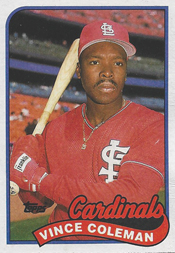
In 1989, Coleman led the National League in stolen bases (65) for the fifth consecutive year and led the Cardinals in runs scored (94), but manager Whitey Herzog wanted more from him.
Coleman hit .200 with runners in scoring position and totaled a mere 28 RBI. He also had lapses in fielding.
“Vince Coleman has been castigated for both his outfield play and his inability to drive in runs,” the St. Louis Post-Dispatch noted.
Seeking either an outfielder who put up big RBI numbers, or a starting pitcher, the Cardinals were willing to give up Coleman to get what they needed.
They set their sights on a couple of potential trade targets: Indians outfielder Joe Carter and Reds pitchers Scott Scudder and Norm Charlton.
Thompson emerges
The top two RBI producers for the 1989 Cardinals, who finished third in their division, were first baseman Pedro Guerrero (117) and right fielder Tom Brunansky (85). Herzog figured the club could do better if it had another RBI producer in left.
An internal option was Milt Thompson.
Because of injuries, center fielder Willie McGee was limited to 47 starts in 1989. Thompson filled in and impressed. His season totals in key categories were much better than those Coleman produced.
Thompson had 68 RBI, 40 more than Coleman did, and hit .318 with runners in scoring position, 118 points better than Coleman did.
Overall, Thompson hit .290, with 28 doubles and 27 steals.
When the 1989 season ended, Herzog told Post-Dispatch columnist Bernie Miklasz, “I consider Vince my fourth outfielder” behind Brunansky, McGee and Thompson.
“In the history of baseball, you tell me a left fielder who batted 565 times and knocked in 28 runs,” Herzog said to Miklasz. “Tell me who it is. I’m interested in Vince hitting .290 and driving in 50 runs. if he can’t do that, I don’t think we can win.”
A switch-hitter, Coleman batted .254 overall in 1989. “After moving his average to .275 in late July, he batted .206 the rest of the season,” the Post-Dispatch noted.
Vince Coleman “has become Wince Coleman to Herzog,” Miklasz concluded. “Two things are likely to happen to Coleman this winter. He’ll be traded or benched.”
“I don’t think Vince would be happy sitting on the bench,” Herzog said.
Reds reconsider
The Reds needed a left fielder to replace Kal Daniels, who’d been traded. Their new general manager, Bob Quinn, envisioned Coleman, 28, joining an outfield with Eric Davis in center and Paul O’Neill in right.
Figuring Thompson could do the job in left for the Cardinals, “the ideal situation would be to get another quality starter” for the pitching rotation, Herzog told Rick Hummel of the Post-Dispatch.
Hummel reported the Cardinals asked the Reds in October 1989 for pitchers Scott Scudder and Norm Charlton in exchange for Coleman.
A right-hander, Scudder, 21, was a first-round draft pick of the Reds in 1986. In the minors, he was 14-3 in 1988 and 6-2 in 1989 before being called up to the majors. He was 4-9 with a 4.49 ERA for the 1989 Reds. The Cardinals saw him as a developing talent and a fit for their starting rotation.
A left-hander, Charlton, 26, was a first-round draft pick of the Expos in 1984. He was 8-3 with a 2.93 ERA as a Reds reliever in 1989.
The Reds told the Cardinals they would trade one, but not both, of the pitchers for Coleman, the Post-Dispatch reported.
Soon after those trade talks began, the Reds hired Lou Piniella to be their manager. According to the Post-Dispatch, Piniella told general manager Bob Quinn, “I don’t like Coleman.”
The Dayton Daily News reported a swap of Scudder for Coleman “probably is dead. Piniella likes young pitchers and wants to see how Scudder” does in spring training.
Special instructions
Meanwhile, the Cardinals reassigned hitting coach Johnny Lewis and replaced him with Steve Braun, who had played for Herzog with the Royals and Cardinals.
“Without a doubt, Braun’s principal pupil is the perplexing Coleman,” the Post-Dispatch reported.
Coleman had a batting cage at his St. Louis home and Braun began making visits there during the winter to work with him and “take the slap out of Coleman’s swing,” according to Dan O’Neill of the Post-Dispatch.
“We’re taking the top hand out of his swing,” Braun said. “That will allow him to keep the bat head in the strike zone longer and hit the ball more solidly. I have conveyed to him that I think he can be much more than a Punch and Judy hitter.”
Braun said he told Coleman he should be hitting more doubles than the 21 he produced in 1989. “He’s strong,” Braun said. “He has the size and the body to drive the ball. He has enough drive and determination to make the change.”
Swing and miss
Heading into the baseball winter meetings at Nashville in December 1989, the Indians were shopping slugger Joe Carter. He had 35 home runs and 105 RBI for them in 1989. The Cardinals wanted him.
“If the Cardinals were to make a deal with Cleveland, it would almost certainly include Vince Coleman and Willie McGee,” the Post-Dispatch reported.
Cardinals general manager Dal Maxvill said the Cardinals “were definitely interested in Carter.” Herzog said getting Carter would revamp the offense.
“We really haven’t got out of our outfield what we have to in order to be contenders,” Herzog said. “We’ve got to have a guy who can do a better job than the guys we have. We’re too undisciplined with runners on base.
“We were in the running (for Carter),” Herzog said. “We made an offer and they thought about it.”
The Indians liked better what the Padres offered. On Dec. 6, 1989, Carter, 29, was dealt to the Padres for catcher Sandy Alomar, second baseman Carlos Baerga and outfielder Chris James.
The Cardinals went back and met with the Reds, but “the Reds aren’t interested in Vince Coleman,” the Dayton Daily News reported.
Something to prove
Entering spring training in 1990, Herzog was reminded that when the 1989 season ended he considered Coleman to be his fourth outfielder. “I haven’t changed my mind,” Herzog told the Post-Dispatch.
“The thing that bothers me about Vince is he hasn’t played to his potential on defense or on offense,” Herzog said. “He has more ability than he has shown.”
On March 28, 1990, two weeks before the season opened, the Post-Dispatch reported, “Vince Coleman is the only all-star player in a major league spring training camp who isn’t assured of a starting job.”
Herzog said, “If the season opened tomorrow, Thompson would be playing left, McGee in center and Brunansky in right. In April, I don’t know.”
When a surge boosted Coleman’s spring training batting average to .368 on April 5, Herzog decided to open the season on April 9 with an outfield of Coleman, McGee and Brunansky.
The 1990 season was one of constant turmoil for the Cardinals. Brunansky was traded in May, Herzog quit in July and McGee was traded in August. The Cardinals finished in last place.
Coleman hit .292 with 39 RBI and 77 stolen bases in 1990. He hit .259 with runners in scoring position. After the season, he became a free agent and signed with the Mets.

 On Feb. 16, 1981, the Cardinals purchased the contract of Santana, a minor-league infielder, from the Yankees on a conditional basis. The Cardinals wanted to take a look at Santana in training camp before deciding whether to keep him or send him back to the Yankees.
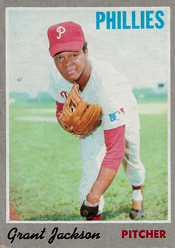 A left-hander, Jackson pitched 18 seasons in the majors.
 In 1970, the Pirates’ outfielder and future Hall of Famer revealed he had been abducted at gunpoint a year earlier by four men in San Diego and robbed. Clemente said he thought he would be shot and left for dead. Instead, he said, he was released and his possessions were returned.
 RetroSimba