(Updated Nov. 24, 2024)
In the longest outing of his Cardinals career, Bob Gibson set a record that illustrated his consistency, dominance and endurance.
 On Aug. 12, 1970, Gibson pitched 14 innings for a complete-game win in the Cardinals’ 5-4 victory over the Padres in St. Louis.
In the second inning, Gibson got his 200th strikeout of the season when he fanned Nate Colbert. Gibson, 34, became the first pitcher to strike out 200 batters in a season eight times.
Gibson’s 14-inning stint versus the Padres surpassed a pair of 13-inning complete games he pitched against the Giants on July 7, 1965, Boxscore and on July 25, 1969. Boxscore
Wobbly warm-up
Before his Wednesday night start against the last-place Padres, Gibson didn’t throw well in the bullpen. “I wouldn’t have given two cents that he’d go nine innings,” manager Red Schoendienst told the St. Louis Post-Dispatch.
Though he lacked command of his pitches, Gibson retired the first nine batters in a row, including four on strikeouts. “I was lucky in the early innings that they were swinging,” Gibson told the Associated Press. “A lot of the strikeout total has to do with the ballclub you’re facing.”
The Padres scored a run in the fourth and three in the sixth. Colbert, a St. Louis native, put the Padres ahead, 4-3, in the sixth with a two-run home run that landed 10 rows up in the seats in left. “I was hitting the corners, but I hung some pitches, too,” Gibson told the Post-Dispatch.
The Cardinals tied the score at 4-4 in the eighth on Dick Allen’s home run versus starter Danny Coombs.
Carrying on
Gibson held the Padres scoreless over the last eight innings.
He worked out of a jam in the 11th. After the Padres loaded the bases with one out, Gibson’s former teammate, Ed Spiezio, batted. With the count 3-and-2, Gibson got Spiezio to ground into a double play. “Gibson didn’t have his real good stuff, but you could see him reach back for something extra in that spot,” Padres manager Preston Gomez said to the Post-Dispatch.
In the 13th, Gibson struck out the side. After pitching the 14th, Gibson was ready to come out if the Cardinals didn’t score in the bottom half of the inning, he told the Post-Dispatch.
Ron Willis, a former Cardinal, was the Padres’ pitcher in the 14th. Dal Maxvill, who batted .201 for the season, led off the inning with his fourth consecutive hit, a single. Gibson, who hit .303 in 1970, was allowed to bat. He bunted and reached safely on a fielder’s choice, with Maxvill advancing to second. Lou Brock’s sacrifice bunt moved the runners to second and third, and Leron Lee got an intentional walk, loading the bases.
The next batter, Carl Taylor, worked a walk, scoring Maxvill from third with the decisive run and giving Gibson his hard-earned win. Boxscore
Wins matter most
Gibson gave up 13 hits and struck out 13.
Asked about becoming the first to achieve eight 200-strikeout seasons, Gibson told the Post-Dispatch, “I’m pleased to have the record. It shows I was a consistent pitcher over the years. Winning games is the big thing, though.”
Gibson threw 178 pitches in the marathon against the Padres, but said, “I don’t care about the number of pitches. You can throw 90 pitches and lose.”
(In a 2018 interview with Stan McNeal of Cardinals Yearbook, Gibson said, “I never came out of a game because of pitch count … I went out there to win a ballgame and complete a ballgame. The idea of getting through the fifth inning with a lead was very important. It doesn’t seem to be anymore. A manager will take you out if he sees you’re in trouble in the third inning and have a three-run lead. I’d have a heart attack if they’d tried that with me.”)
The win gave Gibson a 16-5 record for the season. He went on to finish at 23-7 with 274 strikeouts, earning his second National League Cy Young Award. The 23 wins and 274 strikeouts were his single-season career highs.
Gibson had a ninth season of 200 strikeouts when he fanned 208 batters in 1972. His 3,117 career strikeouts, as well as his 251 career wins, are most by a Cardinals pitcher.
 A right-hander, Sebra pitched in the majors with the Rangers (1985), Expos (1986-87), Phillies (1988-89), Reds (1989) and Brewers (1990).
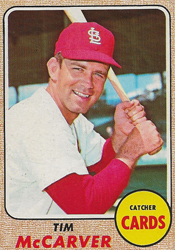 The helicopter carrying McCarver in January 1968 veered in time to avoid a collision with Big Savage Mountain, about 20 miles west of Cumberland, Maryland, near the Pennsylvania border.
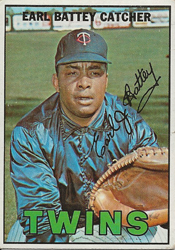 On March 4, 1964, the Minnesota Twins became the last club in the big leagues to end segregation of blacks and whites in spring training residences. The move came 99 years after the end of the Civil War and four months before enactment of the federal Civil Rights Act of 1964.
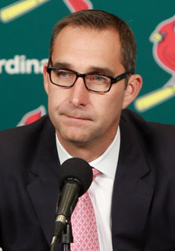 Speaking from Target Field in Minneapolis before the Cardinals played the Twins on July 29, 2020, Mozeliak met for 45 minutes with about a dozen bloggers via Zoom video conferencing to update them on “these unprecedented times” in baseball.
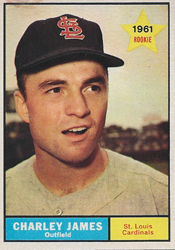 In 1961, while pursuing a degree in electrical engineering at Washington University in St. Louis during the Cardinals’ off-season, James devised an electronic system for calling balls and strikes.
 RetroSimba