Feeds:
Posts
Comments

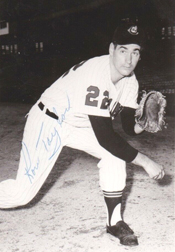
In his short stay with the Cardinals, Bobby Locke pitched a total of two innings in one game and faced four future Hall of Famers.

A right-handed pitcher, Locke played in nine seasons in the majors leagues, primarily with the Indians, Phillies and Angels.

His time with the Cardinals consisted of three weeks in April 1962 when he made one appearance for them. It came against the Cubs, the team that traded him to the Cardinals. Locke pitched two scoreless innings in relief and faced nine batters, including the four who would make it to Cooperstown, Ernie Banks, Lou Brock, Ron Santo and Billy Williams.

Though Locke had a good outing, he and the Cardinals weren’t a good fit.

Unused and unhappy, Locke wanted to pitch more and the Cardinals responded by dealing him to the Phillies.

Pitching prospect

After excelling as a high school athlete in Republic, Pa., about 45 miles south of Pittsburgh, Locke briefly attended Arizona State on a football scholarship, returned home and signed a baseball contract with the Indians in 1953.

After four seasons (1953-56) in the Indians’ farm system, Locke spent two years in military service. He returned to baseball in 1959 with the Indians’ farm club at San Diego, posted a 1.63 ERA and was promoted to the majors in June.

Used as a reliever and spot starter, Locke was 3-2 for the Indians in 1959, 3-5 in 1960 and 4-4 in 1961. He also had a total of six saves.

Coveted by the Cubs

Locke threw a sinking fastball and it caught the attention of the Cubs, who traded second baseman Jerry Kindall for him in November 1961.

“I was surprised by the Kindall deal,” Locke told the Philadelphia Daily News. “Hell, I thought I could hit better than Kindall and I’m a pitcher.”

Before trading for Locke, the Cubs rejected a Braves offer of starting pitcher Bob Buhl for reliever Don Elston and Kindall, The Sporting News reported. Braves general manager John McHale said, “It’s kind of hard to understand. Buhl can win 15 games a year for just about anybody and Locke is pretty much an unknown.”

In its assessment of Locke, The Sporting News declared, “There are times when he appears to be the world’s greatest. At other times, you wonder if he isn’t traveling incognito.”

The Cubs projected Locke, 27, to join a 1962 starting rotation with Don Cardwell, Glen Hobbie and Dick Ellsworth. Locke “was virtually handed the No. 4 starting berth on a platter,” The Sporting News noted.

Elvin Tappe, designated as Cubs head coach in a system featuring multiple coaches as field leaders instead of a manager, said, “Locke is exactly the type of pitcher who is most successful at Wrigley Field. He’s a hard thrower with a good, sinking fastball.”

Regarding his fastball, Locke said, “I’ll match it against anyone’s.”

Conform or else

The relationship between Locke and Cubs management began to deteriorate soon after he arrived at spring training camp in Arizona. The Cubs gave him a manual on fundamentals and Locke disregarded it, saying he knew how to play. They also gave him a jump rope. “Everybody got a rope to skip with in their spare time, but I didn’t see much sense in it,” Locke told the Philadelphia Daily News.

Regarding Locke’s relationship with the coaches, his “clubhouse conversation and independence disenchanted them quickly,” the Chicago Tribune reported.

Locke also disliked the Cubs’ system of a board of coaches, who took turns being head coach, in place of a manager. The issue flared into a controversy on March 6, 1962, during an intrasquad scrimmage. Locke walked off the mound and headed to the training room without consulting any of the coaches. The head coach, Elvin Tappe, wasn’t at the game because he was attending a civic luncheon in Phoenix.

“My arm was tight and I didn’t think I should pitch any more,” Locke told the Philadelphia Inquirer, “but the pitching coach wasn’t around and the others were involved in some kind of argument on the field and weren’t in the dugout when I came in. So I just went into the clubhouse.”

Locke added, “With this all-coach system, I just didn’t know who to talk to.”

One of the coaches, Vedie Himsl, said, “Bobby just has to get used to doing things our way.”

According to Himsl, “Bobby apologized for the public defection,” but Locke stayed deep in the Cubs’ doghouse.

“After that,” wrote Philadelphia Daily News columnist Larry Merchant, “a leper would have become more at home with the Cubbies than Locke.”

Locke said, “Nobody talked to me for two weeks after that incident, honest. Even the players shied away from me. Maybe they could feel I was an outcast with the front office.”

Odd man out

On April 7, 1962, before he had a chance to pitch in a regular-season game for the Cubs, Locke was traded to the Cardinals for a minor-league outfielder, Allen Herring, and cash.

Locke’s arrival gave the Cardinals five right-handed relievers. Getting enough work for Locke, John Anderson, Ed Bauta, Lindy McDaniel and Paul Toth was a challenge for manager Johnny Keane.

Locke was a Cardinal for two weeks before he got into the game against the Cubs. He entered in a mop-up role in the seventh inning with the Cubs ahead, 11-5.

After retiring the first two batters, Locke gave up a single to pitcher Dick Ellsworth before getting Lou Brock to ground to second for a forceout. In the eighth after retiring the leadoff batter, Locked walked Ron Santo, who advanced to second on a wild pitch. After Ernie Banks grounded out, Billy Williams walked, but Locke escaped unscathed when he got Bob Will to fly out to center. Boxscore

According to the Philadelphia Daily News, Locke told the Cardinals he’d just as soon move on if they weren’t going to pitch him more often.

“They had a lot of big stars over there and I knew I wouldn’t get much of a chance,” Locke said. “I want to pitch.”

On the move

On April 28, 1962, the Cardinals traded Locke to the Phillies for Don Ferrarese, a left-handed reliever who had been in the majors since 1955 and was Locke’s teammate with the Indians in 1959.

Ferrarese finished his big-league career with the 1962 Cardinals and was 1-4 with one save and a 2.70 ERA in 38 appearances for them.

In his first appearance for the Phillies, on April 29, 1962, Locke held the Mets to one hit in 4.2 innings of relief and got the win. He also contributed a run-scoring single. Boxscore

A happy Locke said, “With the Cardinals, everyone went separate ways. Here, everyone is on the same level.”

The good vibes faded quickly. Locke yielded runs in each of his next four appearances and was sent to minor-league Buffalo, his fifth club since October.

After pitching in parts of three seasons (1962-64) for the Phillies, Locke pitched for the Reds (1965) and Angels (1967-68).

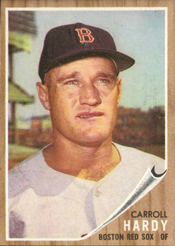
Walt Moryn was a big blonde slugger who hailed from Paul Bunyan country and was nicknamed Moose.

On June 15, 1960, the Cardinals acquired Moryn from the Cubs for utility player Jim McKnight and $25,000.

An outfielder and left-handed pull hitter, Moryn’s swing seemed tailored for the original Busch Stadium in St. Louis, where the shortest distance for a home run was to right.

Though no longer in his prime when he joined the Cardinals, Moryn, 34, had enough pop remaining in his bat to elicit calls of “M-o-o-o-s-e” from the fans in St. Louis when he got hold of a pitch.

Cubs clouter

Moryn was born and raised in St. Paul, Minn. His paternal grandparents immigrated to the U.S. from Russia and his maternal grandparents came from Poland. Moryn entered the Navy when he was 18 and served on an ammunition ship in the Pacific for two years during World War II.

When he returned home, Moryn played baseball in an industrial league. In August 1947, the Dodgers held a tryout camp in St. Paul. Moryn attended and was signed on the recommendation of scout Andy High, a former Cardinals infielder.

Moryn was 28 when he debuted in the majors with the Dodgers in June 1954. He also spent part of 1955 with them and was traded to the Cubs after the season.

For a stretch of three seasons, 1956-58, Moryn hit with consistent power and became a favorite of Cubs fans. He had 23 home runs in 1956, 33 doubles in 1957 and 26 home runs in 1958.

After his production declined to 14 home runs in 1959, Moryn was platooned in left field with Frank Thomas in 1960.

The signature play of Moryn’s career occurred on May 15, 1960, when he made a shoestring catch of a line drive by the Cardinals’ Joe Cunningham with two outs in the ninth to preserve a no-hitter by Don Cardwell. Video

Though Moryn was batting .294 and had an on-base percentage of .366 in 38 games for the 1960 Cubs, his home run total was a mere two when the Cubs shipped him to the Cardinals. Moryn told the Chicago Tribune he was on the outs with Cubs general manager John Holland. “He’s been trying to get rid of me for three years,” Moryn said.

Popular player

To make room for Moryn on their roster, the Cardinals sent Leon Wagner, their Opening Day left fielder, to the minors. The Cardinals were loaded with outfielders. Cunningham, Moryn and Stan Musial batted from the left side, and Curt Flood, Bob Nieman and John Glenn batted from the right. Moryn figured to platoon with Nieman in left.

“At Busch Stadium, I think Moryn still will be dangerous,” Cardinals coach Johnny Keane told the St. Louis Globe-Democrat.

Though listed at 6 feet 2 and 205 pounds, Moryn told the St. Louis Post-Dispatch he weighed 225. St. Louis writers had fun with his alliterative name and his size, referring to him as “Mighty Moose Moryn” and “a mass of muscle from Minnesota.”

Moryn was popular with teammates and helped rookies.

Second baseman Jerry Kindall, another St. Paul native who entered the majors with the Cubs in 1956, told the Chicago Tribune, “He gave the appearance of a very gruff guy, but if you were a teammate, you saw through that in a hurry. He was really a tender-hearted guy.”

In the book “We Played the Game,” Tim McCarver said when he was with the Cardinals as an 18-year-old in 1960, “Guys like Walt ‘Moose’ Moryn and Kenny Boyer couldn’t have been friendlier.”

Hot in August

In his Cardinals debut, on June 17, 1960, against the Braves, Moryn was 0-for-5 and struck out four times. Boxscore

Moryn hit .100 for the Cardinals in June and .194 in July, but sizzled in August, hitting .433 with 19 RBI in 23 games for the month.

“Cardinals crowds raise the “M-o-o-o-s-e’ call whenever the big blonde comes to the plate,” The Sporting News noted.

Moryn’s August performances at home included:

_ Aug. 6 vs. the Reds: 3-for-4, including a triple and a home run, and two RBI. Boxscore

_ Aug. 7 vs. the Reds: 2-for-2, including a home run and a walk, and two RBI. Boxscore

_ Aug. 17 vs. the Giants: 3-for-5, including a home run, and three RBI. Boxscore

_ Aug, 26 vs. the Pirates: 4-for-4, all singles, against Bob Friend. Boxscore

Moryn ended August with a .314 batting average since he joined the Cardinals.

Role player

Though he hit a three-run home run off Robin Roberts to carry the Cardinals to a 4-1 triumph at Philadelphia on Sept. 9, Moryn fell back into a slump and hit .154 for September.

In 75 games for the 1960 Cardinals, Moryn hit .245 with 11 home runs. He batted .301 at Busch Stadium and .196 on the road. Moryn also hit .266 versus right-handers and .111 against left-handers. He was a terror against the Reds, hitting .440 with five home runs and 11 RBI in 11 games for the 1960 Cardinals.

Moryn made 49 starts in the outfield _ 30 in right and 19 in left _ for the 1960 Cardinals.

At spring training in 1961, Moryn surprised the Cardinals by reporting at 198 pounds. “I’ve never been this light before,” he told the Globe-Democrat.

Regarding his playing weight in 1960, Moryn told the Post-Dispatch, “I realized I had let myself get too heavy.”

Cardinals trainer Bob Bauman predicted a slender Moose would slug more home runs at Busch Stadium. “I can see Moryn hitting a lot out on Grand Avenue this year,” Bauman said.

Used exclusively against right-handers and mostly as a pinch-hitter, Moryn, 35, never got untracked with the 1961 Cardinals. He hit .125 in 17 games and was traded to the defending World Series champion Pirates on June 15, 1961, for minor-league catcher Roberto Herrera and cash.

Three days later, on June 18, 1961, in his third game with the Pirates, Moryn, naturally, hit a three-run home run versus the Cardinals’ Larry Jackson. Boxscore

It was one of the last highlights for Moryn in the majors. He hit .200 in 40 games for the Pirates in 1961, his last season in the big leagues.

(Updated Nov. 21, 2024)

For the second time in five years, the Cardinals in June got a future Hall of Fame pitcher who helped them become champions.

On June 16, 1930, the Cardinals acquired Burleigh Grimes from the Braves for pitchers Bill Sherdel and Fred Frankhouse.

A spitball specialist whose dark stubble gave him a menacing look on the mound, Grimes, 36, had a reputation as an intimidating competitor and consistent winner.

In the book “Voices From Cooperstown,” Cubs second baseman Billy Herman said, “Burleigh Grimes was … real hard-nosed. The day he’d pitch, he didn’t want anyone even looking at him. He was mean on the mound.”

With the Cardinals, Grimes was 13-6 in 1930 and 17-9 in 1931, and they won National League pennants both years. In the 1931 World Series, Grimes, pitching in pain caused by an inflamed appendix, started and won the deciding Game 7.

Like Grimes, Grover Cleveland Alexander, a right-hander destined for election to the National Baseball Hall of Fame, was acquired by the Cardinals in a June transaction. The Cardinals claimed Alexander, 39, on waivers from the Cubs in 1926 and he helped them win pennants in 1926 and 1928. His strikeout of the Yankees’ Tony Lazzeri with the bases loaded in Game 7 was the iconic moment in the Cardinals’ first World Series championship.

Winning formula

Grimes, 23, made his debut in the majors with the Pirates in 1916. After posting a 3-16 record in 1917, a trade to the Dodgers (involving outfielder Casey Stengel) revived Grimes’ career. Grimes was 19-9 in 1918, the first of 14 consecutive seasons of double-digit wins.

In February 1920, baseball outlawed the spitball, but exempted pitchers who threw the pitch in the majors before then. Grimes was one of those exempted and was permitted to throw the spitball the remainder of his career. He chewed slippery elm bark for the substance used for the pitch.

Grimes four times had 21 or more wins in a season for the Dodgers, including 1920 when he was 23-11 for the National League champions. “No pitcher in baseball history was a more determined fighter,” The Sporting News reported.

Off the field, Grimes was talkative and thoughtful. He studied and analyzed pitching techniques and willingly shared his views. On the field, he was intense.

“There was only one man standing between me and more money, and that was the guy with the bat,” Grimes said.

The St. Louis Post-Dispatch noted, “When pitching, he is a snarling hard-to-get-along-with personality. He glares at an infielder who makes an error behind him and sneers at umpires who fail to meet his approval in their decisions.”

Bust with Braves

In 1928, Grimes was with the Pirates and was 25-14. The next year, he was 16-2 and on pace for 30 wins when he was struck on the right thumb by a ball off the bat of the Giants’ Bill Terry in July. Sidelined a month, Grimes won once the rest of the 1929 season and finished at 17-7.

A holdout in spring training in 1930, Grimes was traded to the Braves in April when the Pirates rejected his demand for a two-year contract. Rushed into the season without any spring training, Grimes struggled to a 3-5 record and 7.35 ERA for the 1930 Braves, who sought to unload his contract.

When offered Bill Sherdel (3-2, 4.64 ERA) and Fred Frankhouse (2-3, 7.32) for Grimes, the Braves agreed. The year before, Frankhouse was 7-2 for the Cardinals. Sherdel had been with them since 1918 and eight times had seasons of double-digit wins, including 21-10 for the 1928 National League champions.

Sherdel told the Post-Dispatch, “I’ll be pulling for the Cardinals except when I pitch against them.”

Said Frankhouse, “I was hoping we’d land Grimes, but I didn’t even think I might be sent away.”

The Boston Globe concluded, “The Braves cannot be any worse off with Sherdel and Frankhouse. In fact, they should benefit for all the good the high-priced Burleigh Grimes was to them.”

Braves manager Bill McKechnie, who managed the Cardinals to the 1928 pennant, had a different viewpoint, telling the Globe there was no doubt Grimes would win a lot of games for St. Louis.

Making a difference

Grimes joined a Cardinals rotation of Bill Hallahan, Syl Johnson, Jesse Haines and Flint Rhem.

“We have made a deal that will make us a more dangerous pennant contender,” said Cardinals manager Gabby Street. “Grimes is a great pitcher.”

According to the Post-Dispatch, Grimes told club owner Sam Breadon, “You didn’t make any mistake when you got me. There’s nothing the matter with my arm.”

On the day the Cardinals got Grimes, they lost to the Dodgers and their record dropped to 26-28.

The addition of Grimes, along with the return to the lineup of two ailing future Hall of Famers, second baseman Frankie Frisch (spike wound) and left fielder Chick Hafey (sinuses), eventually helped propel the Cardinals higher in the standings.

After posting losing records in June and July, the 1930 Cardinals surged to 23-9 in August and 21-4 in September. Grimes had a significant role. He was 5-2 in August and 4-1 in September.

When Grimes shut out the Pirates on Sept. 25, 1930, it enabled the Cardinals to keep a three-game lead over the Cubs with three to play, assuring at least a share of the pennant. Boxscore

The Cardinals clinched the next day and faced the Athletics in the World Series.

Grimes was 12-4 with a 3.13 ERA as a starter for the 1930 Cardinals and 1-2 with a 6.35 ERA as a reliever. He pitched a pair of five-hitters in the 1930 World Series, but was the loser in both. The Athletics won four of six versus the Cardinals.

In the 1931 World Series rematch, Grimes was 2-0 with a 2.04 ERA. He beat Lefty Grove in Game 3 and George Earnshaw in Game 7.

Field manager

Two months after his World Series success, Grimes, 38, was traded by the Cardinals to the Cubs for outfielder Hack Wilson and pitcher Bud Teachout.

The Cardinals reacquired Grimes in July 1933 after he was released by the Cubs. He pitched in four games for the Cardinals in 1933 and four more in 1934. Grimes also pitched for the Yankees and Pirates in 1934, his last season as a big-league pitcher, and finished with a career record of 270-212.

In 1935, he became manager of a Cardinals farm club in Bloomington, Ill.

In 1937, 20 years after he was traded for Casey Stengel, Grimes replaced Stengel as Dodgers manager. Grimes managed the Dodgers for two seasons before Leo Durocher took over the role.

Grimes managed for several more seasons in the minors, including 1945 and part of 1946 with the Cardinals’ Rochester farm team.

The Cardinals intended for Chris Sabo to replace Todd Zeile as their first baseman, but the plan fizzled when Sabo’s back gave out.

On June 8, 1995, the Cardinals signed Sabo after he was released by the White Sox. A third baseman, Sabo was sent to the Cardinals’ Louisville farm club to learn to play first base so he could be brought back to the majors and fill multiple roles.

About a week later, on June 16, 1995, Sabo was called up to the Cardinals amid a massive shakeup. On the day he arrived, manager Joe Torre was fired and Zeile was traded to the Cubs.

Interim manager Mike Jorgensen put Sabo into the lineup at first base, but his time with the Cardinals lasted only a few games.

Cincinnati kid

Sabo won the National League Rookie of the Year Award in 1988 when he produced 40 doubles and 46 stolen bases as third baseman for the Reds.

A son of a plumber from Detroit, Sabo became a Cincinnati favorite. Nicknamed “Spuds” for a resemblance to the dog Spuds McKenzie in beer commercials, Sabo wore goggles, a buzz cut and a K-mart wardrobe, and drove a well-used 1982 Ford Escort.

In 1990, Sabo had 38 doubles, 25 home runs and 25 steals for the champion Reds. In the Reds’ World Series sweep of manager Tony La Russa’s favored Athletics, Sabo hit .563 with two home runs and fielded flawlessly at third.

After the 1993 season, Sabo became a free agent, rejected an offer from the Mets and signed a one-year contract for $2 million with the Orioles because he viewed them as a contender.

The Orioles opened the 1994 season with a left side of the infield featuring Cal Ripken Jr. at shortstop and Sabo at third, but it didn’t last. Sabo hit .228 in April and went on the disabled list in May because of a bad back. His replacement, Leo Gomez, hit .325 in May and held the job.

Used primarily in the outfield and as designated hitter, Sabo played in 68 games for the Orioles, hit .256 and departed for free agency after the season.

New role

The Cardinals considered signing Sabo to be their third baseman, the St. Louis Post-Dispatch reported, but traded for Scott Cooper of the Red Sox instead. When no other teams showed interest, Sabo, 33, thought about returning to the University of Michigan to finish the work he started on a degree 14 years earlier, the Chicago Tribune reported.

Sabo’s plans changed on April 10, 1995, when the White Sox gave him a one-year contract at $550,000 to be their designated hitter. John Kruk was the first choice of White Sox general manager Ron Schueler to be designated hitter, the Tribune reported, but when Kruk, a free agent, opted to retire, Schueler selected Sabo.

Sabo plays with “intensity and has fire in his eyes,” Schueler said.

Said Sabo: “I’ve never been very level-headed. I have quite a temper. It’s the only way I’ve been able to get where I have. I get fiery. I don’t have a world of talent. So I fire up to help myself.”

Sabo preferred to play third base, but the White Sox had a Gold Glove winner, Robin Ventura, there.

What a Kruk

The White Sox opened the 1995 season with Sabo batting in the cleanup spot between slugger Frank Thomas and Ventura. In May, Kruk changed his mind about retirement and signed with the White Sox, who intended to make him the designated hitter.

Miffed, Sabo told The Cincinnati Post he’d return to the Reds “for a song.”

“I plan on being with the Reds again before I’m done, one way or the other,” Sabo told The Post.

Kruk, 34, joined the White Sox on May 24, 1995. The Tribune’s Paul Sullivan described him as having “the physique of Babe Ruth, the batting eye of Tony Gwynn and the sarcastic wit of David Letterman. He chain-smoked cigarettes, didn’t watch his weight and proudly wore the same T-shirt day after day.”

The White Sox released Sabo on June 5. In 20 games for them, he hit .254 with one home run.

Team in turmoil

Three days later, on June 8, 1995, the Cardinals signed Sabo and indicated he would be used as a utility player for them after he went to Louisville and learned to play first base.

“We know he can play third and the outfield,” said Cardinals manager Joe Torre. “If he can play first, it will add to his versatility. If he’s healthy, he’s a threat with the bat. He can hit the homer and he pulls the ball. He plays well defensively.”

Sabo hit .393 in nine games as Louisville’s first baseman.

Promoted to the Cardinals, he never got to play for Torre. With the Cardinals’ record at 20-27, general manager Walt Jocketty fired Torre on the morning of June 16 before trading Zeile. Though Zeile hit .291 with 22 RBI in 34 games, he was dealt after accusing management of reneging on a contract agreement.

With Zeile gone, Sabo became the first baseman and was assigned uniform No. 18, the same previously worn by Mike Shannon and Andy Van Slyke. In his Cardinals debut on June 16 against the Giants at St. Louis, Sabo batted fifth in the order between Ray Lankford and Scott Cooper. He made a fielding error in the second inning, leading to a run, but had a run-scoring single in the fifth. Boxscore

Sabo played in four more games for the Cardinals, making another start at first, one at third and two pinch-hit appearances. He had a two-run double versus Dodgers rookie Hideo Nomo on June 19. Boxscore

During batting practice one day, Sabo developed back spasms. He went on the disabled list on June 29, 1995, and remained sidelined for six weeks. “I don’t think there’s a lot of fuel left in the tank,” Cardinals coach Gaylen Pitts told Larry Harnly of The State Journal-Register of Springfield, Ill.

In August 1995, the Cardinals sent Sabo to their St. Petersburg farm club in the Florida State League to get in condition for a possible return to the majors in September. Instead, after Sabo hit .231 in 14 games for St. Petersburg, the Cardinals released him because “he didn’t dominate that league like you’d think he would,” Jocketty said.

In 13 at-bats for St. Louis, Sabo had two hits and three RBI.

As he predicted, Sabo returned to the Reds and played his final major-league season with them in 1996.

In 2018, Sabo was named head baseball coach at the University of Akron.

(Updated Dec. 8, 2024)

When Whitey Herzog became Cardinals manager, he replaced a friend who had been his roommate and teammate with the Mets.

On June 8, 1980, the Cardinals fired manager Ken Boyer and hired Herzog to succeed him.

Boyer, an all-star and Gold Glove Award winner as Cardinals third baseman in the 1950s and 1960s, was their manager since April 1978. Herzog managed the Royals to three consecutive division titles before being fired after the 1979 season.

In 1966, the Mets had Boyer as their third baseman and Herzog as a coach. In his book, “White Rat: A Life in Baseball,” Herzog said he and Ken Boyer shared a New York apartment with Yankees players Roger Maris and Clete Boyer, Ken’s brother.

“When the Mets were on the road, Clete and Roger had the place, and when the Yankees were on the road, Kenny and I took it over,” Herzog said.

After Boyer was fired by the Cardinals, he told a St. Louis Post-Dispatch reporter, “Wish Whitey Herzog good luck. I hope they can turn it around.”

The comment was relayed to Herzog, who said, “I appreciate that. We are very good friends.”

Time for a change

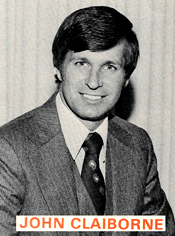
After Herzog left the Royals, Cardinals general manager John Claiborne called him occasionally to seek his opinions on players. Claiborne and Herzog had worked together for Bing Devine with the Mets.

At one point in their conversations, Herzog said, Claiborne asked whether he’d want to become a paid consultant to the Cardinals. “I told him I didn’t want to get tied up with something like that, but I’d be happy to give him my opinions when he asked for them,” Herzog said.

The 1980 Cardinals hit the skids early and Claiborne and club owner Gussie Busch determined Boyer needed to go.

On Saturday, June 7, 1980, Herzog said he got a call from Busch’s attorney, Lou Susman, who asked him to meet Busch in St. Louis the next morning. Meanwhile, Claiborne headed to Montreal, where the Cardinals were playing, to inform Boyer he was fired. Claiborne intended to get to Montreal on Saturday night and meet with Boyer the next morning, but a rainstorm canceled the connecting flight and Claiborne had to spend the night in Chicago.

On the morning of June 8, 1980, Herzog went to Busch’s estate at Grant’s Farm and Claiborne took a flight from Chicago to Montreal, where the Cardinals and Expos were to play a Sunday afternoon doubleheader.

Herzog met with Busch and Susman, and was offered a one-year, $100,000 contract to manage the Cardinals. When Herzog objected to the length of the contract, Busch countered with a three-year deal through the 1982 season. Herzog accepted and Busch made plans to announce the hiring in a news conference late in the afternoon.

(In a 2016 interview with Cardinals Yearbook, Herzog said he was headed out the front door after learning the contract offer was for one year. According to Herzog, Busch then said, “Come back here. You’re right. The ballplayers have long-term contracts; you should have one, too.”)

At Montreal, the Cardinals lost Game 1 of the doubleheader, dropping their record to 18-33 and giving them 21 losses in their last 26 games.

Boyer was in the clubhouse, making out the lineup card for Game 2, when he looked up and was surprised to see Claiborne enter. “I thought for certain he had come here to discuss possible trades,” Boyer told the Montreal Gazette.

Instead, Claiborne told Boyer he was fired. “This is something you want to talk about to a man face to face, not over the telephone,” Claiborne said.

Claiborne offered Boyer another job within the organization, but Boyer said he wanted time to think it over.

“Boyer was on his way to St. Louis by the second inning of the second game,” the Gazette reported.

Coach Jack Krol filled in as manager for Game 2, and the Cardinals lost again.

Mourning in Montreal

In the locker room, after getting swept in the doubleheader, most Cardinals said they were sorry Boyer was gone and exonerated him of blame for the team’s record. Boyer was 166-191 as Cardinals manager.

In comments to the Post-Dispatch, first baseman Keith Hernandez said the 1980 Cardinals were “the worst team I’ve been on since I’ve been in the major leagues. The worst. We are bad. The manager is only as good as his horses and we don’t have the horses. I’m going to miss Ken Boyer.”

Second baseman Tommy Herr said, “There’s a lack of professionalism among certain players as far as guys running groundballs out, 100 percent all-out effort.”

Cardinals catcher Ted Simmons and pitcher Bob Forsch were two of the players most upset by Boyer’s firing, according to the Post-Dispatch. “Old Cardinals die hard,” Simmons said.

Pitcher John Fugham told The Sporting News, “Unfortunately, there were not 25 people on this team as intense as Kenny Boyer was. Therein lies the problem.”

Vern Rapp, who two years earlier was fired while the Cardinals were in Montreal and replaced as manager by Boyer, was a coach with the 1980 Expos. Asked his reaction to Boyer’s firing, Rapp told the Post-Dispatch, “I feel sorry for anybody it happened to. I know how it feels. It’s not a good feeling.”

Oh, brother

At the news conference at Grant’s Farm introducing him as Cardinals manager, Herzog said, “I’m going to take this dang team and run it like I think it should be run. I don’t think I’ve ever had trouble with players hustling. I understand that’s been a problem here. I think you’ll see the Cardinals running out groundballs.”

Asked whether the Cardinals needed a leader to emerge from within the team, Herzog said, “I don’t need a team leader. I’m the leader.”

Said Busch: “My type of manager, without any argument.”

Born and raised in New Athens, Ill., Herzog described himself as a “very opinionated, hardheaded Dutchman.”

At birth, he was named Dorrell Norman Elvert Herzog. His mother said she intended to name him Darrell, but the name got misspelled. In New Athens, where he excelled at basketball as well as baseball, everyone called him Relly. In the New Athens High School yearbook, it was noted, “He likes girls even more than basketball.” As a professional ballplayer, he got nicknamed Whitey because of his light blonde hair.

Herzog had two brothers _ Therron, who everyone called Herman, and Codell, who everyone called Butzy.

When Herzog was named Cardinals manager, Butzy, who “never played baseball in his life,” told Whitey what lineup he should use to help the Cardinals improve.

“I may play his lineup,” Whitey said.

“He better,” Butzy told the Post-Dispatch, “or we’ll have a fight.”

Whether or not it was with Butzy’s help, the Cardinals went on to win three National League pennants and a World Series championship during Whitey’s 11 years as their manager.

Asked about the style of baseball that became known as Whiteyball, Herzog told Cardinals Magazine, “Whiteyball was nothing more than using speed and playing good, sound, fundamental baseball. And your players have to buy in to it.”

Herzog told Cardinals Yearbook, “We changed the way the Cardinals played baseball. We went back to the old Gashouse Gang philosophy.”

Author Mike Mitchell has written a book, “Mr. Rickey’s Redbirds,” and it’s a compelling blend of baseball and American history.

I read it and found it to be thought-provoking and informative.

The book can be ordered on Amazon or at the author’s website, rickeysredbirds.com.

I interviewed Mitchell via email in May 2020. The interview is presented here in an edited, condensed form.

Q: Congratulations on writing the book. What inspired you to do it?

A: “I wrote a book many years ago and appreciated the process. I enjoy researching and writing, but needed time and a new idea. Both emerged around 2015. I had moved back to St. Louis just a few years before, having wound down some previous business commitments. I was fortunate to have the freedom to pursue a new venture. What started as a curious peek into the team’s first World Series championship squad in 1926 eventually became the book that is out today.”

Q: How does this book differ from others about the Cardinals and baseball?

A: “A lot of baseball books focus on a particular person or a particular season. At the other end of the spectrum are books that present a comprehensive history. This book is somewhere in between. It’s largely about Branch Rickey, but also the eras in which he played, managed or ran a front office. It covers a lot of ground because Rickey covered a lot of ground.

“At times, it’s also a book that delves into the broader sweep of history. Prohibition, the Black Sox scandal, the Great Depression, and segregation are all topics Rickey and the Cardinals face during his time in St. Louis.”

Q: From inception to completion, how long did the project take and what was the most time-consuming aspect?

A: “It started around 2015 when I began researching the 1926 team, but as I continued to dig into the material, I quickly realized it was a much bigger story. By 2017, I had the outline for what the book became and by the summer of 2018, I was probably 75 percent complete and expected to have a book done by Christmas of that year. But my father passed away in January of 2019, and from about six months before that until six months afterward, I lost my appetite for the project. I picked it up again in the second half of last year.”

Q: What was the biggest obstacle or challenge you had to overcome and how did you do it?

A: “With the Internet and digitalization of many newspapers, magazines and books, access to information isn’t an issue. Deciding what to include among the fire hose of facts, figures and data available is. One of the ways I handle this is to include all sorts of supplemental information in the end notes of every chapter.”

Q: The book is honest and accurate, and doesn’t sugarcoat or sensationalize. How were you able to strike the right balance?

A: “I can’t say it was some grand strategy, but I can say I started with a blank slate and a curious mind. Whether the information was positive or negative, my main interest was telling a captivating story in a compelling fashion. One thing I notice is that once a book is in print, certain ideas, stories, and quotes get injected into the bloodstream of history. Good stories tend to get told again. I’m sure I’ve fallen for it myself, but I try to be skeptical anytime I see a quote that gets endlessly repeated without attribution. Skepticism, combined with curiosity, goes a long way.”

Q: Do you think anyone in baseball today has qualities similar to Branch Rickey?

A: “If Bill James is the father of SABR metrics, Branch Rickey is the grandfather. As manager of the Browns in 1914, he had a sportswriter named Travis Hoke charting pitches and counting bases, not hits. Later with the Dodgers, he hired a statistician, Allan Roth. The two developed a formula for wins based on things like on-base and slugging percentage.

“If I had to name one person that fits the Rickey mold, Bill DeWitt Jr. comes to mind. His father had a long history with Rickey, worked for him for years. It was Rickey who brokered the deal that saw DeWitt Sr. and Don Barnes take control of the Browns. As a general manager, DeWitt Sr. became the first executive to win pennants in both leagues (1944 Browns, 1961 Reds). Bill Veeck said in the early 1960s, that outside of Rickey, there’s no smarter man in baseball than DeWitt. This is the environment in which DeWitt Jr. grew up.”

Q: What are your personal remembrances of Cardinals baseball and what was its impact on you?

A: “When I think of Cardinals baseball, I think of my family and summertime. My earliest memories aren’t of watching games, but listening to them on the radio with my father, either in the car or on our patio. While I live in St. Louis now, I didn’t grow up here. The only time we saw the Cardinals on television was Sunday road games, or the rare occasion the team would be on the Game of the Week. We made the trip to St. Louis to watch games only a handful of times a year.

“My father got his love for Cardinals baseball from his father, my grandfather, who was born in 1893. I like to think that between the three of us, we’ve had memories of nearly every Cardinals team.

“The weekend Ozzie Smith was inducted into the Hall of Fame, my father and I were there for his speech. That’s the only time I’ve been to Cooperstown, and it’s a memory I’ll always cherish.

“My mother merely tolerated baseball for many years. She’d watch the games because the males in the house would be watching them. That all changed in the summer of 1998. She became a fan that season because of Mark McGwire and the chase to break the record set by Roger Maris. She’s 88 now, still a fan, and like all of us, can’t wait for baseball to return.”

Q: Can you share with us a favorite personal baseball anecdote?

A: “Hands down, Game 6 of the 2011 World Series is my favorite baseball moment. I got lucky. It was the only game of the Series I attended. I remember the knot in my stomach in the bottom of the ninth inning as a group of Rangers fans in front of me stood up to cheer what seemed to be inevitable. Then the David Freese triple happened. Then Josh Hamilton homered and back to despair.  Somehow the Cardinals clawed back to tie it again. The roller coaster ride ended with the Freese home run to center. A friend said I began shouting, ”David Freese!” I don’t remember that, but I do remember the feeling. Pure joy.

“I’d never experienced a moment quite like that as a fan, and doubt I will again.”

Q: Anything else about the book?

A: “I hope readers can think about two questions after reading the book: 1. Why isn’t scout Charley Barrett in the Cardinals Hall of Fame? It may surprise people to realize how influential and well-known Barrett was in St. Louis. 2. Why isn’t Rickey’s image on the left-field wall at Busch Stadium along with other greats of the franchise? He didn’t play for the Cardinals, but neither did Jack Buck nor Gussie Busch. If a franchise can honor a broadcaster and an owner, why not a general manager?”