Feeds:
Posts
Comments

Babe Didrikson, who won Olympic medals in track and field before she became one of America’s top golfers, was the starting pitcher for the Cardinals in a spring training game.

On March 22, 1934, Didrikson pitched for the Cardinals against the Red Sox at Bradenton, Fla.

A relentless self-promoter, Didrikson’s performance helped develop her reputation as America’s premier woman athlete.

Diamond dandy

A daughter of Norwegian immigrants, Didrikson was born in Port Arthur, Texas, and grew up in nearby Beaumont, where she excelled in multiple sports.

At 21, she was a member of the U.S. Olympic track and field team. At the 1932 Summer Olympics in Los Angeles, Didrikson won two golds (hurdles and javelin) and a silver (high jump).

With America in the grip of the Great Depression, opportunities for women in professional sports were limited. Didrikson sought to earn income in several sports, including basketball, billiards and baseball.

In 1934, Didrikson joined the House of David barnstorming baseball team. Promoter Ray Doan arranged for Didrikson to have a training session with Cardinals pitcher Burleigh Grimes in Hot Springs, Ark.

According to the Associated Press, Didrikson “would be one of the best prospects in baseball if she were a boy,” said Grimes.

The Associated Press also noted, “The Babe has mastered somewhat of a curve.”

Timely fielding

The Athletics and Cardinals each agreed to let Didrikson pitch an inning in a spring training game.

On March 20, 1934, at Fort Myers, Fla., Didrikson started for manager Connie Mack’s Athletics against manager Casey Stengel’s Dodgers before a Tuesday afternoon gathering of 400 spectators.

Didrikson walked the first batter, Danny Taylor, and hit the next, Johnny Frederick, with a pitch.

The No. 3 hitter, Joe Stripp, lined the ball. Second baseman Dib Williams caught it for the first out and tossed to shortstop Rabbit Warstler, who tagged second to double up Taylor, who had headed for third. Warstler threw to first baseman Jimmie Foxx to nip Frederick, who couldn’t get back to the bag in time, and complete a triple play.

According to the book “Diz,” a biography of Dizzy Dean, Stengel shook his head in mock sorrow and said, “My little lambs just couldn’t get to her.”

“The Babe was wildly cheered as she left the premises,” the Philadelphia Inquirer reported.

Didrikson, a right-hander, stood between 5-foot-5 and 5-foot-7 and weighed between 115 and 145 pounds, according to varied sources. She “looked like a slightly built boy except for a few stray feminine locks that stuck from under her black baseball cap,” the Fort Myers News-Press reported. “She possessed a slow curve but had some difficulty in finding the plate.”

With her inning of work done, Didrikson was lifted and the Dodgers won, 4-2.

Tough break

Two days later, before a Thursday afternoon crowd again estimated at 400, Didrikson made her start for manager Frankie Frisch’s Cardinals against manager Bucky Harris and the Red Sox.

Didrikson “is gaining experience and improving her pitching,” the St. Louis Post-Dispatch reported. “Under the tutelage of Burleigh Grimes, Dizzy Dean and others, she has learned to stand on the rubber, wind up like a big-leaguer and throw a rather fair curve.”

Joining Didrikson and Frisch, who played second base, in the Cardinals’ starting lineup were first baseman Rip Collins, shortstop Burgess Whitehead, third baseman Pepper Martin, left fielder Joe Medwick, center fielder Buster Mills, right fielder Jack Rothrock and catcher Spud Davis.

After Red Sox leadoff batter Max Bishop grounded out to second, Didrikson allowed singles to Bill Cissell and Ed Morgan, putting runners on second and first.

Cleanup hitter Roy Johnson grounded to Frisch, who threw to Whitehead, covering the bag at second, for the force on Morgan.

With two outs and runners on third and first, rookie Moose Solters faced Didrikson next. Didrikson got two strikes on Solters and threw a curve. Solters watched it go into the catcher’s mitt. To press box observers, the pitch was strike three, which should have ended the inning, but the umpire called it a ball.

Solters hit the next pitch for a two-run double.

Didrikson “deserved a better fate than she received,” the St. Louis Globe-Democrat reported. “A hit followed what could have been called a third strike and the third out.”

The St. Louis Star-Times declared Didrikson would have escaped with a scoreless inning “but for a questionable decision by the umpire.”

On the links

After Solters doubled, Dusty Cooke reached on an error by Rip Collins. Rick Ferrell singled, scoring Solters and giving the Red Sox a 3-0 lead. Didrikson got the next batter, Bucky Walters, to fly out to left.

The Red Sox “would have been scoreless if it had not been for loose fielding and what the Cards described as the plate umpire’s failure to see a third strike as a strike,” the Post-Dispatch reported.

The Cardinals rallied for three runs in the bottom of the first against Fritz Ostermueller. Whitehead, the eighth-place batter, made the last out of the inning, depriving Didrikson of a plate appearance.

Bill Hallahan relieved Didrikson in the second and pitched four innings. Dean, who told Didrikson he’d show her some “real chucking,” pitched the last four, held the Red Sox hitless and the Cardinals won, 9-7. Said Dean: “I had them swinging like ham on a hook.”

“Well, our Red Sox managed to get three runs in one inning off Babe Didrikson, the girl athlete,” the Boston Globe declared. “So perhaps later on they will be able to play ball with the boys.”

Columnist L.C. Davis of the Post-Dispatch concluded, “As a pitcher, Babe is an outstanding field and track athlete. Babe may be a drawing card, but a woman’s place is on the bench.”

Three days later, Didrikson pitched two scoreless innings for the minor-league New Orleans Pelicans against the Cleveland Indians.

Didrikson eventually focused on golf. At the 1938 PGA Tour Los Angeles Open, where she competed against the men, Didrikson met professional wrestler George Zaharias. Eleven months later, in December 1938, they married in St. Louis and she became Babe Didrikson Zaharias.

A founding member of the LPGA Tour, Babe Didrikson Zaharias won 41 titles, including 10 majors. She was a three-time winner of the Women’s U.S. Open, including in 1954 after she underwent surgery for colon cancer.

Babe Didrikson Zaharias was 45 when she died of cancer in 1956.
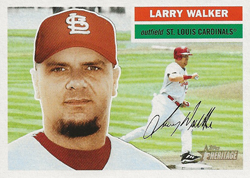
If Walt Jocketty had gotten what he wanted, Larry Walker would have spent most of his career, not just the last two seasons, with the Cardinals.

Walker, a three-time National League batting champion who was elected to the Baseball Hall of Fame on Jan. 21, 2020, played his first six seasons in the majors with the Expos and became a free agent in October 1994, the same month Jocketty replaced Dal Maxvill as Cardinals general manager.

Jocketty was looking for opportunities to improve the Cardinals, who were 53-61 in strike-shortened 1994, and wanted to sign Walker.

The Rockies made the most lucrative offer and Walker signed with them in April 1995.

Nine years later, Jocketty finally got his man, acquiring Walker in a trade with the Rockies in August 2004. Walker finished his career with the Cardinals, helping them reach the postseason in 2004 and 2005.

Opening at first

In December 1994, Walker, who threw right and batted left, had surgery on his right shoulder. The right fielder’s agent, Jim Bronner, said Walker would wait until March 1995 or later to sign because he wanted to show teams his shoulder was healed, the St. Louis Post-Dispatch reported.

Jocketty wanted Walker to be the Cardinals’ first baseman, replacing Gregg Jefferies, who became a free agent, according to the Post-Dispatch.

“Walt Jocketty says if he has time and money to sign only one free agent it would be a hitter to replace Gregg Jefferies rather than a pitcher,” the Post-Dispatch reported on Feb. 5, 1995. “His sights still are set on Larry Walker.”

A week later, as the Cardinals and all other major-league teams prepared to open spring training camps with replacement players while the big-leaguers remained on strike, Jocketty was in pursuit of Walker.

“He’s still the best player out there,” Jocketty said. “I think we’ve got as good a chance as anybody.”

Coors vs. Busch

Whatever amount Jocketty offered, it wasn’t enough to top the Rockies, who gave Walker a four-year contract for a guaranteed $22.49 million on April 8, 1995, according to the Associated Press.

The next day, with Walker out of the picture, the Cardinals acquired third baseman Scott Cooper from the Red Sox and planned to move Todd Zeile from third to first.

On April 26, 1995, Walker made his regular-season Rockies debut in the inaugural game played at Coors Field in Denver and produced three doubles and three RBI in a 14-inning victory against the Mets. Five inches of snow fell in the Denver area during the morning and the game, played at night in temperatures in the mid-30s, took 4 hours and 49 minutes to complete. Boxscore

Walker’s first game against the Cardinals since signing with the Rockies occurred on May 29, 1995, at Busch Memorial Stadium in St. Louis. The high-priced slugger went 0-for-6 and got razzed by some of the spectators after his last plate appearance. Boxscore

“One of the things about this type of deal is you get to hear a lot more imaginative things from the fans,” Walker told the Rocky Mountain News. “They were chanting, ‘Oh for six.’ They didn’t know the half of it.”

Walker’s hitless night extended his skid to 0-for-24 over his last six games.

The next night, Walker was benched by manager Don Baylor. He returned to the lineup for a day game, May 31, 1995, and snapped the slump with a two-run double and a solo home run against Cardinals starter Mark Petkovsek. The homer was a majestic shot which carried into the sixth row of the center-field bleachers, according to the Post-Dispatch. Boxscore

Petkovsek “made two bad pitches to Walker,” said Cardinals manager Joe Torre. “You’d like to make bad pitches to smaller guys, though.”

Said Walker: “I wasn’t sure if I should turn left or right the first time I got a hit because all I had been doing lately was turning to the right and going back to the dugout. That home run really messed me up, having to touch all four bases.”

The Cardinals gave Dave Collins a chance to extend his playing days and to begin a coaching career in the major leagues.

Collins, 37, signed a minor-league contract with the Cardinals on Feb. 16, 1990, and was invited to audition for a spot with the big-league club at spring training.

A switch-hitter with speed, Collins was an outfielder, but the Cardinals envisioned him as a candidate for multiple roles, including pinch-hitter, pinch-runner and defensive replacement for Pedro Guerrero at first base.

Collins won a spot on the Cardinals’ Opening Day roster and spent the 1990 season with them. In 1991 and 1992, he was the Cardinals’ first-base coach and mentored players such as Ray Lankford, Bernard Gilkey and Felix Jose on base running and outfield play.

Career options

Born and raised in Rapid City, S.D., Collins was a top high school athlete in baseball, basketball, football and track. He ran the 100-yard dash in 9.6 seconds. A slender 5-foot-11, Collins was recruited by multiple colleges and opted to pursue a baseball career.

“I got a lot of offers and was seriously thinking about playing basketball, but I knew if I played it would just be in college and that would be it,” Collins told the St. Louis Post-Dispatch. “I thought I would have a better chance of becoming a professional baseball player.”

After a year at Mesa Community College in Arizona, Collins was drafted by the Angels in June 1972 and signed with them. The Angels had Dick Williams as manager and Whitey Herzog as coach when Collins, 22, made his major-league debut with them in June 1975.

Collins played 16 seasons in the majors for the Angels, Mariners, Reds, Yankees, Blue Jays, Athletics, Tigers and Cardinals, producing 1,335 hits and 395 stolen bases.

His best seasons were 1980, when he hit .303, scored 94 runs and had 79 stolen bases for the Reds, and 1984, when he hit .308 with 15 triples and 60 steals for the Blue Jays.

Bench help

Fifteen years after he coached Collins with the Angels, Herzog was manager of the Cardinals in 1990 when they went looking for a pinch-hitter.

According to the Post-Dispatch, the Cardinals pursued Keith Moreland, 35, a free agent who’d spent most of his career with the Phillies and Cubs. When Moreland informed the Cardinals he intended to retire, they turned to Collins.

“He gives us a little bit of experience and he’s better than what we had,” Herzog said.

Though Collins signed a minor-league deal, he said he’d quit if he didn’t earn a spot on the Cardinals’ Opening Day roster.

“I told them I didn’t want to end my career in triple-A,” Collins said. “Either I make the club or I go home. I feel comfortable I can still play.”

Chance to coach

Once the season started, Herzog was pleased with Collins’ fielding at first base, saying, “I really think he has played better there than I thought he could play,” but not with his hitting. Collins had two hits in his first 25 at-bats. When his wife gave birth to a son in June 1990, Collins told the Post-DIspatch, “If I make another out, my baby is going to weigh more than my batting average.”

In July 1990, Herzog resigned and was replaced by Joe Torre in August.

Collins worked to stay fit and make a good impression, running up and down the steps at Busch Memorial Stadium before home games. “I’ve been with eight organizations and this is the best one,” Collins said. “I’d like to stay here.”

Collins finished the 1990 season with a .366 on-base percentage, including .406 as a pinch-hitter. Torre asked him to join his coaching staff and Collins accepted.

“Collins has had some pretty good tutors along the way, like Joe Morgan,” Torre said. “Young players need constant surveillance, somebody to hook on to, to talk to.”

According to the Post-Dispatch, Collins would “instruct young outfielders such as Felix Jose and Ray Lankford” and “work on base stealing with those two and Bernard Gilkey, among others.”

Collins instructed veterans, too. At spring training in 1991, he helped utility player Rex Hudler improve his outfield play. Hudler said Collins taught “how to charge the ball, what foot to field it on, throwing over the top, and picking up a dead ball off the wall after you’ve chased it down. He’s given me a lot of tips and tricks.”

Resetting priorities

After the 1991 season, Collins took a job during the winter as head coach of a boys’ high school basketball team in Anna, Ohio, near Dayton.

“It’s something I always thought about doing,” Collins said. “Basketball was my first love. The only way I can still stay in touch with it is to coach it.”

Collins arranged for Cardinals and Reds players to compete in a charity basketball game at the high school. Players included Lee Smith, Rich Gedman, Milt Thompson and Tim Jones of the Cardinals and the Reds’ Barry Larkin, Paul O’Neill, Hal Morris and Rob Dibble, one of the relievers known as the Nasty Boys.

“If we’d have been charting fouls, Dibble would have fouled out before the game even started,” Collins said. “He was out of control.”

Asked about Lee Smith, the Cardinals’ 6-foot-5 closer, Collins said, “He can really play. He hit about 10 three-pointers.”

After a second season as Cardinals coach in 1992, Collins went back to Ohio and coached high school basketball again.

When Collins reported to 1993 spring training to begin his third year as Cardinals coach, his heart was tugging him back to Ohio, where his two toddlers lived, and where the prep basketball team he coached still was playing its season.

Collins asked the Cardinals to be reassigned so he could spend more time in Ohio. The club granted the request, making him an advance scout.

Collins’ departure from the coaching staff saddened Lankford, who credited him with being a mentor.

“You felt comfortable going to him if you had a problem, or if you weren’t sure about certain things,” Lankford said. “He made the outfield what it was _ Felix, Gilkey, myself. I’m speaking for everybody. We’re going to miss him.”

In January 2020, Collins joined the baseball coaching staff of Indiana University Southeast in New Albany, Ind.

(Updated March 5, 2023)

Roger Kahn, who gained prominence for his work about the Dodgers, wrote extensively about the Cardinals as well.

A newspaper and magazine journalist, Kahn wrote 20 or so books, including the 1972 classic “The Boys of Summer” about his hometown Brooklyn Dodgers.
After covering sports for the New York Herald Tribune, Kahn wrote for magazines such as Collier’s, The Saturday Evening Post and Sports Illustrated.

Kahn was respected by colleagues and the baseball people he covered. In February 1954, he called former Cardinals and Dodgers executive Branch Rickey, who had moved to the front office of the Pirates, at his spring training base in Fort Pierce, Fla., and was “offered a job,” The Sporting News reported.

When Kahn asked Rickey how long it would take him to do for the Pirates what he did for the Cardinals and Dodgers, Rickey replied, “I need help. If you know how to help a tail end ballclub, come down here. I’ll pay you more than you’re making. I don’t care what it is.”

Lane explains

In May 1956, Dodgers outfielder Duke Snider was the subject of a controversial Kahn article in Collier’s titled, “I Play Baseball For Money, Not Fun.”

A month later, in The Saturday Evening Post, Kahn wrote about Cardinals general manager Frank Lane in a piece titled, “I’m Here To Win A Pennant.” Lane was in his first season with the Cardinals and created a ruckus by trading players such as Red Schoendienst, Harvey Haddix and Bill Virdon.

“I didn’t come to St. Louis to raise red roses or tell after-dinner stories or take the tenor lead in ‘Hearts and Flowers,’ ” Lane told Kahn. “I came here to win a pennant and that’s exactly what I intend to do any way I can.

“I’ve got a program here to keep the club growing and improving,” Lane said. “I want to tell the other general managers around the National League that, with our fine farm clubs, and with the tough core we’ve welded, I’m not going to have to jump at every little offer for a trade. If I see something good, though, they’d better be ready.”

Lane lasted two seasons with the Cardinals and didn’t win a pennant.

Prideful struggle

Four years later, in September 1960, Kahn wrote a story on Stan Musial for Sports Illustrated titled, “Benching of a Legend.”

Musial, 39, was hitting .250 when he was benched by Cardinals manager Solly Hemus. Musial was kept out of the starting lineup from May 27 through June 23. His season batting average fell to .229 on June 25, but Musial recovered by hitting .352 in July and finished the year at .275 with 17 home runs.

Musial “intends to end his career with dignity and with base hits,” Kahn wrote. “Neither comes easily to a ballplayer several years past his peak, and so to Musial, a man accustomed to ease and to humility, this has been a summer of agony and pride.”

Regarding Musial’s struggles in the first part of the season, Kahn concluded, “Athletes, like chorus girls, are usually the last to admit that age has affected them, and Musial appeared to be following the familiar unhappy pattern.”

In an interview with Kahn, Hemus said, “What’s my obligation as manager? It’s not to a friendship, no matter how much I like a guy. My obligation is to the organization that hired me and to 25 ballplayers. I have to win. Stan was hurting the club. He wasn’t hitting and balls were getting by him at first base.”

Kahn reported, “Musial hated the bench. He confided to a few friends that he wouldn’t mind being traded to a club that would play him every day.”

After returning to the starting lineup, Musial told Kahn, “Maybe my wheels are gone, but I’ll be able to hit like hell for a long time.”

Musial went on to play three more seasons for the Cardinals, including 1962 when he hit .330, before retiring at 42.

High praise

When “The Boys of Summer” came out in February 1972, it received a glowing review from the St. Louis Post-Dispatch, which called Kahn’s work “a magnificent sports volume” and “a book which is redolent of dream and magic and which finds a common ground between one boyhood in a big city and lots of boyhoods in many other places.”

In September 1972, when Kahn was in St. Louis for a Cubs-Cardinals series, columnist Jerome Holtzman wrote in The Sporting News, “A half-dozen ballplayers got into line to meet and shake hands with Roger Kahn, who was in town promoting his bestselling ‘Boys of Summer.’ I had never seen players line up to meet a writer, and Kahn said it was a big thrill for him.”

Pitching lessons

In 2000, Kahn’s book, “The Head Game,” was published. It focused on pitchers, including two who were prominent with the Cardinals, Bob Gibson and Bruce Sutter.

Gibson told Kahn, “Pitching is inexact. It begins as a craft, working with your hands, but the longer you go, if you know how to think, the more it becomes an art.”

To illustrate, Gibson cited how he threw fewer knockdown pitches as he gained experience.

“As the art, the thinking, takes over, I’ve come to realize not everyone is bothered by knockdowns and some of them are afraid of my fastball, whether I throw at them or not,” Gibson said.

Like Gibson, Sutter won head games with batters. A Cardinals closer, Sutter did it with an innovative pitch, the split-fingered fastball.

“It was some time before I could control the splitter the way I had to,” Sutter told Kahn. “After a while, I found out I did best throwing for the top of the catcher’s mask. That became my target. If I used a wide finger split, the ball would end up in the dirt. If I split the fingers a little less, it would be a strike at the knees.

“Once in a while,” said Sutter, “maybe one pitch in 10, to cross them up, I’d play real dirty. I’d throw a straight fastball that didn’t drop at all.”

Sutter was taught the split-fingered pitch by Cubs minor-league instructor and ex-Cardinals pitcher Fred Martin. Sutter told Kahn that he and Martin later taught the pitch to another ex-Cardinal, Roger Craig, who as a pitching coach and manager encouraged his pitchers to throw it.

“I was the guy who showed Roger Craig how to throw a splitter,” Sutter said to Kahn. “I was with the Cubs. Craig was pitching coach for San Diego. Fred Martin was there with me on the major league club that day, and on the sideline there I showed Roger how to throw it. Then Fred spent some time talking to him about it. I’m sure Roger came up with modifications, but it was Fred Martin and I who showed him the pitch.”

(Updated March 9, 2021)

The election of outfielder Larry Walker to the Baseball Hall of Fame in 2020 qualifies him as the top Canadian to play for the Cardinals.

Here’s a look at the five best Canadian Cardinals:

LARRY WALKER

Acquired from the Rockies on Aug. 6, 2004, Walker, 37, hit .280 in 44 games for the 2004 Cardinals. With a .393 on-base percentage, the right fielder helped the Cardinals win a division title.

In the 2004 postseason, Walker hit six home runs: two in the National League Division Series versus the Dodgers, two in the NL Championship Series against the Astros and two in the World Series versus the Red Sox.

In Game 1 at Fenway Park in Boston, Walker, appearing in a World Series for the first time, was 4-for-5, including two doubles and a home run, and two RBI. Boxscore

The Associated Press noted, “He hasn’t allowed the atmosphere to overwhelm him. He said he was most excited about seeing Aerosmith singer Steven Tyler, who sang ‘The Star-Spangled Banner,’ standing a few feet away from him.”

Born in Maple Ridge, British Columbia, Walker became the second Canadian to hit a home run in a World Series game. The first was George Selkirk for the 1936 Yankees against the Giants.

In 2005, his final season, Walker hit .289 for the Cardinals. His .384 on-base percentage helped them qualify for the postseason again.

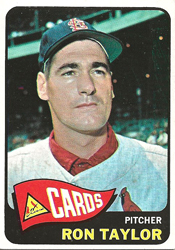
RON TAYLOR

A right-handed pitcher who could start and relieve, Taylor was 19-12 with 20 saves in three seasons (1963-65) with the Cardinals. His best pitches were a sinking fastball and slider.

Acquired from the Indians on Dec. 15, 1962, the Toronto native was a prominent member of the Cardinals’ staff in 1964 when they won a World Series title.
“As long as we have him in the bullpen, we’ll be well-fortified,” Cardinals consultant Branch Rickey told The Sporting News.

In the 1964 World Series against the Yankees, Taylor allowed no hits in 4.2 scoreless innings of relief.

Five years later, in the 1969 World Series for the Mets versus the Orioles, Taylor allowed no hits in 2.1 scoreless innings of relief.

His career statistics in the World Series: seven innings pitched, no hits, no runs and two saves.

Taylor, who earned a degree in engineering from the University of Toronto in 1961, enrolled in medical school after his playing career, graduated in 1977 and became the team physician of the Blue Jays in 1979.

REGGIE CLEVELAND

Born in Swift Current, Canada, the pitcher was 17 when he signed with the Cardinals as an amateur free agent in August 1965.

He made his Cardinals debut with a start against the Phillies on Oct. 1, 1969.

Cleveland lost his first six big-league decisions before outdueling Juan Marichal and beating the Giants at San Francisco on April 20, 1971.

Cleveland’s best season with the Cardinals was 1973 when he was 14-10 with a 3.01 ERA in 32 starts.

Though he threw right-handed, Cleveland used his left hand to eat, write and play other sports such as bowling and billiards.

“If somebody gave me a million dollars, I still couldn’t pitch left-handed,” Cleveland told the St. Louis Post-Dispatch.

In five seasons with the Cardinals, Cleveland was 40-41 with eight shutouts and 27 complete games.

RHEAL CORMIER

A left-handed pitcher, Cormier was chosen by the Cardinals in the sixth round of the amateur draft in 1988 when he was a member of the Canadian Olympic team.

A native of Moncton, Canada, he spent college summers working as a lumberjack.

Cormier played for the Cardinals for four seasons (1991-94). Appearing in 87 games, including 68 as a starter, he was 24-23.

His best Cardinals season was 1992 when he won his last seven decisions in a row and finished 10-10 in 30 starts. The winning streak was a relief for Cormier after he lost 10 of his first 13 decisions. He told the Post-Dispatch, “My wife and I were talking. She said we could be back in Canada chopping wood.”

TYLER O’NEILL

A native of Burnaby, Canada, O’Neill went to high school in Larry Walker’s hometown of Maple Ridge. In 1975, O’Neill’s father was named Mr. Canada for winning the nation’s bodybuilding championship.

O’Neill, who played the piano as a youth, is a power-hitting outfielder who bats right-handed.

Selected by the Mariners in the third round of the 2013 amateur draft, O’Neill was acquired by the Cardinals for pitcher Marco Gonzales on July 21, 2017.

In his first three seasons (2018-20) with the Cardinals, O’Neill had far more strikeouts (153) than hits (94), but the club remained intrigued by his slugging potential.

“I get overanxious and I swing at stuff I shouldn’t swing at,” O’Neill told the Post-Dispatch in January 2020. “When I’m in my groove, I’m not chasing nearly as much and I have the ability to play in this league and excel in this league.”

SPECIAL MENTION

_ Tip O’Neill: A native of Springfield, Canada, the outfielder never played for the Cardinals but he did play for their predecessors.

O’Neill spent seven seasons (1884-89 and 1891) with the St. Louis Browns of the American Association, a major league at the time. The American Association Browns were unrelated to the St. Louis Browns of the American League. In 1892, the American Association Browns joined the National League and eventually were renamed the Cardinals.

O’Neill, a right-handed batter, hit .344 during his St. Louis years, with an on-base percentage of .406.

_ Dave McKay: The Vancouver native was a Cardinals coach for 16 seasons (1996-2011) and helped them win three pennants and two World Series titles. His son, Cody McKay, also a Canadian, was a Cardinals utility player in 2004.

_ Stubby Clapp: A native of Windsor, Canada, Clapp became a Cardinals coach in 2019 after a successful stint as a manager in their farm system. Clapp managed Memphis to consecutive Pacific Coast League titles in 2017 and 2018.

His big-league playing career consisted of 23 games as a utility player for the Cardinals in 2001.

_ April 14, 1969: The Cardinals faced the Expos at Montreal in the first regular-season big-league game played outside the United States.

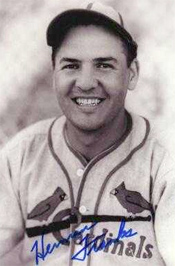
Herman Franks was a player, coach and manager in the major leagues for five decades and it all began with the Cardinals.

A catcher who batted left-handed, Franks made his major-league debut with the Cardinals in 1939 as a backup to Mickey Owen.

With Owen as the starter and prospect Walker Cooper waiting in the minors, Franks was unlikely to get much playing time.

On Feb. 6, 1940, the Cardinals sold Franks’ contract to the Dodgers, who were managed by Leo Durocher, the former Cardinals shortstop. Durocher played a pivotal role in Franks’ career.

Divine intervention

Franks was born in Price, Utah, where his father, an Italian immigrant, and mother settled.

In high school, Franks excelled at multiple sports. He opted to pursue a baseball career. At 18, Franks signed with the Hollywood Stars of the Pacific Coast League and played a few games for them in 1932 and 1933. Overmatched, Franks was advised by manager Ossie Vitt to go home.

“He didn’t think I’d ever be a good ballplayer,” Franks told The Sporting News.

Franks enrolled at the University of Utah and played amateur baseball for a Catholic Youth Organization team. The Catholic bishop of Salt Lake City recommended Franks to Cardinals scout Charley Barrett.

In the spring of 1935, Barrett invited Franks to a Cardinals tryout camp in Houston. Franks impressed Barrett and was signed. The Cardinals sent him to a farm team in Jacksonville, Texas, tomato capital of the world, in the West Dixie League and paid him $100 a month.

“I was just glad to make the club and be back in baseball,” Franks said.

Looking the part

Franks worked his way up the Cardinals’ system. At Sacramento in 1937 and 1938, Franks played for manager Bill Killefer, a former big-league catcher who managed the Cubs from 1921-25 and was a coach for the 1926 World Series champion Cardinals.

“Men in the Cardinals organization have a high regard for Killefer’s judgment,” the St. Louis Post-Dispatch noted.

At spring training in 1939, Franks, 25, fulfilled expectations.

“Franks is built for catching, looks like he has been behind the plate all his life, throws accurately and easily and has the reputation of being a smart receiver,” the Post-Dispatch reported.

The Cardinals opened the 1939 season with Franks and Don Padgett as backups to Owen.

“Pitchers like to throw to Herman Franks.” the Post-Dispatch reported. “He chatters incessantly behind the plate, makes a fine target, isn’t afraid to assume responsibility and is said to be a good thrower.”

Twist of fate

Franks started for the first time in the majors on May 2, 1939, against the Braves at Boston. It was a bittersweet experience.

In the second inning, Franks drove in Johnny Mize from second base with his first big-league hit, a looping single to left against Danny MacFayden.

Moments later, Franks wrenched his left leg when he caught his spikes in the bag sliding back to first while eluding a pickoff throw, the St. Louis Globe-Democrat reported. Franks departed and was replaced by Owen. Boxscore

Sidelined for three weeks, Franks seldom played when he returned.

Sad times

On July 4, 1939, Franks was saddened to learn Charley Barrett, the scout who gave him his big break, died of heart disease at 68.

After the Cardinals played a night game at Cincinnati on July 6, manager Ray Blades and four players, Franks, Owen, Don Gutteridge and Pepper Martin, returned to St. Louis for Barrett’s funeral service the next morning while the rest of the team went to Pittsburgh for a series against the Pirates.

Among the pallbearers were Cardinals owner Sam Breadon, executive Branch Rickey and Martin. According to the Globe-Democrat, “Martin was always considered by Barrett as the greatest player he ever discovered.”

The day after Barrett’s funeral, Franks was sent to a farm club in Columbus, Ohio, after the Cardinals tried to trade him.

“Wonder how much truth there is to the report that the Cardinals offered catcher Herman Franks and $30,000 to Kansas City (a Yankees farm club) for Joe DiMaggio’s brother, Vince,” the Globe-Democrat reported.

Franks batted .297 for Columbus and was called up to the Cardinals in September. For the season, Franks had one hit in 17 at-bats for the Cardinals.

Dodgers days

Killefer, a coach on Durocher’s staff with the 1939 Dodgers, recommended the club acquire Franks.

The Dodgers opened the 1940 season with Babe Phelps as their starting catcher and a pair of former Cardinals, Franks and Gus Mancuso, as backups. In 1941, Owen, acquired from the Cardinals, was the Dodgers’ starting catcher, with Franks and Phelps in reserve.

The Dodgers won the 1941 National League pennant.

In Game 1 of the 1941 World Series at Yankee Stadium, Durocher lifted Owen for a pinch-hitter in the seventh inning. In the ninth, with the Yankees ahead, 3-2, the Dodgers had Joe Medwick on second, Pee Wee Reese on first and one out, with Franks due up. Durocher would have preferred to send a pinch-hitter, Augie Galan, but he couldn’t because Franks was their only available catcher.

On the first pitch from Red Ruffing, Franks grounded to second baseman Joe Gordon, who fielded the ball and flipped to shortstop Phil Rizzuto.

Rizzuto tagged the bag just before Reese arrived. Reese slid hard into Rizzuto, hurling him into the air, but not before Rizzuto made a throw to first to nab Franks and complete a game-ending double play. Boxscore

Career choices

Franks enlisted in the Navy in 1942 and served for four years. After his discharge in 1946, Franks, 32, played for the Dodgers’ Montreal farm club.

Rickey, who left the Cardinals for the Dodgers, made Franks the manager of the St. Paul farm team in 1947. In August, the Athletics, desperate for catching help, inquired about Franks.

“Mr. Rickey gave me my choice of staying on as a manager in St. Paul or going back to the big leagues again as a catcher,” Franks said.

Franks joined the Athletics for the last month of the 1947 season and was with them in 1948, too.

In 1949, Durocher, who became Giants manager, hired Franks to be a coach. Franks was a Giants coach for Durocher from 1949-55.

In his book, “The Echoing Green,” author Joshua Prager revealed Durocher’s Giants stole signs of opposing catchers. Franks used a telescope from a perch above the center field wall at the Polo Grounds to view the signs and relay them via a buzzer system, according to the book.

When the Giants fired manager Alvin Dark after the 1964 season, Franks replaced him. He managed the Giants for four seasons (1965-68) and finished in second place each year, including 1967 and 1968 when the Cardinals prevailed.

Franks also managed the Cubs from 1977-79.