Feeds:
Posts
Comments

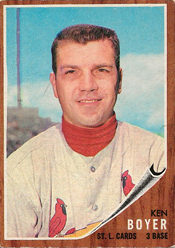
In his return to the Cardinals, Ken Boyer prepared to manage some of their best prospects while preparing veteran Joe Torre to play third base.

In March 1970, Boyer attended spring training with the Cardinals for the first time since he was traded five years earlier.

Boyer, 38, was back as an instructor and as manager of the Cardinals’ Class AA Arkansas farm club. The Cardinals hired him after he retired as a player near the end of the 1969 season.

Stanky protege

Boyer played 11 seasons for the Cardinals, won the Gold Glove Award five times at third base and produced 1,855 hits and 1,001 RBI. He was the recipient of the National League Most Valuable Player Award in 1964 when the Cardinals won the World Series title.

The Cardinals traded Boyer to the Mets after the 1965 season and he went on to play for the White Sox and Dodgers as well.

The Dodgers wanted Boyer to manage in their farm system in 1970, but he accepted an offer from Cardinals general manager Bing Devine to manage at Arkansas because he preferred to return to the franchise where he began his career, according to the book “Ken Boyer: All-Star, MVP, Captain.”

“There is a line of tradition here,” Boyer told the St. Louis Post-Dispatch. “… When you put on a Cardinals uniform, you just seem to fall in step with people like Rogers Hornsby and Frank Frisch.”

Boyer said as a player he enjoyed analyzing games in clubhouse talks with Cardinals teammate Dick Groat, and those discussions prompted him to think about becoming a manager, Post-Dispatch sports editor Bob Broeg reported.

Eddie Stanky was Boyer’s first manager in the majors in 1955. Though Stanky was fired two months into the season, his influence on Boyer was significant.

“I agree entirely with Stanky that safety-first baseball is second-division baseball,” Boyer said. “You’ve got to be aggressive and take chances. Speed is baseball’s only two-way weapon. It’s necessary on both offense and defense.

“I’m glad I broke in under a manager as smart as Stanky … I’m fortunate I learned so many little things from him, including how to run the bases. If he had pitching to go with the offense he developed, the Cardinals in the mid-1950s would have been outstanding.”

Regarding Johnny Keane, manager of the 1964 World Series champion Cardinals, Boyer said, “He encouraged individual ingenuity.”

Teaching skills

At Cardinals spring training in 1970, Boyer was one of the instructors who worked with Joe Torre, the catcher who was learning to play third base. With Cardinals third baseman Mike Shannon sidelined because of a kidney disease, Torre and first baseman Richie Allen were the candidates to take over the position.

“I told Bing Devine that Torre had good enough hands and a strong, accurate arm,” Boyer said. “The only questions are his range and knowing what to do in certain situations.”

As spring training neared an end, the Cardinals named former pitcher Dick Hughes to be a coach on Boyer’s staff at Arkansas. Boyer’s former Cardinals teammate, Carl Sawatski, was the Arkansas general manager.

Boyer’s brother, Len, 24, was the Opening Day third baseman for Arkansas. “I don’t think it’s going to cause any problems,” Ken Boyer told The Sporting News.

Arkansas lost 13 of its first 17 games. Len Boyer struggled, hitting .230 in 24 games, and was sent down to Class A Modesto.

Even with the slow start and his brother’s demotion, Ken Boyer was poised and patient. The club followed his lead, recovered and finished with a 67-67 record.

“The challenge is to get kids to go out and play the game relaxed,” Boyer said. “(Stan) Musial enjoyed playing. That’s a big reason he lasted so long.”

Two of the top prospects at Arkansas were outfielder Jose Cruz (90 RBI, .300 batting average) and pitcher Al Hrabosky (8-1, 3.26 ERA).

“There’s more emphasis on development in double-A.” Boyer said. “When I played, we had four or five players over 30 who didn’t have anywhere to go, or maybe had already been and were coming back.”

Back in the majors

After the 1970 season, Boyer was named Cardinals hitting coach, replacing Dick Sisler, who was fired.

“The young players at Arkansas liked Boyer,” said Cardinals manager Red Schoendienst.

Devine said Boyer “has impressed a lot of people with his work with young players.”

Boyer’s ascension to the big-league coaching staff fueled speculation he was waiting in the wings to replace Schoendienst, whose clubs didn’t contend in 1969 and 1970.

In the Post-Dispatch, Bob Broeg wrote, “Red’s heir apparent now is Ken Boyer.”

Boyer was a Cardinals coach in 1971 and 1972 before returning to managing in their farm system from 1973-76.

When Schoendienst was fired after the 1976 season, the Cardinals bypassed Boyer and hired Vern Rapp. Disheartened, Boyer left the organization and became a manager in the Orioles’ farm system.

Boyer was managing Rochester of the International League when the Cardinals fired Rapp in April 1978. Boyer finally got his chance to manage in the majors, replacing Rapp.

In three seasons as Cardinals manager, Boyer was 166-191 before he was fired in June 1978 and replaced by Whitey Herzog.

Dick Scott waited a long time to reach the major leagues, and when he got there, as a 30-year-old rookie, he quickly experienced highs and lows.

A left-handed pitcher, Scott was in his eighth season in the minor leagues when he got called up to the Dodgers for the first time in May 1963.

The first team Scott faced was the Cardinals at St. Louis. His debut went splendidly. The next night was a different story.

Down on the farm

Born in New Hampshire, Scott went to high school in Maine and played multiple sports. He was 20 when the Dodgers signed him as an amateur free agent in August 1953. After two years in the Army, Scott began his pro baseball career in the Dodgers’ farm system in 1956.

One of Scott’s biggest boosters was Bobby Bragan, who managed him at Spokane in 1958.

Scott “should make the majors,” Bragan said to the Spokane Chronicle.

Bragan, who managed the Pirates and Indians before taking the Spokane job, told the Spokane Review, “All that Scott needs is a little confidence, that feeling of thinking to himself, ‘Just give me the ball and let me out there. I’ll mow them down.’ ”

In 1960, Scott, 27, was 8-1 with a 2.27 ERA for the Dodgers’ farm club in Atlanta, but he had left elbow surgery in September, the Atlanta Constitution reported. Toward the end of spring training in 1961, Scott pitched 18 consecutive scoreless innings, but he remained in the minors.

While pitching for Spokane in 1962, Scott “has given up the idea of trying to overpower every batter and has become a better pitcher in the process,” according to the Spokane Chronicle.

“I’ve found out I have better control when I don’t throw too hard,” Scott said.

Meet me in St. Louis

Scott had a strong spring training in 1963 and nearly made the Dodgers’ Opening Day roster. His impressive pitching carried over to the regular season with Spokane. In his first start, he pitched a three-hit shutout at Denver in a game attended by heavyweight boxing champion Sonny Liston.

On May 7, 1963, Scott was leading the Pacific Coast League in ERA (0.77) when he was called up to the Dodgers.

Scott reported to the Dodgers at St. Louis on May 8 and made his major-league debut that night against the Cardinals.

Entering in the eighth, with the Dodgers ahead, 10-5, Scott retired Curt Flood, Dick Groat and Bill White in order.

After the Dodgers added a run in the top of the ninth, Stan Musial led off the bottom half against Scott and lined out to second. Ken Boyer doubled, but Scott got George Altman to ground out and Tim McCarver to pop out to third. Boxscore

Scott’s two scoreless innings against the star-studded Cardinals lineup made a strong impression. Scott “is ready to pitch any time the Dodgers need him,” the Los Angeles Times declared.

Tough encore

Scott didn’t have to wait long. The next night, May 9, the Dodgers led, 2-0, in the fifth when the Cardinals loaded the bases with none out against starter Pete Richert.

Manager Walter Alston called for Scott to face Bill White, a left-handed batter.

“I was looking for the fastball on the first pitch because I figured Scott would try to get ahead of me,” White told the St. Louis Post-Dispatch. “The ball was right down the middle.”

White hit the ball over the pavilion roof at Busch Stadium and onto Grand Avenue for a grand slam, giving the Cardinals a 4-2 lead.

After Boyer lined out to center and Musial flied out to right, Charlie James singled and Gene Oliver put the Cardinals ahead, 6-2, with a two-run home run off Scott.

Rattled, Scott gave up singles to Julian Javier and Bob Gibson before Larry Sherry relieved him. Sherry surrendered a RBI-single to Flood and the run was charged to Scott.

Scott’s line: 0.2 innings, four runs, five hits. Boxscore

Wrong place, wrong time

Scott pitched in nine games for the Dodgers before he was returned to Spokane in July 1963.

A month later, Scott was sitting on the edge of the visitors dugout at San Diego when the weighted end of a lead warmup bat swung by teammate Bart Shirley, who was in the on-deck circle, came loose and struck him above the right eye.

Scott was taken to a hospital and needed 25 stitches to close the wound, according to the Spokane newspapers.

Fortunately, Scott recovered, started against Portland on Sept. 3 and pitched 7.1 innings, allowing one run.

Scott finished with a 2.28 ERA for Spokane. In December 1963, the Dodgers traded him to the Cubs for pitcher Jim Brewer and catcher Cuno Barragan.

The 1964 season was Scott’s last as a professional player. He pitched in three games for the Cubs and spent most of the year with their Salt Lake City farm team.

A trade to the Cardinals gave Omar Olivares the chance to start his major-league career with the same franchise his father did.

On Feb. 27, 1990, the Cardinals acquired Olivares, a right-handed pitcher, from the Padres for outfielder Alex Cole and reliever Steve Peters.

Six months later, Olivares made his big-league debut, following in the footsteps of his father, Ed Olivares, an outfielder and third baseman who got to the majors with the Cardinals in 1960.

Ed and Omar Olivares became the first father and son to play for the Cardinals.

Family ties

Ed Olivares appeared in 24 games for the Cardinals from 1960-61.

Omar Olivares was born in Puerto Rico in 1967, a year after his father finished his pro playing career in the farm system of the Tigers.

Ed Olivares became a sports and recreation director in Puerto Rico and helped his son develop baseball skills.

“He taught me everything I know,” Omar Olivares told the St. Louis Post-Dispatch. “He’s the one who thought about making me a pitcher. He knew I had a nice and loose arm, and he knew I was going to never get hurt. I was 16 years old. So I changed from an outfielder to a pitcher.”

In September 1986, Omar Olivares, 19, signed with the Padres. He earned 16 wins in the minors in 1988 and 12 at Class AA in 1989.

Special talent

Olivares caught the attention of Cardinals personnel, who urged general manager Dal Maxvill to acquire him.

“Six of our people had seen him pitch and they all liked him,” said Cardinals manager Whitey Herzog. “That’s unusual. The only other player that all our people had good reports on before we got him was Willie McGee.”

Though Olivares was assigned to start the 1990 season with the Cardinals’ farm club at Louisville, Herzog was impressed by what he saw in spring training. “He’s a great athlete,” Herzog told the Post-Dispatch. “I’d like to make an outfielder out of him. He could pitch every fifth day and play the outfield the other four.”

Herzog resigned in July 1990 before he could test his idea, but Olivares remained in the Cardinals’ plans. Cardinals director of player development Ted Simmons said Olivares was “a legitimate pitching prospect, make no mistake.”

During a visit to Louisville, Cardinals minor-league pitching instructor Bruce Sutter noticed Olivares had stopped throwing a forkball and asked him about it. “I threw it the other night and the guy hit it for a homer,” Olivares replied.

Said Sutter: “If he hit your fastball for a homer, would you quit throwing your fastball?” Olivares got the message and returned the forkball to his arsenal.

“I wasn’t too happy about it, but I kept throwing the forkball after that,” Olivares told the Post-Dispatch. “One night, I had 14 strikeouts and that’s the best I’d had my forkball. They told me they wanted me to throw it at least 20 times a game. I’ve got much better control of it than I used to have.”

Welcome to the bigs

in August 1990, Joe Torre replaced Herzog as Cardinals manager. Soon after, John Tudor went on the disabled list. Olivares, with a 2.82 ERA in 23 starts for Louisville, was called up to take Tudor’s spot in the rotation. “When they told me, I called home right away,” Olivares said. “My dad wasn’t there but my mother was … She’s more excited than I am, and I’m pretty excited.”

Torre never had seen Olivares, but he got good reports from those who had.

“He started learning that forkball because he needed another pitch,” said Cardinals pitcher Bob Tewksbury. “He’s got good mechanics and a good, live arm. He’s a good athlete. He swings the bat pretty good. He’s a good kid, too.”

On Aug. 18, 1990, Olivares, 23, made his major-league debut with a start at St. Louis and limited the Astros to a run and three hits in eight innings.

With the Cardinals ahead, 2-1, Torre lifted Olivares for closer Lee Smith, who gave up a home run to the first batter he faced, Franklin Stubbs, in the ninth, depriving Olivares of a win. The Astros prevailed, 3-2, in 11. Boxscore

“You have to go with your best,” Olivares said, defending Torre’s decision. “I’m not angry at all.”

Making his mark

According to the Post-Dispatch, Olivares was the first major-league player with the initials O.O. since Oswald Orwoll, a pitcher and first baseman for the 1928-29 Athletics. In 1993, Olivares switched to uniform No. 00 with the Cardinals.

Olivares got his first major-league home run before he got his first major-league win. On Sept. 8, 1990, Olivares hit a solo home run and a two-run double versus Rick Sutcliffe of the Cubs at Wrigley Field, but didn’t get the decision. Boxscore

His first win came in his next start, on Sept. 13, 1990, against the Expos at Montreal. Boxscore

Olivares finished 1-1 with a 2.92 ERA for the 1990 Cardinals. His best St. Louis season was 1991 when he was 11-7.

Olivares pitched five seasons for the Cardinals and was 29-24 with a 4.02 ERA. He batted .229 with three home runs.

The Cardinals released him in April 1995 and he signed with the Rockies.

In 12 seasons in the majors, Olivares was 77-86, including a combined 15-11 for the Angels and Athletics in 1999.

Decades after he pitched for the Cardinals as a member of the Gashouse Gang, Dizzy Dean was involved in a federal investigation of a gambling gang.

A grand jury indictment named Dean, 60, a co-conspirator in a gambling scandal on Feb. 24, 1970.

Dean, who placed bets for a friend and also made payoffs for him, testified as a witness for the government in the case and wasn’t charged with a crime.

Biloxi blues

Dean was the ace of the 1930s Cardinals clubs known as the Gashouse Gang, a feisty, aggressive group featuring Pepper Martin, Joe Medwick and Leo Durocher.

Dean achieved 30 regular-season wins in 1934 and two more in the World Series against the Tigers. He led National League pitchers in strikeouts for four consecutive seasons (1932-35).

After his playing career, Dean was elected to the Baseball Hall of Fame. He was broadcaster on Cardinals and Browns games in the 1940s and national baseball telecasts in the 1950s.

In retirement, Dean made his home in Bond, Miss. A friend, trucking executive Howard Sober of Lansing, Mich., asked Dean to place illegal bets for him with bookmakers in Biloxi, Miss. Dean agreed to place the bets and be the go-between for receiving and making payouts.

On Jan. 1, 1970, Dean was in Las Vegas when he was questioned and searched by authorities, the Associated Press reported. Dean wasn’t arrested and federal officials said he was cooperating with them.

Dean “is furnishing information,” a U.S. attorney in Detroit said to the New York Times.

According to the Associated Press, a document in federal district court in Detroit alleged Dean delivered a $6,000 gambling payoff for Howard Sober.

Suspended Tigers pitcher Denny McLain, the first big-leaguer since Dean with 30 wins in a season, met with federal attorneys to cooperate in the investigation, the Associated Press reported.

Give info, avoid charges

Ten people, arrested in Detroit and Biloxi, were indicted by the federal grand jury on one county of conspiring to use interstate commerce for illegal gambling.

Dean “was named as a co-conspirator but not as a defendant in the indictment,” the Associated Press reported. Because Dean “is named only as a co-conspirator and not a defendant, he is not charged with any crime.”

According to the indictment, the 10 defendants and six co-conspirators used telephones for “unlawful gambling purposes” from April 1969 to January 1970.

The indictment charged three of the defendants, all from Biloxi, “would knowingly accept bets from unindicted co-conspirators” Dizzy Dean and his nephew, Paul Dean Jr., “on behalf of unindicted co-conspirator Howard Sober.” Paul Dean Jr., was the son of Dizzy’s brother and Cardinals teammate, pitcher Paul Dean Sr.

Dizzy Dean’s “very helpful” information led to several arrests in the case, United Press International reported.

U.S. attorney James Brickley said being cited as a co-conspirator meant “the grand jury believed the person was involved,” but not to a sufficient degree to be indicted.

Favor for a friend

On Feb. 25, 1970, an emotional Dizzy Dean met with reporters and said, “I am happy and pleased I was not arrested, indicted and charged. I am sad for my family and friends all over the United States because I was accused of a lot of things. There is not a bit of truth to it.”

Dean said, “I have never been involved in big-time gambling.” He told United Press International he met the Biloxi defendants “through a friend (Howard Sober) who asked me to make wagers for him and I did. I was later told it was the wrong thing to do and I quit. I never received one dime, not a penny.”

Three years later, on June 20, 1973, two of the Biloxi defendants, Frank Duvic and Salvatore “Sammie” Sicuro, pleaded guilty in U.S. District Court in Detroit They were fined and placed on probation.

Dizzy Dean, Paul Dean Jr. and Howard Sober appeared as witnesses for the government and were excused from the subpoenas after Duvic and Sicuro pleaded guilty, an Internal Revenue Service spokesman told the Associated Press.

Duvic said he accepted wagers from the Deans while working at a Biloxi club, the Associated Press reported.

“Duvic told the court he knew Dizzy Dean was placing bets for Howard Sober, who phoned them to Dean from Michigan,” according to the Associated Press. “Duvic said he accompanied Dean to a bank” and was given a check to cover Sober’s bets.

Sicuro testified he knew Dizzy Dean was placing bets for Howard Sober, the Associated Press reported. Sicuro said Dizzy Dean appeared every Monday to settle the gambling account.

Babe Didrikson, who won Olympic medals in track and field before she became one of America’s top golfers, was the starting pitcher for the Cardinals in a spring training game.

On March 22, 1934, Didrikson pitched for the Cardinals against the Red Sox at Bradenton, Fla.

A relentless self-promoter, Didrikson’s performance helped develop her reputation as America’s premier woman athlete.

Diamond dandy

A daughter of Norwegian immigrants, Didrikson was born in Port Arthur, Texas, and grew up in nearby Beaumont, where she excelled in multiple sports.

At 21, she was a member of the U.S. Olympic track and field team. At the 1932 Summer Olympics in Los Angeles, Didrikson won two golds (hurdles and javelin) and a silver (high jump).

With America in the grip of the Great Depression, opportunities for women in professional sports were limited. Didrikson sought to earn income in several sports, including basketball, billiards and baseball.

In 1934, Didrikson joined the House of David barnstorming baseball team. Promoter Ray Doan arranged for Didrikson to have a training session with Cardinals pitcher Burleigh Grimes in Hot Springs, Ark.

According to the Associated Press, Didrikson “would be one of the best prospects in baseball if she were a boy,” said Grimes.

The Associated Press also noted, “The Babe has mastered somewhat of a curve.”

Timely fielding

The Athletics and Cardinals each agreed to let Didrikson pitch an inning in a spring training game.

On March 20, 1934, at Fort Myers, Fla., Didrikson started for manager Connie Mack’s Athletics against manager Casey Stengel’s Dodgers before a Tuesday afternoon gathering of 400 spectators.

Didrikson walked the first batter, Danny Taylor, and hit the next, Johnny Frederick, with a pitch.

The No. 3 hitter, Joe Stripp, lined the ball. Second baseman Dib Williams caught it for the first out and tossed to shortstop Rabbit Warstler, who tagged second to double up Taylor, who had headed for third. Warstler threw to first baseman Jimmie Foxx to nip Frederick, who couldn’t get back to the bag in time, and complete a triple play.

According to the book “Diz,” a biography of Dizzy Dean, Stengel shook his head in mock sorrow and said, “My little lambs just couldn’t get to her.”

“The Babe was wildly cheered as she left the premises,” the Philadelphia Inquirer reported.

Didrikson, a right-hander, stood between 5-foot-5 and 5-foot-7 and weighed between 115 and 145 pounds, according to varied sources. She “looked like a slightly built boy except for a few stray feminine locks that stuck from under her black baseball cap,” the Fort Myers News-Press reported. “She possessed a slow curve but had some difficulty in finding the plate.”

With her inning of work done, Didrikson was lifted and the Dodgers won, 4-2.

Tough break

Two days later, before a Thursday afternoon crowd again estimated at 400, Didrikson made her start for manager Frankie Frisch’s Cardinals against manager Bucky Harris and the Red Sox.

Didrikson “is gaining experience and improving her pitching,” the St. Louis Post-Dispatch reported. “Under the tutelage of Burleigh Grimes, Dizzy Dean and others, she has learned to stand on the rubber, wind up like a big-leaguer and throw a rather fair curve.”

Joining Didrikson and Frisch, who played second base, in the Cardinals’ starting lineup were first baseman Rip Collins, shortstop Burgess Whitehead, third baseman Pepper Martin, left fielder Joe Medwick, center fielder Buster Mills, right fielder Jack Rothrock and catcher Spud Davis.

After Red Sox leadoff batter Max Bishop grounded out to second, Didrikson allowed singles to Bill Cissell and Ed Morgan, putting runners on second and first.

Cleanup hitter Roy Johnson grounded to Frisch, who threw to Whitehead, covering the bag at second, for the force on Morgan.

With two outs and runners on third and first, rookie Moose Solters faced Didrikson next. Didrikson got two strikes on Solters and threw a curve. Solters watched it go into the catcher’s mitt. To press box observers, the pitch was strike three, which should have ended the inning, but the umpire called it a ball.

Solters hit the next pitch for a two-run double.

Didrikson “deserved a better fate than she received,” the St. Louis Globe-Democrat reported. “A hit followed what could have been called a third strike and the third out.”

The St. Louis Star-Times declared Didrikson would have escaped with a scoreless inning “but for a questionable decision by the umpire.”

On the links

After Solters doubled, Dusty Cooke reached on an error by Rip Collins. Rick Ferrell singled, scoring Solters and giving the Red Sox a 3-0 lead. Didrikson got the next batter, Bucky Walters, to fly out to left.

The Red Sox “would have been scoreless if it had not been for loose fielding and what the Cards described as the plate umpire’s failure to see a third strike as a strike,” the Post-Dispatch reported.

The Cardinals rallied for three runs in the bottom of the first against Fritz Ostermueller. Whitehead, the eighth-place batter, made the last out of the inning, depriving Didrikson of a plate appearance.

Bill Hallahan relieved Didrikson in the second and pitched four innings. Dean, who told Didrikson he’d show her some “real chucking,” pitched the last four, held the Red Sox hitless and the Cardinals won, 9-7. Said Dean: “I had them swinging like ham on a hook.”

“Well, our Red Sox managed to get three runs in one inning off Babe Didrikson, the girl athlete,” the Boston Globe declared. “So perhaps later on they will be able to play ball with the boys.”

Columnist L.C. Davis of the Post-Dispatch concluded, “As a pitcher, Babe is an outstanding field and track athlete. Babe may be a drawing card, but a woman’s place is on the bench.”

Three days later, Didrikson pitched two scoreless innings for the minor-league New Orleans Pelicans against the Cleveland Indians.

Didrikson eventually focused on golf. At the 1938 PGA Tour Los Angeles Open, where she competed against the men, Didrikson met professional wrestler George Zaharias. Eleven months later, in December 1938, they married in St. Louis and she became Babe Didrikson Zaharias.

A founding member of the LPGA Tour, Babe Didrikson Zaharias won 41 titles, including 10 majors. She was a three-time winner of the Women’s U.S. Open, including in 1954 after she underwent surgery for colon cancer.

Babe Didrikson Zaharias was 45 when she died of cancer in 1956.

If Walt Jocketty had gotten what he wanted, Larry Walker would have spent most of his career, not just the last two seasons, with the Cardinals.

Walker, a three-time National League batting champion who was elected to the Baseball Hall of Fame on Jan. 21, 2020, played his first six seasons in the majors with the Expos and became a free agent in October 1994, the same month Jocketty replaced Dal Maxvill as Cardinals general manager.

Jocketty was looking for opportunities to improve the Cardinals, who were 53-61 in strike-shortened 1994, and wanted to sign Walker.

The Rockies made the most lucrative offer and Walker signed with them in April 1995.

Nine years later, Jocketty finally got his man, acquiring Walker in a trade with the Rockies in August 2004. Walker finished his career with the Cardinals, helping them reach the postseason in 2004 and 2005.

Opening at first

In December 1994, Walker, who threw right and batted left, had surgery on his right shoulder. The right fielder’s agent, Jim Bronner, said Walker would wait until March 1995 or later to sign because he wanted to show teams his shoulder was healed, the St. Louis Post-Dispatch reported.

Jocketty wanted Walker to be the Cardinals’ first baseman, replacing Gregg Jefferies, who became a free agent, according to the Post-Dispatch.

“Walt Jocketty says if he has time and money to sign only one free agent it would be a hitter to replace Gregg Jefferies rather than a pitcher,” the Post-Dispatch reported on Feb. 5, 1995. “His sights still are set on Larry Walker.”

A week later, as the Cardinals and all other major-league teams prepared to open spring training camps with replacement players while the big-leaguers remained on strike, Jocketty was in pursuit of Walker.

“He’s still the best player out there,” Jocketty said. “I think we’ve got as good a chance as anybody.”

Coors vs. Busch

Whatever amount Jocketty offered, it wasn’t enough to top the Rockies, who gave Walker a four-year contract for a guaranteed $22.49 million on April 8, 1995, according to the Associated Press.

The next day, with Walker out of the picture, the Cardinals acquired third baseman Scott Cooper from the Red Sox and planned to move Todd Zeile from third to first.

On April 26, 1995, Walker made his regular-season Rockies debut in the inaugural game played at Coors Field in Denver and produced three doubles and three RBI in a 14-inning victory against the Mets. Five inches of snow fell in the Denver area during the morning and the game, played at night in temperatures in the mid-30s, took 4 hours and 49 minutes to complete. Boxscore

Walker’s first game against the Cardinals since signing with the Rockies occurred on May 29, 1995, at Busch Memorial Stadium in St. Louis. The high-priced slugger went 0-for-6 and got razzed by some of the spectators after his last plate appearance. Boxscore

“One of the things about this type of deal is you get to hear a lot more imaginative things from the fans,” Walker told the Rocky Mountain News. “They were chanting, ‘Oh for six.’ They didn’t know the half of it.”

Walker’s hitless night extended his skid to 0-for-24 over his last six games.

The next night, Walker was benched by manager Don Baylor. He returned to the lineup for a day game, May 31, 1995, and snapped the slump with a two-run double and a solo home run against Cardinals starter Mark Petkovsek. The homer was a majestic shot which carried into the sixth row of the center-field bleachers, according to the Post-Dispatch. Boxscore

Petkovsek “made two bad pitches to Walker,” said Cardinals manager Joe Torre. “You’d like to make bad pitches to smaller guys, though.”

Said Walker: “I wasn’t sure if I should turn left or right the first time I got a hit because all I had been doing lately was turning to the right and going back to the dugout. That home run really messed me up, having to touch all four bases.”