The Cardinals liked what they saw from Matt Holliday in the short term and decided to pay the price to keep him for the long term.
 On Jan. 5, 2010, Holliday, a free agent, accepted the Cardinals’ offer of a seven-year contract for $120 million. It was the richest contract given by the Cardinals and it went to a left fielder who had played 63 regular-season games for them.
Holliday batted .353 and had an on-base percentage of .419 for the 2009 Cardinals after being acquired on July 24 in a trade with the Athletics. With Holliday, the Cardinals were 39-25 and won the 2009 division title with an overall mark of 91-71.
When Holliday became a free agent in November 2009, agent Scott Boras said his client wanted an eight-year contract with an average annual salary of $17 million to $18 million and a no-trade clause.
The prospect of featuring a middle of the batting order with Albert Pujols, Holliday, Colby Rasmus and Ryan Ludwick in the third through sixth spots motivated the Cardinals to propose a deal.
Leading suitor
On Dec. 10, 2009, as baseball’s winter meetings were ending, the Cardinals made a formal offer to Holliday, the St. Louis Post-Dispatch reported, but the terms were kept secret.
Club owner Bill DeWitt Jr. and general manager John Mozeliak were hoping to have negotiations settled by Christmas Day, but talks moved at a deliberate pace.
The Red Sox offered five years, but were rejected, according to the Post-Dispatch.
After the Red Sox dropped out of the bidding, it was unclear whether any other clubs were competing with the Cardinals for Holliday. The Orioles and Mets reportedly expressed interest, but it was believed only for a short-term deal.
Boras said Holliday “had a variety of options of various lengths from different teams.”
Waiting game
During the first weekend in January 2010, DeWitt and Mozeliak met with Boras and Holliday near the player’s home in Austin. Texas, in an effort to close a deal.
The Cardinals indicated if Holliday didn’t accept their offer by Jan. 8, 2010, they would have to move on to other candidates.
A possible alternative to Holliday in left field had been Mark DeRosa, who played for the Cardinals in 2009 before becoming a free agent, but he signed with the Giants. The Cardinals didn’t want to risk missing out on other free agents while waiting for Holliday to make a decision.
The Cardinals reportedly were interested in free-agent third baseman Miguel Tejada, who hit .313 with 46 doubles and 86 RBI for the 2009 Astros, if they couldn’t sign Holliday.
Regarding negotiations with Holliday, Cardinals manager Tony La Russa told the Post-Dispatch, “We’ve made it clear how much we want to keep him. At some point, you have to go in one direction or another.”
Good fit
Soon after DeWitt and Mozeliak returned to St. Louis from Austin, Holliday notified them he accepted their offer. Two hours later, Holliday made his decision public in an interview with ESPN Radio.
“Playing in St. Louis with guys I made friends with, and given the way the organization is run, became very appealing to me,” Holliday said.
Regarding the decision process, Holliday said, “You get into January, you want to get excited about spring training and not worry about contract stuff. I was ready for it to be over.”
The Cardinals’ willingness to approve no-trade protection and guarantee $17 million for a seventh season sealed the deal, according to the Post-Dispatch.
Holliday accepted the offer two weeks before he turned 30.
“The Cardinals did their homework and were willing to gamble that Holliday will age well as a player,” wrote Post-Dispatch columnist Bernie Miklasz.
At the announcement of the formal signing, the Cardinals said Holliday would wear uniform No. 7. Holliday said he chose the number to honor fellow Oklahoma native Mickey Mantle, whose No. 7 was retired by the Yankees.
With the Rockies and Athletics, Holliday had worn No. 5, but Pujols had that number with the Cardinals, When Holliday was traded to St. Louis in July 2009, he was given No. 15, previously worn by Cardinals luminaries such as Tim McCarver, Darrell Porter and Jim Edmonds.
Holliday played eight seasons (2009-2016) for the Cardinals and produced 1,048 hits in 982 games, with a batting average of .293 and a .380 on-base percentage.
The Cardinals qualified for the postseason in six of Holliday’s eight seasons with them. In the 2011 National League Championship Series versus the Brewers, Holliday batted .435 and had 10 hits and three walks in 26 plate appearances, giving him a .500 on-base percentage.
After his seven-year contract expired following the 2016 season, Holliday became a free agent and signed with the Yankees.
In 15 seasons with the Rockies, Athletics, Cardinals and Yankees, Holliday had 2,096 hits and 1,220 RBI.
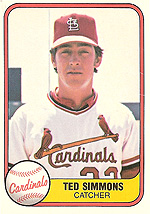 One reason Simmons was elected to the National Baseball Hall of Fame in December 2019 was he could hit any kind of pitching, including the best.
 In May 1964, the Cubs and Cardinals discussed a proposed swap of
  On Dec. 21, 1959, the Cardinals acquired Kline from the Pirates for outfielder
 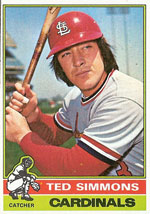 Batting for another switch-hitter, Reggie Smith, who had to depart because of back pain, Simmons hit an 0-and-2 pitch from Jon Matlack over the left-field wall, giving the Cardinals a 4-0 victory over the Mets in the second game of a doubleheader on June 23, 1975, at New York’s Shea Stadium.
 On Dec. 20, 1999, the Cardinals got Vina from the Brewers for pitchers Juan Acevedo and Matt Parker, plus catcher Eliezer Alfonzo.
 RetroSimba