(Updated Aug. 3, 2022)
On the brink of being sent to the minor leagues for the third time in four seasons, Chuck Diering delivered on a make-or-break opportunity and soon found himself playing regularly in a Cardinals outfield with Stan Musial and Enos Slaughter.
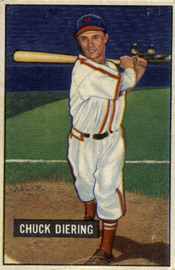
A St. Louis native, Diering played five seasons for the Cardinals.
In 1949, Diering began the season with the Cardinals but seldom was used, going hitless with a walk in three plate appearances. The Cardinals were planning to send him back to Class AAA Rochester by May 20. Diering had played there in 1946 and most of 1948 after breaking into the majors with the Cardinals in 1947.
Diering’s fortunes changed on May 8, 1949, as the Cardinals prepared to face left-hander Joe Hatten of the Dodgers at Brooklyn. Cardinals manager Eddie Dyer had opened the season with Stan Musial as his center fielder. But, wrote Bob Broeg in The Sporting News, “Dyer didn’t like the idea of subjecting Musial to the daily wear and tear of center field, and the valuable slugger made it plain he would prefer not playing there game after game.”
So Dyer was looking for a right-handed batter to play center against left-handed pitching, with the thought he could move Musial to right and keep Slaughter in left. Dyer decided to give Diering a chance against Hatten and the Dodgers.
Batting leadoff and playing center field, Diering responded with a 2-for-4 performance, with two RBI and a walk that Sunday at Brooklyn. Boxscore
Impressed, the Cardinals opted to keep Diering. By June, Diering regularly was starting in center field. On June 16, his seventh-inning single off Hatten snapped a 2-2 tie and propelled the Cardinals to a 6-2 victory over the Dodgers at St. Louis. Boxscore Three days later, against the Phillies, Diering’s fifth-inning single off Ken Heintzelman tied the score 2-2 and his two-out single off Robin Roberts in the ninth drove in the winning run in the Cardinals’ 6-5 victory at St. Louis. Boxscore
“Six weeks have brought a happy change in the career of Chuck Diering, who expected to eat Rochester restaurant food again this summer and instead has been enjoying home cooking as much as St. Louis fans have liked his clutch hitting and sensational center fielding,” Broeg wrote.
Diering continued his stellar play throughout the summer. On Aug. 19, his batting average was .281. He also impressed with his ability to chase down drives to the gaps. A headline in The Sporting News referred to him as “Deerfoot Diering.” Broeg reported that Diering “almost has made the fans forget Terry Moore with his brilliant center field play.”
Moore, a four-time all-star and starting center fielder for the Cardinals’ World Series championship clubs of 1942 and 1946, was a coach for the 1949 Cardinals. Diering credited Dyer and his coaching staff for his transformation into a Cardinals starter in 1949.
“I’ve had a lot of help,” Diering told The Sporting News. “Dyer persuaded me to choke my grip at bat. Tony Kaufmann made me lay off high pitches. Buzzy Wares encouraged me to try a preliminary swing or two to loosen my tense shoulder muscles and Terry Moore goes over the pitchers with me every day, showing how each is different and how they’ll try to pitch to me.”
Said Dyer: “We want to handle him just right because the kid really has done a job of helping solve a big problem. He has become a valuable man in this club’s success.”
The 1949 National League pennant race went down to the last day of the season, with the Dodgers (97-57) winning the title by a game over the Cardinals (96-58).
Diering finished the year with a .263 batting average, 21 doubles and eight triples in 131 games. His fielding percentage of .987 led all National League center fielders. He also ranked in the top five among NL center fielders in putouts (295) and assists (seven).
At spring training in 1950, Diering impressed Yankees center fielder Joe DiMaggio, who told the St. Louis Post-Dispatch, “Pretty good kid they got out there in center field.”
Yankees manager Casey Stengel said Diering “gets a fast jump on a ball, all right.”
Diering split playing time in center with Bill Howerton and Harry Walker in 1950. He primarily was a bench player for the Cardinals in 1951.
On Dec. 11, 1951, the Cardinals traded Diering and pitcher Max Lanier to the Giants for Eddie Stanky, who became player-manager.
Diering completed his big-league career with the Orioles in 1956. The Cardinals signed him to play for their minor-league club at Omaha, managed by Johnny Keane, in 1957.
After the season, he returned to St. Louis and purchased an automobile dealership in nearby Alton, Ill.
Diering batted .252 in five seasons with the Cardinals and .249 overall in a nine-year major-league career.

 RetroSimba
Mark, I’m glad that I let my curiosity get the best of me. I’ve really enjoyed doing a little reading about Chuck Diering. From the accounts that I’ve seen he was an incredible defensive player who made some phenomenal catches. Too bad there aren’t any video clips of those plays. Something else that really impressed me is how he meticulously describes the outfield and outfield fences in various ball parks. As well as how a center fielder needs to position himself on fly balls and also how to play balls that come off the outfield fences. Really incredible.
Phillip, I’m so glad this post was part of your research on Chuck Diering. Thanks for taking the time to read and for providing your insights.
As a St. Louisan, I thought you’d appreciate knowing that Diering grew up at 5663 Labadie in St. Louis, according to a profile Bob Broeg did of him.
Based on your comments, I thought you’d also appreciate the story of a catch Diering made against Mickey Mantle. The Baltimore Sun called it the best catch ever made by an Oriole since the St. Louis Browns relocated to Baltimore. It happened on May 27, 1955, a Friday night, at Memorial Stadium in Baltimore. Here is what the Sun reported:
“Batting left-handed, Mantle got hold of a letter-high fastball and sent it towering toward the 450-foot mark in right-center, almost the same spot his triple had landed in the fifth inning. Back went Diering … back … back … back, and over raced Hoot Evers from right. As the ball descended, the two flychasers were in high gear. It appeared for a moment as if they would collide, but at the last instant Diering spurted past Evers, reached out and with his back to the diamond hauled the pellet out of the murky darkness some 440 feet from home plate. It was the same kind of grand larceny Willie Mays committed on Vic Wertz’s drive in the first game of the World Series last fall.”
Orioles manager Paul Richards rated Diering’s catch as being more difficult than Mays’ because Diering had to run farther. “Chuck was so far away I thought we’d have to send for him in a taxi,” Richards told the Sun. “From where I was sitting, he looked about as large as a pop bottle.” https://www.retrosheet.org/boxesetc/1955/B05270BAL1955.htm