(Updated Dec. 1, 2023)
On Jan. 31, 1994, the Cardinals signed free agent Rick Sutcliffe to a minor-league contract and invited the right-hander to spring training with the hope he could earn a spot on their roster and in their starting rotation.
Sutcliffe won the 1979 National League Rookie of the Year Award with the Dodgers and the 1984 Cy Young Award with the Cubs but the Cardinals were getting a pitcher on the back side of his career.
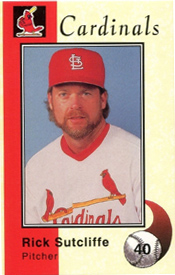 Sutcliffe had injured a knee in 1993 and posted a 5.75 ERA in 29 appearances for the Orioles, but the Cardinals saw him as an inexpensive solution to replace starting pitcher Donovan Osborne, who was sidelined for the 1994 season after having shoulder surgery.
“I have no doubt I can still pitch,” Sutcliffe, 37, told the St. Louis Post-Dispatch.
Cardinals general manager Dal Maxvill said to the St. Louis newspaper, “The reports we have are his arm is in good shape and he was throwing the ball well at the end of the (1993) season. I know one thing: He’s won 26 games the last two seasons (16 in 1992 and 10 in 1993). We only have one guy on our staff (Bob Tewksbury) who has more.”
Post-Dispatch columnist Bernie Miklasz called the signing of Sutcliffe “a good pickup” and added, “He’s a leader revered by young pitchers. If Sutcliffe can help settle down the young staff and win a few games, great.”
Sutcliffe called the Cardinals when he couldn’t reach a deal to stay with the Orioles, the Post-Dispatch reported.
According to the Baltimore Sun, “He entered January (1994) still thinking that he would return for one more season in Baltimore, but chose St. Louis after turning down an Orioles offer that he thought was made only out of a sense of obligation.”
Sutcliffe’s contract with the Cardinals called for him to be paid $250,000 if he made the team, and he could get another $250,000 in appearance incentives.
For the birds
Naturally, Sutcliffe’s first spring training start for the Cardinals came against the Orioles. He gave up three runs in the first inning, but none in the next two. “It took him a while to get comfortable with the idea of pitching against a team that he fully expected to play for this season,” the Baltimore Sun reported.
Sutcliffe told the Baltimore newspaper, “When you want to come inside (with a pitch), it’s tough to have your friends standing there.”
According to the Sun, Orioles manager Johnny Oates had “pushed hard” for the return of Sutcliffe. So had their shortstop, Cal Ripken. Before Sutcliffe signed with St. Louis, Ripken had told The Sporting News, “It is very important that Suttcliffe come back. He’s an experienced pitcher who matches up with some of the top pitchers in the league. He takes the pressure off the rest of the guys. He’s a great teacher and a great leader.”
Sutcliffe had helped with the development of the Orioles’ “young starting rotation and his leadership had contributed to the development of a winning attitude in the clubhouse,” the Sun reported.
At Cardinals spring training, Sutcliffe took on the role of mentor to pitchers such as Rheal Cormier, Tom Urbani and Allen Watson.
“Cormier keeps a thick notebook on his pitching appearances, with many of the entries influenced by Sutcliffe,” the Louisville Courier-Journal reported.
Watson told the Louisville newspaper, “Last year, I had nobody to talk to. After I met Rick in spring training, he gave me a lot of insight on how to go through the bad times.”
Sutcliffe’s work with the pitchers had the approval of Cardinals manager Joe Torre and pitching coach Joe Coleman.
“I had that role toward the end of my career _ an experienced player that other players could come to,” Torre said to the Post-Dispatch. “They feel funny about going to the manager all the time. It’s like going up to the teacher all the time, like you’re trying to kiss up.”
Coleman told the Courier-Journal, “We knew that Rick had this type of leadership.”
Ups and downs
Though he posted a 5.57 ERA in spring training games, the Cardinals opened the 1994 season with Sutcliffe on their roster.
Sutcliffe won his first start for them, beating the Dodgers at St. Louis. Boxscore
Following that, he got shelled at Atlanta. The Braves got back-to-back-to-back home runs from Ryan Klesko, Fred McGriff and David Justice in the first inning and won, 7-1. Boxscore
In 11 career appearances at Atlanta-Fulton County Stadium, Sutcliffe was 0-5 with a 6.70 ERA.
Soon after, Sutcliffe suffered a severe hamstring injury. After three starts during an injury rehabilitation assignment in the minors, he came back to the Cardinals in late May.
Sutcliffe had a couple of other terrible starts for them _ seven runs in two innings versus the Marlins on June 15 Boxscore and eight runs against the Rockies in 5.1 innings on July 17 Boxscore. He also produced quality wins, with 7.2 scoreless innings versus the Dodgers again on May 31 Boxscore and a stifling of the Cubs (one run in six innings) on June 26. Boxscore
Sutcliffe earned wins in three of his last four decisions.
His last appearance was a win against the Braves on July 22, 1994, but he left in the sixth inning after he threw a wild pitch and felt pain in his arm. Boxscore
An exam revealed he had a torn labrum as well as a major tear in his rotator cuff and problems with his biceps. In looking back at the last pitch he threw, Sutcliffe told the Post-Dispatch, “I guess I’m lucky my arm didn’t go with it. There wasn’t anything else holding it on.”
In 16 appearances (14 starts) during the strike-shortened 1994 season, Sutcliffe gave up 93 hits in 67.2 innings, posting a 6-4 record despite a 6.52 ERA. In his 14 starts, his ERA was 6.78. He walked more batters (32) than he struck out (26).
Sutcliffe’s problems were a reflection of a troubled pitching staff. The pitching standouts for the 1994 Cardinals were relievers Rob Murphy (3.79 ERA) and John Habyan (3.23). The primary starters were Bob Tewksbury (5.32 ERA), Vicente Palacios (4.44), Allen Watson (5.52), Sutcliffe (6.52), Omar Olivares (5.74) and Tom Urbani (5.15).
Overall, the 1994 Cardinals’ staff ERA was 5.15, tied with the Rockies for worst in the National League.
Granted free agency after the 1994 season, Sutcliffe attracted little interest and retired in April 1995. His career record in the majors is 171-139. He went into broadcasting. In March 2008, Sutcliffe was diagnosed with colon cancer. After receiving treatment, he resumed his broadcasting career.

 RetroSimba
Thank you for the kind words, Mark. That season was tough from beginning to end.
Thanks, Rob. Readers also might be interested in knowing that you allowed only 8 of 33 (24 percent) inherited runners to score while with the 1994 Cardinals.Mighty fine performance.