(Updated April 5, 2026)
Two years after his professional baseball debut at the Class C level of the minor leagues, Tom Alston was the Opening Day first baseman for the Cardinals. Making that leap in such a short time would be a challenge for any prospect. Alston had the additional pressure of being the player who integrated the Cardinals.
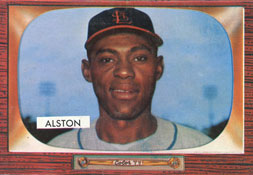 On April 13, 1954, Thomas Edison Alston was the first African-American to play in a regular-season game for the Cardinals, batting sixth and playing first base against the Cubs at St. Louis.
Seven seasons after Jackie Robinson joined the Dodgers, the Cardinals were the 10th of the 16 big-league teams to integrate.
Alston, 28, was the 14th African-American player in the Cardinals’ organization, but the only one on the big-league roster. (Among the other blacks in the Cardinals’ system in 1954 were pitchers Bill Greason, Brooks Lawrence and John Wyatt. All eventually pitched in the big leagues.)
Rapid rise
Alston and Jackie Robinson were born on the same date, Jan. 31. Robinson’s birth year was 1919 and Alston’s was 1926.
Alston’s rise from baseball novice to Cardinals pioneer was fast and unexpected. After serving in the Navy from 1945-47, Alston enrolled at North Carolina A&T in his hometown of Greensboro and earned a degree in physical education and social sciences. College was where Alston first played organized baseball.
In 1952, he entered professional baseball with Porterville, Calif., of the Class C Southwest International League, hit .353 in 54 games and caught the attention of the San Diego club of the Class AAA Pacific Coast League.
Alston joined San Diego midway through the 1952 season and hit .244.
In 1953 for San Diego, Alston had 207 hits in 180 games, with 101 runs scored, 23 home runs, 101 RBI and a .297 batting average. Cardinals scouts recommended him.
On Jan. 26, 1954, the Cardinals sent first baseman Dick Sisler, pitcher Eddie Erautt and $100,000 to San Diego for Alston. San Diego manager Lefty O’Doul called Alston “a great prospect who can field as good as any first baseman in the big leagues.”
He “looks like he’s going to be a great hitter, too,” O’Doul told The Sporting News.
Said Cardinals owner Gussie Busch: “When we purchased the Cardinals, I promised there would be no racial discrimination. However, Alston was not purchased because of his race. Our scouts and manager Eddie Stanky believe he is a great prospect. While he may need more experience, we didn’t want him to slip away from us.”
Bill Starr, president of the San Diego club, offered to cut the cash portion of the deal to $75,000 if the Cardinals would wait until 1955 to take Alston, according to the Los Angeles Daily Mirror, but the Cardinals wanted Alston for 1954. The incumbent at first base was Steve Bilko, who hit 21 home runs for the 1953 Cardinals but also led the National League in striking out (125 times). The Cardinals used spring training in 1954 as a competition between Alston and Bilko for the first base job.
“I think we have a real ballplayer in this colored boy,” Stanky said to The Sporting News in March 1954.
Said Alston: “They treat me here just the same as any other ballplayer and that’s how I want to be treated.”
Major leaguer
Stanky said he’d platoon Alston (a left-handed batter) and Bilko (right-handed), but Alston got the Opening Day start against Cubs left-hander Paul Minner.
“I guess I’ve come a long way in a short time,” Alston said. “I guess I came up like a real rocket.”
Alston went 0-for-4 with a strikeout and committed an error in his debut game. Boxscore
In his next game, April 17, 1954, at Chicago, Alston went hitless in his first four at-bats. In the eighth, he led off with a home run, his first big-league hit, against Cubs reliever Jim Brosnan. Boxscore
The next day, April 18, Alston got his second hit, a pinch-hit, three-run homer off left-hander Jim Davis, lifting the Cardinals to a 6-4 triumph. Boxscore
On April 30, in an endorsement of Alston, the Cardinals sent Bilko to the Cubs.
In a doubleheader against the Giants on May 2, Alston was 5-for-6 with five RBI, an inside-the-park home run and three walks. His performance was overshadowed by teammate Stan Musial, who hit five home runs with nine RBI. Game 1 boxscore Game 2 boxscore
In The Sporting News, Bob Broeg wrote of Alston’s inside-the-park home run: “His speed enabled him to circle the bases easily after Willie Mays misjudged his long wind-blown drive to left-center.”
Slowed by slump
Alston hit .301 (37-for-123) in May and was at .285 overall on May 30, but he slumped in June, enduring a 2-for-27 stretch and batting .181 (15-for-83) for the month. He had seven RBI in his last 42 games.
Alston complained that a mysterious physical ailment was causing him to feel weak. Medical exams turned up nothing. Eventually, Cardinals trainer Bob Bauman determined Alston was suffering from neurasthenia. A psychiatrist confirmed the diagnosis. According to the St. Louis Post-Dispatch, “The complicated emotional disorder somehow manifests itself in physical symptoms such as unexplained fatigue, sweating, vertigo and inability to sleep or concentrate.”
In June 1954, the Cardinals called up a black pitcher, Brooks Lawrence, from the minors and arranged with Lawrence and Alston to stay with a black family. As Lawrence recalled to Wendy Conlin of the Post-Dispatch, Alston would pray out loud at night in bed. “I would lie there and hear him praying, ‘I can hit, I can hit, I can hit.’ He made it kind of difficult to sleep sometimes,” Lawrence said.
On June 30, the Cardinals sent Alston to Class AAA Rochester and called up another rookie, Joe Cunningham, to replace him at first base. Alston’s overall numbers for the 1954 Cardinals: 60 hits in 66 games, 14 doubles, four home runs, 34 RBI and a .246 batting average. He made 62 starts at first base.
Said Cardinals general manager Dick Meyer: “Alston wasn’t ready … Eddie (Stanky) and I still have a very high regard for Alston as a prospect.”
Cunningham hit .284 with 11 home runs in 85 games for the 1954 Cardinals. The next season, the Cardinals moved Musial from the outfield to first base.
Alston made brief appearances with the Cardinals in 1955, 1956 and 1957. According to the Associated Press, when Gussie Busch asked Cardinals manager Fred Hutchinson why he didn’t play Alston, Hutchinson coldly replied, “If you want a clown to play first base, why don’t you hire (circus performer) Emmett Kelly?”
In 91 big-league games, all with St. Louis, Alston had 66 hits and batted .244.
In the 1990 book “Redbirds Revisited,” Alston told authors David Craft and Tom Owens, “I got a fair shake. It was just my physical condition that kept me from playing ball the way I knew I could play, the way the Cardinals expected me to play. My teammates treated me fairly. I don’t think they thought I was that good a hitter, though, and I guess I didn’t show them much while I was there.”
Ten years after Alston’s big-league debut, the Cardinals became World Series champions, building a reputation as a franchise that embraced diversity with players such as Bob Gibson, Bill White, Curt Flood, Lou Brock and Julian Javier.
Tom Alston took the first steps toward making that possible.
Troubled times
In 1958, Alston was arrested on arson charges after he admitted setting fire to a North Carolina church, the St. Louis Argus reported.
Police inspector M.L. Riley told the Argus that when he asked Alston why he set the church afire, Alston replied, “I had a fight with my sister and I just wanted to show her something.”
Alston spent from 1959 to 1969 in two state institutions in North Carolina, the Post-Dispatch reported.
In 1990, the Cardinals invited Alston to throw the ceremonial first pitch before a game against the Cubs at St. Louis. “I had more fun that visit than I ever had when I was playing,” Alston told Wendy Conlin of the Post-Dispatch.



Thank you for posting this. A wonderful story, even though, the the life of Tom Alston was also a bit tragic. It’s interesting. As a kid, the first Cardinal stories I became acquainted with were Dizzy Dean winning 30 games and the day Stan Musial hit 5 homeruns in one day. Nobody told me though, that Tom Alston had a darn good day as well. Too bad. I don’t think it’s too much of an exageration to say that without the sacrifices of people like Tom Alston, the 1964 Cardinals not only might not have won the Series, but they also might have never become the model franchise regarding integration. Joe Garagiola, has always been one of my most favorite baseball personalities. Since learning that he went out of his way to give Tom Alston a helping hand, I admire him even more. Just a little sidenote. Tom is a part of an exclusive group of players whose first two hits were homeruns. Please let me know if there are any videos of Tom throwing out the first pitch in 1990. Once again thanks for showing this.
Thanks you. From Flagstaff Films, here is a short video clip of Tom Alston batting and running the bases at a 1954 spring training game. He is No. 10: https://twitter.com/flagstafffilms/status/1059532827539226624
Here is another short clip from Flagstaff Films showing Tom Alston (No. 10) fielding at 1st base. This amazing clip from 1954 spring training also shows Stan Musial and Mickey Mantle batting: https://twitter.com/flagstafffilms/status/1059096481632804866
John Wyatt would pitch for Boston against the Cardinals in the 1967 World Series. In 1968, he finished the season pitching for Detroit, although I don’t believe he was on the roster for that year’s World Series, also against St. Louis.
Thanks for the info. Indeed, John Wyatt pitched in two games against the Cardinals in the 1967 World Series and got the win in Game 6 in relief of Gary Waslewski, even though Wyatt gave up a two-run home run to Lou Brock.
My name is Walter Alston I am a nephew of Tom Alston Could someone please reach out to me I’ll give you a reach at 3364658742 they says black history month And I would love to speak to someone concerning my Uncle and some of the articles that has been left to me