(Updated Nov. 8, 2024)
Recognition for being a player of multiple skills was as important to Lou Brock as being elected to the National Baseball Hall of Fame.
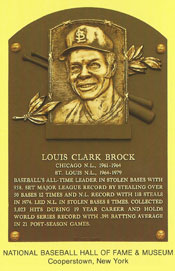 On Jan. 7, 1985, Brock got elected his initial time on the Baseball Writers Association of America Hall of Fame ballot.
Though base stealing was his signature talent, attributes such as smarts, work ethic, teamwork, being a catalyst and ability to intimidate foes helped make Brock a Hall of Famer.
Aside from the inaugural Hall of Fame class of Ty Cobb, Babe Ruth, Honus Wagner, Christy Mathewson and Walter Johnson, the 14 players who preceded Brock in being elected their first time on the ballot were Ted Williams, Stan Musial, Bob Feller, Jackie Robinson, Sandy Koufax, Ernie Banks, Willie Mays, Warren Spahn, Mickey Mantle, Al Kaline, Bob Gibson, Hank Aaron, Frank Robinson and Brooks Robinson.
“I think my greatest gift was the ability to be a force on the field, to beat you many ways,” Brock said to United Press International. “I was an unpredictable guy who could beat you in the clutch.”
Red Schoendienst, Brock’s manager from 1965-76, said to Super Sports magazine in 1969, “What’s there he can’t do? He’s a streak on the bases. He can hit and he also can hit with power. He can turn singles into doubles and doubles into triples. He can cover the outfield with the best around … He has to be the most exciting player in the game.”
Brock was named on 315 of 395 ballots (79.5 percent). A candidate needed to be named on 75 percent of the ballots to get elected.
Also elected that year was Hoyt Wilhelm. A knuckleball specialist, Wilhelm was the first relief pitcher elected. He played for nine teams, including the 1957 Cardinals.
Offensive force
Brock played 16 years (1964-79) with the Cardinals after four seasons (1961-64) with the Cubs. His most impressive career statistics: 938 stolen bases (the National League record) and 3,023 hits in 2,616 games.
With the Cardinals, Brock had 888 steals, 1,427 runs and 2,713 hits in 2,289 games. Primarily a left fielder, Brock ranks second to Stan Musial all-time among Cardinals in hits, runs and games.
(With 1,469 strikeouts as a Cardinal, 20 more than Ray Lankford, Brock is the club’s franchise leader in that category, too. “I’m the type of hitter who leaves the bench swinging and that’s why I don’t really possess the qualifications for a leadoff man,” Brock told Super Sports magazine. “I don’t look for walks, the way a leadoff hitter should … I just look for the baseball. I don’t care if it’s not in the strike zone. I see it, I hit it.”
Brock also ranks second all-time among big leaguers in steals (Rickey Henderson has 1,406). He led the National League in steals eight times, including 1974, when he had a career-high 118 at age 35.
“His speed meant so much that he had a greater effect and worried more pitchers than any home run hitter did,” Ted Sizemore, the Cardinals infielder who often batted second in the order behind Brock in 1974, told The Sporting News.
Said Brock: “I was a force that had to be reckoned with.”
In a 2014 interview with Cardinals Magazine, Brock said, “The stolen base artist has a passion. He is always seeking to occupy a piece of territory behind the enemy line, and there is something distasteful to the opposition about getting out there and taking that territory.
“If you hit a double, you actually land at second base, but if you walk, there’s something arrogant about looking at second base and saying, ‘I want to go over there and stand, and I’m going to do it between pitches.’ ”
Asked to describe his legacy, Brock said it was an “ability to light the fuse to enthusiasm, to cause teams and myself to play to the limit of their ability. You become a chemist, which makes a team tick. I think I had that ability.”
Will to win
Acquired along with pitchers Paul Toth and Jack Spring from the Cubs for pitchers Ernie Broglio and Bobby Shantz and outfielder Doug Clemens on June 15, 1964, Brock sparked the Cardinals to two World Series titles (1964 and 1967) and three National League pennants.
“He was a hard worker,” Bing Devine, the Cardinals general manager who made the trade, said to the Associated Press. “He worked very hard to become the expert base stealer he was. The base stealing is the dramatic thing about him, but he was an all-around ballplayer.”
Brock told Cardinals Magazine, “Being a base stealer was a double whammy. You had to be in shape, along with the rest of your teammates, but you also had to be in base-stealing shape, or you weren’t going to be successful. That was a special challenge, all by itself, that you had to prepare for.”
Brock excelled in the spotlight. He batted .391 (34-for-87) with 16 runs, 14 steals and 13 RBI in 21 World Series games for the Cardinals.
“He was as good as I’ve ever seen rising to the occasion,” Devine said.
United Press International columnist Milton Richmond described Brock as “the thinking man’s ballplayer. He knew almost as much about gravity and motion as Sir Isaac Newton.”
Ted Sizemore, a Dodgers second baseman before joining the Cardinals, had the perspective of observing Brock as an opponent as well as a teammate. Sizemore told Cardinals Magazine, “He slid very late and a lot of times the guys on the club wondered how he didn’t break his ankle sliding so late. Being on the other end of that, I hated tagging him because his knee was always up so high when he came in. You could break your hand putting it in there.”
Keith Hernandez, who joined the Cardinals as a 20-year-old first baseman in 1974, recalled Brock as a Hall of Fame person.
“He helped me more than anybody in my career,” Hernandez said. “He’s one of the guys in my career that if they weren’t around at a certain stage I might not have made it … He was such a giving person.”

 RetroSimba
Leave a comment