(Updated Jan. 12, 2026)
In seeking a third consecutive pennant, the Cardinals traded six players to get a No. 5 starter for their rotation.
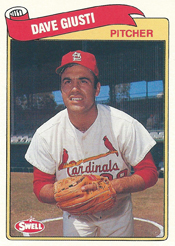 On Dec. 3, 1968, the Cardinals reacquired pitcher Dave Giusti from the Padres for infielder Ed Spiezio, outfielder Ron Davis, catcher Danny Breeden and pitcher Philip Knuckles.
Two months earlier, on Oct. 11, 1968, the Cardinals got Giusti and catcher Dave Adlesh from the Astros for catchers Johnny Edwards and Tommy Smith, but then the Padres snatched him in the Oct. 14 National League expansion draft.
The Cardinals, who won league championships in 1967 and 1968, were determined to add Giusti to a 1969 starting rotation with Bob Gibson, Steve Carlton, Nelson Briles and Ray Washburn, but the payoff didn’t match the price.
In exchange for Edwards, Smith, Spiezio, Davis, Breeden and Knuckles, the Cardinals got a pitcher who earned three wins in his lone season with them.
Houston calling
Giusti was a successful college pitcher at Syracuse and nearly signed with the Cardinals when he turned pro in June 1961. The Cardinals and Houston Colt .45s each offered Giusti a signing bonus of about $35,000 and Giusti was leaning toward choosing St. Louis, partly because his former Syracuse roommate, Doug Clemens, was a Cardinals outfielder.
“If the Cardinals had hurried just a bit at that point, they undoubtedly would have landed Giusti,” The Sporting News reported.
Giusti opted for the Colt .45s, entering the National League as an expansion club in 1962, because he said “it would be the fastest way to the big leagues.”
Giusti made his major-league debut in April 1962 and developed into a durable starter for the club, which was renamed the Astros in 1965. In each of three consecutive seasons (1966-68), Giusti reached double digits in wins and topped 200 innings pitched.
During the off-seasons, Giusti, who earned a master’s degree in physical education, was a substitute teacher in a Syracuse suburb.
Giusti was delighted when the Cardinals acquired him from the Astros. With Dal Maxvill at shortstop, “I’ll have more experience behind me at that spot than I’ve had before,” Giusti said, and with an outfield of Lou Brock, Curt Flood and Vada Pinson to chase down drives “you don’t have to worry about making the perfect pitch all the time.”
Come and go
To help stock the rosters of the expansion Expos and Padres, the National League held a draft on Oct. 14, 1968, consisting of six rounds. The Expos and Padres each were allowed to select five players per round from the existing National League franchises.
Each existing team initially could protect 15 players. A team could protect three more players each time one was taken from its list of unprotected.
After the Cardinals got Giusti from the Astros, he asked general manager Bing Devine whether he’d be protected and Devine “didn’t say yes or no,” Giusti said.
The Cardinals wavered until the last minute before protecting Washburn instead of Giusti, the St. Louis Post-Dispatch reported. The Cardinals would have protected Giusti in the second round if another one of their players was chosen in the first round, according to the Post-Dispatch, but Giusti was the first Cardinals player drafted. The Padres selected Giusti with their second pick in the first round.
“I’m very disappointed,” Giusti said. “Nobody in St. Louis told me this was going to happen. I wanted to work for a championship club.”
Let’s make up
Trade offers for Giusti poured in to the Padres from the Reds, Orioles, Astros and Cardinals. The Reds were offering shortstop Leo Cardenas or outfielder Hal McRae, The Sporting News reported.
Devine came up with the package of four players at positions the Padres were looking to fill. “We needed numbers and the Cards wanted the proven starting pitcher,” said Padres president Buzzie Bavasi.
Devine called to inform Giusti he’d been reacquired by the Cardinals and said, “You can stop being mad at me. We’ve got you back.”
In addition to a fastball and slider, Giusti threw a palmball, which is similar to a changeup. “The difference is the pitcher grips the ball back in the palm rather than with the fingertips,” the Post-Dispatch explained.
“Learning to throw the palmball was a matter of survival,” Giusti said. “I found out early the hitters up here can hit the fastball. I had to come up with another pitch.”
Said Cardinals pitching coach Billy Muffett: “He can throw the palmball over the plate just about any time he wants. He’s not afraid to throw it no matter what the situation. He never tips off the pitch.”
Starter to closer
In his first regular-season appearance for the Cardinals, on April 12, 1969, Giusti pitched a shutout and scored the lone run in a 1-0 victory over the Mets. The run came in the third inning when Giusti doubled and scored on Flood’s double against Don Cardwell. Boxscore
Giusti pitched a three-hitter against his favorite patsy, the Cubs, for his second Cardinals win. (Giusti finished with a career record of 23-9 versus the Cubs). Boxscore.
His season began to unravel in late May when he wrenched his back while fielding during batting practice. He was on the disabled list for a month and in his absence Chuck Taylor and Mike Torrez won rotation spots. Giusti was used in long-inning relief in August and September as the Cardinals faded from contention.
He finished the season at 3-7 with a 3.61 ERA in 22 appearances.
On Oct. 21, 1969, the Cardinals traded Giusti and catcher Dave Ricketts to the Pirates for outfielders Carl Taylor and Frank Vanzin. Pirates general manager Joe Brown made the deal on the recommendation of outfielder Roberto Clemente, who told him Giusti “always had good stuff and he is a tough competitor.” (Clemente had one hit, an infield single, in his last 10 career at-bats versus Giusti.)
The Pirates converted Giusti into a closer and he became one of the best. Against the Cardinals in 1970, he was 3-0 with a save. In one of those wins, he smacked a two-run triple against Bob Gibson. Boxscore
In 1971, Giusti led the National League in saves (30) for the World Series champions. Giusti pitched 5.1 scoreless innings against the Orioles in the 1971 World Series and earned a save in Game 4 when he retired all six batters he faced. Boxscore
Regarding how he assessed pitchers, Bing Devine told the Post-Dispatch in 1971, “The only way I can judge a pitcher is by how the ball misses the bat. There are some pitchers who can overpower the hitters, and some who win when you know they’re not that good. The majority is in the middle group, and you judge them by how many times the ball gets to the catcher’s glove.”
In seven seasons (1970-76) with the Pirates, Giusti was 47-28 with a 2.94 ERA and 133 saves.

 RetroSimba
Trading Giusti to the Pirates was another of Bing’s poor trades in his second tenure with the Cardinals. He had taken over a championship team and had traded it into mediocrity by the early seventies. Tolan for a declining Pinson, Flood and McCarver for Dick Allen who was traded after one season. Reggie Smith for Joe Ferguson in a stunner. And, of course Carlton and Reuss on trades that Devine later said were ordered by an angry Gussie Busch.
Good points. Thanks for commenting.
Reggie Smith for Joe Ferguson was because Reggie was playing out his option and wasn’t going to re-sign.
Thanks for the info. The trade of Reggie Smith to the Dodgers in 1976 was made within the last hour before the midnight deadline on June 15 only after the Dodgers offered a two-year contact and Smith agreed to terms, according to the June 17, 1976, St. Louis Post-Dispatch. The Dodgers agreed to a deferred salary arrangement that had been a stumbling block in Smith’s failure to sign with the Cardinals, the Los Angeles Times reported.
The Cardinals stumbled in April and May of 1969. Runs were hard to come by. They got hot in July, played well the rest of the year, but couldn’t make up for that punchless start.
Yes, thanks. The 1969 Cardinals were 9-12 in April, 12-13 in May and 14-16 in June. They had winning marks each month after that, but finished in fourth place in the National League East at 87-75.
As noted, most of Devine’s deals during his second tenure as the Cardinals’ GM were clunkers. Some of the deals made no sense right away (releasing Jose Cruz, the Smith-Ferguson trade, Carlton-Wise), but then even deals that seemed to be good ones turned out bad. Rick Wise had a solid 1971, and in terms of the modern stat WAR, was actually a little better than Carlton. He also had two solid seasons with the Cardinals, but Carlton was unbelievable in ’72 and continued to be great for many years, while Wise was dealt after those two years in St. Louis and was not as good with Boston and other clubs.
Two members of the 1969 pitching staff went on to do well as closers, Giusti and Mudcat Grant. Another good closer we gave away was Wayne Granger (in the ill-fated Tolan-for-Pinson trade).
One last comment – Devine always defended the Tolan-Pinson deal, saying Pinson gave the Cardinals what they were looking for in replacing Roger Maris. But he would conveniently leave out any comments about how great Tolan turned out to be in Cincinnati, nor anything about also giving up Granger. Those two helped make a solid Reds team into the early version of the “Big Red Machine”.
Regarding Cruz, I remember the Cardinals giving him plenty of chances (especially between 1971-73) to become a regular. He didn’t become a consistent hitter until his second season with Houston. Plus, the emergence of Bake McBride in centerfield, and the acquisition of Reggie Smith also led to him being sold to the Astros.
Giusti had one helluva palm ball. I could never tell when he was throwing it.
Which, I guess, is the whole idea.
Good point. I remember Orlando Pena was another who threw an effective palmball for Cardinals.
All these posts are 5-6 years old, but I too question how good Bing Devine actually was as the Cardinals’ GM. I’d find a well-researched essay on his tenure fascinating.
To be fair: Bing worked, twice, for an owner who was both devoted to success and just meddlesome enough with a short fuse to boot.
I was only 9 years old during Giusti’s one season with STL, but I certainly was aware of “all these players” Bing was trading away to get this one pitcher… only to dump him after one (injury marred) season?? That does seem like a possible “Gussie Mandate.”
But given the Cardinals’ relief pitching woes of the early 1970s, prior to Hrabosky’s arrival, Giusti’s instant success with Pittsburgh does not reflect well upon the evaluation skills of Devine/Schoendienst.
Mike Torrez? Bob Broeg wrote that Torrez was beset by a failing marriage, and certainly 1970 was a hit-the-wall season for Torrez and then he washed out with the Cardinals inside 1971. But for Bing to trade him to Montreal for BOB REYNOLDS??
Thanks for your input, Timothy. You know your baseball.
It’s almost like there were two Bing Devines. He was the general manager who acquired Lou Brock, Curt Flood, Dick Groat, Julian Javier, Bill White and Curt Simmons, all prominent members of the 1964 champion Cardinals. With the Mets, he acquired several of the key players (plus manager Gil Hodges) that led to them becoming 1969 champions. Then he made a bunch of those unfortunate trades in his second stint with the Cardinals. Unlike those 1970s Pirates and Reds, I think Devine was too slow to recognize the shift in baseball to having a dominant closer and a deep bullpen.
A very good and fair extra point RE Devine as GM building what proved to be The Miracle Mets… whose player development chief in the mid-60s was, interestingly, some fella named Dorrel Herzog — before Whitey donned a uniform as third base coach in 1966, I think it was.
Back to Bing II with Los Birdos: You make another good point about him being perhaps not visionary about the growing importance of a deep bullpen.
I could happily spend hours immersing into Baseball Reference, to get these guys’ statistics … but I’m thinking of quality relievers who Bing would acquire then jettison after very short stays with the Cardinals… Frank Linzy, Orlando Peña (yes, quite old, but consecutive seasons with an ERA of less than 2.40), Diego Segui, Stan Williams… who else?
Bing was with Red all these years… maybe they had a shared commitment to Gibson’s heart, a la Johnny Keane, and therefore didn’t value relievers not named Joe Hoerner.
Good stuff, Timothy. Yes, I think you are correct that Bing Devine deep into the 1970s expected starters to pitch complete games, much like Bob Gibson had, and therefore saw relievers as secondary, rather than primary, needs.
Unfortunately for Cardinals fans, many more names can be added to your good list of quality relievers traded or released by Bing II. A few others included Wayne Granger (27 saves for Reds in 1969 and 35 in 1970), Ramon Hernandez (14 saves for Pirates in 1972 and 11 in 1973), Ted Abernathy (12 saves for Royals in 1970 and 23 in 1971), Jerry Johnson (18 saves for 1971 Giants), Tom Murphy (20 saves for Brewers in 1974 and 20 more in 1975) and Lerrin LaGrow (25 saves for White Sox in 1977 and 16 in 1978).