(Updated Jan. 13, 2025)
A right-hander whose extensive mix of pitches included a spitball, Lew Burdette was supposed to give the Cardinals the edge they needed to win the 1963 National League pennant, but it didn’t work out. Instead, he helped them attain a championship the following year, even though he was gone by June.
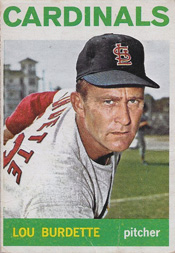 On June 15, 1963, the Cardinals obtained Burdette, 36, from the Braves for catcher Gene Oliver and pitcher Bob Sadowski.
The Cardinals expected Burdette could make the difference in a pennant race the way June acquisitions Grover Cleveland Alexander (1926) and Burleigh Grimes (1930) did for them.
Dynamic duo
Selva Lewis Burdette was from Nitro, W.Va., along the Kanawha River near Charleston. The town sprung up during World War I as a center for the manufacturing of gunpowder for the military.
Burdette went by a shortened version of his middle name, Lew or Lou. Asked by the St. Louis Globe-Democrat in 1963 which spelling he preferred, Burdette replied that either way was acceptable. “I always (endorse) the check the way it’s written,” he said.
After reaching the majors in 1950, making two relief appearances with the Yankees, Burdette was traded to the Braves for Johnny Sain in August 1951.
Burdette and Braves teammate Warren Spahn (baseball’s career leader in wins among left-handers) liked palling around together, each bringing out the mischievous side in the other, and became road roommates. Their friendship was “as close as Damon and Pythias,” The Sporting News observed.
Asked why he and Burdette got along so well, Spahn told Bob Broeg of the St. Louis Post-Dispatch, “It’s because we appreciate each other’s sense of humor … No one else can stand us.”
Glory days
Burdette led National League pitchers in ERA (2.70) and shutouts (six) in 1956.
The next year, he was named the most valuable player of the World Series, winning Games 2, 5 and 7 against the Yankees. Burdette went the distance in all three games, allowing a mere two runs in 27 innings for an 0.67 ERA. Video
As the New York Times noted, Burdette relied on “sinkers, screwballs and sliders, his excellent control and his unswerving poise.”
He also mixed in a devastating spitball.
“Burdette has a great sinker, and when he gets into a tight spot, he throws a wet sinker,” Reds outfielder Jerry Lynch told The Sporting News.
With 20 wins in 1958, Burdette helped the Braves repeat as National League champions, but the Yankees prevailed in the World Series, in part because he was 1-2 with a 5.64 ERA.
He remained an ace, leading the National League in wins in 1959 (21), in complete games in 1960 (18) and in innings pitched in 1961 (272.1).
A man for all seasons
Burdette injured an ankle in May 1962 and Braves manager Birdie Tebbetts lost confidence in him. “Burdette makes no secret of the fact that he feels he was mishandled by Tebbetts,” The Sporting News reported.
Though he finished the 1962 season with a 10-9 record, Burdette allowed 172 hits in 143.2 innings (the first time since 1953 he didn’t pitch at least 230 innings) and made no starts after Aug. 16. Afterward, he told The Sporting News, “Last season was the most miserable one I ever spent in baseball. It’s the worst feeling in the world not to be a part of things.”
Bobby Bragan, who replaced Tebbetts, told The Sporting News that Burdette was not in his plans for 1963. After getting a look at him in spring training, Bragan changed his mind and named Burdette the Braves’ Opening Day starter.
“He’s an even better athlete than I had envisioned,” Bragan told The Sporting News. “He can field, he can run, he can hit _ anything.”
Let’s make a deal
When Ray Washburn, who won his first five decisions for the 1963 Cardinals, suffered a shoulder injury, general manager Bing Devine searched for a starter to replace him and to join a rotation with Bob Gibson, Ernie Broglio, Curt Simmons and Ray Sadecki.
Devine’s first choice was Burdette, but the Braves were close to trading him to the Orioles, The Sporting News reported. Devine then tried to deal for Houston’s Ken Johnson, but the Colt .45s took him off the market when Turk Farrell injured a hip, according to the Globe-Democrat.
Next, Devine approached the Mets about Roger Craig. The Mets offered Craig, pitcher Ken MacKenzie and catcher Norm Sherry for Gene Oliver, outfielder Duke Carmel and pitchers Harry Fanok, Bob Sadowski and Ron Taylor, but the Cardinals wouldn’t part with Taylor, the Post-Dispatch reported.
Devine went back to the Braves and convinced them to deal Burdette to him. When they acquired Burdette, the Cardinals (36-26) were tied with the Giants for first place in the 10-team National League. The Sporting News described him as “an ideal pickup for a St. Louis club which felt that one more established pitcher might put it in the World Series.”
Globe-Democrat sports editor Bob Burnes declared, “It’s a good deal for the Cardinals. Eight to 10 victories by Burdette the rest of the season added to what the Cardinals already have potentially on their side could mean the pennant.”
Cardinals debut
Burdette was 6-5 for the 1963 Braves and won his last three decisions, including a shutout of the Mets in his final game with Milwaukee on June 12. Boxscore
His first appearance for the Cardinals was a start against the Mets on June 18 and he pitched a complete game for the win. Burdette held the Mets scoreless until Tim Harkness hit a two-run home run with two outs in the ninth. Boxscore
“He had the ball really moving, sailing, sliding and sinking,” Cardinals third baseman Ken Boyer said to the Post-Dispatch.
Cardinals catcher Tim McCarver, 21, told the newspaper, “I’ve never seen a pitcher who can move the ball around as much as Burdette did.”
In the book “We Would Have Played For Nothing,” Burdette said, “I had an uncanny ability of throwing strikes … If you get the reputation that you don’t walk anybody, you don’t have to throw strikes. They swing at anything.”
Brave new world
On July 11, 1963, Burdette faced the Braves for the first time in a start at St. Louis. After taking a pitch from Burdette for a strike in the third inning, Hank Aaron asked plate umpire Chris Pelekoudas to check the ball to see whether it had a foreign substance. Pelekoudas took a look and kept the ball in play. “Henry has a better sense of humor than people think,” Burdette told the Post-Dispatch.
Two innings later, Aaron snapped a 1-1 tie with an RBI-double against Burdette and the Braves went on to a 5-3 victory. Boxscore
Two weeks later, Burdette made his first appearance in Milwaukee since the trade. The opposing starter was his friend, Warren Spahn.
Burdette held the Braves to a run in nine innings and got the win. Spahn allowed the Cardinals three runs in eight innings. “Spahn didn’t pitch badly for an old man,” Burdette told The Sporting News. He added, “I didn’t feel especially good about pitching against the best friend I ever had in baseball, but I had a job to do, and all I could do was go out and do my best.”
Braves manager Bobby Bragan said to The Sporting News that Burdette “won that game with less (velocity) than anybody I’ve ever seen on a major-league mound.” Boxscore
Burdette beat the Braves again with a complete game at St. Louis on Sept. 15, 1963, helping the Cardinals win their ninth in a row and end the day a game behind the first-place Dodgers. Boxscore
“We got Burdette just for a game like this,” Cardinals manager Johnny Keane said to the Post-Dispatch. “He gave us what we wanted when we had to have it.”
The Dodgers followed the Braves into St. Louis, swept a three-game series and went on to win the pennant. The Cardinals (93-69) finished in second place.
Burdette was 3-8 with two saves and a 3.77 ERA for the 1963 Cardinals. He had a 4.15 ERA in 14 starts and an 0.77 ERA in seven relief appearances. His losing record for the season was his first since 1952.
Starting over
In November 1963, the Cardinals acquired Roger Craig from the Mets and projected him to fill Burdette’s role. Burdette, 37, was moved to the bullpen in 1964. “I prefer starting,” he told The Sporting News.
Burdette was 1-0 with a 1.80 ERA in eight relief appearances for the 1964 Cardinals when he was traded to the Cubs on June 2 for pitcher Glen Hobbie.
It turned out that Burdette’s relief win for the Cardinals on April 24, 1964 _ a scoreless 11th inning against the Houston Colt .45s _ was important because the Cardinals (93-69) won the National League pennant that year by a mere one game over the Phillies (92-70) and Reds (92-70). Boxscore
“The Cardinals are a fine organization and I have no complaints with their treatment of me,” Burdette told the Associated Press. “It’s just that I didn’t get the opportunity to pitch. I guess they felt I was too old to be a starter. I’m 37, but I can outdo a majority of the 21-year-olds in most things.”
Burdette was 40 when he pitched his last game in the majors, a relief stint for the Angels versus the Twins in 1967. He faced three batters _ future Hall of Famers Rod Carew, Harmon Killebrew and Tony Oliva _ and pitched a scoreless inning. Boxscore
In 18 seasons in the majors, Burdette was 203-144.

 RetroSimba
Already a legend in my eyes for beating the Yankees 3 times in the 1957 World Series.
His numbers sort of reminded me of Felix Hernandez, so just for fun I compared them on stathead.com. Just as I suspected, they have very similar numbers although Hernandez was more dominant with the strikeout, Burdette had 34 more career wins assumingly because Hernandez’s career was cut short because of injuries. What’s interesting to me is how they were very different as pitchers but got almost the same result. (also not taking into account the modern-day 100 pitch “rule”)
I would not have thought Lew Burdette and Felix Hernandez had comparable career stats. Thanks for an interesting take.
Lew Burdette is one of 13 pitchers with three wins in one World Series, according to baseball-reference.com.
The 13 are:
_ Bill Dinneen, 1903, Red Sox
_ Deacon Phillippe, 1903, Pirates
_Christy Mathewson, 1905, Giants
_ Babe Adams, 1909, Pirates
_ Jack Coombs, 1910, A’s
_ Smoky Joe Wood, 1912, Red Sox
_ Red Faber, 1917, White Sox
_ Stan Coveleski, 1920 Indians
_Harry Brecheen, 1946, Cardinals
_ Lew Burdette, 1957, Braves
_Bob Gibson, 1967, Cardinals
_ Mickey Lolich, 1968, Tigers
_ Randy Johnson, 2001, Diamondbacks
One of the best from that era. What a dominating performance in the 1957 World Series. I can understand why the Cardinals traded him, but it is only fair to say that he went on to have a decent year with the Cubs. Seven complete games victories.Two of them by shutout, with one of them coming against St. Louis.
Glad you mentioned how Lew Burdette did with the 1964 Cubs.
In one month, June 1964, the Cardinals traded to the Cubs 3 prominent pitchers: Ernie Broglio, Lew Burdette and Bobby Shantz. Of course, the Cardinals got Lou Brock in exchange for Broglio and Shantz. Hard to imagine the Cardinals and Cubs making deals with those kind of marquee players in any one month again.
The 1964 Cubs were loaded with former Cardinals on their pitching staff. Here are their names and how they did for the 1964 Cubs: Larry Jackson (24-11), Ernie Broglio (4-7, one save), Lindy McDaniel (1-7, 16 saves), Bobby Shantz (0-1, one save), Lew Burdette (9-9).
Lew Burdette was one of two Burdettes who pitched for the 1964 Cubs. The other, Freddie Burdette, no relation to Lew, made 18 relief appearances for the 1964 Cubs and was 1-0 with one save.
You wonder why the Cardinals did not think Bob Sadowski, who along with Gene Oliver went to the Braves in the trade for Burdette, was not considered to take Washburn’s rotation spot. Sadowski only went 5-7 in 18 starts with Milwaukee after the deal, but had a 2.62 ERA. B-R has him with a 2.2 WAR for the Braves in ’63, while Burdette was essentially a “replacement” player for the Cardinals (a 0.1 WAR). I dug out my 1963 Cardinals yearbook, and in there they call Sadowski “one of the more promising pitchers in the Cardinal organization.”
Also, in that big September series against the Dodgers Walt Alston started three left-handers, knowing the Cardinals struggled against lefties. Oliver’s power from the right side might have helped in that series.
While many felt Burdette might have given the Cards just enough to secure a pennant, they could very well have been better off by not making that trade.
You make several strong points, Michael.
In 12 starts for the Cardinals’ Class AAA Atlanta farm club in 1963, Bob Sadowski was 9-2 with a 1.80 ERA. According to the St. Louis Globe-Democrat, the reason the Cardinals put him in the Lew Burdette deal is because they “had used up their options on Sadowski” and couldn’t bring him back from the minors “until he had been exposed to the draft” of unprotected minor-league players in the fall. Because of his stellar performance with Atlanta, the Cardinals “knew they couldn’t maneuver him through the draft,” and decided to get something for him via a trade, the Globe-Democrat reported.
In that late-September three-game sweep of the Cardinals in 1963, the Dodgers started Johnny Podres, Sandy Koufax and Pete Richert. Tim McCarver, the left-handed batter who became the Cardinals’ catcher after Gene Oliver was traded for Burdette, was 3-for-11 in the series (plus, he was hit by a Koufax pitch) and totaled no runs and no RBI.
Great piece. One of my favorite stories is how Burdette got to the Braves in the first place (from a recent book about the ‘57 Braves). While Yankee property in ‘51, he was pitching for the S.F. Seals against Hollywood. A Hollywood guy strikes out and says to the manager, Fred Haney, “that guy has the best spitter I’ve ever seen.” Haney was a friend of the Braves’ owner, Lou Perini. For the stretch drive, the Yankees wanted Johnny Sain, and the Braves said OK, we’ll take Burdette. Six years later, Burdette has that great Series, and Haney is the manager. Bill James says Burdette is one of the luckiest pitchers ever, but I’m not sure I buy it.
Thanks for sharing the story of how the Braves became interested in Lew Burdette. He led that 1951 San Francisco Seals team (managed by Lefty O’Doul) in wins (14) and complete games (13) before being traded to the Braves.
After the way the game has changed, going the distance in 3 World Series games seems monumental.
Quite true, Ken. The last pitcher to pitch a complete game in a World Series was the Royals’ Johnny Cueto, Game 2, 2015, versus the Mets. He was the first American League player to pitch a World Series complete game since Jack Morris of the Twins in Game 7 versus the Braves in 1991.
Madison Bumgarner of the Giants pitched the last complete game in a World Series for a National League club. That was Game 5 against the Royals in 2014.
I love reading about old Braves players and pitchers, them all being well before my time, but Burdette such an important part of Milwaukee baseball history, him being such a big part of them winning in 57 and what strikes me and attracts me to him is how few strikeouts he had……must have made the defense interested in the game. Strikeouts are macho and exciting, but I’ll take a multi-pitch pitcher like Burdette with control over a K king any day.
But Braves aside, Burdette as a Cardinal adds to what seems like a long standing connection between the two teams. I’ve heard before what a tremendous addition former Cardinal Red Schoendienst was to the Braves in 57.
I related his quote of “It’s the worst feeling in the world not to be a part of things.” This often happens to me in crowds and it’s much lonelier than being alone.
I share your appreciation for pitchers who use multiple skills and tools, including their smarts, to pitch rather than simply trying to overpower a batter.
I thought you might like an anecdote from Tim McCarver’s 1998 book, “Baseball for Brain Surgeons and Other Fans.”
McCarver said that when Lew Burdette came to the Cardinals in 1963, “I was 21 and he was much older than dirt, and we became tight friends. When I wanted him to throw his famous spitball, I would tug on the bottom of the chest protector and whatever signs I gave after that were decoys. In 1984, we were playing golf together in St. Petersburg and I reminded him that his spitter went down as much as any spitter I ever caught. Lew said, ‘I didn’t throw a spitter.’ I said, ‘What? We even had a sign for it.’ He said, ‘I never threw a spitter.’ ”
Even in retirement, Burdette still was playing head games and not conceding anything that might take away his edge.
Thanks for the anecdote. It’s amazing your knowledge and recall…much appreciated Mark. I love how Burdette and probably many spitter pitchers caused batters and umpires to always wonder if it was coming and even if they knew it was coming, what can you do with a pitch that as McCarver suggests went down so much.
Hi Mark, I don’t know if my last point was clear. I just wanted to say that sometimes when we’re in crowds and don’t feel a part of things, it’s lonelier than when we are by ourselves.
Crystal clear. I can relate. I’ve had that feeling all my life.
Thanks for the information on Sadowski and the options, Mark. That is odd that the Cardinals had used up his options, as he never appeared in a game for the big league club. Maybe I do not understand the options rules – were minor league options part of the limited options rules? Or maybe the Cardinals brought him up to the big club a few times but never used him. At any rate, it sounds like the organization was negligent in the way they managed Sadowski while they had him.
In case it is helpful, here is a link to the MLB definition on minor-league options: https://www.mlb.com/glossary/transactions/minor-league-options