On a team with little pop, pitcher Don Durham qualified as somewhat of a slugger for the Cardinals.
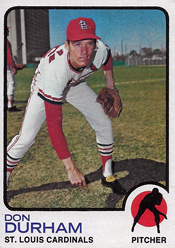 A rookie right-hander with St. Louis in 1972, Durham had as many home runs (two) as wins (two). He batted .500 (seven hits in 14 at-bats) and had a slugging percentage of .929.
Durham was part of a Cardinals pitching trio, along with Bob Gibson and Rick Wise, that provided as much power as some of the infielders and outfielders.
Gibson (five), Durham (two) and Wise (one) combined for eight home runs on a club that ranked last in the 12-team National League in home runs (70) in 1972.
Catcher Ted Simmons (16) and third baseman Joe Torre (11) were the lone 1972 Cardinals to reach double digits in home runs. They and outfielder Bernie Carbo (seven) were the only Cardinals with more home runs than Gibson that year.
Even Durham, with his two in 14 at-bats, had as many home runs as second baseman Ted Sizemore (two in 439 at-bats) and center fielder Jose Cruz (two in 332 at-bats), and more than shortstop Dal Maxvill (one in 276 at-bats) and third baseman Ken Reitz (none in 78 at-bats).
Promising prospect
Though born in Kentucky, Durham was a resident of the Ohio village of Arlington Heights near Cincinnati between the ages of 6 and 9, according to the Cincinnati Enquirer. He played Little League baseball there and faithfully followed the 1950s Reds, The Sporting News reported,
At Western Kentucky University, Durham was a first baseman and pitcher. Though slender at 6 feet and less than 170 pounds, he threw hard and hit for power.
In a 1969 doubleheader versus Austin Peay, Durham started and won the first game, then belted a grand slam to help Western Kentucky complete the sweep, according to The Park City Daily News of Bowling Green, Ky. A year later, he struck out 14 in pitching a no-hitter against Bellarmine. Durham led the team in hitting (.418) his final season, according to The Sporting News.
On the recommendation of scout Mo Mozzali (who signed Ted Simmons three years earlier), the Cardinals chose Durham in the seventh round of the 1970 draft. After a strong season with Class A Modesto in 1971 (13-7, 2.80 ERA, 202 strikeouts in 177 innings, plus a .240 batting average), the Cardinals decided Durham should bypass Class AA and move to Class AAA Tulsa in 1972.
On June 3, 1972, Durham pitched a shutout and hit a home run against Indianapolis. The two-run homer came after Durham fouled off two pitches trying to bunt and then was told by manager Jack Krol to swing away. “I’ve always been proud of my hitting,” Durham said to the Tulsa World.
Four days later, with Tulsa ahead, 1-0, in the last of the ninth inning at Evansville, Durham needed one out to complete a no-hitter, but Bob Coluccio grounded a single to left. Exasperated, Durham flung his glove into the air. After a brief discussion with Krol on the mound, Durham faced Darrell Porter, who the night before lined a two-out, two-run home run in the bottom of the ninth to lift Evansville to a 4-2 victory.
On Durham’s first pitch to him, Porter lofted a high fly that carried over the fence, barely beyond the reach of right fielder Bob Wissler, for a game-winning home run. “To tell you the truth, I didn’t think I hit the ball that good,” Porter said to Tom Tuley of The Evansville Press. “I thought it was going to be caught.”
Sitting alone on the dugout steps after going from possible no-hitter to losing pitcher in two pitches, Durham told Tuley, “I’m still in shock.”
Fitting in
A week later, Durham, 23, was called up to the Cardinals and put into the starting rotation, even though he had pitched only a partial season at a level higher than Class A.
He made his big-league debut against his boyhood favorite, the Reds, at St. Louis on July 16, 1972. The first batter he faced, Pete Rose, grounded out. The next, Joe Morgan, flied out. In the second inning, Durham struck out the side. One of the victims was Tony Perez.
Durham went seven innings, allowed three runs, got little support and was the losing pitcher in a 4-1 Reds triumph. Bobby Tolan hit a solo home run _ the only homer Durham would allow in 47.2 innings for the 1972 Cardinals.
“The kid had good stuff,” Cardinals manager Red Schoendienst said to the St. Louis Post-Dispatch. “He’s going to be a good pitcher. He had a good fastball and his control was good. We just didn’t get a break for him.”
Reds manager Sparky Anderson told the Dayton Daily News, “The kid had a good fastball and he kept it around the plate real well.”
According to the Post-Dispatch, Cardinals catcher Ted Simmons nicknamed Durham “The Rattlesnake” because of the way he uncoiled as he delivered a pitch. Boxscore
Tough going
On Aug. 4, 1972, when the Phillies faced the Cardinals, the starting pitchers had a combined season record of 0-11. Ken Reynolds was 0-8 and Durham was 0-3.
In the second inning, using a Bob Gibson bat, Durham got his first big-league hit, a three-run home run on a fastball down the chute from Reynolds. Then he retired the Phillies in order in the second through fifth innings and contributed two more hits, both singles. “If ever a pitcher seemed destined for victory, Durham was the guy,” the Post-Dispatch noted.
It wasn’t to be, though. The Phillies scored six runs in the eighth and won, 8-3. “Sitting forlornly in the clubhouse,” Durham was “so despondent he could hardly bring himself to talk,” the Post-Dispatch reported.
He described himself to the newspaper as “a choke artist.” Boxscore
Giant killer
After losing a fifth consecutive decision, Durham finally got his first big-league win on Aug. 18, 1972, against the Giants at Candlestick Park in San Francisco.
In addition to limiting the Giants to a run in 6.1 innings before being relieved by Diego Segui, Durham scored the Cardinals’ first two runs. Using a Ted Simmons bat, he singled and scored in the third and walloped a hanging slider from Jim Willoughby for a solo home run in the fifth.
After the game, Durham went around the clubhouse, getting autographs on a baseball from all of his teammates, the Post-Dispatch reported.
“My confidence has been restored,” Durham told the Post-Dispatch. Boxscore
Durham got one more win and again it came against the Giants. Facing a lineup with the likes of Bobby Bonds, Willie McCovey and Dave Kingman, Durham pitched a three-hitter. He also stroked two singles _ one against Juan Marichal and the other versus Sam McDowell.
“After the first inning, I zeroed in nicely on the outside zone and took the power away from their big hitters,” Durham told the San Francisco Examiner. Boxscore
End game
Durham pitched in 10 games, making eight starts, for the 1972 Cardinals and was 2-7 with a 4.34 ERA.
At some point, he experienced elbow problems and was sent back to Tulsa for the 1973 season.
On July 16, 1973, the Cardinals traded Durham to the Texas Rangers, who were managed by Whitey Herzog. The American League had the designated hitter rule, so Durham didn’t get a chance to bat. When he pitched, he wasn’t effective.
After posting a record of 0-4 with a 7.59 ERA for the 1973 Rangers, Durham, 24, was finished in the big leagues.

 RetroSimba
You’re making me miss the days when pitchers could bat. What’s more exciting than having your pitcher hit a home run? I’ll always remember seeing Bartolo Colon hit one at age 40+. I also remember a game where Noah Syndergaard pitched a nine-inning shutout and hit a home run to win 1-0.
At a seminar I attended in 1983 or 1984, Tom Boswell of the Washington Post was one of the speakers. He gave a tip about how he got reluctant pitchers to give him extensive interviews. He would research their batting records and begin the conversation by asking them about the first hit or first RBI or first home run they achieved. He found that most pitchers just loved talking about a hitting accomplishment, and this relaxed them and then got them talking about the topics Boswell really wanted to know from them.
It’s too bad they rushed him through the minors. It seems like he never got the chance to prove if he had major league stuff. One things for sure is that the Cardinals were already suffering the consequences of trading Steve Carlton. I was comparing the offensive stats of the 1972 Cardinals with some of the Whitey Herzog teams. The WhiteyBall teams weren’t big on homeruns either but in all other areas they were in a class all by themselves. If I not mistaken Don Durham might have the distinction of having the highest lifetime batting average for a player with at least 14 at bats.
Good points, Phillip. The sudden promotion of Don Durham to the Cardinals was done because they needed a starter to replace the injured Scipio Spinks, but Durham never expected to get the call-up. As the Tulsa World reported, “Don Durham minored in speech at Western Kentucky, but he was speechless upon learning of his promotion to the Cardinals.”
After he gathered his thoughts, Durham told the Tulsa newspaper, “It’s incredible. It’s something you live for and hope for, and then when it happens, you just don’t know. I’ve got to get to St. Louis as soon as I can, just to be sure it’s true.”
They definitely rushed him because his numbers at Tulsa were sort of lackluster. Too bad his career ended so quickly.
I took a look at the stats on that 1972 Cardinals team. They had great/good starting pitching, an ok bullpen, and a horrendous bench. And of course, no power AT ALL. To me, these are the most frustrating teams because they just hover around .500 and you wait around all summer hoping for them to get over the hump or “figure it out” and maybe stumble into a winning streak and they never do.
Lots of good insights, Gary. I can relate to your conclusion because I was 16 in 1972 and stupidly lived and died with the outcome of every Cardinals game then. It took me too long to finally learn not to waste time and emotions on professional sports teams.
As you note, the 1972 Cardinals were especially frustrating because they had three future Hall of Fame players (Lou Brock, Bob Gibson, Ted Simmons), the reigning National League MVP (Joe Torre, who made the Hall of Fame as a manager), and another NL batting champion (Matty Alou), plus a manager (Red Schoendienst) and two coaches (Ken Boyer and George Kissell) who are franchise icons _ and yet the team was mediocre.
My recollection of the 1972 Cardinals is that they seemed to be playing well until around the time that Scipio Spinks was greeted at home plate by Johnny Bench on the Fourth of July. That was also about when Joe Torre’s power hitting began to decline (for the rest of his career).
Yes, indeed. The 1972 Cardinals were 38-33 heading into the July 4 game in which Scipio Spinks was injured. The Cardinals had a hot June (18-8). It was the only month that they had a winning record. Joe Torre hit six home runs in June, then just one the remainder of the season. For those interested, here is a link to the Scipio Spinks story: https://retrosimba.com/2022/04/14/shooting-star-scipio-spinks-glowed-briefly-with-cardinals/
Always smart to use a Ted Simmons bat! If I had one, I think I’d bring it to work to tilt the ‘have a good day’ scales in my favor. How great that after his first win, he went around and got everyone to sign the ball. So much gratitude and humbleness in that.
I’m always impressed by pitchers that can hit. It reminds me how much I hate the universal DH, not only because the pitcher batting gave each league it’s own unique flavor, but because it showcases two way talents. Seems ironic or whatever that in this new era of universal DH, we have maybe the greatest two way player of all-time in Ohtani.
I enjoy finding and including those kinds of details (the Simmons bat, the autographed ball), so it makes me happy when a reader notices them and comments on them. Thanks, Steve. I’d like to think that autographed team ball remains a treasure in the Durham family.
Pitchers who could hit, or even luck into a hit, brought a special sense of wonder to the game. Same with a marathon extra-inning duel. It was stupid of baseball to take those away.
I’m with you all the way Mark. I don’t mind the pitch clock, but the runner on 2nd to start extra innings and no more pitchers batting….horrible ideas.
Thanks for a great story. I remember his 1972 season well and wondered why the Cardinals weren’t more patient with him. I did not know about the elbow problems. It seems like in today’s game they may be more willing to have a guy change positions down in the minors if he could hit the way he could.
It seems like coaching and player development 50-60 years ago was such a hit or miss proposition, totally dependent upon the manager and the organization. It feels like so many managers and coaches back then did things on a whim as opposed to having a true path of development for young players.
I appreciate your perspective, Thom.
Don Durham was one of 11 players to make his major-league debut with the Cardinals in 1972. The others were pitchers Jim Bibby, Ray Bare, Charlie Hudson and Tim Plodinec, and non-pitchers Ken Reitz, Skip Jutze, Mick Kelleher, Mike Tyson, Bill Stein and Ron Allen (brother of Dick Allen).