(Updated Jan. 9, 2025)
A couple of Hoosiers made life miserable in Brooklyn for the Cardinals.
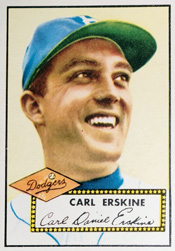 In 1953, the Cardinals were 0-11 for the season against the Dodgers at Ebbets Field in Brooklyn’s Flatbush section.
The players most responsible for the Cardinals’ troubles there were pitcher Carl Erskine of Anderson, Ind., and first baseman Gil Hodges of Princeton, Ind.
Dominant Dodgers
The 1953 Brooklyn Dodgers, subjects of the Roger Kahn book, “The Boys of Summer,” were a powerhouse, featuring a lineup with five future Hall of Famers _ Roy Campanella, Gil Hodges, Pee Wee Reese, Jackie Robinson and Duke Snider.
They rolled to the National League pennant with a 105-49 mark, finishing 13 games ahead of the runner-up Braves (92-62) and 22 ahead of St. Louis (83-71).
The Cardinals won seven of 11 against the 1953 Dodgers at St. Louis, but it was a much different story at Brooklyn. Not only did they lose all 11 games at Ebbets Field, they often got crushed. The Dodgers outscored them, 109 to 36, in those 11 games at Brooklyn.
The Cardinals were beaten by scores of 10-1 on June 7, 9-2 on July 16, 14-0 on July 17, 14-6 on July 18, 20-4 on Aug. 30 and 12-5 on Sept. 1.
There were two one-run games, the Dodgers winning both by scores of 5-4. The cruelest for the Cardinals was on June 6, when Hodges wiped out a 4-2 St. Louis lead with a three-run walkoff home run versus Stu Miller in the ninth. Boxscore
Home sweet home
Many players contributed to the Dodgers’ perfect home record against the Cardinals in 1953, but Erskine and Hodges did the most damage.
A right-hander who mixed an overhand curve and changeup with his fastball, Erskine, 26, was nearly unbeatable at Ebbets Field that year. He ended the regular season with a home record of 12-1, including 4-0 versus the Cardinals. All four of his home wins against St. Louis were complete games.
Erskine also won Game 3 of the 1953 World Series at Ebbets Field, setting a record by striking out 14 Yankees batters, including Mickey Mantle four times. “Erskine made the Yankees look like blind men swatting at wasps,” J. Roy Stockton reported in the St. Louis Post-Dispatch. Boxscore
(Since then, the only pitchers with more strikeouts in a World Series game are Bob Gibson, who fanned 17 Tigers in Game 1 in 1968, and Sandy Koufax, who struck out 15 Yankees in Game 1 in 1963.)
“Look, up in the sky….”
When Erskine beat the Cardinals with a five-hitter on May 6, 1953, at Brooklyn, it was his seventh consecutive win against them, dating back to September 1950. Erskine went undefeated versus the Cardinals in 1951 (4-0) and 1952 (2-0). Boxscore
The streak was snapped a week later, May 14, 1953, at St. Louis when Erskine was knocked out in the first inning without retiring a batter. “He had no control, no stuff and no outs,” Dick Young reported in the New York Daily News. “He warmed up for 15 minutes and pitched for five.” Boxscore
Back in Brooklyn, Erskine ducked into a phone booth, donned his Superman cape and beat the Cardinals for the second time in 1953, a four-hitter in a 10-1 rout on June 7. “It was the sort of affair that grew progressively more one-sided and monotonous, finally reaching the stage where many of the fans amused themselves by launching paper planes onto the field,” Dick Young reported. “Some of these came close to hitting Erskine. So did the Cardinals, but not many succeeded.” Boxscore
A month later, Erskine beat the Cardinals at Brooklyn for a third time, even though he gave up nine hits and two walks, threw a wild pitch and committed two errors. Boxscore
Erskine’s fourth home win against the 1953 Cardinals, on Aug. 30, also was his 13th consecutive win at Ebbets Field. Erskine contributed three RBI and scored a run. Boxscore
“Some pitchers were spooked by the thought of working in Ebbets Field with its cozy fences, but not Erskine,” the New York Times noted.
(In his next start, the Braves gave Erskine his lone home loss of 1953. With the score tied at 1-1 in the eighth, Eddie Mathews hit a three-run home run and Jim Pendleton had a two-run shot. Boxscore)
Erskine finished 1953 with a regular-season record of 20-6, including 6-2 versus the Cardinals.
For his career with the Dodgers, Erskine was 122-78, including 66-28 at Brooklyn. He was 23-8 against the Cardinals _ 13-2 at Ebbets Field.
(Erskine’s second win in the majors came against the Cardinals in a 1948 relief appearance. In the book “We Would Have Played For Nothing,” Erskine recalled, “I beat Howie Pollet and he waited for me after the game in the runway to congratulate me. He said, ‘I like the way you throw.’ He was a class act. I think he identified with me because he had a unique pitch _ a straight change _ and I could throw that pitch.” Boxscore)
Among the Cardinals regularly baffled by Erskine were Enos Slaughter (.162 batting average against) and Red Schoendienst (.211). The exception, naturally, was Stan Musial. He batted .336 with eight home runs versus Erskine. According to Time Magazine, Erskine said, “I’ve had pretty good success with Stan by throwing him my best pitch and backing up third.”
In July 2023, Erskine, 96, recalled to Tyler Kepner of the New York Times that Musial “almost never missed a swing. He always hit the ball somewhere.”
In his book, “Stan Musial: The Man’s Own Story,” Musial said, “Erskine had control, a remarkable changeup and a great overhand curve.”
(Erskine had an association with the Cardinals in 1971 when he joined play-by-play men Jack Buck and Jim Woods as a guest analyst on select telecasts of games on KSD-TV Channel 5 in St. Louis.)
Lots of lumber
Three pitchers _ Stu Miller (0-3), Joe Presko (0-3) and Gerry Staley (0-2) _ accounted for eight of the 11 Cardinals losses at Ebbets Field in 1953.
Dodgers hitters were led by Gil Hodges, who had eight home runs and 23 RBI against Cardinals pitching in the 11 games at Brooklyn. Hodges had 16 hits and seven walks in those games.
(In 31 at-bats at St. Louis in 1953, Hodges had no home runs, no RBI and batted .129.)
Others who hammered the 1953 Cardinals at Ebbets Field were Roy Campanella (18 hits, 18 RBI), Jackie Robinson (18 hits, 11 RBI) and Duke Snider (four home runs and 11 RBI).

 RetroSimba
1953 was also the year that Brooklyn’s Carl Furillo edged Red Schoendienst for the National League batting title (.344 to .342).
Yes, indeed. What a batting race. The top 4 finishers all were Dodgers and Cardinals: Carl Furillo (.344), Red Schoendienst (.342), Stan Musial (.337) and Duke Snider (.336).
On Sept. 5, 1953, Furillo went 4-for-4 against the Giants. The day next, Giants manager Leo Durocher ordered pitcher Ruben Gomez to hit Furillo with a pitch. Furillo was struck on the right wrist. In his book, “Leo Durocher: Baseball’s Prodigal Son,” author Paul Dickson describes what happened next:
With Furillo standing on first base, Durocher in the dugout “wagged his finger at him. Furillo charged the Giants’ dugout, got Durocher in a headlock and began choking him. In the melee, Furillo’s left hand was broken and he was shelved for the rest of the season.”
In his autobiography, “Red: A Baseball Life,” Schoendienst said, “My manager, Eddie Stanky, really wanted me to win the (batting) title. He was upset that Furillo was going to win without having to play the last three weeks, and he told me if I could just get ahead of (Furillo), he would pull me out of the lineup and let me sit out the rest of the year so I could win it.”
Schoendienst said he rejected Stanky’s suggestion.
Furillo hit .344 in 479 at-bats. Schoendienst hit .342 in 564 at-bats. Red hit better than .300 in every month of the 1953 season.
I always seem to read your stuff in the mornings when I’m sitting down with my coffee and it’s a nice ritual. This post prompted me to remember that I had read “Boys of Summer,” but it was so long ago that I don’t remember much.
I experienced a similar paper airplane situation at the “new” Dodger Stadium but I can’t quite remember (a common theme) what stoked the fire in that situation. I’m going to assume it was a blowout as well. I remember being tickled that someone had propelled one with such force that it landed on the pitcher’s mound.
I am flattered that you read this blog during your morning coffee. What a compliment. I consider the morning coffee time (especially that first cup) to be nearly sacred time and I’m pretty choosey about what I want to read then. So, thanks.
I never have been able to make a good paper airplane. Mine usually nosedive after wobbling in the air for a foot or so. I have respect for those who have the engineering and design minds to do them well.
The 1972 A’s had kind of a 1953 Dodgers-like feat. Those A’s were 6-0 at home versus the 1972 Indians and outscored them at the Coliseum 25 to 6.
The Cardinals dominated the Dodgers throughout the 30’s and 40’s. The decade of the 50’s belonged however to the Dodgers. The Cardinals failed to win even one season series during that ten year period. I discovered that in 1951 Brooklyn really burned us by winning 18 out of 22. If that’s not bad enough, 10 of those losses were by one run. And of those 10 losses, 7 were walk off losses. Overall though, since 1903 its been about as even as you can get. The Cardinals have won 1,107 compared to 1,079 for the Dodgers.
Thank you for those insights, Phillip.
It’s telling that Branch Rickey built the Cardinals clubs that dominated the Dodgers in the 1930s and the war years of the 1940s, and he built those Dodgers clubs that dominated the Cardinals during the Brooklyn years of the 1950s.
It would be interesting to see career stats for stadiums like for example, what was the overall batting average for both home and away teams at a certain park. In this case, Erskine defied the quote you included from the NY Times – “Some pitchers were spooked by the thought of working in Ebbets Field with its cozy fences, but not Erskine.”
Maybe pitching at home gave him an advantage, maybe like being at your best after a good night’s rest as opposed to a late night flight followed by not such a great sleep or in the older times, those train rides. I’ve never slept on a train, but I would think it would be hard unless you were intoxicated. Then, you can sleep anywhere.
You may be on to something there, Steve.
Even when the Dodgers played some home games at Roosevelt Stadium in Jersey City in 1956 and 1957, Carl Erskine pitched like he was in Ebbets Field. In three starts for the Dodgers at Jersey City, he was 1-0 with a 1.78 ERA.
Different story on the road. For example, Erskine had careers marks of 3-5, 7.27 ERA, at Chicago’s Wrigley Field, and 4-6, 5.30, at Milwaukee’s County Stadium.
Those baseball train trips are fascinating. In the book “We Payed the Game,” Spider Jorgensen said of traveling with the 1947 Dodgers, “There’d be card playing on the trains _ often poker for pennies and nickels, or dimes and quarters. I preferred going to the club car to listen to the reporters argue.”
Hank Sauer of the 1948 Reds said, “Those trips took forever. The team had about three Pullmans. We drank beer, we talked a lot of baseball and we played cards.”
Andy Seminick of the 1949 Phillies recalled, “On the 28-hour train trips from Boston to St. Louis, you had better get along.”
Al Smith of the 1953 Indians said, “The train trips were something. The Cleveland to Boston trip was long and boring. We had a baggage car, a diner, two sleepers for the players, and one sleeper for the sportswriters. In Cleveland, we brought our own baggage to the station. Like most teams, the Indians played cards. We played poker and bid whist.”
Just awesome Mark, kudos to your great research to dig up these amazing quotes – “Andy Seminick of the 1949 Phillies recalled, ‘On the 28-hour train trips from Boston to St. Louis, you had better get along.'” I love Seminick’s honesty debunking the glory of being a rock and roll star or baseball player. There’s a great challenge in that, a testing of democracy, in everyone’s opinion in the same place. So different from the typically private life I live. I wonder what Al Smith meant by “bid whist?”
Whist is a forerunner of bridge. Thought whist has gone out of style, there is a 3-minute video on You Tube on how to play the game: https://www.youtube.com/watch?v=9v5UxlUg55Y
Thanks for the link Mark. Any card game is a great reminder to me of playing the card game casino with my grandpa.