An introduction to the big leagues with the 1966 Cardinals was about as challenging as it gets for Jimy Williams.
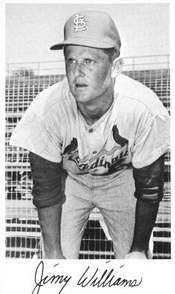 A middle infielder whose professional baseball experience consisted of one season at the Class A level of the minors, Williams got his first at-bat in the majors against none other than Sandy Koufax. His second plate appearance also came against a future Hall of Famer, Juan Marichal.
As if that wasn’t enough of a test, the rookie leaped into a frog-jumping contest involving Cardinals and Giants players.
Though his stint with the Cardinals was short, Williams went on to become a manager in the majors with the Blue Jays, Red Sox and Astros. He also managed the Cardinals’ top farm team.
Name of the game
James Francis Williams, known as Jimmy, was the son of farmers who raised cattle and garbanzo beans on 800 acres in Arroyo Grande, Calif. (Asked where Arroyo Grande is located, Williams told the Boston Globe, “It’s about three miles past ‘Resume Speed.’ “)
In high school, Williams changed the spelling of Jimmy, dropping one “m” as a prank. “I spelled it that way on a term paper or a test, and the teacher didn’t say anything about it, so I kept it,” he told the San Luis Obispo Tribune.
Williams played college baseball at Fresno State, earned a degree in agribusiness and was signed in June 1965 by Red Sox scouts Bobby Doerr and Glenn Wright. With Class A Waterloo (Iowa) that summer, Williams led the Midwest League’s shortstops in fielding percentage and hit .287.
When the Red Sox didn’t protect Williams on their winter roster, the Cardinals drafted him in November 1965 on the recommendation of scout Joe Mathes.
After Cardinals manager Red Schoendienst got his first look at Williams during 1966 spring training, he said to the St. Louis Post-Dispatch, “I can see why Joe was so hot about the kid. He sure looks like a comer.”
According to the Post-Dispatch, Williams at shortstop displayed “agility as he moved with speed to field balls hit to either side.”
Schoendienst, whose career as a second baseman got him elected to the Baseball Hall of Fame, mentored Williams on how to play that position and was pleased by the rookie’s progress in making the double play, the Post-Dispatch reported.
By being able to play both shortstop and second base, Williams enhanced his value as a utility player and earned a spot on the 1966 Cardinals’ Opening Day roster, joining Jerry Buchek, Phil Gagliano, Julian Javier and Dal Maxvill as the middle infielders.
On their way from St. Petersburg to St. Louis to begin the season, the Cardinals stopped in Kansas City to play exhibition games against the Athletics. In one, Williams entered as a replacement for Javier at second base and produced two hits and three RBI in the Cardinals’ 7-6 triumph.
Candlestick croakers
When the 1966 season opened, Williams sat for two weeks. His debut came on April 26 at Dodger Stadium when he replaced Maxvill at shortstop in the sixth inning. The first batter, Nate Oliver, hit a ground ball to Williams. The next, John Kennedy, hit a pop fly to him. Williams handled both chances flawlessly.
In the eighth, Williams got his first at-bat, facing Koufax. Asked what he was thinking as he came to the plate, Williams replied to the San Luis Obispo Tribune, “That I was going to get a hit. That’s the only reason to get into the batter’s box.”
Koufax struck him out. “I punched out two foul balls and got a hook (curveball) and it was, ‘Sit down, Jimy Williams,’ ” the rookie said to the San Luis Obispo newspaper. Boxscore
Two weeks later, at St. Louis, Williams got his second plate appearance. Facing Marichal, he grounded out, but two innings later, he singled to center versus Marichal, driving in Tim McCarver from third. Boxscore
In the time between his at-bats versus Koufax and Marichal, Williams and the Cardinals were in San Francisco for a series. A frog-jumping contest was planned at Candlestick Park before the Sunday finale. Ten players _ five Cardinals (Nelson Briles, Curt Flood, Mike Shannon, Bob Skinner and Williams) and five Giants (Bob Barton, Len Gabrielson, Bill Henry, Ron Herbel and Bob Priddy) _ were the participants. The player who coaxed his frog to make the longest jump would win $50 and the frog would be entered in the Calaveras Frog Jumping Contest made famous in the Mark Twain short story.
“I can sure use the $50 prize,” Williams told the Post-Dispatch. According to the newspaper, Williams practiced at a pond the day before the contest. (In a line Twain might have appreciated, Williams said to the Boston Globe, “If a frog had wings, he wouldn’t bump his booty.”)
The winner, however, was Gabrielson, whose frog (named Bat Legs) jumped 11 feet, eight inches. Priddy placed second (10 feet even) and Williams was third (nine feet, one inch).
In the game that followed, Gabrielson hit a home run against Bob Gibson, and the Giants won. “What a day,” Gabrielson exclaimed to the Oakland Tribune. Boxscore
Big break
Williams, 22, rarely played for the 1966 Cardinals. He had three hits in 11 at-bats before his season was cut short by a six-month stint in the Army reserve.
The Cardinals sent Williams to the minors in 1967. He returned to them in September, played in one game and was traded after the season with Pat Corrales to the Reds for Johnny Edwards.
Williams never again played in the big leagues. He was in the farm systems of the Reds, Expos and Mets before a bum shoulder ended his career in 1971. Williams hurt the shoulder in 1969 while working an off-season job at a Ford plant in St. Louis. “An employee who was playing around threw a Styrofoam cup at me,” Williams recalled to the San Luis Obispo Tribune. “When I threw it back at him, I felt something pop in my shoulder.”
After his playing career, Williams returned to St. Louis and operated a convenience store for two years, according to the San Luis Obispo newspaper.
A former Fresno State teammate, Tom Sommers, brought Williams back into baseball. Sommers was director of minor league operations for the Angels and needed a manager in 1974 for the Class A Quad Cities team in Davenport, Iowa. He gave the job to Williams, 30. “I was the happiest man in the world when Sommers called,” Williams said to the El Paso Times.
Williams rose through the Angels’ system and managed their top farm team, the Salt Lake City Gulls, in 1976 and 1977.
“I like to get young players to do things they don’t think they can,” Williams told the Deseret News. “That way, they boost their confidence and increase their potential. Our players will have freedom on the field to expand their talents.”
Back and forth
In October 1977, Tom Sommers was fired by Angels general manager Harry Dalton. Many of Sommers’ hires, including Williams, got fired, too.
Williams landed back in the Cardinals’ organization as manager of their Class AAA Springfield (Ill.) club in 1978. He accepted the job after Florida State University baseball coach Woody Woodward turned it down, according to Larry Harnly in The Sporting News.
Springfield had players such as Terry Kennedy, Dane Iorg, Tommy Herr, Ken Oberkfell, Silvio Martinez and Aurelio Lopez. The club finished 70-66.
According to the Salt Lake Tribune, Williams and A. Ray Smith, owner of the Springfield franchise, had “a personality conflict” and Williams was looking to manage somewhere else in 1979.
Art Teece, owner of the Salt Lake City franchise, pushed for the Angels to rehire Williams, and they agreed. “Bringing Jimy back to Salt Lake was the key in my resuming a working agreement with the Angels,” Teece told The Sporting News.
Williams said to the Salt Lake Tribune, “I enjoyed being with the Cardinals. They have a good organization and good people, but I really had a nice time in Salt Lake and I’m anxious to return.”
Major moves
Salt Lake City was nice but it wasn’t the majors. When Williams was offered a chance to be third-base coach on the staff of Blue Jays manager Bobby Mattick in 1980, he took it. After Bobby Cox replaced Mattick in 1982, he retained Williams.
After leading the Blue Jays to their first division title in 1985, Cox became general manager of the Braves and Williams replaced him. “Cox did a great job with the players, but I think Jimy’s style might be a little more imaginative,” Blue Jays general manager Pat Gillick told The Sporting News.
(When Gillick fired him in 1989, he told the Toronto Star that Williams was “too nice a guy and too honest.”)
In 12 seasons as a big-league manager with the Blue Jays (1986-89), Red Sox (1997-2001) and Astros (2002-04), Williams had a 909-790 record, but never had a pennant winner.
(When the Red Sox fired Williams in 2001, Cardinals manager Tony La Russa said he was “shocked,” the Post-Dispatch reported. “I think he’s a hell of a baseball man,” La Russa said. “He’s as qualified as anybody around and he got results. You kind of scratch your head.”)
As a coach with the Braves (1990-96) and Phillies (2007-08), Williams was part of five National League pennant winners and two World Series championship teams.

 RetroSimba
I saw him play his only complete major league game, May 8, 1966, in the final game at the Sportsman’s Park edition of Busch Stadium. The early-season regular shortstop, Jerry Buchek, moved over to second base that day.
Thanks for sharing that. How fortunate you are to have witnessed the last game played in that iconic ballpark. Jimy Williams batted 7th in the Cardinals’ order that day and had a single (vs. Bob Shaw), a walk and scored a run. He fielded flawlessly and played the entire game: https://www.retrosheet.org/boxesetc/1966/B05080SLN1966.htm
I think whenever I’ve heard something about Williams it was indeed either he had a great mind for baseball…or he was a really good guy.
Though Williams had his detractors (such as players George Bell and Damaso Garcia of the Blue Jays and Carl Everett of the Red Sox) when he managed, he had the respect and admiration of many baseball people.
When he was hired in October 2006 to be the bench coach for Phillies manager Charlie Manuel, speculation was that Williams was picked by Phillies GM Pat Gillick (who had hired him and fired him with the Blue Jays). Though Gillick and his top front office staffers joined Manuel in interviewing the coaching candidates, Gillick told the Philadelphia newspapers that Manuel had the final say in the selection of Williams and others coaches (Art Howe and Davey Lopes).
In his two seasons as Phillies bench coach, Williams “most certainly saw himself as a co-manager, a belief that Manuel’s egoless manner did not tame,” Philadelphia Daily News columnist Sam Donnellon wrote.
When the Phillies clinched the 2008 World Series title, Manuel and Williams embraced in the dugout. Asked how much Williams had to do with the team’s success, Manuel replied to Donnellon, “A lot.”
According to the Philadelphia Inquirer, “Though (Williams) and Manuel were never bosom buddies, they shared a mutual respect.”
Manuel told Donnellon, “We had a good relationship but at the same time we had our moments, too. We’d go at it pretty good at times. I think he got to know me, though, and understood where I was coming from … I have a lot of respect for Jimy Williams. He’s a tremendous baseball guy.”
Jimy Williams was another great baseball mind from an era that unfortunately is no longer. He truly paid his dues working his way up through the minors. I loved the Toronto Blue Jays of the mid 80’s early 90’s. They played a great style of baseball. As a third base coach Jimy Williams was involved in two unforgettable moments. Lonnie Smith holding at 3rd during game 6 of the 1991 World Series. And Jimy Williams waving Sid Bream home with the Series clinching run in game 7 of the 1992 NLCS. I’m happy that Jimy Williams picked up a couple of World Series rings before retiring. He deserved them.
Thanks for those mentions of key plays involving Jimy Williams as Braves coach.
I agree with you about those Blue Jays teams. Tons of talent and an exciting brand of baseball. In the four seasons that ex-shortstop Jimy Williams was his manager, Blue Jays shortstop Tony Fernandez won an American League Gold Glove Award in each of those years (1986, 1987, 1988, 1989). In 1986, Fernandez also produced 213 hits and 25 stolen bases for Williams’ Blue Jays.
When Williams began his minor-league managing career, he returned to using “Jimmy” with a traditional spelling. However, at Salt Lake City in 1976, he went back to using “Jimy” to avoid confusion with another Jimmy Williams who was managing in the minors in the Dodgers system.
I love that frog jumping story. It strikes me as an exciting activity. Williams sounds like a pretty darn good manager in the way he says “Our players will have freedom on the field to expand their talents.” I sure wish he was managing the Dodgers in 2025 when Shohei returns to the mound. Then he could put Shohei in left field and have him pitch to batters throughout the game, in high leverage situations.
I am delighted you liked the frog-jumping anecdote, Steve. I knew, too, you’d appreciate a link between Mark Twain and baseball.
I agree that having a manager, or a boss, or a supervisor, who encourages staff to expand their talents is a good and appealing concept.
There were many sides to Jimy Williams. For instance, the Boston Globe noted that he “worked crossword puzzles religiously,” and “was a huge fan of (comedian) Jonathan Winters and did a dead-on impression” of him.
Now I know what modern day baseball is missing. Frog jumping contests. And now we could add legalized sports betting.
Yes, you got it right, Ken. The sports books and MLB would croak like a frog in heat at the notion of having the millions of gullible fans betting on the outcome of player union-sponsored frog-jumping contests. Imagine the revenue! Disney, Fox and Warner could share the streaming rights. Frogs finishing in sixth place still would qualify for the frog-jumping playoffs as wild cards and the championship could be held each year at the All-Star Game in Las Vegas. Inevitably, the stakes involved would bring about cheating _ just like in the Mark Twain story when a contestant stuffed buckshot down the throat of a competitor’s frog. No doubt, we’d see frogs injected with performance-enhancing drugs until they became the size of John Kruk.
Another great piece. I have ties to SLO (lived there for a short bit in the early 2000’s. It’s a cool vibe as is its neighbor, Morro Bay) so it was nice to see the town mentioned. My stream-of-consciousness can only conjure Williams’ 1987 Topps as I was pretty young back then and don’t remember watching the Jays much until they were a threat to the A’s in the A.L. I believe Cito Gaston was the manager at that time. Nevertheless, I still love reading these stories about “old school baseball men” before the game became this capitalistic juggernaut.
I’m glad you got to live in San Luis Obispo, Gary. We visited there in 2012 during a stay in Santa Barbara for our 25th wedding anniversary. We were dazzled and enchanted by Morro Bay.
According to The Sporting News, when Billy Martin left the A’s to return to the Yankees after the 1982 season, Blue Jays coach Jimy Williams was a finalist for the Oakland manager job. Jim Leyland also was a serious candidate. The A’s instead hired Steve Boros.