During the 10 years he was a catcher in the big leagues, Bill Plummer may have been the most patient man in baseball. For most of that time, he sat and watched, waiting to get called into a game.
 Plummer had hoped to play for the Cardinals, the club that signed him to his first professional contract, but it didn’t happen. Instead, he was mostly with the Reds, whose starting catcher, Johnny Bench, performed at a level that earned him election to the Baseball Hall of Fame.
Being Bench’s backup kept Plummer on the bench. On the rare times Plummer did get on the field, the team he often did the best against was the Cardinals.
In the genes
Plummer came from a baseball family. His father, also named Bill, was a pitcher in the minor leagues for five seasons in the 1920s. An uncle, Red Baldwin, was a longtime minor-league catcher. Plummer’s father and uncle were teammates on the 1924-25 Seattle Indians.
Playing baseball at Shasta College in Redding, Calif., in April 1965, Plummer caught the attention of the reigning World Series champion Cardinals. Scout Bill Sayles offered him $10,000 and said the club also would finance the remainder of Plummer’s college education. “I came from a small country town (Anderson, Calif.), so I jumped at the offer,” Plummer recalled to the St. Louis Post-Dispatch.
According to the Redding Record Searchlight, “The Cardinals were interested in Plummer because of his hitting, ability as a catcher and rifle arm.”
Plummer, 18, joined the Cardinals’ 1965 Florida Rookie League team in Sarasota managed by George Kissell.
Behind the plate, Plummer looked terrific. He was “reputed to have one of the best arms in the Cardinals organization,” the Modesto Bee reported. Standing at the plate, he looked helpless. With Class A Eugene (Ore.) in 1966, Plummer batted .144 and had more strikeouts (33) than hits (18).
Catching on
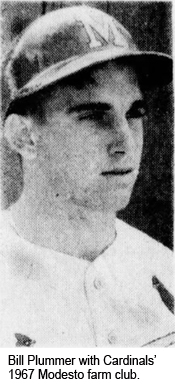
Assigned to Class A Modesto in 1967, Plummer was managed by Sparky Anderson. The relationship did not begin well.
“I was using Sonny Ruberto for most of the catching early in the season and Plummer didn’t like it,” Anderson told the Post-Dispatch. “He gave me a mean stare one day as he entered the shower. I told him that stare would only get him back to Eugene if he kept it up. He played better after that.”
Plummer said to the Dayton Daily News, “I was young and had temper problems. I was frustrated and depressed because baseball was my career and I was floundering in the minors. I used to get so depressed I’d hide somewhere, and have a few cocktails where nobody talked baseball.”
Anderson eventually moved Ruberto to the infield and made Plummer the everyday catcher. Though he struggled to make contact (100 strikeouts, 93 hits), his catching skills were impressive. Modesto won a league championship.
The Cardinals organization had an abundance of talent in 1967. The big-league club became World Series champions that year. One of its core players was the catcher, Tim McCarver. The Cardinals’ first-round pick in the amateur draft that year was McCarver’s heir apparent, Ted Simmons.
Plummer’s hopes of becoming a Cardinal went down the drain when they left him off the 40-man big-league winter roster after the 1967 season. The Cubs claimed him in the November 1967 Rule 5 draft.
Forgotten man
By drafting him, the Cubs were required to keep Plummer, 21, on their big-league roster the entire 1968 season or else offer him back to the Cardinals, but manager Leo Durocher wasn’t inclined to use a catcher who hadn’t played above the Class A level.
As the Chicago Tribune noted, Plummer “appears doomed to little work if Randy Hundley stays healthy behind the plate.”
Hundley caught nearly every game for the 1968 Cubs. Plummer was mostly ignored. He got into two games all season. In his debut, April 19, 1968, at St. Louis, he batted for pitcher Chuck Hartenstein and was struck out by Cardinals rookie reliever Hal Gilson. Boxscore
Plummer’s only other appearance came on May 12 during a Mets rout of the Cubs in the second game of a doubleheader at Wrigley Field. Plummer caught two innings as a replacement for Hundley and was retired on a fly to right. Boxscore
“It was so bad that when we played an exhibition game in the middle of the year against the White Sox they called a catcher from the minors up to catch the game,” Plummer told the Cincinnati Enquirer. “They didn’t even use me then.”
Spending most of his time in the bullpen located along the outfield sideline at Wrigley Field, Plummer was similar to a spectator in the stands. Mike Murphy, a founder of the ballpark’s Bleacher Bums, told McClatchy News Service, “He was like one of us. He sat on a bench, just like we did. He’d wave and smile at us. He hit lots of home runs in batting practice. All the girls noticed him.”
Though popular, the season of inactivity “set me back a couple of years,” Plummer said to the Associated Press.
Reserve duty
Plummer hoped to get drafted by one of the four expansion teams (Expos, Padres, Pilots, Royals) that entered the majors in 1969, or go to any other club needing to play a catcher, but instead the Cubs sent him to the Reds in January 1969 for reliever Ted Abernathy.
Johnny Bench, who in 1968 won National League Rookie of the Year and Gold Glove awards, had a lock on the Reds starting catching job and his backup was the former Cardinals veteran, Pat Corrales.
According to the Redding Record Searchlight, “there was some talk of converting Plummer into a pitcher,” but the Reds reconsidered.
Plummer spent most of the next three seasons (1969-71) in the minors before emerging as Bench’s backup in 1972. According to the Modesto Bee, Sparky Anderson, who became Reds manager in 1970, said Plummer “already has an arm better than two-thirds of the catchers up here.”
Asked to describe the catching strengths he and Bench possessed, Plummer said to the Cincinnati Enquirer, “John had the excellent release, great foot movement and super hands. He was excellent at receiving throws from the outfield and making tags. I was the kind of guy who stayed in and blocked the plate and crunched people. Those were my skills.”
The Enquirer added, “Plummer was adept defensively. He was a fine handler of pitchers and had a strong arm. He could make all the plays behind the plate.”
Reds pitcher Jack Billingham said to the newspaper, “He couldn’t carry Bench’s bat, but, defensively, you didn’t lose much at all when Plummer was in there.”
In 797 career at-bats for the Reds, Plummer hit .186, but there were some highlights, especially against the Cardinals and one of their former pitchers.
Magic moments
On June 8, 1974, facing Steve Carlton at Veterans Stadium in Philadelphia, Plummer slugged two home runs and Bench, playing third, hit another, but the Phillies prevailed, 6-5. In 16 career plate appearances versus Carlton, Plummer batted .429 and had a .500 on-base mark. Boxscore
Plummer’s most productive game came almost exactly two years later, June 6, 1976, a Sunday afternoon at St. Louis. Filling in for Bench, who was experiencing muscle spasms, Plummer had seven RBI in the Reds’ 13-2 triumph at Busch Memorial Stadium.
Plummer had a RBI-single against Pete Falcone in the second, a three-run triple that knocked Falcone out of the game in the third, and a three-run home run versus Danny Frisella in the sixth.
“I actually felt chills when I circled the bases after hitting that homer,” Plummer told The Cincinnati Post. “Seven RBI. That’s almost a full season’s work for me.”
Plummer’s home run would have been a grand slam if George Foster hadn’t been picked off second on the previous play with the bases loaded.
As for Plummer’s bases-clearing triple, it came about when his liner took a high hop on the AstroTurf, went over the head of right fielder Willie Crawford and rolled to the wall. It was Plummer’s only big-league triple. Boxscore
A week later, playing the Cardinals at Cincinnati, Plummer had three hits, a walk, two RBI and scored twice, but the Cardinals won, 12-9. Two of Plummer’s hits _ a single and a home run _ came against Bob Forsch. Boxscore
Plummer had three three-hit games in the majors and two of those were against the Cardinals.
Of Plummer’s 19 RBI for the Reds in 1976, 10 came against the Cardinals. For the season, he hit .248 overall but .381 versus St. Louis.
Baseball teacher
During his time with Cincinnati, the Reds played in four World Series but Plummer never appeared in any of those games.
Released by the Reds in 1978, he played a final season with the Mariners.
Plummer managed in the minors for 20 years, primarily in the farm systems of the Mariners, Tigers and Diamondbacks. He also coached in the majors with the Mariners (1982-83 and 1988-91) and Rockies (1993-94).
Plummer got one chance to manage in the majors. That was with the Mariners in 1992. Though the team had future Hall of Famers Edgar Martinez (the American League batting champion that year), Ken Griffey Jr. and Randy Johnson, the 1992 Mariners finished with the worst record in the league (64-98). Plummer was fired and replaced by Lou Piniella.
A grandson of Plummer, Conner Menez, pitched in the majors for the Giants (2019-21) and Cubs (2022).

 RetroSimba
What a relatable quote – “I was young and had temper problems. I was frustrated and depressed because baseball was my career and I was floundering in the minors. I used to get so depressed I’d hide somewhere, and have a few cocktails where nobody talked baseball.”
I’d buy Bill a drink after hearing his tale any day, everyday just like I’ buy Terry, the janitor at St. Jorges Prep school a drink.
I started collecting cards with fever in 1978 and remember Bill Plummer’s card because of how twisted he looked with the bat and the stance. Thinking about it now hammers home the reality of just how hard it is to hit a baseball.
I raise a toast to you, Steve, and hope the day comes when I can buy you a drink.
Here’s a link to that 1978 Topps Bill Plummer card: https://www.ebay.com/itm/364838010205?itmmeta=01HZ23E4YRCS2B1BRKH9PRMPH0&hash=item54f20a3d5d:g:oxcAAOSwrcFmIhpm&itmprp=enc%3AAQAJAAAA8LK7KxE%2BKx0v9wmn7K1VvLY4JinzYJpi08UXCO0176xfjBdJqlCapVwzwNrL8uQqyDCDW1f5W%2BoYicKkoJ4qRuehMNUw12xqDKeei3dqYZ8HCgVMAZnjiHf5qL%2FgsDkV7jhnowv0gH1ILfH9l4BD5eMZAxgLrrmUXK2En7HiEEuUAYnwOfhap89XsoJd46Pv%2FHPKrakcZzv3rAllbmGY8572RI2khCpyYUb1kzNt9T%2BP6qlXdSgoqAQHi562ZiY%2B4REU9CBcSwzVSGx6K6Tjhe9TMAE%2FPrkSdY%2F8Rgliy40A7aY6FAW%2BzMMziYNoL1cFjQ%3D%3D%7Ctkp%3ABk9SR7rPuMP4Yw
The card almost looks like he’s batting cross-handed. I remember hearing or reading that Aaron batted cross-handed in the beginning. Looking forward to that drink! Cheers Mark.
We’ve all heard the expression, “somebody has to do it.” Well, someone had to be Johnny Bench’s backup. Bill Plummer was probably the best one for the job. His former Big Red Machine teammates had nothing but praise, admiration and respect for him. Pete Rose even went as far as to say that Bill Plummer kept himself from having a decent career simply by the fact that he remained in Cincinnati. Even though his one stint as manager of the Mariners didn’t turn out too good it’s only fair to say that the trade they made for Kevin Mitchell before the start of the season back fired on them. The three pitchers that Seattle sent to San Francisco, inpartitulaly Bill Swift, went on to have a couple of good seasons.
As you note, Phillip, being the backup to Johnny Bench for an extended period could be a frustrating task for any catcher, like Bill Plummer, who would prefer to play. In July 1972, Sparky Anderson bluntly said to the Associated Press, “Plummer has a lot of ability but when you’ve got a guy like Bench, unless Bench gets hurt, you’re never going to find out. I’ll be truthful: I hope I never find out.”
How very strange…this reminded me that I have a Plummer autographed card somewhere, and I believe it could be in my mother’s storage unit in Sacramento. 1974 Topps.
I found a few vintage Cardinals cards that I apparently misplaced and didn’t send to you. I’m gonna get those in the mail tomorrow. Sometimes I feel like an absent-minded stoner and I don’t even smoke the wacky tobbacky. Probably brain damage from my nefarious past.
Bill Plummer had some interesting links to Dave Duncan.
In 1966, when Modesto was a Kansas City A’s farm club, Duncan was the Modesto catcher. The next year, when Modesto switched affiliation to the Cardinals, Plummer was the Modesto catcher. (Ted Simmons was the Modesto catcher in 1968.)
In 1972, Plummer and Duncan both were on the World Series rosters but experienced personal frustrations. With Johnny Bench at catcher for the Reds, Plummer never got into a game. Gene Tenace, rather than Duncan,was the starting catcher for the A’s in the first six games of the Series. Duncan got to start Game 7 when Tenace was shifted to first base.
Ten years later, Duncan and Plummer were coaches on the staff of the 1982 Mariners, who were managed by Rene Lachemann. Duncan was pitching coach and Plummer was bullpen coach.
A final note: When Plummer managed the 1992 Mariners, his team was 1-12 against the A’s (whose pitching coach was Dave Duncan).
Interesting he had great success against Carlton. I remembered his name right away…and have the feeling I had many duplicates of his baseball card at one time lol. He obviously could have used a better landing spot than the Reds to ply his trade.
Something about those Reds catchers made Steve Carlton see red, and feel black and blue.
On July 20, 1970, Johnny Bench belted 3 home runs against Carlton in the Reds’ 12-5 win versus the Cardinals at Cincinnati. In his book “Chasing the Dream,” Joe Torre, who was Carlton’s roommate on Cardinals road trips in 1970, recalled, “After the game, Lefty and I commiserated over dinner and a little wine. I guess we had more than a little wine. When we got back to our hotel suite, I think we broke every stick of furniture in the room. When we awoke in the morning and realized what we had done, we tried to glue everything back together. When we left the suite, we had to make sure we didn’t close the door too hard because we were afraid the noise would cause everything to fall apart.”
Three years later, on May 9, 1973, Bench again slugged 3 home runs versus Carlton in the Reds’ 9-7 triumph against the Phillies at Philadelphia.
For his career, Bench hit 12 homers versus Carlton and hit .305 against him.