When the Cardinals acquired Ken Dayley, they thought they were getting a top of the line starting pitcher. Then they were worried he might be a dud.
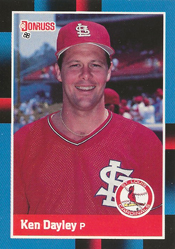 As it turned out, Dayley developed into one of the top left-handed relievers in the National League during the 1980s.
On June 15, 1984, the Cardinals traded third baseman Ken Oberkfell to the Braves for Dayley and utility player Mike Jorgensen.
Dayley helped the Cardinals win two National League pennants.
Jorgensen also played for the 1985 league champion Cardinals and served several roles for the organization, including interim manager in 1995, minor-league manager (1986-89), director of player development (1992-2001) and special assistant to the general manager (2001-2018).
Easily rattled
A marketing major who played baseball and basketball at the University of Portland in Oregon, Dayley was the first pitcher selected in the 1980 June amateur draft. The Braves took him with the third overall pick.
Two years later, Dayley, 23, made his big-league debut in a start against the 1982 Cardinals, who roughed him up for four runs in 1.1 innings. The big blow was Tito Landrum’s two-run homer. Boxscore
Two months later, the Cardinals’ Willie McGee whacked a grand slam against Dayley. Boxscore
Shuttled back and forth between starting and relieving, Dayley had losing records with the Braves in 1982 and 1983. “He’s a fairly high-strung kid, and it seemed when we sent him to the mound, he felt he was pitching for his life,” Braves manager Joe Torre told the Atlanta Constitution.
Braves pitching coach Bob Gibson said to the newspaper, “He has to learn to relax more than he does now. He tries to give you the appearance that everything is fine and that he’s cool inside, but he’s really not.”
Dayley’s stress level wasn’t helped when, after the 1983 season, the Braves released franchise icon Phil Niekro and said doing so opened a starting spot for Dayley. “In other words,” wrote Gerry Fraley of the Atlanta Constitution, “Dayley is supposed to replace Phil Niekro on the mound and in the statistics, if not in the hearts of Braves fans.”
Pitching more like Phil Silvers than Phil Niekro, Dayley was 0-3 with a 5.30 ERA in four starts for the 1984 Braves before he was demoted to the minors. According to the Atlanta Constitution, trying to replace Niekro “became an oppressive mental burden for the already skittish Dayley.”
Braves director of player development Hank Aaron said to the Constitution, “We still think Ken Dayley has a tremendous future in the big leagues. It’s a matter of him getting his act together _ relaxing.”
High hopes
The Cardinals sent three scouts to watch Dayley at Class AAA Richmond (Va.) and they liked what they saw. When the Braves went looking for a third baseman to replace Bob Horner, who suffered a season-ending wrist injury in May 1984, the Cardinals agreed to swap Oberkfell for Dayley and Jorgensen.
Cardinals manager Whitey Herzog said Dayley, 25, had the capability to be a “No. 1 or No. 2” starter, the St. Louis Post-Dispatch reported. “I feel he’s ready,” Herzog told the newspaper. “He’s paid his dues … He’s got a chance to be a very good pitcher.”
The results, though, were alarming. The Cardinals pitched Dayley in three games, including two starts, and he was shelled in each, allowing 16 hits and 10 earned runs in five total innings. Dayley gave up so many hard shots that “we had to get the married men off the infield, or there’d have been a lot of widows and orphans,” Herzog told The Sporting News.
Dayley said to the Post-Dispatch, “I was muscling up on the ball. I wasn’t smooth. I wasn’t relaxed in letting the ball go.”
The Cardinals dispatched Dayley to Class AAA Louisville and left him there for the rest of the 1984 season.
Pleasant surprise
At 1985 spring training, The Sporting News reported, Dayley “may be getting his last look by the Cardinals.” He told the Atlanta Constitution, “I was just trying to make the team.”
The Cardinals’ closer, Bruce Sutter, had become a free agent and signed with the Braves. Herzog decided to use a committee of relievers to fill the void. “I never even thought about relieving,” Dayley said to reporter Chris Mortensen.
Herzog and pitching Mike Roarke envisioned a bullpen that featured a balance of right-handers and left-handers. Seeking another left-hander to join Ricky Horton, they worked on making Dayley a fulltime reliever.
“Dayley is kind of hyper and … we had to teach him to pitch in pressure situations,” Herzog told The Sporting News.
Roarke said to the Post-Dispatch, “We changed a few things in his delivery. He’s got better location with his pitches now. Last year (in 1984), he was throwing too many around the waist.”
Dayley made the 1985 Opening Day roster. Keeping his pitches low and on the corners, and maintaining his poise, he flourished, allowing one run in his first 13 appearances, covering 18.2 innings.
He’d become so valuable that when the Cleveland Indians offered starter Bert Blyleven to the Cardinals in July 1985 for three pitchers _ Dayley, Kurt Kepshire and Rick Ownbey _ the bid was rejected, The Sporting News reported.
“Dayley probably has been the biggest surprise” of the Cardinals’ bullpen committee, The Sporting News declared.
When the Cardinals clinched the 1985 pennant with a win in Game 6 of the National League Championship Series, Dayley got the save, retiring the Dodgers in order in the ninth. Boxscore and Video
He’d come a long way from the shaky candidate who went to spring training without a lock on a job. Dayley led the 1985 Cardinals in games pitched (57) and was second on the club in saves (11). His ERA was 2.76 and he yielded a mere two home runs (though one was a titanic game-winning shot by Darryl Strawberry) in 65.1 innings.
In the 1985 postseason, Dayley was nearly perfect, with six scoreless innings in five appearances in the playoff series against the Dodgers and six more scoreless innings in four games pitched versus the Royals in the World Series. He was the winning pitcher in World Series Game 2.
As Herzog said to the Post-Dispatch, “In 1985, he was the best left-handed reliever in the league.”
On the mend
In 1986, Dayley’s left elbow didn’t feel right. By July, the pain became unbearable and he was sidelined the rest of the season. An exam revealed a torn ligament.
A nerve and tendon from Dayley’s right arm were surgically transplanted to his left elbow in October 1986. By May 1987, he was pitching for the Cardinals. “It came along much faster than I had any right to hope,” Dayley exclaimed to the Post-Dispatch. “I kind of think it’s a miracle.”
Herzog told columnist Kevin Horrigan, “When we got Dayley back, and when it looked like he was going to pitch effectively, that’s when I began to think we could win (the pennant).”
A month after his return, Dayley faced another health hurdle when he was diagnosed with meningitis (an infection and inflammation of the fluid and membranes surrounding the brain and spinal cord).
Dayley recovered and had an exceptional July (5-1, one save, 1.56 ERA in 15 games pitched that month). He finished the 1987 season as the team leader in ERA (2.66), posting a 9-5 record with four saves and striking out 63 in 61 innings.
In the 1987 National League Championship Series versus the Giants, Dayley saved two of the Cardinals’ four wins and didn’t allow a run in three appearances.
Dayley’s remarkable success in the postseason continued into the 1987 World Series against the Twins. He didn’t allow a run in his first three appearances, including 2.2 innings for a save in Game 4. Boxscore
His fourth appearance of the Series, Game 6, was a different story. Ahead, 6-5, in the sixth inning, the Twins had the bases loaded, two outs, when Herzog brought in Dayley to face left-handed batter Kent Hrbek.
Dayley had not allowed a home run to a left-handed batter all season. He had not allowed a run in 20.1 postseason innings.
According to the Associated Press, Herzog told Dayley, “Get this guy out and we’ve got a chance to win.”
The first pitch was a fastball “over the plate where he could extend his arms on it,” Dayley told the Louisville Courier-Journal. “I wanted it inside a little.”
Hrbek drove the ball 439 feet for a grand slam. The Twins won, 11-5, to even the Series and then clinched the title in Game 7. Boxscore
Dayley told columnist Rick Bozich, “When you’re a reliever, you’re either a hero or a zero.”
Falling out
Granted free agency after the 1990 season, Dayley signed with the Blue Jays. At spring training in 1991, he experienced dizzy spells and was diagnosed with a severe case of vertigo.
According to the 2005 book “Cardinals: Where Have You Gone?” doctors determined the vertigo most likely “stemmed from when he contracted meningitis in 1986. That virus stayed dormant until it moved out and traumatized a nerve years later.”
Appearing in just 10 games for the Blue Jays, Dayley’s pitching career ended at age 34.

 RetroSimba
When i first read the name Phil Silvers, I thought it might be a pitcher from a previous post. What a surprise to see he was a comedian! It seems to me that making it in the majors depends on so many factors with an often overlooked one being the way teams treat players in terms of recognizing their personalities and helping them make the necessary adjustments. There must be so many what ifs who never received the help they needed. I”m glad that Ken Dayley did and that he enjoyed great success for a short while anyway.
An astute comment, Steve, on the way teams treat players in terms of recognizing their personalities and helping them make adjustments.
When the Cardinals converted Ken Dayley to a fulltime relief role in 1985, manager Whitey Herzog used him in middle innings for his first five or six appearances. “He didn’t throw me into the game-saving situations until later,” Dayley told the Atlanta Constitution. “That helped. It eased me into the picture.”
Contrast that with the Braves, who “sometimes questioned his intestinal fortitude,” the Atlanta newspaper reported.
An aside on Phil Silvers: He played the devil, Mr. Applegate, in the 1967 film version of “Damn Yankees.”
I’ve never seen Damn Yankees. I’ll be on the look out for the 1967 version. Thanks Mark. Maybe it’s on youtube? It sucks that video stores closed. I have no idea how to download movies from the internet.
This is nuts on a few accounts.
First of all, it’s kind of wild that a “bonus baby” was picked out of the UO Portland. I don’t even think it’s a Division 1 school.
Secondly, it’s wild that a meningitis virus can stay dormant and then give you vertigo. (As scientists laugh at my stupidity….dammit, I’m an optometrist not a doctor)
Another informative piece. Thanks for these baseball nuggets, Mark.
Indeed, Ken Dayley is the only baseball player from the University of Portland to get drafted in the first round.
After Dayley, another left-handed pitcher from the University of Portland who made it to the majors was Bill Krueger. He was undrafted. The A’s signed Krueger as an amateur free agent in July 1980. Krueger went on to pitch five seasons with the A’s (27-31) and 13 years in the majors overall.
Nick Esasky, a slugger for the Reds and Red Sox, was another who had his playing career cut short because of vertigo. According to the Society for American Baseball Research, Esasky’s vertigo was thought to have been caused by a virus of the inner ear, but there remained uncertainty both as to the diagnosis and the cause. He had at least 30 tests by various physicians, including a visit to the Mayo Clinic.
This post brings back a lot of memories from a great era of Cardinals baseball. For me, the trade to aquire Ken Dayley was a typical Whitey Herzog move that while on paper didn’t make sense, ended up paying big dividends. It’s only right to mention though that during the 80’s, along with the baseball genius of Whitey Herzog, the Cardinals had coaches who knew exactly what to do to fix players. This post on Ken Dayley also makes me wonder. What if Whitey stays with Ken Dayley for the 9th inning of game 6 of the 1985 WS? What if the location on the pitch he threw to Kent Hrbek had been exactly where he had intended? Oh well, that’s baseball.
Good point about the talented coaches Whitey Herzog had on staff such as Mike Roarke. Ken Dayley also benefitted from having Jim Fregosi as his manager in Louisville in 1984. Dayley had a 3.27 ERA in 13 starts for Louisville, getting back on track after the the poor showings with the Braves and Cardinals that season. Cardinals scout Mo Mozzali said of Fregosi, “I’ve never seen anybody better working with young players.” Louisville pitching coach Dyar Miller said, “Jim is a great teacher. He works on the field for three or four hours before every game, on theories of hitting, turning the double play, getting ready to pitch in the bullpen, whatever.”
You raise an intriguing thought about what might have happened if Whitey Herzog had stuck with Ken Dayley in the ninth inning of 1985 World Series Game 6. Dayley had worked a strong eighth, striking out George Brett and Lonnie Smith for two of the three outs. Herzog sent him out to begin the ninth. Royals manager Dick Howser countered by replacing the first batter, Pat Sheridan, who hit from the left side, with Darryl Motley. That’s when Herzog relieved Dayley with Todd Worrell. Then Howser took out Motley and sent up Jorge Orta. Who knows what would have happened if Dayley had pitched to Motley instead of Worrell pitching to Orta, but it is fun to consider.
Please subscribe to my blog.
Back around 2012, I got paired on the golf course in NorCal with a guy who’d been a college umpire in the Portland area. He said he was behind the plate when Dayley had a no-hitter in the top of the 9th in a scoreless game. Dayley got the first hitter, but walked the next. Trying to pick that runner off, he threw the ball down the right field line, and the guy advanced to third. The next guy hit a sac fly. Dayley completed the no-hitter and lost 1-0.
Thanks for the story. Ken Dayley had quite a season for the University of Portland in 1980: 8-2 record, 1.58 ERA, nine complete games, 138 strikeouts in 85.1 innings. Opponents hit .159 against him that season.
Quite a roller coaster career.
Yes, indeed. That roller coaster ride was reflected in his career numbers versus the Mets: 3-7 record but seven saves and a 3.17 ERA. Dayley’s most impressive season against the Mets may have been 1989 when he made 10 appearances covering 8.1 innings, allowing no runs and earning four saves.
I’m not going to dig up the box score from 1985 WS G6 at Royals/Kauffman…
And I’m also not going to rain down upon HOF Whitey, RIP… much, lol
But Whitey, I’m convinced you’d have two WS titles with the Cardinals on your resume if you’d left Dayley in for the bottom of the 9th! In Ken’s B8… two swinging Ks and a flyout sandwiched around a harmless walk. 46 blew ’em away, as he’d done to close out the Dodgers in G6 NLCS!!
&*($%@#/!!
Have Worrell warming up, if you and Roarke really insist, to start the ninth… but goodness, give Dayley a chance to continue to mow the Royals down!
Sigh… that’s baseball… Sigh…
It sure would have helped matters for the Cardinals, too, if they had pushed across more than one run in Game 6 of the 1985 World Series. In the sixth inning, the Cardinals got singles from the first two batters, Cesar Cedeno and Darrell Porter, but Danny Cox’s sacrifice bunt attempt led to a force out at third and Ozzie Smith then grounded into a double play. In the eighth, after the Cardinals had taken a 1-0 lead, they had the bases loaded, two outs, but Dan Quisenberry relieved Charlie Leibrandt and retired Willie McGee.