In a bid to contend with the Cardinals and others for the 1964 National League pennant, the Giants added the majors’ first Japanese import to their bullpen.
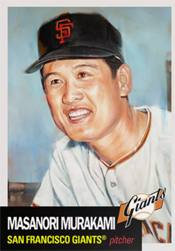 On Sept. 1, 1964, Masanori Murakami, 20, became the first Japanese native to play in the big leagues when he pitched in relief for the Giants against the Mets.
Possessing impressive command of his pitches, Murakami, a left-hander, made an impact. Though the Giants didn’t win a pennant in either of his two seasons with them, Murakami “was right at the top among relief pitchers in the National League,” Giants general manager Chub Feeney told the San Francisco Examiner in 1965. “Possibly only Ron Perranoski of the Dodgers was better.”
In two years with the Giants, Murakami was 5-1 with nine saves and struck out 100 batters in 89.1 innings.
He faced the Cardinals four times, all in 1965, and was 1-0 with a save.
Baseball rebirth
Murakami was born during World War II in Otsuki, Japan, a silk production center, on May 6, 1944.
After the war, Tsuneo “Cappy” Harada, a Japanese-American who served the Allies in military intelligence, was assigned by General Douglas MacArthur to encourage the resumption of baseball in Japan, according to the Hartford Courant.
Helping Harada in his efforts was Lefty O’Doul, two-time National League batting champion. O’Doul made multiple trips to Japan to promote baseball before the war and became a national institution, according to Red Smith of the New York Herald Tribune. In return visits there after the war, O’Doul was an influence on young Masanori Murakami, according to the Examiner.
Murakami was 19 when he joined the Nankai Hawks of the Japan Pacific League in September 1963. Cappy Harada was scouting for the San Francisco Giants then. Harada arranged with Nankai to let three of their teen prospects _ Murakami, infielder Tatsuhiko Tanaka and catcher Hiroshi Takahashi _ join the Giants’ organization in 1964. “They sent me over … to study the baseball system,” Murakami said years later to the New York Times.
New world
After getting a look at the Japanese teens in 1964 spring training, the Giants determined Murakami could pitch for the Class A Fresno farm club. The other two players were sent there with Murakami to observe before they’d join a rookie level farm team at Twins Falls, Idaho, in June.
The agricultural Fresno area then was home to 15,000 Japanese-Americans. Murakami and his two countrymen resided in the home of Keek Saiki and his wife Fumiko. “They drink milk by the gallon,” Fumiko said to the Examiner, “and go for fried chicken and westerns on TV. They are very quiet, write letters a yard long and ask where they can swim.”
Murakami’s manager at Fresno was Bill Werle. A former left-handed reliever for the Cardinals, he saw Murakami had the makeup to be a closer. “His control is incredible,” Werle told the Examiner. “That’s why I put him in tight spots in late innings … His low curve makes the batsmen tap grounders for double plays.”
Murakami was 11-7 with 11 saves and a 1.78 ERA for Fresno. He struck out 159 batters in 106 innings. Murakami made one start _ on Japanese-American Night in Fresno _ and pitched a complete game in a 3-2 win over Reno.
“He was too good for the league,” Werle told the Los Angeles Times.
The 1964 Giants entered September in third place in the National League and were a half game ahead of the Cardinals when they called up Murakami. Attempting the leap from Class A to the majors was formidable. The cultural significance of being the first Japanese-born big leaguer added to the challenge.
Big Apple
The rookie joined the Giants in New York for their series against the Mets. At Shea Stadium, he was greeted by general manager Chub Feeney and several Japanese reporters and photographers.
Murakami carried with him a Stan Musial model glove. When asked by the Examiner whether Musial was one of his favorites, Murakami shrugged. His English was limited.
Feeney “trailed him around the field, pen in hand, before the game,” trying to get Murakami to sign a major-league contract, the Times reported. Murakami didn’t want to sign until he understood what the contract meant. Feeney scrambled to find an interpreter and eventually got Murakami’s signature.
With the Mets ahead, 4-0, Giants manager Al Dark brought in Murakami to pitch the eighth. According to Newsday, “Many of the (39,379) fans stood and cheered when the pitcher came into the game.”
Mets starter Al Jackson told the newspaper, “We thought he might be a little nervous, but he wasn’t.”
Actually, Murakami told the San Francisco Chronicle, “I was afraid.” To calm his nerves, he said he hummed the tune “Sukiyaki” as he walked to the mound.
Murakami struck out the first batter, Charlie Smith. Chris Cannizzaro singled, then Ed Kranepool struck out and Roy McMillan grounded out. “As Murakami, with a spring in his gait and a wad of chewing gum in his mouth, strode toward the Giants’ dugout, Mets fans stood and cheered,” the Associated Press reported.
Stadium organist Jane Jarvis saluted Murakami’s successful debut with “The Japanese Sandman.” Boxscore
The next day, from Lefty O’Doul’s saloon near San Francisco’s Union Square, Examiner columnist Prescott Sullivan wrote that Murakami’s debut made the proprietor the happiest man in town. “Such was his joy, that for a period of six seconds, shortly before 11 a.m. when a slow bartender was on duty, all drinks served at his Geary Street tavern were on the house,” Sullivan noted.
Back in New York, Murakami was a guest on Ralph Kiner’s TV show, but, even with an interpreter, something got lost in translation, according to the Examiner.
Kiner: “What is your best pitch?”
Murakami: “Koufax.”
Kiner: “Who is your favorite pitcher?”
Murakami: “Curveball and a little bit changeup.”
Murakami asked to meet 74-year-old Mets manager Casey Stengel, who spoke his own unique style of English, Stengelese. Stengel posed with Murakami for a photo. Asked what he thought of him, Murakami said to the Examiner, “Nice old man. Very friendly.”
Sudden impact
In his first nine appearances for the 1964 Giants, covering 11 innings, Murakami didn’t allow a run. His first big-league win came against Houston at San Francisco’s Candlestick Park. Murakami pitched three scoreless innings and the game ended when Matty Alou of the Dominican Republic slugged a home run (his first in two years) against French-Canadian Claude Raymond in the 11th. Boxscore
In his next appearance, against the Cubs, Murakami faced three future Hall of Famers, Billy Williams, Ron Santo, Ernie Banks, and retired them in order. Boxscore
Described by the Examiner as “the slingin’ samurai,” he finished with a 1-0 record, one save and a 1.80 ERA for the 1964 Giants, striking out 15 and walking one in 15 innings. Batters hit .163 against him.
The Giants and Nankai Hawks both wanted Murakami to pitch for them in 1965, causing a dispute between the clubs. The matter got settled in late April 1965 when the Hawks agreed to let Murakami play for the Giants on the condition he’d be allowed to return to Japan in 1966 if he desired.
Murakami made his first appearance for the 1965 Giants on May 9, three days after he turned 21. (Murakami and teammate Willie Mays shared a birthday.)
When the Giants were at home, Murakami resided at the Benjamin Franklin Hotel in San Mateo. On the road, his roommate was fellow left-handed reliever Bill Henry, 37, a Texan, who began playing professional baseball in 1948 with the Clarksdale Planters of Mississippi.
Popular with teammates, Murakami “has an innate dignity, a quiet confidence and a sly sense of humor,” the Examiner’s George Murphy observed.
Giants manager Herman Franks was trying to find the players who were helping Murakami learn English. When Franks went to the mound to talk to Murakami during a game, the pitcher smiled and said to him, “Take a hike.” (Or words a good deal stronger than that.) Franks told the Examiner, “I don’t think he knows what he’s saying.”
Reliable reliever
Murakami beat the Cardinals the first time he faced them. With the score tied at 2-2 and Cardinals runners on first and second, one out, Murakami relieved Frank Linzy. He got Tim McCarver to pop out to second and fanned Carl Warwick. After Tom Haller’s two-run homer against Bob Gibson in the top of the 13th, Murakami retired the Cardinals in order for the win. Boxscore
A month later, with the Giants clinging to a 3-2 lead, the Cardinals had Julian Javier on second, two outs, in the ninth when Murakami relieved Linzy and struck out Bill White for the save. Boxscore
Murakami was especially effective against the Dodgers. In eight appearances covering 11 innings versus the 1965 Dodgers, he allowed one run (for an 0.82 ERA) and struck out 11. He also got his first big-league hit, a bunt single, against the Dodgers’ Sandy Koufax. Boxscore
Because of his delayed start to the season, Murakami wasn’t available when the Giants’ bullpen lost games to the Dodgers on April 30 and May 7.
“We lost the pennant to the Dodgers by only two games, and I missed one month,” Murakami said to Jim Murray of the Los Angeles Times. “If I pitched more, we would have won the pennant.”
Murakami was 4-1 with eight saves for the 1965 Giants. He struck out 85 in 74.1 innings and held batters to a .206 average.
Times have changed
Afterward, Murakami opted to play for the Nankai Hawks. “Murakami explained he wanted to stay with the Giants in 1966, but pressure from his parents, among others, forced him to return to Japan,” the Examiner reported.
Years later, asked by Jim Murray whether he wished he had stayed a Giant, Murakami replied, “Oh, yes.”
Murakami pitched in Japan for 18 years. His best season was 1968 when he was 18-4 with a 2.38 ERA for the Nankai Hawks. His teammates that season included second baseman Don Blasingame, a former Cardinal, and first baseman Marty Keough, who would become a Cardinals scout.
In 1983, when he was 38, Murakami attempted a comeback with the Giants but was released in spring training. “Fastball not so fast,” he told the Examiner.
Thirty years passed between the time Murakami last pitched for the 1965 Giants and the next Japanese player, Hideo Nomo of the 1995 Dodgers, reached the majors. A Japanese network arranged to televise Nomo’s games and hired Murakami as a broadcaster. On Aug. 5, 1995, at Candlestick Park, Murakami was honored by the Giants and threw the ceremonial first pitch. Then Nomo took the mound and hurled a one-hit shutout. Boxscore
Nomo received the 1995 National League Rookie of the Year Award. More Japanese players followed. The Cardinals signed their first, outfielder So Taguchi, in January 2002. In 2024, the most celebrated player in the game was the Dodgers’ Shohei Ohtani of Japan.

 RetroSimba
Wonderful piece Mark. It’s so reassuring in terms of some sort of peace and understanding that relations have flourished between Japan and the US thanks to baseball with the Japanese internment camps being only a few decades prior to Murakami’s arrival on the Giants not to mention the bomb droppings though nowadays it seems like a fortune to just bid on Japanese players.
I share your perspective, Steve, and I hope baseball rapidly becomes more and more diverse, bringing a wide range of ethnicities (including more women) into all facets of the amateur and professional game.
I guess we’re being forced to welcome more and more AI devices too or maybe there will be a ban on Androids in the future and they’ll be forced to play in their own league and humans will be banned from their league too and then we can have a new kind of World Series.
Keep that thought, Steve. You have the imagination and skill to turn it into a fiction novel or screenplay. I could see the day when the World Series matches the Sacramento Robots against the Hanoi Humans.
Thanks for saying so Mark. That would be a fun project.
Another beautiful post that goes beyond baseball. The Masanori Murakami story is really inspirational and fascinating. From his childhood living in a country recovering from the devastation of WW2. His not always easy relationship with his father and making his way to professional baseball in the States. Perhaps what touches me most is that it’s as if Masanori Murakami had the perfect character and personality for being the first Japanese baseball player to play professionally in America. The way also he responded well to the pressures and international rift that took place between the major league and the Japanese professional league. Thanks Mark.
Your astute comments enhance the quality of the post, Phillip.
You are correct about him having the character and personality to take on the task of representing the Japanese in big-league ball in America. The talent was there, too. As Jim Murray noted, “No telling how good he might have become (in the U.S.). He had good stuff, he was fearless and he had a high threshold of pain.”
I’m still laughing at the “take a hike” story.
I’m delighted you appreciated that anecdote, Ken.
A followup: Nearly 20 years later, when Masanori Murakami made a comeback try with the 1983 Giants at spring training, his English was better but he still needed help when giving interviews to American media. Giants pitcher Atlee Hammaker (whose mother, Miyake, was born in Japan) helped with translation, according to the San Francisco Examiner.
Murakami would have been highly coveted in today’s FA market! Speaking of Japanese pitchers, the NPB playoffs start tomorrow at the ghastly time of 4 AM. I’ve been sleeping well lately (go figure)so might not even watch most of it.
I’m back from Sacramento. I had a nice time with my family. Today I will read Stephen King’s “On Writing” and listen to the MLB playoffs in the background. I figure I’ll root for the Dodgers and then Steve’s Brewers although neither team plays today I don’t believe.
Great piece, Mark. Hope all is well as the seasons change.
Brewers game is today at 5:32. Why in the hell do they make the starting time 5:32 instead of 5:30? Glad to hear the trip home to see family went well. Go Brewers! Thanks for mentioning them. Every little bit helps!
Yes, indeed, Masanori Murakami would have done well in today’s market. According to the San Francisco Examiner, Murakami was paid about $400 a month when he was with Fresno in 1964.
Glad you had a good time in Sacramento, Gary, and are engrossed in a good book. I am re-reading Bernard Malamud’s “The Natural” for the first time in 50 years. I appreciate it a lot better now. (Too bad the Hollywood movie version was such sappy mush.) Next on my list is Graham Greene’s “The Tenth Man.”
May the Rams get their top players healthy and have another second half surge.