For a club with Bob Gibson and Steve Carlton, the Cardinals hired a coach who caught Bob Feller and aided the development of Sandy Koufax and Don Drysdale.
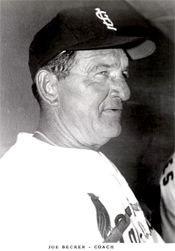 In October 1964, Joe Becker joined the Cardinals as pitching coach on the staff of newly appointed manager Red Schoendienst.
Becker, a St. Louisan, came to the Cardinals from the Dodgers after serving 10 seasons (1955-64) as their pitching coach. During that time, the Dodgers won three World Series titles (1955, 1959, 1963) and four National League pennants (1955, 1956, 1959, 1963). Becker coached three Cy Young Award winners: Don Newcombe (1956), Don Drysdale (1962) and Sandy Koufax (1963).
A catcher who played in the Cardinals farm system, Becker reached the majors with Cleveland the same year another rookie, Bob Feller, joined the club.
Learning the ropes
Becker grew up on the south side of St. Louis and attended Cardinals games as a Knothole Gang member. His favorite player was catcher Bob O’Farrell.
In 1930, the year he turned 22, Becker signed with Des Moines, an independent minor league team. “I started at $200 a month in the middle of the Depression and I was the richest kid on the block,” Becker told the St. Louis Post-Dispatch.
The Cardinals purchased his contract during the 1930 season on the recommendation of scout Charley Barrett. Becker played four seasons (1930-33) in the Cardinals’ farm system, then was declared a free agent by baseball commissioner Kenesaw Mountain Landis. After sitting out a year, Becker signed with the San Francisco Seals of the Pacific Coast League in 1935 and became a teammate of their 20-year-old center fielder, Joe DiMaggio.
The Seals sold his contract to the Cleveland Indians and that’s how Becker reached the majors as a backup catcher in 1936. His first big-league hit was a home run at Boston’s Fenway Park against winning pitcher Jim Henry. Boxscore
Most of the time, though, Becker, 28, was catching warmup throws of Cleveland pitchers, including those of 17-year-old fellow rookie Bob Feller.
“Feller was just a kid … but he had the liveliest fastball I ever saw,” Becker said to Bob Broeg of the Post-Dispatch in 1965. “Afterward, he developed not only one good curve, but three or four different sizes and speeds.”
Though Feller’s fastball was a rocket, the ball came in “alive and light” rather than heavy and didn’t sting the catcher’s hand, Becker told the Los Angeles Times.
After a second season with Cleveland in 1937, Becker returned to the minors. At 36, he joined the Navy and served for two years (1944-45) as a chief gunner’s mate on the USS Wake Island, a converted Casablanca-class escort carrier in the Pacific during World War II.
Discharged in February 1946, Becker went to play for a Giants farm team but tore cartilage in a knee early in the season. Discouraged, “I just wanted to go home and forget baseball,” Becker told the Sioux City (Iowa) Journal.
Giants farm director Carl Hubbell convinced Becker to try managing instead. Becker took over a club in Seaford, Del., in 1946 and went on to manage in the minors for nine years in the Giants, Browns and White Sox systems.
Special project
After his first season as Dodgers manager in 1954, Walter Alston replaced pitching coach Ted Lyons with Becker, who had impressed Alston when they managed against one another in the minors.
Becker was put in charge of a pitching staff that included Don Newcombe, Carl Erskine, Johnny Podres and a 19-year-old rookie, Sandy Koufax.
When he first saw Koufax, the left-hander “had a world of stuff,” Becker told the Chicago Tribune, but “was so damn wild he couldn’t throw the ball through an open barn door.”
At spring training in Vero Beach, Fla., “we had a half-dozen mounds and home plates so that several pitchers could work at the same time,” Becker said to Bill Bryson of the Des Moines Register. “They were spaced far enough so there wasn’t any danger from wild pitches _ until Koufax came along.”
Becker moved Koufax to a secluded area of the training site. “Sandy was a sensitive boy and he was getting awfully self-conscious about his wildness,” Becker told Bryson. “The guys were laughing at him and he was losing what little confidence he had. So we had the groundkeepers build us a mound over behind the barracks where nobody could see us.”
Though it took six years to get the desired results _ “Many kids would have given up,” Becker told the Post-Dispatch _ he and Koufax put in the effort to improve the pitcher’s poise, control and confidence. “I’d made up my mind that what the boy needed most was kindness and encouragement _ and work,” Becker said to the Des Moines newspaper. “I never had a pitcher who worked harder.”
Koufax told Bill Bryson, “Becker taught me the curve and just about everything else about pitching. I don’t know whether I ever would have mastered control if Joe hadn’t been so patient with me in those early years.”
(Don Drysdale, a more polished rookie, joined the Dodgers a year after Koufax did, in 1956. Though Becker helped him, too, such as on location of pitches and footwork, the approach was sometimes different. “Becker will bawl me out and chew me out and even tell me I’m lousy, but I like that,” Drysdale told the Los Angeles Mirror. “He does it face to face.”)
Change of scenery
In 1964, the Cardinals won the pennant, dethroning the Dodgers, who finished 80-82, even though Becker’s pitching staff had the best ERA (2.95) in the National League. Management reacted by overhauling Alston’s entire coaching staff. Becker was banished to the minors to manage Spokane. “I’d spent too many years in the minors to go back,” Becker told the Post-Dispatch.
After the Cardinals beat the Yankees for the World Series title, manager Johnny Keane resigned (in part, because club owner Gussie Busch clumsily schemed during the season to hire Dodgers coach Leo Durocher as manager) and joined the Yankees. Red Schoendienst, who replaced Keane, told the Post-Dispatch he talked with pitching coach Howie Pollet about staying but Pollet indicated he wanted to spend more time on his insurance business in Houston.
Schoendienst and the Cardinals then reached out to Becker, who agreed to replace Pollet as pitching coach. (A week after Becker was hired, Pollet was named pitching coach of the Astros.)
“I had talked with some of the Dodgers pitchers abut Joe,” Schoendienst told the Post-Dispatch. “They all said Joe helped them quite a bit, especially with control.”
Though the Cardinals were champions in 1964, their pitching staff allowed more runs than all but three National League teams. Becker said to the Los Angeles Times, “It’s quite a challenge to see if I can improve the Cardinals’ staff and make it easier for the club to win the pennant again.”
Good stuff
Bob Gibson was the ace of the Cardinals’ staff. He earned 19 wins in 1964, including the pennant-clinching season finale, and also won Games 5 and 7 of the World Series.
“Of 100 pitchers in the National League, not more than five or six can throw high strikes,” Becker said to the Toronto Star. “By that, I mean throwing strikes to a batter’s strength _ up where he can hit them. Koufax and Drysdale can do it. So can Bob Veale and Jim Maloney. Gibson is on that list, too.”
Becker said to the Post-Dispatch, “With what Gibson has going for him, there’s no reason in the world why he can’t become the best pitcher in the league.”
Gibson was averaging 140 to 145 pitches per game, according to Becker. He worked with Gibson to cut that to 120 to 125 by getting ahead in more counts.
The results were impressive: Gibson won 20 in a season for the first time with the 1965 Cardinals and struck out 270 batters.
(At spring training in 1965, Becker also took notice of a 20-year-old Steve Carlton. “He can be a good one in the future,” Becker told the Post-Dispatch.)
Moving on
A year later, with a mix of established starters (Gibson, Al Jackson and Ray Washburn) and emerging prospects (Carlton, Larry Jaster and Nelson Briles), Becker’s pitching staff ranked second in the National League in ERA.
Gibson won 21 in 1966 and his 78 walks were quite an improvement from the 119 he totaled five years earlier when he joined the starting rotation.
“The big thing about Gibson is that he’s continuing to cut down on his pitches and he’s not just trying to overpower the hitters,” Becker told the Post-Dispatch. “No doubt it, Gibson has been much more a pitcher than a thrower. His concentration is so much better. He’s (pitching) to spots much better.”
Despite the strides he made, Becker resigned after the 1966 season because he objected to “interference from the front office,” the Post-Dispatch reported.
According to the newspaper, “It is no secret that Becker has resented numerous suggestions and memorandums from general manager Bob Howsam regarding the pitching staff.”
Red Schoendienst tried to get Becker to reconsider but was unsuccessful. “My relationship with Schoendienst has been happy,” Becker told the Post-Dispatch. “Red has done a real good job under the circumstances. I’ve enjoyed working with the Cardinals players, especially the pitchers.”
A couple of weeks later, at the urging of manager Leo Durocher, the Cubs hired Becker to be their pitching coach. He completed the conversion of Ferguson Jenkins from reliever to starter and worked with another emerging left-hander, Ken Holtzman.
Becker wanted to retire after the 1969 season but the Cubs convinced him to come back for another year. In August 1970, Becker, 62, suffered a heart seizure and collapsed in the clubhouse. He recovered but his coaching days were finished.

 RetroSimba
What an impressive resume. You would certainly have to rank Joe Becker as one of the top pitching coaches in the history of major league baseball. And all without analyitcs, advanced stats, computers and iPads. And therefore, no one size fits all approach. Pretty cool reading about his relationship with Sandy Koufax. Also, how he knew that Don Drysdale needed to be coached differently and how he helped Bob Gibson. Just out of curiosity Mark, do you have any specific details on the differences that Joe Becker had with general manager Bob Howsam? Thanks for another great post.
I’m glad that you noted how Joe Becker was able to use knowledge, experience, fundamentals, powers of observation and the like, rather than analytics and computers, to help pitchers get better, Phillip. I enjoyed a recent story in the Baseball Hall of Fame magazine by reporter Tim Kurkjian, who was asked to predict what professional baseball will look like in 2080. One of Kurkjian’s many predictions: “In 2080, the sabermetric revolution has ended, we watch the games with our eyes, not on our iPads, and consequently, attendance and interest is soaring.”
Regarding the details of Joe Becker’s differences with Bob Howsam: According to the St. Louis Post-Dispatch, Becker wanted the 1966 Cardinals to give opportunities to young talents such as Steve Carlton and Larry Jaster, but the Cardinals had several veteran pitchers (Curt Simmons, Bob Purkey, Tracy Stallard, for instance) who Howsam wanted to trade, so he ordered Becker to use them early in the season in order to create a trade market for them. Becker was especially upset when the Cardinals demoted Jaster to the minors to open a spot for a veteran. (Jaster came back and shut out the Dodgers five times that season.)
As Bob Broeg of the Post-Dispatch noted, Becker’s unhappiness with Howsam “was based on the realization that to be consistent with rebuilding aims, the Cardinals had to go with young arms” and “to work over-the-hill pitchers would be to deprive the staff of the future.”
Broeg concluded, “It was unfortunate that Becker decided not to return.”
As it turned out, Howsam didn’t last much longer with the Cardinals than Becker.
Yes, good point. In January 1967, three months after Becker departed, Bob Howsam quit the Cardinals and went to the Reds.
The Cardinals’ hierarchy had lost confidence in Howsam and blocked two major trades he tried to make.
During the 1966 season, before swinging the deal for Orlando Cepeda, Howsam tried to trade pitchers Steve Carlton and Nelson Briles, outfielder Mike Shannon and infielder Phil Gagliano to the Reds for shortstop Leo Cardenas, first baseman Gordy Coleman and pitcher Joey Jay, but the Cardinals’ “high command” vetoed the trade, The Sporting News reported.
After the 1966 season, Howsam wanted to trade Carlton, Briles and outfielders Bobby Tolan and Alex Johnson to the Cubs for outfielder Billy Williams, but again was stopped. “The price in promising young talent was too high, ownership concluded,” Bob Broeg wrote.
Wow. Great story. What an impressive “baseball man.”
Baseball man is an apt description of Joe Becker, Gary.
According to the St. Louis Post-Dispatch, Bob Gibson thought so highly of him that he pinned up a picture of Becker in his locker.
I echo what phillipmezzapelle said…..about Joe Becker’s impact on Koufax, on handling him with what Becker considered most necessary – kindness, to boost his confidence back up. He must be the most underrated pitching coach of all-time and to me, demonstrates how the right coach can make all the difference in the world.
I have a question. I’m always confused to hear about free agents prior to free agency becoming official in the early 70’s. In this case, Becker being declared a free agent by baseball commissioner Kenesaw Mountain Landis.
Thanks for your comments, Steve.
Regarding how the right coach can make all the difference, Dodgers farm director Fresco Thompson told a Spokane newspaper, the Spokesman-Review: “More than anyone else, Joe Becker should be given credit for developing and bringing out the talent in our young pitchers.”
Regarding your question, though free agency as we know it today did begin in the 1970s, the term “free agent” shows up in publications going back to baseball’s early years to describe a player that no team yet had the rights to.
Free agent also was the term used to describe a player set free by baseball commissioner Kenesaw Mountain Landis. This excerpt from the Society for American Baseball Research explains how and why Landis set some players free:
“Landis was never a fan of the farm teams owned by major league teams. Branch Rickey had pioneered the modern farm system in the early 1920s, but Landis was committed to try to tear down the system. In April 1930, St. Louis Browns owner Phil Ball attempted to send Fred Bennett to the Milwaukee Brewers, a minor-league team under the Browns’ control. It was the third season Bennett would play for a Browns-controlled team. Bennett petitioned Landis for free agency and Landis granted it.
“Landis continued fighting major-league control of the minor leagues _ freeing minor leaguers on a case-by-case basis, either individually or by the carload. In 1938, he freed 73 Cardinals farmhands. In 1939, he freed 90 players in the Tigers farm system.”
Excellent. Thanks for the explanation Mark. I like Landis’s respect for the minor leagues or at least I think I do? It would seem to make the minor league season be more about winning (which would be great) rather than individuals showing off to get called up by the big league team.
That’s an amazing list of pitchers that he coached. Interesting how someone with such a modest career himself could guide so many others to stardom.
Like Paul Richards and Al Lopez at the time, and later Dave Duncan, Joe Becker showed that catchers could become first-rate pitching instructors.
The 1965 Angels had good, young starting pitching (May, Dean Chance, Marcelino Lopez and Fred Newman). Rudy May was the only pitcher from that quartet to have success past age 30. The Cincinnati Reds of the late-60s to mid-70s also had strong, early Disabled Listees (Jim Maloney, Gary Nolan, Wayne Simpson and Don Gullett). The Reds had a bit more run-scoring ability than the Angels.
Your comment made me think about Jim McGlothlin. A teammate of Rudy May’s with the Angels, McGlothlin was 12-8 with a 2.96 ERA for the 1967 Angels and was named to the American League all-star team. Traded to the Reds after the 1969 season (in the deal involving ex-Cardinal Alex Johnson), McGlothlin was a starting pitcher in two World Series (1970 and 1972) with Cincinnati. He was 14-10 for the 1970 Reds.
I meant that comment for the Rudy May post. Oh, well. Makes more sense with Joe Becker than with Pat Fischer.