As a high school all-star, Don Ferrarese impressed Babe Ruth, who, like the California teen, knew what it was like to be a left-handed pitcher with stuff. Later, when Ferrarese was in the majors, he hit like Ruth, too, at least for one game _ cracking three consecutive doubles.
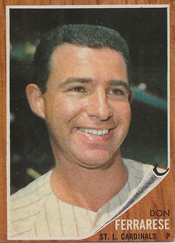 In his first big-league start, Ferrarese struck out 13. In his first win, he held the Yankees hitless for eight innings, then completed the shutout by retiring Mickey Mantle with the potential tying run in scoring position.
For Stan Musial and Ted Williams, Ferrarese was as hard to hit as it was to say his name correctly.
Ferrarese (pronounced “Fer-ar-ess-ee,” with the emphasis on the “ess”) ended his playing career as a Cardinals reliever and was especially effective against left-handed batters. He also pitched for the Orioles (1955-57), Indians (1958-59), White Sox (1960) and Phillies (1961-62).
Meeting Babe
Born in Oakland, Don Ferrarese was the son of Italian immigrants, Hugo and Bruna Ferrarese. (“I am a rare Italian that cannot sing a note,” Don told the Victorville, Calif., Daily Press.) The family moved to Lafayette, Calif., and that’s where Don attended high school while working in his parents’ produce business.
(Ferrarese went to Acalanes High School, also the alma mater of Hall of Fame quarterback Norm Van Brocklin.)
As a prep freshman, Ferrarese was a left-handed second baseman. A math teacher suggested he try pitching, the Oakland Tribune reported.
Though he was short and slight, Ferrarese’s pitches had speed and movement. After his senior season, he was chosen for an August 1947 prep all-star game sponsored by Hearst newspapers at the Polo Grounds in New York. Other future big-leaguers invited to play included Gino Cimoli, Dick Groat and Bill Skowron.
Babe Didrikson Zaharias performed a golf and baseball skills exhibition as part of the entertainment before the game, which drew 31,232 customers.
Starting for the U.S. all-stars, Ferrarese pitched three scoreless innings and lined a double to the wall in left against the Metropolitan all-stars. Named most valuable player of the game, Ferrarese was presented a trophy by Eleanor Gehrig, widow of Lou Gehrig. A spectator was the game’s honorary chairman, Babe Ruth.
“Babe Ruth asked to meet me,” Ferrarese told Newspaper Enterprise Association. “He was in the front row of box seats, all hunched over and wearing a camel’s hair beanie. Ruth had throat cancer, so it was hard to hear him.”
(Ruth died a year later at 53.)
Ferrarese enrolled at Saint Mary’s College in California, pitched well as a freshman and caught the attention of Jimmy Hole, a scout for the 1948 Oakland Oaks of the Pacific Coast League. The Oaks’ manager was Casey Stengel. Ferrarese signed with them for $4,000 in June 1948, three days before he turned 19, and was sent to Stockton of the California League.
The little left-hander was effective _ when he got the ball over the plate, which wasn’t often enough. In his first three seasons in the minors, he walked 48 in 32 innings with Stockton, 184 in 188 innings with Albuquerque, and 209 in 185 innings with Wenatchee (Wash.).
The best experience Ferrarese had at Wenatchee was he met Betty Jean Olsen, “who ate lunch at the same restaurant where he ate breakfast at noon,” according to the St. Louis Post-Dispatch.
The couple married and Ferrarese did a two-year hitch in the Army. After his discharge, he pitched poorly (6.28 ERA) for the 1953 Oakland Oaks.
Then he got the break his career needed.
True grit
After the Dodgers fired manager Chuck Dressen, who led them to two National League pennants in three seasons, he went to Oakland to manage the 1954 Oaks. Ferrarese won 18 that season and struck out 184.
“It was Chuck Dressen who helped me most,” Ferrarese said to the New York Daily News. “Chuck taught me how to throw my curve and helped me with my control.” He also told Newspaper Enterprise Association, “I was strictly a thrower before Dressen got hold of me in Oakland.”
Dressen said to the Baltimore Sun, “He’s got a great curve, and can really fire that ball when he relaxes and doesn’t try to aim it.”
The Oaks capitalized, selling Ferrarese’s contract to the White Sox for $30,000 in December 1954. The White Sox then packaged him in a trade with the Orioles.
Ferrarese, 5-foot-9, 170 pounds, opened the 1955 season with the Orioles, made six relief appearances and was sent down to the San Antonio Missions. In 12 games for them, including nine starts, he was 9-0 with a 1.48 ERA.
Sticking with the Orioles in 1956, Ferrarese’s first start came against the Indians, who won, 2-1, though Ferrarese struck out 13. “When you’ve got a curve like he has and don’t have to be afraid to throw it when you’re behind, you’re a tough man,” Indians pitching Mel Harder said of Ferrarese to the Baltimore Sun. Boxscore
Ferrarese’s next start was another nail-biter. Displaying what the Sun called “170 pounds of grit and heart,” he entered the ninth at Yankee Stadium with a 1-0 lead (Ferrarese’s single drove in the run) and a chance for a no-hitter. First up in the inning was Andy Carey, who, like Ferrarese, had attended Saint Mary’s College.
Carey swung down on a pitch. The ball struck near home plate and bounced high over the mound _ a classic Baltimore chop. Ferrarese pedaled backward, peering for the ball in the afternoon glare, while Carey raced toward first. “I lost it in the sun as it was coming down,” Ferrarese told the Baltimore newspaper.
As the ball plopped into Ferrarese’s glove, he stumbled slightly, then bounced a hurried throw to first _ too late to nab Carey, who reached base with the first hit.
After Billy Martin struck out, Hank Bauer blooped a single off the bat handle into short left, moving Carey to second. Pitcher Don Larsen, pinch-hitting for second baseman Bobby Richardson, popped out to the catcher. Mickey Mantle, leading the American League in hitting, was next.
According to the Baltimore Sun, Mantle “swung viciously” at a Ferrarese curve and lofted a gentle fly to center for the final out. Boxscore
“That near no-hitter Ferrarese pitched ranks as one of my big thrills,” Orioles manager Paul Richards told the Sun. “It really was something to watch him battle them inning after inning and finish up strong after Carey got that first hit.”
Yankees manager Casey Stengel said to the newspaper, “I thought he deserved a no-hitter. Neither hit was a good one.”
On the move
The magic didn’t last. Two weeks later, Ferrarese faced the Yankees again and gave up seven runs in two innings. He finished the 1956 season at 4-10.
The next year, demoted to Vancouver and instructed to develop a slider, Ferrarese became “almost discouraged enough to quit,” the St. Louis Post-Dispatch reported. A teammate, former Cardinals outfielder Joe Frazier, showed him how to throw the pitch. “I’ve had a good slider ever since,” Ferrarese said.
Traded to the Indians for Dick Williams in April 1958, Ferrarese started against the Orioles four months later, pitched 11 scoreless innings, then walked Williams with the bases loaded in the 12th and lost, 1-0. Boxscore
In 1959, Ferrarese won four of his first six decisions for the Indians. A highlight came on May 26 when he smacked three doubles versus the White Sox’s Dick Donovan and pitched 6.1 scoreless innings for the 3-0 win at Chicago’s Comiskey Park. Ferrarese drove in two of the runs and scored the other. “There was nothing fluky about Ferrarese’s hits: all were hard smashes into right-center,” the Akron Beacon Journal reported. Boxscore
A month later, inflammation spread throughout Ferrarese’s left shoulder. After the season, he was dealt to the White Sox, who sent him to the minors. Eventually, his shoulder healed and the Phillies acquired him in April 1961. He didn’t throw as hard, but his control was better.
Appearing in 42 games, including 14 starts, for the 1961 Phillies, Ferrarese had the best ERA (3.76) for a team that lost 107 games, including 23 in a row.
Lefty specialist
Early in the 1962 season, the Cardinals acquired two left-handed relievers _ Ferrarese from the Phillies (for Bobby Locke) and Bobby Shantz from Houston.
Between May 13 and June 12, Ferrarese made nine relief appearances totaling 12.2 innings for the Cardinals, didn’t allow a run and got a win against the Phillies at St. Louis. Boxscore
In his first appearance at Philadelphia since the trade, he clouted the lone home run of his big-league career, a two-run shot versus Jim Owens. Boxscore
Ferrarese earned a save for the Cardinals against the Reds, striking out Vada Pinson to end the game with the potential tying run on second. Boxscore
As a Cardinal, left-handed batters hit .195 against Ferrarese. For his career, he limited them to a .214 batting average. Stan Musial hit .091 (1 for 11) versus Ferrarese and Ted Williams was at .143 (1 for 7).
(A right-handed batter, the Cardinals’ Julian Javier, who had a career .299 batting mark against left-handers, was hitless in 15 at-bats versus Ferrarese.)
In February 1963, the Cardinals dealt Ferrarese to Houston for pitcher Bobby Tiefenauer, but Ferrarese opted to go home and help his parents run Hugo’s Deli in Apple Valley, Calif.
After his folks retired in 1974, Ferrarese owned and operated Ferrarese’s Ristorante in Victorville, Calif., and then another restaurant, Hugo’s, in Apple Valley. He also ran a commercial real estate company.
A charitable foundation created by Ferrarese provided college scholarships to students based on how much they’d done to help their communities.

 RetroSimba
Pretty cool he got to meet Babe Ruth in his final days. I’m on the lookout for a camel hair beanie now….sounds kind of stylish.
Excellent, Gary. I hope you find one. You have the ‘elan to make it work.
You have to admire and respect a former professional athlete who after his career is over goes on not only to become a successful businessman but gives a great deal back to society. It’s only right to mention that he lost two years of his minor league career because of military service. It’s pretty interesting that an outfielder taught him how to throw a slider. Nice post Mark.
Like you, Phillip, I was intrigued that outfielder Joe Frazier provided the tip that enabled Don Ferrarese to develop a slider. According to the St. Louis Post-Dispatch, Frazier told Ferrarese “to shorten up on his curve” in order to throw a slider. My interpretation of that is by throwing a variation of his curve, using tighter spin and less sweep, the pitch moved the way a slider should.
Joe Frazier apparently was a student of all facets of the fundamentals of the game. When he was named manager of the Mets, Frazier told the New York Times, “I’ve seen some great athletes, some great golfers, who couldn’t teach a lick. I try to teach. I don’t have any special philosophy … I just believe in fundamentals.”
With Thanksgiving this week, this is a good time for me to say “thank you” to you Phillip for being such a loyal reader and for consistently taking the time to make insightful comments. It is greatly appreciated.
I agree with Phillip….about him giving back to society, a great idea to hand out scholarships based on how much kids helped their communities.
Always amazed how one person, one coach (Chuck Dressen) can help a player or in this case pitcher right his ship. I’m reminded of individuals who have helped me so much along the way, inspiring so much gratitude towards them.
Yes, indeed, Steve. According to the Victorville Press-Dispatch, the Don Ferrarese Foundation began awarding the scholarships in 2005. Each year, a student from each of 10 high schools was awarded a $4,000 college scholarship. The scholarships were awarded “to students dedicated to improving the quality of life through their volunteer activities” in local communities, the newspaper reported.
I’m reminded of Al McGuire who looked beyond basketball when speaking to his student athletes and encouraged them to ride taxis and visit local farms before they graduated.
Al McGuire is one of the very few sports figures I genuinely miss. I admired him. To your point, Dave Anderson of the New York Times noted that McGuire said, “I think everyone should go to college and get a degree, then spend six months as a bartender and six months as a cab driver. Then they’d really be educated.”
Two of my other favorite Al McGuire quotes, as cited by the New York Times:
_ “Sports is a coffee break.”
_ “I can’t recruit a kid who has a front lawn. Give me a tenement and a sidewalk.”
Rick Majerus, who graduated from Marquette and then served as Al McGuire’s assistant there before becoming a head coach, said to the Associated Press of McGuire, “On a campus with great scholars, I had great, great teachers here, but none better than him.”
AHA! That’s it. The quote. I’ve looked for it for a long time and never found it. Thanks Mark and sorry on my part for messing it up. I guess I was close with taxis, but thought it was getting to know farmers rather than being a bartender. I love that quote by Majerus.
I loved basketball as a kid and feel spoiled to have had the opportunity to see and follow the Warriors and the Bucks.
you got me on this one! from about 1955 forward, most names of STL players look familiar to me, not this one. and he met Ruth! His story, well-told here, shows how hard this game is.
Thanks for reading and for commenting, Bill. Don Ferrarese sure did fly under the radar as a Redbird. I’m glad you appreciate the stories about the unsung players.
I’ve seen interviews with him on the Web and he always seemed to be a nice, friendly guy.
I got that same sense, too, from reading newspaper clips about him.
In 2008, the Victorville (Calif.) Press Dispatch reported, “Ferrarese hosted more than 100 charitable wine auctions throughout southern California, raising over $1 million for various foundations and organizations.”
“We have never received a penny for our effort,” Ferrarese told the newspaper. “It was strictly a donation of our time.”
He also coached all levels of local baseball _ from Little League to community college _ and held clinics to teach youths the game.
So many great pieces of this story. Like the high school math teacher coming up with the idea that maybe there was no future in being a left-handed second baseman. And how about Don Larson pinch hitting for Bobby Richardson? The Yankees never did, and still don’t, appreciate guys who can just get on base.
Excellent, Ken. I’m so glad you appreciate those details. Don Larsen batted .241 for those 1956 Yankees (and .286 as a pinch-hitter). He had 2 home runs, 5 doubles and 12 RBI that season. Of course, 1956 turned out to be quite special for Larsen in another way.