The Cardinals acquired right-hander Bob Purkey to be their fifth starter. It turned out they got a whole lot more from him.
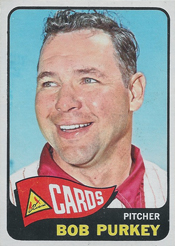
On Dec. 14, 1964, the Cardinals traded Roger Craig and Charlie James to the Reds for Purkey, projecting him to join a rotation with Bob Gibson, Ray Sadecki, Curt Simmons and Tracy Stallard.
Purkey, 35, delivered 10 wins for the 1965 Cardinals, and also provided a bonus. Gibson credited Purkey with making him a better pitcher.
In his autobiography “Stranger to the Game,” Gibson said, “Purkey knew how to pitch and win. I learned more about pitching from Purkey in one season as his teammate than I did from any pitching coach I ever had.”
Pitching lessons
Gibson, 29, was the Cardinals’ ace, winning 19 in 1964 and then two more in the World Series, including Game 7, but Purkey helped him improve.
In his autobiography, Gibson said, “Purkey taught me a way to take advantage of my bad curveball. I seldom threw my curve because I was afraid of hanging it, but Purkey convinced me that a hanging curve can oddly enough be an effective pitch to left-handed hitters, who dive into (it) expecting the ball to break. So I’d leave the curveball hanging inside now and then to left-handed hitters.
“Another pitch Purkey added to my repertoire was the backup slider _ a slider that doesn’t break away from a right-handed hitter but holds its course and maybe even bends back a little like a screwball,” Gibson said in his autobiography. “Purkey explained that, especially in day games, hitters will recognize the spin on a pitch, and when they identify a slider they will instinctively lean out in anticipation of the ball breaking away from them. A quick backup slider, consequently, ought to result in broken bats and balls hit weakly off the fists.”
Gibson told Purkey he sometimes accidently threw sliders that backed up but didn’t know how to deliver the pitch on purpose.
In the book “Sixty Feet, Six Inches,” Gibson said Purkey “showed me how to do it purposely by raising your arm a little too high and then throwing it like mad, as hard as you can.”
As Gibson noted in his autobiography, “So I started deliberately overthrowing the slider on occasion, and just like that I had a nasty new pitch.”
The Tigers’ Willie Horton told Cardinals Magazine it was a backup slider Gibson threw him for his 17th strikeout to finish Game 1 of the 1968 World Series. Gibson said to Cardinals Yearbook he was trying to pitch a slider, but “I overthrew it and didn’t get it where I wanted. Instead of breaking outside, it went right at him. He flinched and it broke over the plate for strike three. I had missed by a big margin, but it was a good place to miss.”
In “Sixty Feet, Six Inches,” Gibson said of the backup slider, “Purkey had it perfected, but it takes a lot of guts to throw something that stays over the plate and doesn’t really do much. The vast majority of the time, I wasn’t that courageous. It’s not a pitch that children should try at home.”
Learning the craft
Born in Pittsburgh, Purkey grew up in the Mount Washington neighborhood across the river from downtown. He didn’t play for a baseball team until he was 13. Purkey took up pitching because his favorite player was the Cardinals’ Harry Brecheen. “I’d go to Forbes Field whenever (Brecheen) was pitching,” Purkey recalled to the St. Louis Post-Dispatch. “I admired his style, his guts.”
Purkey, 18, signed with the hometown Pirates in 1948 for $150 a month. After four years in the minors and two in the Army, he reached the majors with the Pirates in 1954 when Branch Rickey was general manager. In his first start, Purkey beat the Cardinals and held Stan Musial hitless. Boxscore
At spring training in 1955, Purkey was given special instruction to learn an extra pitch. “Rickey himself took charge and showed some of us how to throw the knuckleball,” Purkey told the Post-Dispatch.
Purkey added the knuckler to an arsenal that included a sinker and slider. “He used to throw you everything but the kitchen sink,” the Dodgers’ Ron Fairly said, according to the Post-Dispatch. “Now he throws the sink, too.”
Joe Brown replaced Rickey as general manager in 1956 and a year later he dealt Purkey to the Reds for reliever Don Gross. “The worst trade I ever made,” Brown later told the Pittsburgh Post-Gazette.
The Reds were managed by former catcher Birdie Tebbetts, and he and Purkey clicked. Purkey, who never had a winning season with the Pirates, was 17-11 for the 1958 Reds.
“I didn’t become a pitcher until I joined Birdie Tebbetts,” Purkey explained to the Post-Dispatch. “Birdie told me I’d been a defensive pitcher, meaning I nibbled too much at the corners and fell behind too much on the ball-and-strike count. He knew I could get the ball over. ‘Be aggressive,’ he told me. ‘Get that first pitch over with good stuff on it and challenge the hitter.’ “
Under control
With the Reds, Purkey began using the knuckleball more frequently. “It took five years to develop the knuckler where I could throw it effectively in a game,” he told the Post-Dispatch.
The Cardinals’ Ken Boyer said to The Cincinnati Post, “When he gets ahead of you (with the sinker), he throws you that knuckler _ and he has a good one.”
In a September 1961 win against the Cardinals, Purkey threw five consecutive knuckleballs to Stan Musial and struck him out looking. (As usual, Musial adjusted and hit .323 with three home runs versus Purkey for his career). Boxscore
“Of all the knuckleball pitchers I’ve seen, I’d have to rate Purkey’s second only to Hoyt Wilhelm’s,” Darrell Johnson, who caught in the majors for six years, told the Post-Dispatch.
Unlike many other knuckleballers, Purkey was a control pitcher. He walked 49 in 250 innings in 1958; 43 in 218 innings in 1959.
Because batters knew he threw strikes, Purkey made sure they didn’t get too comfortable at the plate. He eight times ranked among the top 10 in the league in hitting batters with pitches. He plunked 14 in 1962. A favorite target was the Cardinals’ Curt Flood, who got struck by Purkey pitches five times in his career.
“He’d brush back his own grandma if she crowded home plate and took too firm a toehold in the batter’s box,” Bob Broeg wrote in the Post-Dispatch.
Purkey said to Broeg, “Willie Mays must have thought I was the meanest man in the league. I’d brush him back, pitch him tight, brush him back, pitch him tight.”
Highs and lows
After being fired by the Cardinals, Fred Hutchinson became Reds manager and led them to a National League pennant in 1961. Purkey, who won 16 that season, got the start in Game 3 of the World Series versus the Yankees.
Ahead 2-1, Purkey got a slider too high to Johnny Blanchard, who tied the score with a home run in the eighth, and then a slider too low to Roger Maris, who won it for New York with a home run in the ninth. Regarding the Maris homer, Purkey said to the Dayton Daily News, “It looked to me, when he hit it, like a guy swinging at a golf ball with his No. 9 iron.” Boxscore
Everything came together for Purkey the next season. He had the best winning percentage (.821) in the league, with a 23-5 record for the 1962 Reds. Purkey won his first seven decisions and was 13-1 after beating Sandy Koufax and the Dodgers on June 22. Boxscore
Purkey tore a muscle in his right shoulder at spring training in 1963. He rebounded in 1964, winning eight of his last 11 decisions and finishing at 11-9.
Wrapping it up
Starting against the Reds in the 1965 Cardinals’ home opener, Purkey’s knucklers rolled toward the plate like beach balls. Vada Pinson hit one for a three-run homer and Gordy Coleman clouted another for a grand slam. After allowing nine runs in six innings, Purkey told the Post-Dispatch, “I just did a lousy job of pitching and I had the daylights kicked out of me.” Boxscore
With a 9.00 ERA after his first four starts, the Cardinals sent him to the bullpen for a month. When he returned to the rotation, he gradually got better. For the month of July, Purkey was 3-1 with a 1.76 ERA in four starts.
A week after he turned 36, Purkey pitched well against the Astros, but lost, 3-2, to 18-year-old Larry Dierker. In his next start, Purkey shut out the Giants and beat 44-year-old Warren Spahn. Boxscore and Boxscore
In April 1966, the Cardinals sold Purkey’s contract to the Pirates and he played his final season with them. His career record: 129-115, including 103-76 with the Reds. Purkey was 17-11 against the Cardinals.
Though he experienced tragedy in 1973 when his son, Bob Jr., died of a heart ailment at 18, Purkey had a long and successful second career operating an insurance agency in the Pittsburgh suburb of Bethel Park.

 RetroSimba
Interesting how much credit Bob Gibson gave to Bob Purkey. For Gibby to say he learned more about pitching from Purkey as his teammate in one year than from any pitching coach he had speaks volumes. Great article!
Indeed, Bob Purkey earned respect from those who knew him.
When Purkey was traded to the Cardinals, Si Burick of the Dayton Daily News wrote, “Purkey is one of the smartest pitchers around. Bob used his head in pitching more than any other member of the (Reds’) staff. With limited stuff, he became a winner in Cincinnati.”
Ritter Collett of the Dayton Journal Herald described Purkey as “able, sincere, articulate” and added, “The Cardinals will find him a willing workman.”
As soon as I began to read this post I couldn’t help but remember something that Ted Simmons said during his Hall Of Fame induction speech. “However we get here, none of us arrives here alone.” I’m really amazed how much Bob Gibson confided in Bob Purkey and sought out his advice. He must have had an incredible amount of respect for him. How I miss the days when pitching was more than just throwing “heat.” When the game of baseball had pitchers with an assortment of different pitches. And to top it off Branch Rickey giving clinics on how to throw a knuckleball. Wow! Great post Mark.
Thanks for the Ted Simmons quote, Phillip. I hadn’t seen that one. I like it a lot. It’s so true and so apt for this post.
I’m in full agreement with you on preferring pitchers to throwers. Bob Broeg of the St. Louis Post-Dispatch wrote, “Purkey at his peak never did seem to be overpowering but he carved the strike zone with a surgeon’s skill, and with the same self-assurance.”
In 1962, after Purkey improved his season record to 7-0, Reds manager Fred Hutchinson said to The Pittsburgh Press, “He’s smart and he keeps moving the ball around. He has good control, especially with his knuckler. He’s simply a Grade A pitcher now.”
The back story on Branch Rickey teaching the knuckleball: He picked out 10 Pirates pitching prospects _ Vern Law and Ron Kline were two of them, in addition to Bob Purkey _ and had them attend special sessions he led at 1955 spring training.
Gibson was amazingly cerebral, and obviously so was Purkey. I love reading the minutae of baseball.
Bob Gibson rarely resorted to banalities. His approach was to be candid and thoughtful. He wasn’t keen on reminiscing much, unless he was talking with former teammates. Instead, he was at his best as a communicator when given the chance to analyze, explain and advocate.
He also was a careful listener. Gibson picked up on tone and nuance when asked a question. For instance, at an event in Peoria, Ill., in 2013, when he was talking about helping players at Cardinals spring training, someone began a question by saying, “When you’re hanging out at spring training …” Gibson cut off the questioner, made a face like he had opened a bottle of sour milk and said, “Hanging out? I don’t go to spring training to hang out.” The questioner apologized and Gibson went on to answer graciously, but he had made his point: Put thought and care into your question, and he would answer in kind.
He picked a good pitcher to have as a hero. That Harry Brecheen had a nice career. I’m amazed that after Purkey kind of mastered the knuckleball, he still had such excellent control. I’m surprised more pitchers don’t learn how to throw the knuckleball earlier on in their careers, such a great contrast with all the fireballers in today’s game.
You are correct about Harry Brecheen, Steve. Coincidently, he and Bob Purkey ended up with similar career win totals _ Brecheen at 133 and Purkey at 129.
Brecheen went on to become pitching coach of the Orioles from 1954-67 and helped in the development of Jim Palmer, Dave McNally, Milt Pappas, Steve Barber and Bob Turley, among others. Speaking of knuckleballs, Brecheen was Hoyt Wilhelm’s coach with the Orioles from 1958-62 and helped him convert from reliever to starter and back to reliever again. With the 1959 Orioles, Wilhelm led the American League in ERA (2.19).
To your point, Bob Purkey told the St. Louis Post-Dispatch that by learning to use the knuckleball effectively “I find it easier on the arm than my other stuff.”
June 5, 1965. First major league game I attended. I still remember that the first Cardinal I saw that day had the name, “Purkey” on the back of his uniform. !8-year-old Larry Dierker started against another old guy-Curt Simmons-that day.
Thanks for sharing that experience. You saw a good game and got to see one of the first played by 21-year-old Houston 2nd baseman Joe Morgan. Also interesting that the Cardinals batted Lou Brock in the No. 2 spot behind Curt Flood. Here is the box score: https://www.retrosheet.org/boxesetc/1965/B06050SLN1965.htm