Imagine having the American League batting champion and the National League batting champion from the same season at the top of the order. The 1990 Oakland Athletics came close to having that happen.
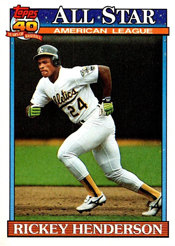 Manager Tony La Russa put Rickey Henderson in the leadoff spot and Willie McGee in the No. 2 position during the last weeks of the 1990 season and then into the playoffs and World Series.
After leading most of the way, Henderson finished a close second to the Royals’ George Brett in the 1990 AL batting race. (His consolation prize, if you will, was the AL Most Valuable Player Award.) McGee, who played for the Cardinals before being dealt to Oakland near the end of August, won the 1990 NL batting title.
The combination of Henderson and McGee as table setters, followed by bashers Jose Canseco and Mark McGwire, might make a pitcher reconsider his vocation.
Athletic ability
At Oakland Tech High School, Henderson excelled in multiple sports and the one he liked best was football. He recalled to the San Francisco Examiner, “That was my game, football … I wanted to play for the (Oakland) Raiders.”
His mother, though, preferred he pursue baseball. So, Henderson turned down a football scholarship offer from Arizona State and signed with the Athletics when they drafted him at 17 in 1976.
During his first stint with the Athletics (1979-84), Henderson achieved 130 stolen bases in 1982, breaking the record of 118 held by the Cardinals’ Lou Brock. Traded to the Yankees in December 1984, Henderson was reacquired by the Athletics in June 1989 and helped them become World Series champions.
Doing it all
In 1990, as the Sacramento Bee described it, Henderson, “flamboyantly acting as if he were the leading man in a Broadway show,” deployed all his considerable skills. He led the league in on-base percentage (.439), runs scored (119) and stolen bases (65), and placed second to Cecil Fielder in slugging (.577).
“There’s nobody in our league doing more than (Henderson),” Tony La Russa said to the Bee.
Athletics pitcher Scott Sanderson told the newspaper, “When Rickey is determined to dominate a game, he can do it.”
Henderson hit .330 or better each month from April through July in 1990. He entered August at .340 for the season.
When Athletics center fielder Dave Henderson (no relation to Rickey) suffered a knee injury in August, general manager Sandy Alderson acquired Willie McGee to fill in for the injured outfielder. Winner of the 1985 National League MVP Award, McGee hit .335 for the 1990 Cardinals. On Aug, 29, the day Oakland obtained McGee, Rickey Henderson led the American League at .323.
McGee was from the Bay Area and still resided there. The Cardinals opted to trade him (for Felix Jose, Stan Royer and Daryl Green) rather than lose him to free agency after the season.
“McGee batting behind Henderson gives the A’s incredible speed at the top of the lineup,” Oakland Tribune columnist Dave Newhouse wrote.
Rangers pitcher Bobby Witt told the Examiner, “With Rickey Henderson leading off and Willie McGee batting second, that’s a great lineup.”
Dynamic duo
Though it took McGee a while to adjust to being with a different team _ “Every day I expect red (uniforms), and it’s green,” he told the Sacramento Bee _ he and Henderson teamed up for several strong performances.
 On Sept. 3, for instance, at Boston’s Fenway Park, Henderson led off the game with a single, McGee followed with another single and the rattled rookie, Dana Kiecker, threw a wild pitch. The Athletics went on to score five runs in the inning and won, 9-5. Henderson and McGee combined for four hits, two walks, two steals, three runs and three RBI.
Red Sox designated hitter Mike Marshall, who played for the Dodgers against the Athletics in the 1988 World Series, told the Boston Globe, “They’re a strong team, mostly because now they’ve got that leadoff threat. They’ve got Rickey and now they’ve got McGee. He’s almost just as bad (to defend against).” Boxscore
Later that week, at Yankee Stadium, “Henderson lit the fuse and McGee kept it burning,” the Oakland Tribune reported.
With the Yankees ahead 2-1, Henderson led off the eighth with a home run into the third deck in left against Mike Witt, tying the score. McGee then lined a single to right and, when Jesse Barfield juggled the ball, Willie dashed to second. Irritated, Witt threw a wild pitch, enabling McGee to reach third. Then came another wild toss, and McGee scored the winning run.
As the Sacramento Bee noted, “Each time, the moment the ball trickled away, McGee took off. Seriously quick instincts.”
Tony La Russa told Newsday, “He’s got real explosion, plus he’s got guts. Often the guts factor is underestimated with baserunning. Willie has more guts than most.” Boxscore
The next day, with the score tied 3-3 in the ninth, the Athletics had one on, two outs, when Henderson worked a walk against the Yankees’ Greg Cadaret. McGee was next. After falling behind in the count, he fouled off five two-strike pitches before sending a drive to right. Mel Hall said he thought the ball would come directly to him, but it carried and sliced toward the corner.
“Hall pirouetted in the outfield before falling face-first onto the warning track,” the New York Daily News reported. The ball landed there, too, and bounced against the wall. Both runners scored and McGee streaked to third with a triple. The Athletics won, 7-3.
“An at-bat doesn’t get any better than that,” La Russa told Newsday’s Joe Donnelly. “Willie’s one of the smartest players I’ve ever been involved with. You can see it in the field, on the bases and at the plate.” Boxscore
Hit and run
In mid-September, George Brett, batting .256 through June, overtook Henderson in the race for the 1990 American League batting title.
With a week to go, Brett was at .330 and Henderson at .324. To protect his lead, Brett sat out three of the remaining six games, skipping two tough left-handers, Chuck Finley and Mark Langston, and knuckleballer Tom Candiotti.
Henderson said to the Oakland Tribune, “I respect (Brett), but I really thought he should have played. I guess I feel he did it a little different than I thought a good ballplayer would.”
Brett finished four percentage points ahead of Henderson, becoming at 37 the oldest American League batting champion since Ted Williams (40) in 1958. Brett also became the first player to win batting titles in three decades _ 1976 (.333), 1980 (.390) and 1990 (.329).
(No one ever won an AL batting title while playing for the Oakland Athletics.)
McGee had enough at-bats with the 1990 Cardinals to qualify for the National League batting crown. He won it with a .335 mark, finishing ahead of the Dodgers’ Eddie Murray (.330).
Comings and goings
The Athletics won their third straight American League pennant in 1990, sweeping the Red Sox in the playoffs, but then got swept by the Reds in the World Series.
McGee became a free agent and signed with the Giants, the team he rooted for as a youth. In December 1995, he returned to the Cardinals, who were managed then by Tony La Russa.
Henderson got traded to the Blue Jays in July 1993, returned to the Athletics five months later, left for the Padres in October 1995, returned to the Athletics in January 1998 and left again for the Mets in December 1998.
With the 1999 Mets, Henderson had 13 hits and five walks in 25 plate appearances versus the Cardinals _ a .720 on-base percentage.
He completed his big-league career in 2003 as the all-time leader in runs scored (2,295) and stolen bases (1,406).

 RetroSimba
Great tribute Mark to a very memorable player – Rickey Henderson. I loved his rookie card in 1980 and as a shy kid growing up, I admired his moxie and confidence, kind of an inspiration. I totally forgot about McGee being traded to the A’s. How bizarre that the eventual batting champion would wind up with a different team in the same season! I wonder if that’s ever happened before?
I also had no idea Brett sat those games out to preserve his lead in the batting average race. Kind of disappointing in my opinion, especially when one considers what Ted Williams did back when hit over .400, deciding to play both games of a double header taking a risk and boy was he rewarded for his courage.
I wanted the A’s to win that World Series, but I was happy for former Brewer Glenn Braggs to earn a ring.
Thanks, Steve. According to the New York Times, Willie McGee became the first player to switch leagues during the season and win the batting title in the first league. If Rickey Henderson had won the AL batting crown that year, the 1990 World Series would have been the first World Series since 1954 (Willie Mays of Giants; Bobby Avila of Indians) to have both league batting champions.
In October 1990, Kansas City Star columnist Jonathan Rand wrote, “It is boring to watch George Brett, one of the game’s most aggressive competitors, suddenly avoiding at-bats to protect his average. Throughout his career, there has not been a pitcher Brett ducked. Now he and manager John Wathan will risk his lead only if an opposing pitcher is right-handed and unimposing and all the stars are aligned just right.”
Brett, however, made no apologies. Regarding his strategy against Rickey Henderson in the final week, Brett told the Star, “It was a long-distance chess match. We had the best poker hand and we won.”
Acquired from the Brewers for his bat, Glenn Braggs was platooned smartly by Reds manager Lou Piniella and delivered. In 115 at-bats versus left-handers, Braggs hit .339 for the 1990 Reds and had an on-base percentage of .437. It was Braggs’ glove, though, that made the biggest impression. He made one of the best catches I have witnessed in person. With the Reds ahead 2-1 in the ninth inning of Game 6 of the 1990 National League Championship Series, the Pirates had a runner on first, one out, when Carmelo Martinez drove a Randy Myers pitch to deep right. “I thought it was a home run,” Pirates manager Jim Leyland told The Cincinnati Post. With his back pressed against the wall, Braggs, the right fielder, leaped, stretched his 6-foot-4 frame, extended his arm above the wall and caught the ball, keeping the Pirates from pulling ahead. The Reds won the game, clinching the pennant.
Your research is impeccable Mark and I appreciate the efforts you make to add so much to a post.
Speed is one of the things I enjoy most about baseball. It generates so much more unpredictability than swinging for the fences. Imagine what these two guys would have done under today’s rules.
Good points, Ken. I agree. In touting the value of Rickey Henderson and Willie McGee at the top of the lineup, Athletics manager Tony La Russa said to the Sacramento Bee in October 1990, “Most games are won with singles and baserunning and clutch hitting. You don’t win many games with dramatic three-run home runs.”
So sad to hear about the passing away of Rickey Henderson at only 65 years of age. I can speak from personal experience that things like bronchitis and pneumonia are nothing to take lightly. Even though the1990 Oakland A’s came up short in the World Series their acquisition of Willie McGee was a smart move. Even though the tandem of Henderson and McGee lasted only 31 regular season games they indeed made life difficult for the opposing pitcher. McGee failed to get on base in only two of those games and Henderson only in one.
It’s jarring that a person who was so athletic and fit should die so relatively young. Thanks for the warning to all about bronchitis and pneumonia. I hope you have no more experiences with those maladies, Phillip.
The stats you cite about how often Rickey Henderson and Willie McGee got on base together are testaments to their skills. Those two made a big difference in setting the tone for the 1990 playoff series with the Red Sox. With Oakland ahead 2-1 in the ninth of Game 1, Henderson and McGee each reached base, then each stole a base and each eventually scored. That sparked a 7-run uprising and Oakland won, 9-1. With Oakland ahead 2-1 in the ninth of Game 2, McGee led off, bunted for a single, stole second and eventually scored. Oakland won, 4-1, and went on to sweep the series.
In 1990, McGee led the major leagues in hits, with 199 _ 168 for St. Louis and 31 for Oakland.
Great stuff! I have never seen that Topps Willie McGee card. What the hell?
I worked for a bit at the Sacramento Bee in like 1998 (I had completely forgotten that time in my life until reading this) but I wasn’t a writer for that rag…I worked at a coffee kiosk in the main entrance. I remember serving various sports writers and thinking, “What a hack.” lol
Did the scribes actually pay, or did they run a tab? :)
Too bad you weren’t a writer for the Sacramento Bee, Gary. You’d be a must-read city-side columnist. Seriously.