As Goose Goslin of the Washington Senators readied for his last plate appearance in the final game of the 1928 season at St. Louis, he thought about how the outcome would determine the American League batting champion.
 Entering the ninth inning, Goslin was tied with Heinie Manush of the St. Louis Browns for the league’s top batting average. If Goslin got a hit, he’d win the batting crown. If he made an out, Manush would gain the title.
Some other options were available as well. One was for Goslin to skip the plate appearance and share the batting title with Manush.
Hit men
Leon “Goose” Goslin was from New Jersey and Henry “Heinie” Manush hailed from Alabama. Both were left-handed batters and left fielders.
Goslin began his pro career in the minors as a pitcher before moving to the outfield. He debuted in the majors with the 1921 Senators and got nicknamed Goose because he flapped his arms and moved awkwardly while chasing fly balls.
According to The Sporting News, the Goose also “was attracted to the bright lights” of the cities. The night before an afternoon doubleheader against the Yankees he escorted Babe Ruth “on a tour of speakeasies,” hoping The Bambino would become too fatigued to play effectively. Instead, a wobbly Goose only made it home because of help from Ruth.
Goslin’s extracurricular activities didn’t keep him from hitting. He twice led the American League in triples (18 in 1923 and 20 in 1925). In consecutive World Series (1924-25), Goslin hit .344 against the Giants and .308 versus the Pirates.
In 1926, when he had a league-high 129 RBI, Goslin batted .354, but the leader was Manush, a .378 hitter for the Tigers. “You had to be a wizard to come anywhere close to the top in those days,” Goslin told author Lawrence Ritter.
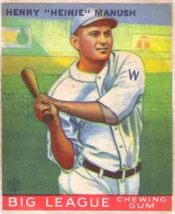 Manush reached the majors with the 1923 Tigers. The nickname Heinie was slang for Heinrich, a German form of the name Henry. Manush became a protege of his Tigers manager Ty Cobb, who taught him to shorten his stroke and try for hits instead of homers.
Cobb departed for the Athletics in February 1927 and Manush clashed with the replacement, George Moriarty. When his batting average dropped 80 points _ from .378 in 1926 to .298 in 1927 _ Manush was traded to the Browns.
Neck and neck
Goslin hurt his throwing arm in 1928 and was a liability in the outfield, but his hitting kept him in the lineup. He hit .450 (45 for 100) in the month of June and entered July with a batting mark for the season of .422.
Heading into September, Goslin (.376) and the Yankees’ Lou Gehrig (.373) led the batting race. Manush was at .355. Goslin and Gehrig had strong Septembers but Manush was otherworldly, hitting .495 (51 for 103) for the month.
On Sunday, Sept. 30, with the Senators playing the Browns at St. Louis on the last day of the 1928 season, the batting race became a showdown between Goslin (.379) and Manush (.377). Gehrig, with a game in Detroit, was at .372.
Pitching for the Browns against Goslin was George Blaeholder, 24, a right-hander in his first full season in the majors. Pitching for the Senators versus Manush was their ace, Sam Jones, 36, a right-hander who had been in four World Series.
Both Goslin and Manush were positioned in the No. 3 spots of the batting orders.
Fit to be tied
Manush put the pressure on early. In the first inning, Goslin struck out and Manush singled, putting each at .378. Both made outs in the fourth and remained tied at .377.
In the fifth, Goslin homered; an inning later, Manush tripled. Goslin grounded out to short in the seventh and Manush flied out to Goslin in the eighth.
With an inning to go and the Senators ahead, 7-1, Goslin and Manush both were batting .378 for the season.
Decisions, decisions
Goslin was due to bat second in the top of the ninth. Manush wasn’t likely to appear at the plate again, because he had six batters ahead of him in the bottom of the ninth. Therefore, whatever Goslin did likely would settle the batting race.
_ If Goslin got a hit, he would be batting champion.
_ If Goslin made an out, Manush would be batting champion.
_ If Goslin drew a walk, he and Manush would share the batting title.
_ If Goslin opted to be removed from the game, he and Manush would share the batting title.
In the book “The Glory of Their Times,” Goslin recalled that Senators manager Bucky Harris said to him, “What do you want to do, Goose? It’s up to you. I’ll send in a pinch-hitter if you want me to.”
Goslin replied, “I’ve never won a batting title, and I sure would love to, so I think I’ll stay right here on the bench, if it’s OK with you.”
According to Goslin, teammate Joe Judge warned, “They’ll call you yellow.”
Goslin thought about that and said, “All right, all right. Stop all this noise. I’m going up.”
A left-hander, Hal Wiltse, 25, was on the mound for the Browns. When the count got to 0-and-2, Goslin argued with umpire Bill Guthrie, calling him names and even stepping on his toes, hoping an ejection would negate the at-bat and preserve a share of the batting title, but Guthrie ordered him to stay put. “You better be in there swinging,” Guthrie warned.
Goslin took a pitch outside the strike zone, then stroked a double to right-center, moving his batting average to .379, one point ahead of Manush.
The Browns went down meekly in order in the bottom of the ninth, depriving Manush of a final at-bat. Manush, who led the majors in hits (241), finished at .378, the same average he had in winning the batting crown two years earlier.
Goslin became the Senators’ first league batting champion. Boxscore
Let’s make a deal
Both Goslin and Manush got into trouble with management in 1930.
According to the Washington Star, the relations between Goslin and Senators manager Walter Johnson were strained because of Goose’s failure to observe training rules.
According to The Sporting News, Manush and Browns owner Phil Ball “wrangled over salary” and Heinie “refused to attend a luncheon with Ball.”
On June 13, 1930, the Browns traded Manush and pitcher Alvin Crowder to the Senators for Goslin. “I am getting a slugger who hits home runs,” Browns manager Bill Killefer told the St. Louis Star-Times. “This park is made for Goslin.”
According to the St. Louis Post-Dispatch, the consensus of fans in St. Louis was that the Browns “were worsted in the bartering.” Star-Times columnist Sid Keener wrote, “I would not trade Manush for Goslin, even up.”
Two of a kind
In three seasons with the Browns, Goslin hit .317 with 71 home runs. He went back to the Senators and helped them reach the World Series in 1933. Traded to the Tigers, he played for them in the 1934 World Series against the Cardinals and the 1935 World Series versus the Cubs.
Goslin produced seven home runs and 19 RBI in five World Series.
Manush hit .328 in six seasons with the Senators. He and Goslin were teammates in the 1933 World Series versus the Giants. Manush later had stints with the Red Sox, Dodgers and Pirates.
For their careers, Manush batted .330 with 2,524 hits; Goslin batted .316 with 2,735 hits.
When Manush was elected to the Baseball Hall of Fame in 1965, Goslin told The Sporting News, “I have a right to be jealous. Manush makes it and I don’t. I led him in every department except average.”
Goslin’s turn came three years later with his election to the Hall.
Goslin and Manush remained linked to the end of their lives. Manush, 69, died on May 12, 1971. Goslin, 70, died three days later, on May 15, 1971.

 RetroSimba
How bizarre! The batting title battle and then dying within three days of each other. I love your eye Mark for noticing and relaying these connections to us.
I know batting average has sort of gone out of style, but whatever, I’m still a fan of batting average. OK, so it considers a home run and a single as the same, both as hits, but still, a hit’s a hit. I remember when Jose Reyes sat out the last game to win the title and me too, I was like – yellow.
I got a kick out of Goose’s strategy of taking the Babe out for drinks, to get him tired and then it backfiring on him. Never test the Babe in a bar! I’m reminded of that funny, but apparently true book – Secret Fighting Arts of the World.
I enjoyed your comments, Steve, and appreciate that you, too, were amazed by how Goose Goslin and Heinie Manush remained connected right up to the end.
When Manush won the American League batting title at .378 in 1926, Babe Ruth placed second at .372. For his career, Ruth hit .342, which shows what nonsense it is when some people today say players shouldn’t sacrifice power for batting average. The best big-leaguers should achieve both. Those who have diminished batting average do so to justify higher ticket (and merchandise) prices for lower standards of player performance.
I couldn’t agree with you more Mark and this post strikes me as perfect timing with Ichiro now in the HOF. He stands out as such an anomaly in 21st century baseball. I miss him already and can only hope that some up and coming players see him as a player to emulate.
I had no idea Ruth had such a high career BA or that he hit .372 in a season! He embodies exactly what you suggest – achieving both power and average. I guess in Ichiro’s case, the power was lacking, but still, I’d take him over the all power, whiff a lot players of today.
Total bases is the baseball stat that rates most important to me for hitters. Ichiro’s 3,994 total bases in the big leagues put him ahead of the likes of Orlando Cepeda (3,959), Joe DiMaggio (3,948), Larry Walker (3,904), Duke Snider (3,865), Joe Medwick (3,852), Johnny Bench (3,644), Mark McGwire (3,639) and Johnny Mize (3,621), to name a few.
That’s perfect. Says it all for me as far as Ichiro’s excellence is concerned. Thanks.
Today must be a lucky day as I got Mark and Steve damn near back to back in my WP scroll. :)
Thanks, Gary. Thought you’d enjoy knowing that there was a pro football defensive back named Goose Gonsoulin. He played for the Broncos and 49ers. As a rookie with the original Broncos in 1960, Goose made 11 interceptions in 14 games. His final season was 1967 with the 49ers. In a game against your Rams, he picked off a Roman Gabriel pass, setting up the first of John Brodie’s three TD passes for the 49ers.
According to the Associated Press, Goose had a fear of being cut from the roster, so he would pack all his clothes from his apartment for every road game. “Just in case,” he said. “If they ever said, ‘You’re not coming back,’ well, at least I had my stuff, right?”
No evidence of a NFL player being called Heinie, at least not without his facemask on.
What an incredible race for the batting title. I really enjoyed looking at their batting game logs for that season. Goose Goslin besides winning the batting championship closed out the season with an on base streak of 42 consecutive games. Heinie Manush had an incredible 367 total bases that season which was second only to Babe Ruth.
Delighted that you got engaged in the spirit of this incredible batting race, Phillip. Thanks for the data you provided.
I didn’t know that Goose Goslin reached base safely via hit or walk in each of his last 42 games of the 1928 season. The last time he didn’t was on Aug. 10 versus the 45-year-old right-hander of the A’s, Jack Quinn, who won 18 that season.
That figure of 367 total bases for Heinie Manush in 1928 is indeed incredible for a player who hit a mere 13 home runs. Instead, he had 47 doubles and 20 triples that season. What an exciting player he must have been to see. Just as incredible is the fact that Heinie’s 20 triples didn’t lead the league. Earle Combs of the Yankees had 21. What a shame we don’t see so many triples today. I think it’s a more exciting play than a home run.
On the morning of Sept. 24, with six days left in the season, Heinie was the leader in the batting race at .374, a point ahead of Goose. That day, though, Heinie was 1-for-5 against the A’s (Jack Quinn started), dropping his average to .373, and Goose was 3-for-4 against the White Sox, vaulting him ahead of Heinie at .376.