As a youth in small-town Texas, Bobby Joe Conrad would go to a vacant lot near his house and practice kicking a football. He taught himself to boot the ball high and far and straight. After a while, he was kicking footballs over the arching branches of a cluster of hackberry trees.
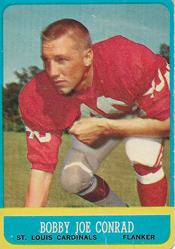 “I guess a lot of it came naturally,” he recalled to the Bryan-College Station Eagle.
Conrad could throw, catch and run with a football, too. There wasn’t much, actually, he couldn’t do on a football field. When Conrad got to college at Texas A&M, he was a quarterback, running back, receiver and defensive back.
Those kicking skills, though, are what first got him national attention.
Home on the range
Conrad was from the Texas town of Clifton, which was settled by Norwegian immigrants in the 1800s. Located along the Bosque River, 100 miles south of Dallas, Clifton’s population never topped 3,500. Conrad felt right at home there. “I never found any compelling reason to leave,” he told the Waco Tribune-Herald.
A standout prep quarterback, Conrad planned to attend Texas Christian but the arrival of head coach Bear Bryant at Texas A&M in 1954 changed his mind. “A&M wasn’t among my top five choices but Bear came up and sold me, not only sold me on himself but the school as well,” Conrad told the Fort Worth Star-Telegram.
As Conrad explained to the Waco Tribune-Herald, “The main thing I wanted was a college degree because no one in my family had one.”
Conrad found the position he liked playing best in college was receiver but Texas A&M didn’t pass much. So he mostly played cornerback and substituted at quarterback and at running back (behind John David Crow and Loyd Taylor). “I never did anything spectacular,” Conrad told the Bryan-College Station Eagle. “I just did my job wherever they wanted me to play.”
One of his best games came as a senior in 1957 when Texas A&M won at Missouri, 28-0. Conrad totaled 196 yards. He ran back the second-half kickoff 91 yards for a touchdown, rushed for 92 yards on 13 carries and caught a pass for 13 yards.
Conrad also did some kicking on extra-point attempts, sharing that duty with two teammates. It was his skill as a cornerback, though, that enticed the New York Giants to select him in the fifth round of the 1958 NFL draft.
Going pro
A fellow Texan and former cornerback, Giants defensive coordinator Tom Landry, signed Conrad. However, in May 1958, four months after they drafted him, the Giants swapped Conrad and Dick Nolan (future head coach of the San Francisco 49ers and New Orleans Saints) to the Chicago Cardinals for Lindon Crow and Pat Summerall (the future sportscaster).
Noting how being dealt to New York led to Summerall getting national broadcast opportunities, Conrad later quipped to the Belleville (Ill.) News-Democrat, “If it weren’t for me, Pat Summerall would be a Falstaff beer salesman in St. Louis.”
Soon after the trade, Conrad earned a business degree from Texas A&M. He would put that to good use, but first he wanted to give the NFL a try.
His first test would come as a member of the college all-star team in an exhibition against the reigning NFL champion Detroit Lions at Chicago in August 1958. Though projected to be a reserve defensive back in that game, Conrad practiced placekicking while home in Clifton during the summer in order to be ready if the all-stars needed kicking help.
Getting his kicks
Being prepared paid off for Conrad. At workouts with the college all-stars in Chicago, he surprised and impressed head coach Otto Graham with his placekicking skills.
According to the Clifton Record, Graham said, “I knew nothing about his kicking except that he had done some kicking off and kicked some extra points (in college) … Conrad simply kicked better than anybody else during our workouts.”
Though the college all-stars had Lou Michaels, a lineman who had been a good placekicker for Kentucky, and Wayne Walker, an Idaho linebacker who, like Michaels, would kick successfully in the NFL, Graham chose Conrad to do the placekicking against the Lions.
“I never kicked a field goal before in my life _ high school or college,” Conrad said to the Clifton Record. “I never even tried to kick a game field goal before.”
In addition to doing kickoffs and placekicking for the all-stars, Conrad started in the defensive secondary after Jim Shofner of Texas Christian injured an ankle.
Playing before 70,000 spectators at Chicago’s Soldier Field and a national TV audience on Aug. 15, 1958, Conrad booted four field goals (19, 44, 24 and 24 yards) and three extra points in a 35-19 victory for the college all-stars.
In explaining why he’d never tried to kick a field goal in college, Conrad told the Chicago Tribune, “At Texas A&M we either scored (a touchdown) or didn’t get close enough to attempt a field goal.” Video
Eight days later, Conrad’s 30-yard field goal with four seconds left enabled the Chicago Cardinals to salvage a 31-31 tie with the Baltimore Colts in a NFL exhibition game at Austin, Texas.
Conrad followed that with 16 points _ a 17-yard touchdown catch, two field goals and four extra points _ in the Cardinals’ 27-26 exhibition game win against the Los Angeles Rams at Seattle.
Mr. Versatility
Cardinals first-year head coach Pop Ivy liked what he saw from his versatile rookie. Ivy gave Conrad three roles with the 1958 Cardinals _ placekicker, defensive back and punt returner.
In the Cardinals’ regular-season finale against the Pittsburgh Steelers, Conrad intercepted three Bobby Layne passes. Game stats
For the season, he totaled 51 points _ six field goals and 33 extra points.
Conrad remained the Cardinals’ placekicker in 1959, but Ivy moved him from defense to running back. In the season opener versus Washington, Conrad scored three touchdowns (35-yard run on a double reverse, 56-yard run and five-yard catch) and kicked seven extra points for a total of 25. Two of his touchdowns came in the second half when he played with a broken nose. Game stats
Conrad’s scoring total for the 1959 season was 84 points. He threw a touchdown pass (52 yards to Joe Childress against the Steelers) and returned a punt for a touchdown (69 yards versus the Giants). He also scored two touchdowns rushing and three receiving, and kicked six field goals and 30 extra points.
“You never could tell where I was going to be, or what I was going to do, throughout my football career,” he said to the Bryan-College Station Eagle.
The Cardinals relocated from Chicago to St. Louis in 1960 and Conrad no longer was the primary placekicker. Two years later, when Wally Lemm replaced Pop Ivy as head coach, Conrad became a fulltime receiver, moving to the flanker position, and he excelled in the role.
“Bobby Joe was a natural at flanker,” Cardinals quarterback Charley Johnson told the Waco Tribune-Herald. “He ran very precise patterns which made him hard to cover. He wasn’t afraid to go over the middle. Not every receiver was like that.”
Conrad had consecutive seasons of 62 catches (1962), a NFL-leading 73 (1963), 61 (1964) and 58 (1965). He caught passes in 94 straight games. Video at 3:10 mark
Conrad’s last season with the Cardinals was 1968. He ended his playing career with the 1969 Dallas Cowboys.
Back in Clifton, he raised cattle on 630 acres. Then he became a bank executive for 16 years. In 1994, Conrad was elected Bosque County judge and served eight years before retiring in 2002.

 RetroSimba
The Big Red’s three outstanding pass catchers of the 1960s-Conrad, Sonny Randle and Jackie Smith-finished their careers with the hated Cowboys.
Good point. Thanks for that.
After Charley Winner took over as Cardinals head coach in 1966, Bobby Joe Conrad got fewer receptions as the club gave playing time to receivers such as Billy Gambrell and then Dave Williams. Conrad was being used more often as a decoy. Just before Conrad was sent to the Cowboys to be a backup to Bob Hayes and Lance Rentzel, Cardinals placekicker Jim Bakken presented him with a duck decoy signed by his teammates. It read: “To Bobby Joe Conrad, decoy of the year, 1968.” When a reporter for the Fort Worth Star-Telegram visited Conrad in his office years later, he noticed that the duck decoy was the only memento Conrad displayed from his NFL days.
What a player and person. I enjoyed, as always how you include beautiful details like him as a kid kicking balls “over the arching branches of a cluster of hackberry trees.” To read how he developed into a successful player gives his tale legendary status. I got a kick out of Bobby Joe saying that if it weren’t for him, Pat Summeral would be selling Falstaff beer. Has there ever been a player with that much ability in so many different football ways? Amazing.
I’m so glad you “got a kick” out of reading the story, Steve. I, too, liked the sense of humor Bobby Joe Conrad displayed with his line about Pat Summerall. In doing the research, I learned that Bear Bryant had quite a positive influence in helping Conrad grow as a person. In a 1984 interview with the Bryan-College Station Eagle, Conrad said of Bryant, “He taught more discipline than football … Under Bryant, you learned to make yourself do things, to work hard. You didn’t put off today and do it tomorrow.”
oooh, what a great nugget. i could sure integrate some of that wisdom. get me getting busier. thanks.
Another great Big Red player from the 60’s who never made it to the playoffs. Too bad they didn’t have wildcard teams during that era. With a couple of those football Cardinals teams you never know what might have happened. The 254 pass receptions that Bobby Joe Conrad had from 1962 to 1965 ended up being the most receptions over a four year period for any St.Louis Cardinals receiver. The story surrounding his consecutive streak of 94 games in which he caught a pass is pretty interesting. And as always I really appreciate that Bobby Joe Conrad went on to have a successful life after retiring.
Thanks for the insights, Phillip. As a fan of St. Louis sports, I thought you’d also appreciate this connection: Bobby Joe Conrad and Gene Stallings were Texas A&M teammates in 1955 and 1956. Stallings was a receiver then. In 1966, when Stallings was head coach at Texas A&M, Conrad helped coach the team’s receivers during spring practice. Stallings was the last head coach of the NFL St. Louis Cardinals.
Another excellent story, Mark! Bobby Joe was such an underrated receiver for the Cardinals. He was their all-time leading pass catcher until Jackie Smith broke the record in 1973. His Summerall quote reminded me of one made by another Big Red receiver, Sonny Randle, who joked that Jay Randolph “would have been without a job if I hadn’t been traded to San Francisco.” Randolph of course took Randle’s job at Channel 5 and worked there for about 30 years.
Thanks, Bob. Your insights and support are appreciated.
I thought you’d find interesting this additional bit of info I stumbled upon in the research: Asked by the Paducah (Ky.) Sun to name the best defensive backs he faced in the NFL, Bobby Joe Conrad picked Cornell Green and Erich Barnes.
I remember you wrote a story about Erich Barnes a few years ago. He and Bobby Williams got into it late in a game in the mid-60s!