Technically, John McGraw turned down an offer to manage the Cardinals. Actually, though, he was their de facto manager for part of a season.
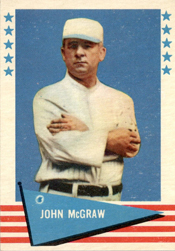 The question of whether McGraw was or wasn’t the Cardinals’ manager made headlines in August 1900. After manager Patsy Tebeau resigned, Cardinals president Frank Robison said publicly that McGraw, the Cardinals’ captain and third baseman, agreed to be player-manager. McGraw said Robison was mistaken.
A peculiar compromise was reached: A member of the Cardinals’ business staff, Louis Heilbroner, who had no baseball experience, became manager and sat on the bench in that role during games. McGraw made out the lineups, decided which pitchers to use and ran the team on the field.
“It appears McGraw is manager with a scapegoat in the person of Mr. Heilbroner … in case he fails to make the team win,” the St. Louis Republic declared.
Two months later, after the Cardinals went 23-25 in the 48 games managed by the Heilbroner/McGraw tandem, McGraw departed St. Louis for Baltimore. He eventually went on to become manager of the New York Giants, attaining three World Series titles and 10 National League pennants.
McGraw totaled 2,763 wins, though none were credited to him for his role with the Cardinals. Only Connie Mack (3,731) and Tony La Russa (2,902) achieved more wins as managers.
Good times, bad times
Born and raised in Truxton, N.Y., a village 65 miles west of Cooperstown, McGraw was 12 when his mother and four of his siblings died in a diphtheria epidemic. He moved in with a neighbor to escape a father who beat him.
Advancing from local sandlot baseball to the professional ranks, McGraw was 18 when he reached the majors with the 1891 Baltimore Orioles. He began as a utility player before developing into “a brilliant third baseman … who brought a keen, incisive mind to the national game, a fighter of the old school whose aggressiveness inspired his teammates,” according to the New York Times.
Nicknamed Little Napoleon by the press and Mugsy by his foes, McGraw, 26, became player-manager of the 1899 Orioles. In August, his wife, Mary, 22, died of acute appendicitis. After the season, the Orioles, a National League franchise, disbanded, and McGraw went to play for the Cardinals when the club agreed to waive from his contract the reserve clause which bound a player to a team.
Joining a club that featured three future Hall of Fame players _ left fielder Jesse Burkett, shortstop Bobby Wallace and pitcher Cy Young _ McGraw played third base and ignited the offense. His .505 on-base percentage was tops in the league. He totaled 115 hits, 85 walks and was plunked by pitches 23 times. McGraw struck out a mere nine times in 447 plate appearances.
Yet, the 1900 Cardinals were underachievers, losing 15 of 20 games in June. As the St. Louis Republic noted, “Baseball players are nervous, sensitive mortals … Despite all the hot air about … every man … pulling hard to win … it is a cinch that one-third of the team has no use or love for the other two-thirds.”
Big change is coming
The Cardinals staggered into August with a 34-42 record. Manager Patsy Tebeau had seen enough.
Born in north St. Louis near 22nd and Branch streets, Oliver Wendell Tebeau learned baseball on the Happy Hollow diamond beneath Goose Hill and became a member of the Shamrock Club team, earning the Irish nickname Patsy despite a French-Canadian surname. He went on to be a standout first baseman in the majors and managed the Cleveland club before going back to St. Louis.
Tebeau submitted his resignation to Cardinals president Frank Robison in early August 1900. Robison asked Tebeau to reconsider and to at least finish the season as manager, but Tebeau was obdurate. He and Robison agreed to stay mum about the decision until a replacement could be found.
Robison offered the job to McGraw.
On Aug. 19, 1900, the Reds won at St. Louis, 8-5, dropping the Cardinals’ record to 42-50. Afterward, Robison met in his office with seven St. Louis newspaper reporters and told them Tebeau had resigned and McGraw had accepted an offer to replace him. “Mr. McGraw will manage the club in Mr. Tebeau’s place,” Robison said. “He will have full charge of the team on the field.”
Robison also told the reporters that his secretary, Louis Heilbroner, would be business manager, acting as Robison’s representative on road trips.
That night, a St. Louis Republic reporter tracked down McGraw at the Southern Hotel, where he stayed. “I have accepted the management of the St. Louis club,” McGraw told the newsman.
Not so fast
The morning newspapers on Aug. 20 reported McGraw was manager of the Cardinals, but McGraw told the afternoon St. Louis Post-Dispatch a different story. He claimed he rejected Robison’s offer. “I would not be doing myself justice to accept the management of the team at the present time,” McGraw said to the Post-Dispatch. “I would be held responsible for any shortcomings that the team might show, and I do not care to accept this responsibility.”
As the St. Louis Republic saw it, “McGraw is evidently a bit leery of … trying to make a silk purse out of a sow’s (ear), of converting a losing team into a winning one. Though the team is strong enough to win, it is badly disorganized and full of cliques. McGraw is not sure of his ground. He doubts the fidelity of his men.”
To appease McGraw, Frank Robison and his brother, club treasurer Stanley Robison, named Louis Heilbroner as manager but all agreed McGraw would run the team on the field.
“Mr. McGraw has complete charge of the team,” Heilbroner told the St. Louis Republic. “He can … change any player, bench any player, do as he pleases with the men on the field. At least that is my understanding.”
Stanley Robison said to the Post-Dispatch, “McGraw … will have entire charge of the players when on the field. He will place the pitchers and his orders will govern their conduct during the game. Louis Heilbroner … will occupy the manager’s seat on the bench but he will not in any way interfere with McGraw’s orders.”
Most comfortable dressed in a buttoned shirt with collar and cuffs, Heilbroner was 4-foot-9, barely weighed more than 100 pounds and had a “thin, piping voice,” according to the Post-Dispatch. Many of the players he was tasked with managing had reputations for being roughnecks.
Labeling Heilbroner, 39, as “simply a straw man,” the Republic added, “Everyone knows that Mr. Heilbroner makes not even the ordinary fan’s pretensions to knowing baseball. He is a capital business man, a first-class fellow, but he does not know baseball.”
Home alone
That afternoon, Aug. 20, “not more than 800 enthusiasts” showed up at League Park to see the visiting Reds play the Cardinals, the St. Louis Globe-Democrat reported. According to the Republic, “not enough persons were in the stands to start a game of pinochle.”
Not even McGraw was a spectator. He stayed in the clubhouse, claiming he was “under the weather,” the Globe-Democrat reported, and leaving poor Heilbroner to fend for himself in his debut as manager.
Heilbroner did a sensible thing: He gave the ball to Cy Young. Unfortunately, Young’s pitching didn’t earn any awards that day. He gave up 11 runs and was heckled from the stands before Heilbroner lifted him after six innings.
Young “dressed hurriedly and sought to even up matters in some way,” the Republic reported. “He hied himself to the grandstand and picked out a spectator who had called him a rank quitter … (Young’s) wife was seated beside the individual who roasted him while he was on the rubber. The spectator took Cy’s scolding and slunk away without making a reply.”
The Reds won, 15-7, but as the Post-Dispatch noted, “Mr. Heilbroner is not losing any sleep over the situation. He sat on the players’ bench and seemed to enjoy the game. He does not pretend to know anything about baseball from a playing standpoint (and) virtually admits that he is a figurehead.”
McGraw sat alongside Heilbroner on the bench the next day, Aug. 21, and the Cardinals beat the Reds, 9-8.
One and done
McGraw was one of two future Hall of Fame managers playing for the 1900 Cardinals. The other was his friend, catcher Wilbert Robinson, but Heilbroner remained Cardinals manager until season’s end. The Cardinals finished at 65-75 _ 42-50 with Tebeau and 23-25 with Heilbroner.
(According to John Wray of the Post-Dispatch, Heilbroner wasn’t a pushover during his stint as skipper. After Heilbroner rejected a request from pitcher Jack Powell for a pay advance, “Powell started to stuff Louie into the safe but changed his mind when the little man confronted him with such a barrage of language and threats that Big Jack fell back.”)
Because the Cardinals had waived the reserve clauses in the contracts of McGraw and Wilbert Robinson as incentive to come to St. Louis, both men became free agents after the 1900 season. McGraw returned to Baltimore, becoming part owner and player-manager of the new Orioles franchise in the American League. Robinson went with him.
In July 1902, McGraw jumped from the Orioles to the Giants and had his greatest successes, building a reputation as “the molder of championship clubs, a stickler for discipline and a martinet who saw that his orders were rigidly enforced both on and off the field,” the New York Times noted.
Patsy Tebeau never returned to baseball after leaving the Cardinals. He ran a popular saloon on North Sixth Street in St. Louis, but became despondent after his health deteriorated and his wife left him. He committed suicide at 53.
Outfielder Patsy Donovan replaced Louis Heilbroner as Cardinals manager for the 1901 season.
Heilbroner went on to scout for the Cardinals and St. Louis Browns before operating a respected baseball statistical service. He published the annual Baseball Blue Book of statistics and records. “His statistics did as much to build up the game as any one factor,” the Globe-Democrat reported.

 RetroSimba
Thanks for this Mark. Wonderfully written. I have such a better understanding of McGraw, his upbringing and all that meant in the shaping of his personality.
I’ve never thought of managing a team in the way McGraw did, so hesitant initially from fear of failing and how excellent for all of us that he took a risk and went for it. There’s a book by I think Frank Deford about McGraw and Mathewson and their connection and if i remember right, they couldn’t have been more different in terms of personality. That sticks with me in this life, to never know for sure who we will become friends with. It can happen so suddenly. That connection. Rare, but always possible.
Anyway, that quote about cliques also interested me. It’s not something teams seem to readily admit unless it’s a happy place; then we hear the we are family slogans though I read somewhere that those 79 Pirates had cliques too, even fights between players. I’ll have to reread the book to be sure about that one.
That August 20th afternoon could be a movie. My jaw kind of dropped after reading Mr. Heilbroner ‘s height and weight.
I enjoyed your analysis, Steve. It’s like getting a bonus post from you. Thanks for taking the time to do it.
I know what you mean about getting a better understanding of John McGraw. The deaths of his mother, sibling and wife. The father issue. Enough to harden a person.
Most of the St. Louis newspapers were understanding of why McGraw opted not to be named Cardinals manager. One of the best explanations came from the St. Louis Post-Dispatch: “The (Cardinals) players were not trained according to his ideas. They have not been playing the game that conforms to his Baltimore methods and he was cognizant of the fact that it would take some time to educate them to those methods.”
That clubhouse mix with the 1900 Cardinals did seem toxic. Patsy Tebeau told the St. Louis Globe-Democrat that “the team would not play winning ball for him” and claimed that “a cabal of players” had tried to oust him for the purpose of having McGraw succeed him.
The St. Louis Republic concluded, “Ballplayers are like actors. When a lot of stars get into one company, there always is trouble because of jealousy. There are 4 or 5 stars on the St. Louis club who think themselves just as indispensable to its success as McGraw.”
Very interesting. Too many chefs in the kitchen apparently applies to baseball too.
There sure is a lot to research on this post. Sorry to hear about the sad tragic ending of Patsy Tebeau. That annual publication by Louis Heilbroner brings back wonderful childhood memories. I was one of those kids who could spend hours devouring sports encyclopedias and sports yearbooks. That 1900 Cardinals team actually had quite a few good players unfortunately it didn’t show up in the won lost record. The on base percentage that John Mcgraw had that year is phenomenal.I would love to see if I could find his batting game logs for that year.Setting aside the tainted numbers of Barry Bonds the only other NL player to end the season with an OBP over .500 was Rogers Hornsby in 1925.
Thanks for enhancing the post with your comments, Phillip.
I, too, was saddened to learn of the tragic death of Patsy Tebeau. He certainly had the respect of Frank Robison, who told the St. Louis Republic in August 1900, “Did he wish it, he could be manager of my team as long as he lived.”
I share your lifelong enjoyment of sports encyclopedias and yearbooks. As a kid (and, yep, as an adult), I’d study and memorize the stats on the backs of bubblegum cards, too.
I’m so glad you appreciated that on-base percentage of John McGraw. What makes his performance that season even more astounding is that he didn’t want to be in St. Louis and wasn’t at full health. “McGraw has not been a well man since coming to St. Louis,” the St. Louis Post-Dispatch reported in August 1900. “The water and climatic conditions have not agreed with him and he’s, in consequence, run down.”
In the book, “The Spirit of St. Louis,” author Peter Golenbock wrote, “McGraw and (Wilbert) Robinson were Baltimore fixtures who hated the idea of abandoning their hometown. Both swore to quit the game rather than move to St. Louis … McGraw and Robinson had hated their year in St. Louis.”
However, after McGraw decided in October 1900 to leave the Cardinals and join the new Baltimore Orioles club in the American League, the St. Louis Globe-Democrat noted, “St. Louisans will be sorry to lose McGraw. Though located here but five months … he showed Missourians that he knows the game, is its most adept exponent, and that in control with the proper men around him his efforts would be bound to be crowned with success.”
McGraw has a career on-base percentage of .466. Only Ted Williams (.482) and Babe Ruth (.474) have higher career OBPs, according to baseball-reference.com.
P.S.: Check out the 1894 on-base percentages of Hugh Duffy of the Boston National League team and Joe Kelley of the Baltimore National League team. Each had a .502 on-base percentage that year, according to baseball-reference.com.
What a fascinating deep dive… I really enjoyed how you wove together not just McGraw’s complicated role with the Cardinals, but also the personalities, tensions, and even the humor of the era. The detail about Heilbroner being only 4-foot-9, sitting on the bench as a “straw man,” really brought the scene to life and highlighted the absurdity of the arrangement.
I’m grateful for your comments, Gary. So glad you enjoyed this.
The whole soap opera was great fodder for the St. Louis newspapers. At one point, Cardinals president Frank Robison asked John McGraw whether Louis Heilbroner should sit on the bench during games. According to the St. Louis Globe-Democrat, McGraw replied, “Certainly, that’s the place for the manager, always.”
The St. Louis Republic noted, “Mr. Heilbroner has nothing to lose. He makes no pretensions to baseball knowledge. He does not know a base hit from a foul flag … He knows his business.”