Like a fabled Wild West gunslinger fast on the draw, Sonny Jurgensen had the quickest release of any quarterback.
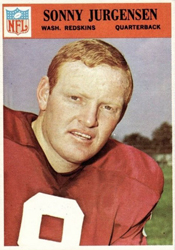 “Swaggering onto the field and then back into more or less a pocket, he would pump quickly and release,” Gordon Forbes of the Philadelphia Inquirer observed. “The ball would spiral beautifully, like a horizontal top, sometimes incredibly close to the defenders and almost always against the chest of (the receiver).”
“He never puts his body into a throw,” receiver Pete Retzlaff told the Philadelphia Daily News. “He uses the arm, and that’s all. That’s why he can get rid of the ball so fast when he’s falling down or being tackled.”
Yet, for all his considerable skill in mastering the release, not even Jurgensen could overcome porous pass protection and a savage St. Louis Cardinals blitz.
In a 1964 game against the Cardinals, Jurgensen was sacked eight times _ the most sacks he suffered during 18 seasons in the NFL.
One of football’s all-time best passers as well as a notorious bon vivant, Jurgensen was 91 when he died on Feb. 6, 2026.
Name of the game
Christian Adolph Jurgensen III was from Wilmington, N.C. Everyone called him Sonny. As Jack Kent Cooke, who owned the Washington NFL franchise, told the Los Angeles Times, “Sonny Jurgensen is a perfect juxtaposition of words. Sonny Jurgensen. It rolls. It’s euphonious.”
At New Hanover High School (also the alma mater of Roman Gabriel), Jurgensen was captain of the football, basketball and baseball teams. He played college football at Duke and his poise and pin-point passing carried the Blue Devils to road wins against Ohio State and Tennessee.
According to the Durham Herald-Sun, Duke backfield coach and former NFL standout Ace Parker told Philadelphia Eagles general manager Vince McNally, “Jurgensen is one of the finest pro quarterback prospects I’ve seen in years.”
The Eagles chose Jurgensen in the fourth round of the 1957 NFL draft, but at his first training camp, “I was like a scared rabbit,” the quarterback recalled to the Philadelphia Daily News.
Jurgensen made four starts his rookie season but then Norm Van Brocklin arrived from the Los Angeles Rams and became the Eagles’ No. 1 quarterback. For three seasons, Jurgensen sat and learned from the Dutch master. Van Brocklin “had a tremendous influence on my career,” Jurgensen told the Daily News.
After leading the Eagles to the 1960 NFL title, Van Brocklin turned to coaching, taking over the Minnesota Vikings. His understudy, Jurgensen, stepped up to the starting role with Philadelphia.
Good times roll
Jurgensen liked to have fun and was fun to watch _ cool, bold, with a gambler’s disposition on the field. “When Sonny Jurgensen walks, you can hear the dice rattle,” Bruce Keidan of the Inquirer wrote.
Once, while wrapped in the arms of defensive tackle Bob Lilly, Jurgensen was about to go down when he slung a behind-the-back pass to Pete Retzlaff for a gain of 14 yards. Another time, according to Jack McKinney of the Daily News, Sonny was “rushed from the right, switched the ball to his left hand, stiff-armed the defensive end and drilled a pass, left-handed, to Billy Barnes” for 12 yards.
There seemed something special about everything Jurgensen did. As Ray Didinger of the Daily News put it, “The way he knelt in the huddle, picking at the grass as he called the next play. The way he swaggered to the line, looking over the defense with those smirking, pool hustler eyes.”
Jurgensen had the panache of a quarterback but the paunch of an offensive lineman. “He had this belly that spilled from beneath his numeral 9 like flour from a torn sack,” wrote Ray Didinger. Bob Quincy of the Charlotte Observer noted, “He excused his belly as his only sure blocker.”
“The paunch is deceptive,” Jurgensen told Shirley Povich of the Washington Post. “It’s simply the way I’m built.” Or, as he said to the Inquirer, “You don’t throw the ball with your stomach.”
The heavy belly was offset by a light heart. He liked a good laugh and looked for a good time. Once, when the Eagles were stinking up the field during a home game, frustrated fans began a chant, demanding Jurgensen’s backup, King Hill. “The only thing I resented about it was I noticed my wife was leading it,” Jurgensen said to the Inquirer. “”She’s a King Hill fan.” A Washington Daily News reporter once complimented Sonny on appearing thinner and asked what diet he was on. “Cutty Sark and water,” Jurgensen replied.
Beer was a favorite, too. “Sonny has a warm spot in his heart for malt, hops and barley,” Bruce Keidan wrote, “and years of indulging that affection have left him looking as though he recently swallowed a keg of draft, barrel and all.”
Bob Quincy noted, “Jurgensen diligently trained in nightclubs and corner pubs, cool retreats where he could strengthen his elbow.”
With the Eagles, Jurgensen twice led the NFL in passing yards. He also threw a league-best 32 touchdown passes in 1961. (The only Eagle with more touchdown tosses in a season is Carson Wentz, with 33 in 2017.) In a 1962 game versus the Cardinals, Sonny had five touchdown throws, including three to Tommy McDonald. Video
Joe Kuharich became the Eagles head coach in 1964 and he wanted a different quarterback. When Jurgensen was traded to Washington for quarterback Norm Snead, “the bartenders in Philadelphia all wore black arm bands,” wrote Dave Burgin of the Washington Daily News.
Run for your life
The Washington team Jurgensen joined was a mess. “He played for Washington when a solid offensive block was rarer than a tax cut,” Bob Quincy wrote.
On Sunday afternoon, Oct. 4, 1964, while the baseball Cardinals were beating the Mets in St. Louis to clinch the National League pennant on the last day of the season, the unbeaten football Cardinals were at District of Columbia Stadium to play winless Washington.
It was a dark, rainy day in D.C. and the mood of the fans matched the weather. Jurgensen and his teammates were jeered and booed during player introductions. Then, early in the game, Washington’s best offensive lineman, guard Vince Promuto, injured a knee and was unable to continue. The Cardinals capitalized, sending blitzers in waves against the overmatched Washington line.
According to the Charlotte News, the Cardinals were “blitzing one, two, and sometimes even three, linebackers on the same play.” Cardinals head coach Wally Lemm told the St. Louis Post-Dispatch, “That’s the most (blitzing) we’ve done in some time, but we had to do it against a quick thrower like Jurgensen.”
Blockers provided “horrible protection for poor Sonny,” the Washington Daily News reported, and, even with a quick release, Jurgensen couldn’t escape the rush. In addition to being sacked eight times for losses totaling 66 yards, he was intercepted twice. Pat Fischer returned one of the picks for a touchdown.
In the fourth quarter, with the Cardinals ahead, 21-10, the angry crowd screamed for backup quarterback George Izo. Coach Bill McPeak gave the people what they wanted. On Izo’s first play, he was sacked for a safety. The Cardinals won, 23-17. Game stats
“Gee, fellas, even The Almighty needs time to throw the ball,” Jurgensen said to the Philadelphia Daily News.
(Sonny got his revenge. In a 1965 game at St. Louis, he completed 12 of 14 passes, including three for touchdowns, and was sacked just twice in a 24-20 Washington victory. Game stats)
Odd couple
When Otto Graham, the straitlaced former Cleveland Browns quarterback, became Washington head coach in 1966, Jurgensen quipped to the Daily News, “I hear he’s a stickler for discipline _ a non-smoker, a non-drinker and a non-cusser. We ought to get on famously. There are only a few of us left.”
Jurgensen thrived, though, on the field. During Graham’s three seasons with Washington, Jurgensen twice led the NFL in completions and passing yards. He also threw a league-best 31 touchdown passes in 1967. That remains the Washington franchise single-season record.
“He can throw as well as anyone I have ever seen, barring none,” Graham told the Inquirer. “He’s a student of the game. He knows more football than I do, I think.”
Jurgensen alone, however, couldn’t make Washington a winner. The franchise hadn’t achieved a winning season since 1955, when Jurgensen was in college.
Then Vince Lombardi arrived.
Golden arm
Lombardi was a Sonny Jurgensen fan. He admired Jurgensen’s quick release and accuracy. With the Green Bay Packers, Lombardi won five NFL championships. Bart Starr was his quarterback. In the book “When Pride Still Mattered,” Lombardi biographer David Maraniss wrote, “Starr had been his brain on the field, the most committed and disciplined of his ballplayers, but in terms of pure talent he was not in the same category as Jurgensen.”
At first Jurgensen worried his fondness for fun would anger Lombardi, but as David Maraniss noted, “Jurgensen’s reputation as a playboy did not bother Lombardi. If anything, it reminded him of his favorite son in Green Bay, Paul Hornung. (Hornung) might break curfew, but he had uncommon talent and did not waste it. He was the best money player Lombardi had coached.”
Hornung, the Golden Boy, told Jurgensen, the Golden Arm, “Sonny, you’re going to love the guy.”
Lombardi immediately showed confidence in the quarterback, treating him like a leader. Jurgensen, in turn, bought in to Lombardi’s system. “It placed the emphasis on reading the defense and giving the quarterback fewer plays but more options,” David Maraniss noted. “As soon as Jurgensen got into Lombardi’s system, the game seemed to slow down. What had been chaotic suddenly made sense; everything became clear and comprehensible.”
Jurgensen led the NFL in completions and passing yards in his season with Lombardi, and Washington achieved a winning season in 1969. Its 7-5-2 record (including a 33-17 thumping of the Cardinals) was much like the 7-5 mark Lombardi posted in his first season at Green Bay in 1959.
In one year, Lombardi had turned the Washington franchise into a winner, but he didn’t live to coach another season. He died in 1970 at 57.
With George Allen as head coach, Washington became a perennial contender. The team became NFC champions in 1972, but Jurgensen tore an Achilles tendon in Game 6 and Billy Kilmer took over. Jurgensen watched on crutches from the sideline as the Miami Dolphins completed a perfect season with a 14-7 triumph over Washington in the Super Bowl. Washington fans were left to wonder what might have been if Jurgensen had played.
Two years later, in 1974, when Jurgensen was in his last season as a backup to Kilmer, George Allen gave him a start against the Dolphins. Jurgensen completed 26 passes for 303 yards and two touchdowns, leading Washington to a 20-17 victory. “I was 40 years old but I felt 16 that day,” Sonny recalled to the Philadelphia Daily News.
Jurgensen was elected to the Pro Football Hall of Fame in 1983 and became a popular Washington sportscaster, partnering with former linebacker Sam Huff for highly entertaining radio broadcasts of Washington football games.

 RetroSimba
This one is packed with so many great sentences and humor. That Jurgensen learned so much Van Brocklin “a tremendous influence” reminds me of something you mentioned the other day Mark, about passing on what you’ve learned from others. It’s a wonderful baton transfer that we see play out in various olympic events.
This is my new favorite quote – “When Sonny Jurgensen walks, you can hear the dice rattle” It’s like the danger some people possess, to knock us out of complacency and off our comfort thrones.
There’s something special about seeing a quarterback avoid tacklers….clearing away doubts and other invasive thoughts and being ready for what’s right in front of us – a receiver with a step heading for the end zone!
How hilarious – his wife calling for the back up quarterback and the paunch, beer, a Babe Ruth legend! and then the arm bands after he got traded. What a great guy. Beers in heaven! Great post Mark.
Thanks, Steve. This one was a pure pleasure to research. I’m glad you appreciate Bruce Keidan’s great line about Sonny Jurgensen. Sonny seemed to bring out some of the best writing from the columnists I came across in my research.
Regarding mentor Norm Van Brocklin, Jurgensen told Dave Burgin of the Washington Daily News, “As a passer Norm had that innate thing of knowing exasctly when to cut loose. Range and accuracy just seemed to be built in with Norm.”
Bob Quincy of the Charlotte Observer summed up Sonny this way: “He often had as much fun on the field Sundays as he did on Saturday nights.”
It’s interesting that the fun loving Sonny Jurgensen didn’t appear to have any personality conflicts with Norm Van Brocklin and Otto Graham who were both somewhat disciplinarians. Actually, the fact that Sonny Jurgensen learned from both of them and thrived proves that even though Sonny liked to have a good time he was serious about his football. The question of whether or not he would have been able to lead the Redskins to victory in Super Bowl VII will probably be forever asked. What really gets me though is how highly Vince Lombardi thought of him.
Thanks for your astute comments and observations, Phillip.
“I’ve always had a serious approach to football,” Sonny Jurgensen said to the Philadelphia Inquirer. “It may have been misinterpreted because of my personality. I like to joke and have fun and cut up.”
In the book “When Pride Still Mattered,” biographer David Maraniss wrote that Lombardi studied game films of the Washington players after being named head coach. The films confirmed Lombardi’s impression that Jurgensen was the best pure thrower he had ever seen. “My God,” Lombardi was heard saying in the darkness of the film room one day. “If we’d had him in Green Bay…”
Another great story Mark!
I remember Sonny making one big mistake in a 1974 loss to the Big Red at Busch. He threw a pick-6 to Roger Wehrli on his first pass of the game and the Skins lost 23-20. He claimed that he was trying to throw the ball away and was surprised as anyone that Wehrli was there.
Sonny was a great one and he and Jim Hart became very close friends after football.
Thanks for the keen insights, Bob.
That story you told about Roger Wehrli illustrates what a smart and talented defensive back he was, and how he was able to adapt. Five years earlier, in October 1969, when Wehrli was a rookie, he told the Washington Daily News, “Jurgensen releases so quick, you don’t have a chance to intercept or anything. The ball doesn’t have any arch to it, so you don’t have a chance to get in front of it.”
It’s good to know Jim Hart and Sonny Jurgensen were friends. I noticed that Jurgensen died in Naples, Florida. I believe Jim Hart resides in that town, too,
Yes, Jim still lives in Naples. I think Mike Ditka is down there too. I believe they used to all play golf together.
Seems like quite an endearing character. In addition to all his accomplishments he seemed unusually consistent despite all the changes going on around him.
Quite true. The Philadelphia Inquirer described Sonny Jurgensen as “irrepressible.” The Philadelphia Daily News called him an “uninhibited artist.” The Charlotte Observer summed him up this way: “talent, showmanship, courage.”
Outstanding stuff; I always read you, as you know. I happened to speak with David M, the author of that Lombardi bio. I plan to read it after I write an article on Clemente. My piece, for a Catholic magazine, will argue that Roberto should be a saint and have his number retired throughout baseball, like Jackie Robinson’s. I spoke with David, as I said, and he gave me some cool quotes.
If you’d like I’ll send you a copy of my report on Clemente. Take care.
bill townsend
Thank you, Bill!
That’s quite an intriguing premise for your magazine article. I wish you success with it. I would like to read it. I’ll send you my home address.
You are smart to contact David Maraniss. I respect his skill as a writer and researcher. You will enjoy his biography of Vince Lombardi. The part about the Jesuit influence on Lombardi’s philosophies is especially insightful.
Also in that biography, Maraniss reveals that Lombardi could have been Sonny Jurgensen’s coach with the Philadelphia Eagles. According to Maraniss, after the 1957 season, when Lombardi was a New York Giants assistant, he accepted an offer to become head coach of the Eagles. Giants owner Wellington Mara responded by promising to match the $22,500 salary the Eagles were offering and increase Lombardi’s life insurance policy to $100,000. Lombardi went to St. James Roman Catholic Church in Red Bank, N.J., sat in the pew for several hours and, when he emerged, told the Giants he would stay with them.