Famous for the Hollywood ending he brought to a World Series, Bill Mazeroski was a natural for a part in a movie.
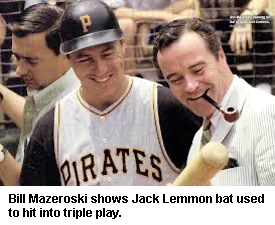 Seven years after hitting a walkoff home run for the Pirates in the ninth inning of Game 7 in the 1960 World Series against the Yankees’ Ralph Terry, Mazeroski was hired to make an out in the film “The Odd Couple.” Actually, the role required he make three outs _ with one swing.
Two ex-Cardinals, Ken Boyer and Jerry Buchek, had parts, too.
An eight-time National League Gold Glove Award winner at second base during his 17 years (1956-72) with the Pirates, Mazeroski was elected to the Baseball Hall of Fame in 2001. He was 89 when he died on Feb. 20, 2026.
Casting calls
In 1967, filming began for “The Odd Couple,” a comedy about two bachelors sharing a New York apartment. Walter Matthau played a sportswriter slob, Oscar Madison, and Jack Lemmon was the persnickety roommate, Felix Unger.
One scene had Oscar covering a baseball game for his newspaper. At the crucial point of the game, with the score 1-0 and the bases loaded in the bottom of the ninth, a press box phone rings. Sports reporter Heywood Hale Broun, playing himself, answers. The caller asks for Oscar and says it’s an emergency. Oscar reluctantly leaves his seat and takes the receiver. The caller is Felix. He tells Oscar he’s planning to make frankfurters and beans for dinner, so skip the ballpark hot dogs. As Oscar’s back is turned, the batter hits into a rare game-ending triple play. Oscar screams at Felix for causing him to miss the key moment in the game for such a trifling phone message.
The filmmakers arranged for the scene to be shot at New York’s Shea Stadium before the start of a Tuesday afternoon Pirates vs. Mets game on June 27, 1967. Seeking authenticity, they opted to use major-league players for the triple play segment on the field rather than actors. Each player participating received $100, the Screen Actors Guild minimum at the time.
Pirates outfielder Roberto Clemente was offered the role of the batter who hits into the triple play, but he declined. “They will use my name in the movie and exploit me for $100,” Clemente said to The Pittsburgh Press. “Not for me.”
Clemente told the New York Daily News, “They insult me. One hundred dollars. One hundred lousy dollars. That’s what they wanted to pay me? Who do they think they are trying to fool? They think Roberto Clemente was born last week?”
Mazeroski was asked to replace Clemente. “They must have seen me run,” the slow-footed Pirate quipped to the Associated Press.
Pirates base runners for the scene were Donn Clendenon at first, Matty Alou at second and Vern Law at third. (On the advice of his agent, Maury Wills turned down an offer to be a base runner).
A director’s dream
“Director Gene Saks set up three cameras in the back of the press box to shoot down on Matthau and the field,” the New York Times reported. A 75-person crew was given only 35 minutes to complete the shot after cameras were in place.
According to Newsday, as the ballplayers took their positions, Matthau turned to a real sports reporter and said, “I’ll bet a quarter we don’t get it on the first take.” The reporter nodded. Six minutes later, he took Matthau’s money.
On the fifth pitch from Jack Fisher, Mazeroski grounded sharply to third baseman Ken Boyer, who stepped on the bag and threw to Jerry Buchek at second. Buchek whipped the ball to first baseman Ed Kranepool, completing the triple play.
The Mets “had completed in seconds what most film companies require hours, sometimes days, to accomplish: an entire scene,” Newsday noted. Video
On with the show
As soon as the filming stopped, the Mets held a pregame ceremony in which 8,000 Bronx Little Leaguers honored outfielder Ron Swoboda as their favorite player. Then, in the first inning, Swoboda slammed a three-run home run.
The Pirates added a comical touch to the game as well. Gene Alley and Jose Pagan batted out of turn. When Mets manager Wes Westrum informed the umpires of the gaffe, the Pirates defaulted two third-inning runs. The Mets won, 5-2. Boxscore
According to the Pittsburgh Post-Gazette, when “The Odd Couple” had its Pittsburgh premiere at a charity benefit in 1968, the gold $5 tickets read: “The Odd Couple, starring Bill Mazeroski and Jack Lemmon.”
As a big-leaguer, Mazeroski never hit into a triple play, but he did help turn two triple plays. Both occurred in games against the Reds. Boxscore and Boxscore

 RetroSimba
That was right around the time that Pirates manager Harry Walker received the dreaded “vote of confidence” from the front office, and the frequently un-retired Danny Murtaugh would soon replace him. Pirates were a disappointment in 67 and 68; the Cardinals, on the other hand…
Your mention of Harry Walker with the Pirates prompts me to share a bizarre move he made. I came across it recently in my research.
On Sept. 10, 1966, at Pittsburgh, the Cardinals led, 6-5, when the Pirates put runners on first and third, two outs, in the ninth. Willie Stargell was due up next. Stargell was having a great season. He’d finish with 33 homers, 102 RBI and a .315 batting mark for the 1966 Pirates. However, with left-hander Hal Woodeshick on the hill for St. Louis, Walker decided to have a right-handed batter, Andre Rodgers, pinch-hit for Stargell.
Granted, Stargell batted .181 versus left-handers in 1966 but Rodgers did even worse: .161 against southpaws. For the season, Rodgers would hit .184. Plus, for his career, Rodgers hit .136 (3 for 22) versus Woodeshick.
Imagine sending Andre Rodgers to bat for Willie Stargell with the outcome of the game on the line. Harry Walker thought this was a good idea.
Naturally, Rodgers bounced a grounder to Woodeshick for the game-ending out: https://www.retrosheet.org/boxesetc/1966/B09100PIT1966.htm
And every game that September was important to the Dodgers, Giants and Pirates.
Good point! After that 6-5 loss to the Cardinals, the 1966 Pirates clung to first place, a half-game ahead of the Dodgers and 1.5 ahead of the Giants.
The Dodgers went 20-9 in September and 1-1 in October to clinch the 1966 NL pennant with 95 total wins. The Giants (12-13 in September; 3-0 in October) finished with 93 wins. The Pirates (14-12 in September; 0-3 in October) totaled 92 wins. The Pirates entered the final weekend of the season 1.5 behind the Dodgers but got swept by the Giants. Today, in the watered-down version of baseball, that 92-win Pirates season would be celebrated as a playoff worthy achievement.
That was a classic scene. In truth Roberto Clemente was too fast of a runner to hit into a triple play. Sorry to hear about the passing away of Bill Mazeroski. I bet it was something special to see him turn a double play. I’ve read a few criticisms about him being in the Hall of Fame due to his lack of offense. That to me holds no water. Look at the poor hitting in today’s diluted game. Take into consideration also the quality pitching that Bill Mazeroski and his contemporaries faced on a regular basis.
For several seasons, Bill Mazeroski played between shortstop Dick Groat, who had limited range, and first baseman Dick Stuart, who was nicknamed “Dr. Strange Glove.”
In the book “We Played the Game,” Groat said, “It’s lucky we had Bill Mazeroski on the right side of the infield to pick up some of the balls that Stuart couldn’t reach. Of course, he did the same thing for me around second. That’s why he led the league in assists. Without doubt, Mazeroski was the greatest defensive second baseman in the history of baseball. My wife could have led the league in double plays playing short next to Mazeroski. He was that good. I think by 1958, when we started to win, he was beginning to be appreciated. He was also a very good hitter. Maz was just starting out on a great career that would, without question, be worthy of induction in the Hall of Fame.”
it is odd that they would ask mazeroski to ground into a triple play. i loved learning this. it adds to his legacy for sure. Clemente. i don’t know much about him but his stance on the 100 dollars-smart guy and wow about Swaboda and all his fans. he musta been a great guy.
Here’s a bonus item for your loyal readership, Steve:
After their move from Seattle, the first triple play turned by the Milwaukee Brewers came on April 28, 1971, at Fenway Park. In the third inning, the Red Sox had George Scott on third and Don Pavletich on first, none out, when Billy Conigliaro grounded a Bill Parsons pitch to shortstop Rick Auerbach. Auerbach flipped to second baseman Ted Kubiak for one out and Kubiak fired to first baseman Mike Hegan for the second out. Inexplicably, George Scott then broke from third to home. Hegan threw to catcher Ellie Rodriguez, who blocked the plate and tagged out Scott for the triple play. “A stupid baserunning play by me,” Scott confessed to the Boston Globe: https://www.retrosheet.org/boxesetc/1971/B04280BOS1971.htm
your research brings up golden nuggets! thanks. i’ve never seen a triple play live, not on tv either.
I haven’t read this story before….and it’s what I’ve come to expect from you, Mark. Top notch as always.
Thanks, Gary. I remember seeing “The Odd Couple” in a movie theater in 1968 (I was 12) and being thrilled and amazed that a real big-league baseball player, Bill Mazeroski, was shown hitting into a triple play. Of course, I thought then it was filmed during an actual game.
What a great story! Only one problem with that movie scene. If Jack Fisher was on the mound, no way the ball would have stayed in the ballpark.
Terrific line, Ken _ and true. Jack Fisher led the National League in most earned runs allowed in three of his four seasons with the Mets. His record with the Mets was 38-73, including 8-24 in 1965. Bill Mazeroski had a career .385 batting average (with four home runs) against Fisher.
According to the New York Times, during the filming of “The Odd Couple” scene, Mazeroski smacked two line drives against Fisher before hitting a pitch on the ground to third.
I remember the triple play scene well. Mazeroski certainly was a better candidate to hit into a triple play than Clemente, although Clemente hit the ball so hard, he conceivably could have done it. I love that you mention Heywood Hale Broun. I always liked Clendenon and Alou, so I still enjoy watching this scene.
Speaking of baseball scenes in movies, I like the one from Candlestick Park featuring the Dodgers and the Giants in the noir classic, Experiment in Terror, starring Glenn Ford and Lee Remick. That movie shows actual footage from a couple of different games. At times we see Don Drysdale, John Roseboro, Harvey Kuenn, Willie Mays, and a few others. We also get to hear Vin Scully with the play-by-play.
I met Heywood Hale Broun once and he was very kind to me. It was at Keeneland Race Track in Kentucky. I was there to do a feature story. I knew almost nothing about horse racing. Broun was there and I introduced myself and asked if I could interview him. He graciously agreed to the interview and also provided me with helpful insights about Keeneland for my story.
I am mighty impressed you know about “Experiment in Terror.” My wife and I saw it not too long ago on TCM. We are big classic movie fans and we especially enjoy film noir. That was some finale to the film at Candlestick!
According to International Movie Data Base, Don Drysdale also made several guest appearances on TV shows such as “The Rifleman,” “Leave it to Beaver,” “The Flying Nun,” “The Brady Bunch,” “Then Came Bronson” and “Lucas Tanner.”
My wife and I watch TCM more than any other channel. I’m fairly certain we recently saw Experiment in Terror on “Noir Alley” with Eddie Muller.